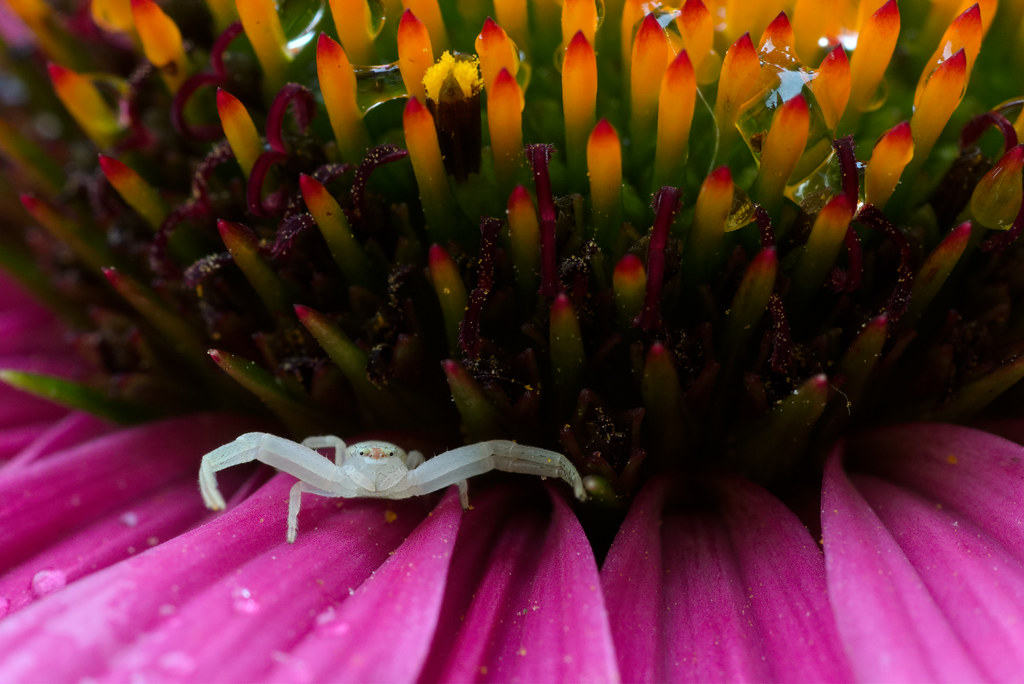
Don’t do it, ye bees and butterflies of the world, for in her inviting arms awaits a deadly embrace! The front two pairs of legs of the goldenrod crab spider like this large female are much longer than the back, as she doesn’t spin a web to catch her prey but rather waits for them to land on her flower, embraces and immobilizes them with a venomous bite, then sucks the fluids from their bodies. While they often hold out all four long legs to grab their prey, In this particular case she’s using two of her long legs to gain extra purchase on the petals of the aster and holds out only her two frontmost legs. From the front of the flower she was invisible save for two tiny feet sticking around the edge of the petals.
Category: Plants
Defender of the Pollen
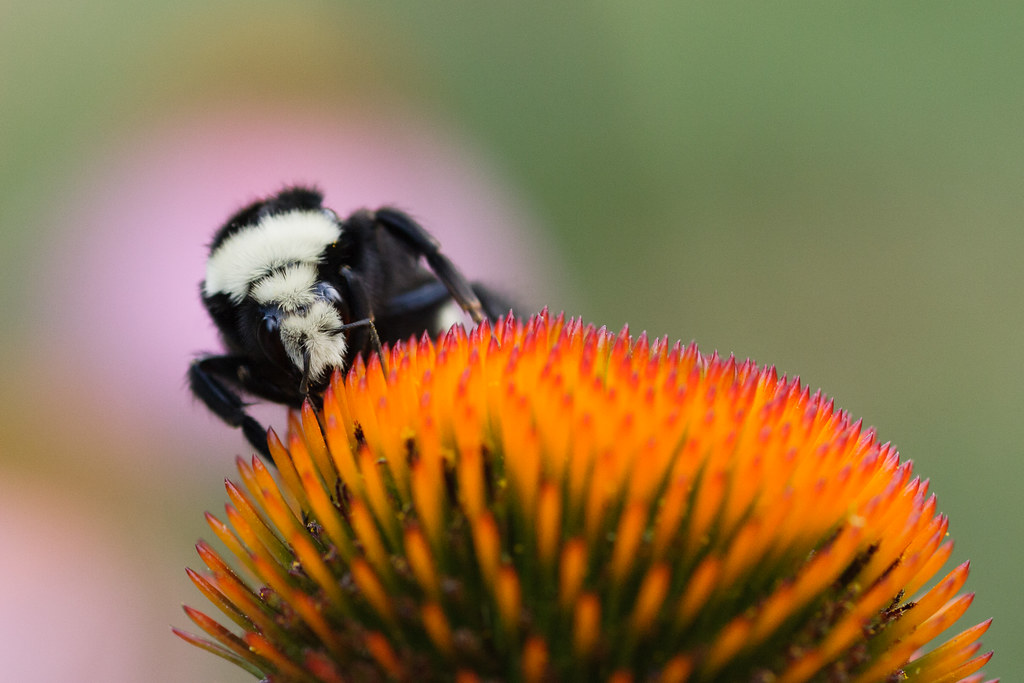
After a much-needed summer shower, I grabbed my macro lens to take some pictures of rain drops on the flowers in our garden and was amused by this little crab spider seemingly defending the last remaining clump of pollen on one of our purple coneflowers. Her life is actually tied to the pollen, as she is lying in wait for a pollinator like a bee to land on the flower so she can kill and eat it.
Water Slide
After an unusually hot and dry summer, we got some much needed rain this weekend so I grabbed my macro lens for some pictures of the flowers and insects in our garden covered in raindrops. This is a close-up of one of the flowers of our black-and-blue salvia. I ended up with a sore back from standing or sitting in uncomfortable positions to get the macro shots that I wanted, I find it rather unfortunate that Canon didn’t put an articulating LCD on the back of the 7D Mark II, which I would use constantly for macro or pet photography.
I pre-ordered the Sony A7R II back when it was first announced and I need to decide in the next week or so if I should cancel the order. I would vastly prefer a mirrorless camera for macro work, and they have a stunning new macro lens for their system, but while the LCD tilts it isn’t fully articulated.
Cape Fuchsia
When we bought our house years ago there was a plant out front with gorgeous red flowers that was struggling. I guessed it wasn’t getting enough sun and it seemed like it would be hummingbird friendly, so when we started a wildflower garden in the backyard in memory of my mother-in-law and the hummingbirds that swarmed her feeders, I decided to try transplant some of the suckers of the plant and see if any survived. I didn’t have any potting soil handy so they went from clay to clay. I kept them watered during the dry summer and was stunned to see that they all did fine and now we have two thriving sections of what I discovered are cape fuchsias.
Despite the name and appearance of the flower, they aren’t true fuchsias. While not native to the Northwest (they come from South Africa), they do well during our dry summers and wet winters and are thriving even during our unusually dry and hot summer. The hummingbirds love them and they require little attention from me and have proven to be a lovely addition to our wildflower garden. I normally dislike suckering plants but these are easy to keep under control, and I even use one section of them as a buffer between the wildflowers and the raspberries, which are rather obnoxious in how they sucker and spread.
Teasel
Introduced into the United States hundreds of years ago, teasel can be seen at a variety of locations around the Ridgefield auto tour.
Hot Lips
I first learned of salvia from Ciscoe Morris, host of my favorite gardening show, and I quickly came to love them almost as much as our local hummingbirds. As Ciscoe would say, oh la la! We have several varieties now, this one is known as “Hot Lips” and has lovely red-and-white flowers from spring until late fall.
Barking Up The Right Tree
While in Taos, my wife and I drove out to the Wild Rivers Recreation Area for a little hiking and sight seeing. My wife wanted to touch the Rio Grande so after waiting for some thunderstorms to pass through, we hiked the Little Arsenic Trail down into the Rio Grande Gorge. Following a long and seemingly endless series of switchbacks down into the canyon, we were tired but happy when we finally reached the riverbank. The trees by the water had a beautiful red color and I loved the patterns in their bark. The hike back up was even more punishing, but I was excited to find a tarantula sharing the trail with us, the first one I’ve seen in the wild.
Papa Smurf
When we moved into our house, there was a forest of weeds growing under the grapes that lined the backyard. While clearing out the weeds, I found a few good plants as well, either remnants of an old garden or volunteers from some other place. I preserved as many of the good plants as I could but some of those were later casualties when I decided to dig up the grapes.
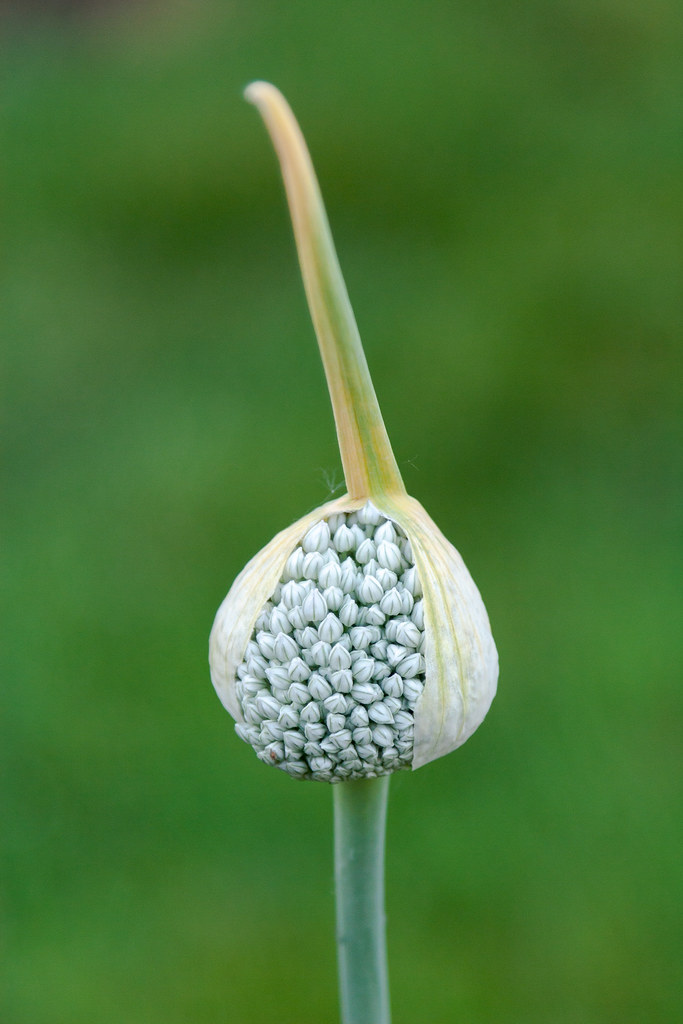
One such casualty was a cluster of onions or garlic, the bulbs got broken up by the shovel while digging up the roots of the grape vines. One survived as it grew on the other side of the little metal guard that separated the yard from the grapes. This picture was taken in late June of last year, the flower is just about to break out of the casing and fully bloom.