A female Gila woodpecker brings food to the nest while the waiting male is about to pop out and make room for her. This is zoomed in less than the previous pictures to show more of the saguaro, I was kicking myself later for forgetting to take a much wider shot with my regular lens of the full saguaro and the surrounding desert. I forgot partially because of the excitement of watching woodpeckers and partially because it was 5:30am. At that hour I’m just happy if I dress myself properly because that isn’t guaranteed.
Tag: cactus
Are You a Tasty Bee: Gila Woodpecker Edition
Do Gila woodpeckers eat honeybees? With the sun starting to rise this honeybee hovered over the saguaro blossom for so long that this male craned his neck out and started watching it. If he was thinking about jumping out and snaring it he never did, he stayed at the nest entrance until his mate returned. Which didn’t take long, the pair was pretty amazing to watch, even before sunup they were constantly bringing food back to the nest. I don’t know if they eat honeybees or not but there is an ample supply nearby when the saguaros are blooming.
Two-tailed Thrasher
The curve-billed thrasher is common here but not so the two-tailed thrasher, this is the only one I’ve seen. To my eyes it looks like a failure in design, one tail in front and one behind, but perhaps I’m not the best judge since one of us soars above the desert and one of us gets dizzy standing on a ladder.
Large Mercies
Even with a relatively long beak, come springtime curve-billed thrashers end up with faces covered in pollen courtesy of the massive flowers of the saguaro. Saguaros are many things, subtle is not one of them. I’m thankful for the mercy of these large flowers, because if they were carnivorous they could easily eat their fill of desert birds who thrust their entire heads into the blossoms (and later, fruit) to feed.
OCCUPIED! OCCUPIED!
A white-winged dove looks up from feeding from a saguaro blossom as another is about to land. The incoming bird landed on the leftmost blossom so they were able share the perch for a while. I haven’t seen so many white-wings this year, to be fair I haven’t hiked as much this spring and summer and when I do it’s often on different trails, but we also aren’t seeing so many in the yard as last year. Which works out well for the mourning doves as in numbers the larger white-wings can push the smaller doves around but this year the white-wings are fairly subdued and it’s only the quail parents with babies whose wrath the doves have to avoid.
A Nest Surprise
After the hawk I had been watching flew off and sat beside another member of its family on a transmission tower to the north, I wandered up to the saguaro where it had been sitting. Wanting to extend the tranquility of the morning and with the sun about to rise, rather than hoof it up the trail to find the saguaros I originally intended to photograph, I stopped for a water break and to enjoy that moment when the light sweeps over the mountains. I lazily pointed my long lens at the old hawk’s nest I saw last year, I didn’t think it was being used so I was rather shocked to see one of the adults atop it. I put the camera on the tripod and got off a shot before the pink skies disappeared. When the sun rose, the hawk’s face was in shadow, as it was last year. A deliberate choice? I’d certainly do the same, the sun here is something else altogether.
A Moment of Peace
My hiking has fallen off dramatically the last six weeks as most days I’ve been too worn out to get up early. I managed it a couple weeks back and decided to photograph a pair of saguaros in the light of dawn and sunrise. Before I got that far up the trail I ran across a Harris’s hawk from the family I watched last year, so I stopped and played around with some near-silhouettes as it sat atop the fruiting arms. I decided not to press on to my original target as this saguaro is literally next to the trail and I wouldn’t be able to pass without spooking the bird. It felt like a form of sacrilege to disturb the tranquility of the desert dawn, so I whispered “Take as long as you like,” then laughed and added “only let’s not make it hours.” I stayed back but knew I could really only buy it minutes as I’m not the only one who loves this trail. Only no one else came by, leaving the two of us in the quiet, relative quiet, as we were joined by flycatchers and thrashers and woodpeckers and wrens, with small flocks of white-winged doves flying overhead and mourning doves cooing in the distance.
I didn’t get the picture I came for but what joy I received in return!

Three Predators: Ash-Throated Flycatcher Edition
An ash-throated flycatcher was about to land in the arms of this saguaro when it noticed the two fuzzy heads in the nest and did a mid-air about face and returned to the trees below. Flycatchers are built to snare insects on the wing so aerial acrobatics are second nature to them. Through it all the saguaro has fruit bursting open up top, offering up both its red pulp and its many seeds to all willing to risk flying above the hawk’s nest. Death comes in many forms in the desert, but so too does life.
Three Predators: Loggerhead Shrike Edition
A loggerhead shrike jumps from the top arm of a saguaro to try to catch some small prey moving about in the desert below. Oblivious to it all, inside the big nest of sticks are two fuzzy heads barely able to hold themselves up, young Harris’s hawks who can’t much move about the nest much less the desert. The shrike is no threat to the youngsters or it wouldn’t have been allowed this close, as unseen in the picture are three other predators, an adult hawk not visible from my vantage point but sitting atop a saguaro nearby, and two more high up on a transmission tower a ways behind me with an expansive view of the desert and any threats that might approach. An adult had been on the nest at sunrise but had left presumably to hunt while the rest of the family kept an eye on their newest arrivals.
Hallelujah Arms
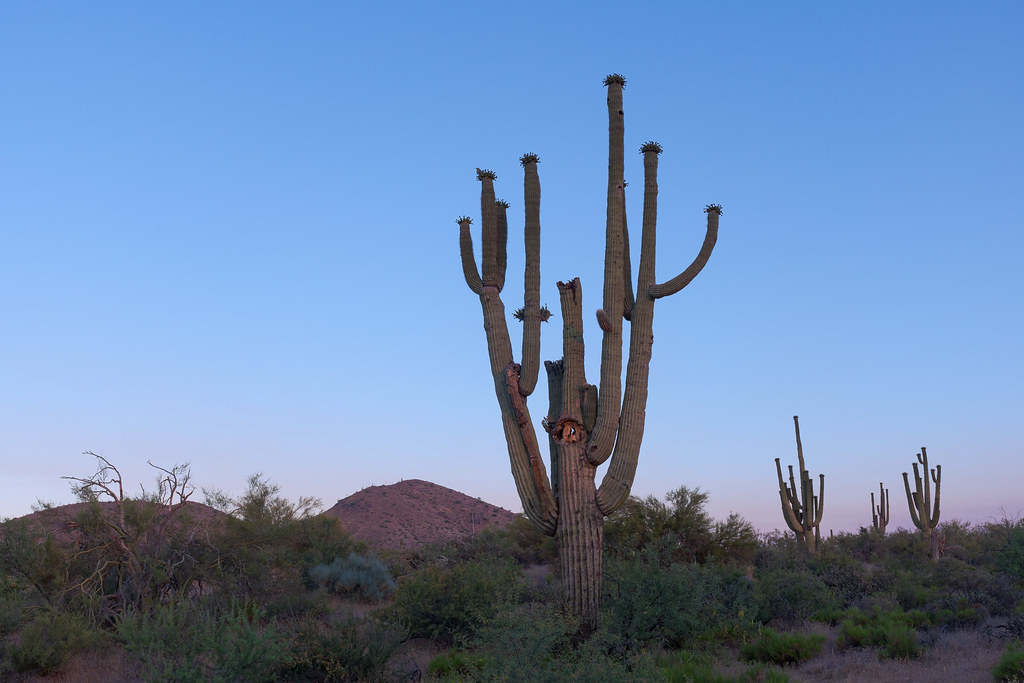
The rising sun illuminates a battered old saguaro, some of its arms shattered in half and some broken off altogether. But it still has a host of hallelujah arms raised towards heaven, all now fruiting and not just hopefully starting new life from its seeds but sustaining the lives of others with its fruit, a prized treat for many birds. In the picture below, taken just before the sun rose, a curve-billed thrasher feeds atop one of the taller arms.