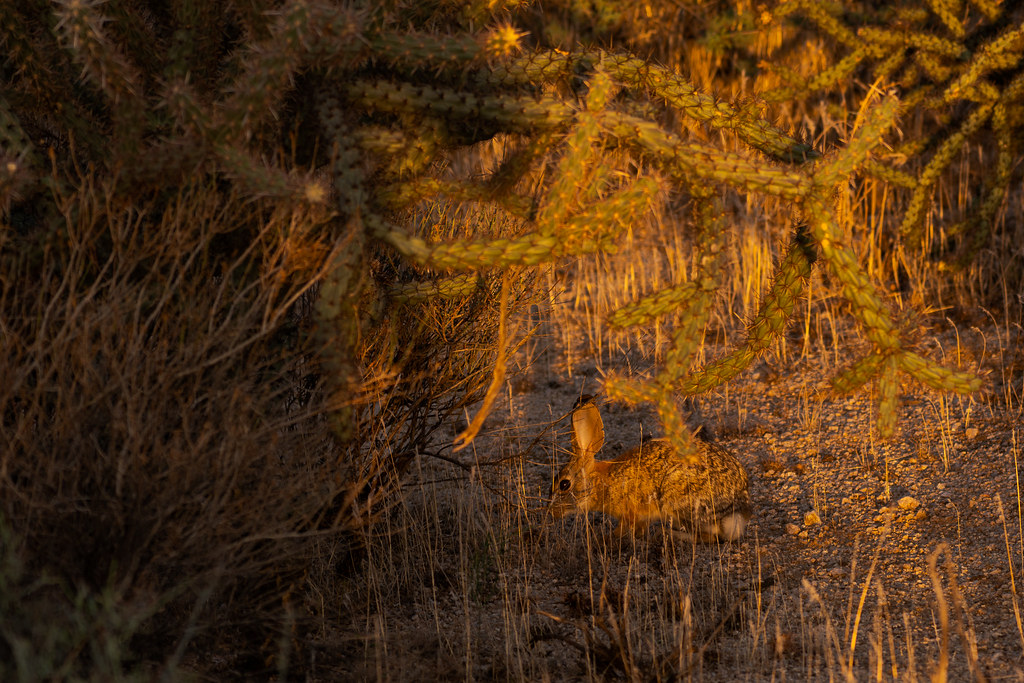
The rising sun, so easily blocked by hills and saguaros and even myself, does what I cannot, slip through the outstretched arms of a buckhorn cholla to embrace a cottontail as it feeds beside the Chuckwagon Trail. It is mine but to observe, to record, to be grateful.
Tag: eating
Delighted
Soft Browns
A desert cottontail eats dried grasses in the soft light before the sun was up on a warm spring morning. I was back on the trails this morning after taking a couple of weeks off to let a sore left knee heal and didn’t see a single cottontail (or jackrabbit), most of the time I see at least one if not a handful so either today I was unlucky or perhaps they are not as visible in the summer. I meant to go hiking yesterday but forgot to set my alarm so I walked the pup instead, Ellie and I saw four cottontails on a short walk in the neighborhood.
The Desert Giraffe
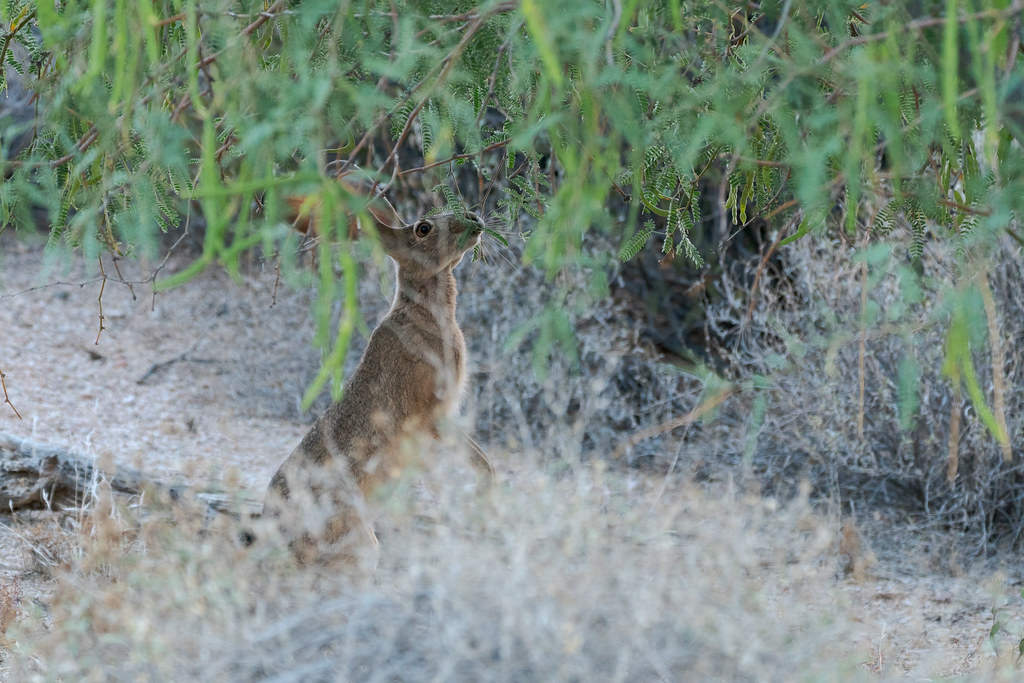
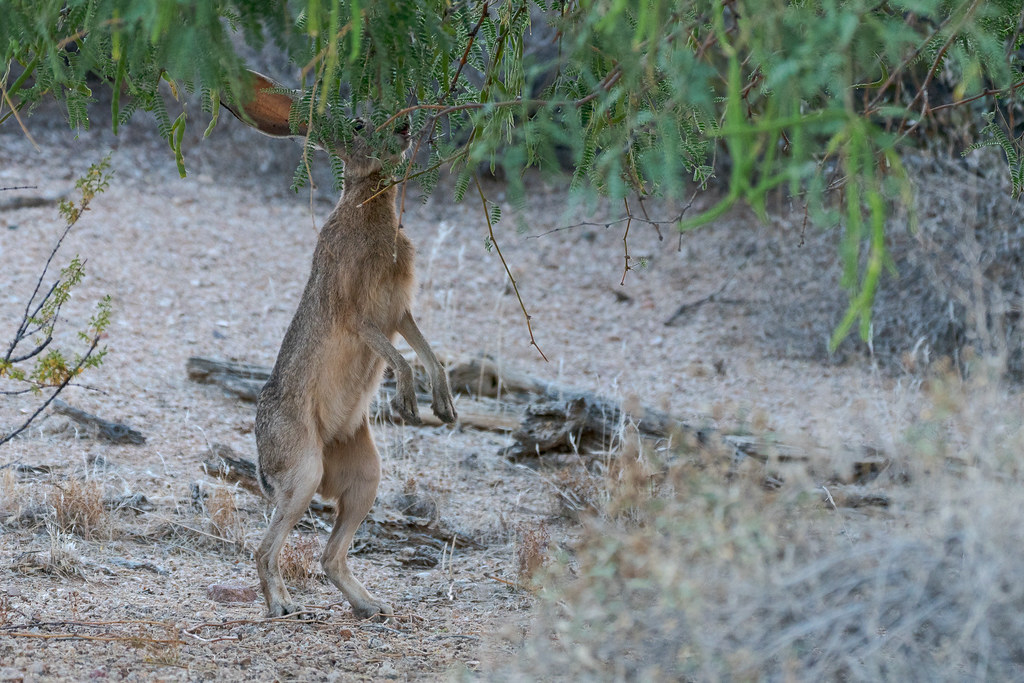
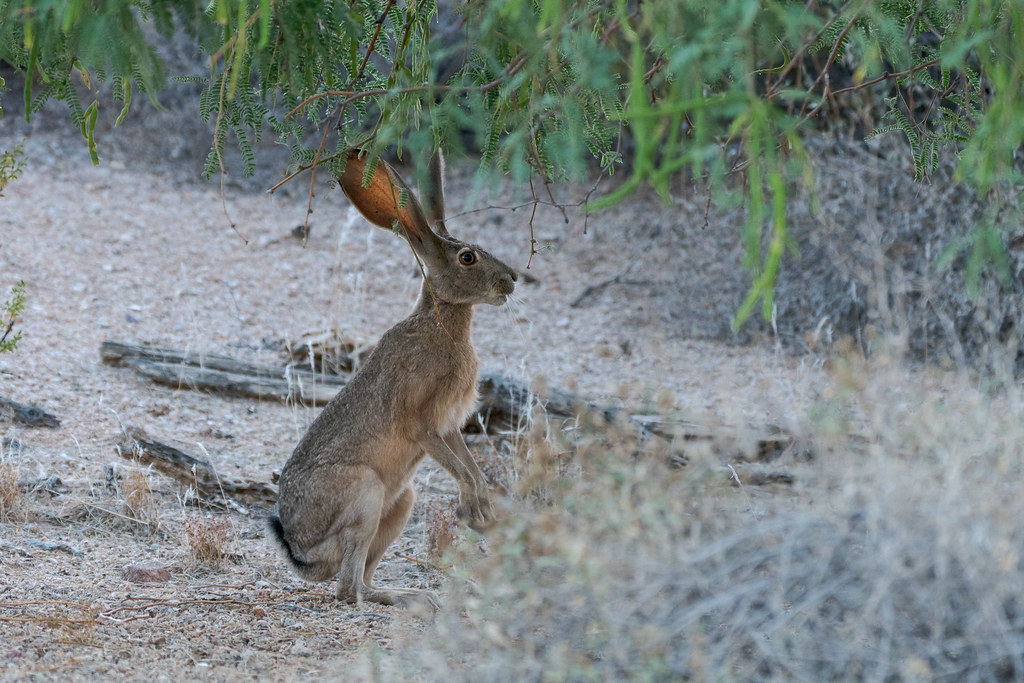
The sun hadn’t yet risen above the mountains when I met this hungry black-tailed jackrabbit. They share their habitat with the more numerous desert cottontail but the larger jackrabbit with its long legs can get to food that the cottontail cannot, reminding me of a giraffe using its long neck to eat leaves high in the trees. I hadn’t seen a rabbit spend so much time up on its hind legs before, this desert is full of surprises.
Both the black-tailed jackrabbit and the desert cottontail are named for their tails. The cottontail has a round white tail like a giant cotton ball, while the black-tailed jackrabbit has a tail that is black on top, as you can see as it sits up off the ground as it eats leaves it has pulled from the tree. It’s hard to tell from these pictures but the tops of their ears have black tips as well. Apparently they can run quite fast and jump in long leaps but the three times I’ve seen them they’ve casually hopped through the desert.
Face Full of Flowers
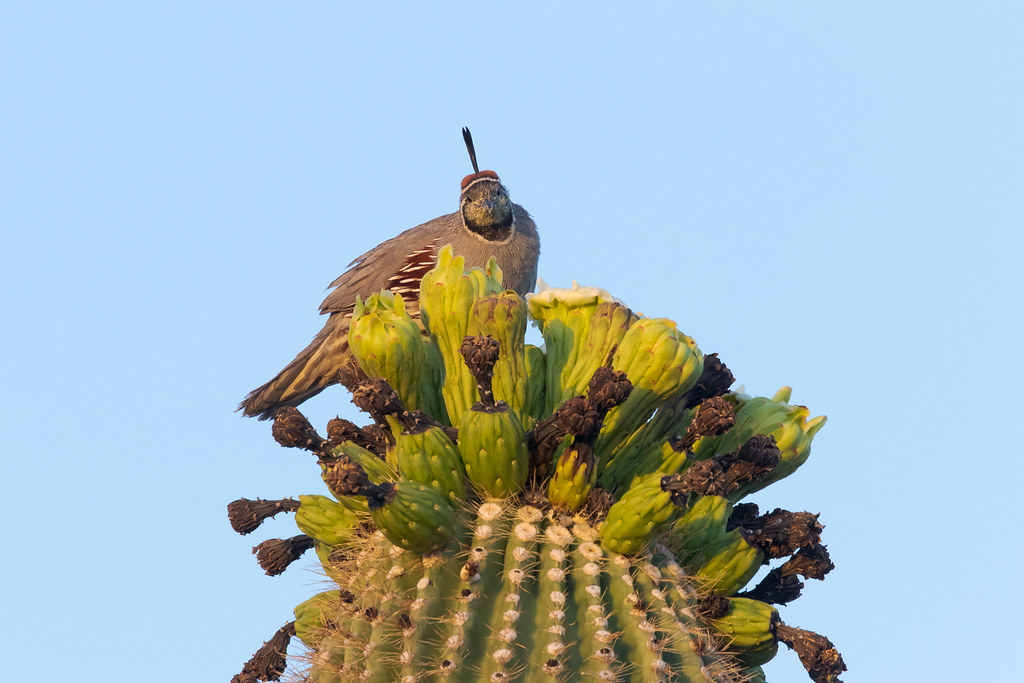
A white-winged dove sticks its entire face into a saguaro blossom as it feeds. It’s face was covered in pollen, as were many of the birds in my pictures from this time, such as the Gambel’s quail below. The birds and bats and bees took full advantage of the suddenly plentiful blooms, dining quickly as they flew from one flower to the next, pollination in action. The blooms are mostly gone now, this morning I saw only two flowers during several hours of hiking, and one of those was pretty wilted.
Calling Me Home
One of the birds I most wanted to photograph when we arrived in Arizona was the Gambel’s quail. Not because they are rare – we saw them in the neighborhood when we were looking at our rental house – but because they called me home. It was our vacation in New Mexico a decade ago that got me excited about living in the Southwest, and my encounter with Gambel’s quail there was one of the highlights of the trip, their serenade at sunrise. So it was a special delight to photograph this male and female up on the saguaros as the sun rose, dining on the cactus blossoms, in our shared desert home. Home in a larger sense, though I see them every day in my backyard these quail were at Brown’s Ranch in McDowell Sonoran Preserve.
Bringing Up Dinner
Not for the Squeamish
A female American kestrel pulls apart what looks like a mouse at Ridgefield National Wildlife Refuge on a winter morning in 2006. There are a couple of species of mice at the refuge that I’m aware of, deer mice and Pacific jumping mice, but I have no idea which this is (was). Some predators at the refuge swallow their prey whole, while others like kestrels pull them apart and eat just the parts they want and toss aside the rest.
Balance
I grew up with mockingbirds but I left them behind when I moved to Oregon 21 years ago. We’ve been reacquainted at times over the years when I traveled back east, I met this mocker eating berries while balanced at the end of a tree branch on a trip to South Carolina in 2006. My stepfather had passed away a couple of weeks earlier and my wife and I stayed with my mother through Christmas. I took a number of walks around the neighborhood, watching the local wildlife, seeking out joy to balance the sadness.
Mockingbirds will be a part of my life once more, they are one of a small group of birds that aren’t in my part of Oregon but are in both Arizona and the Southeast where I grew up. Looking forward to the reunion.
The Snail Pace
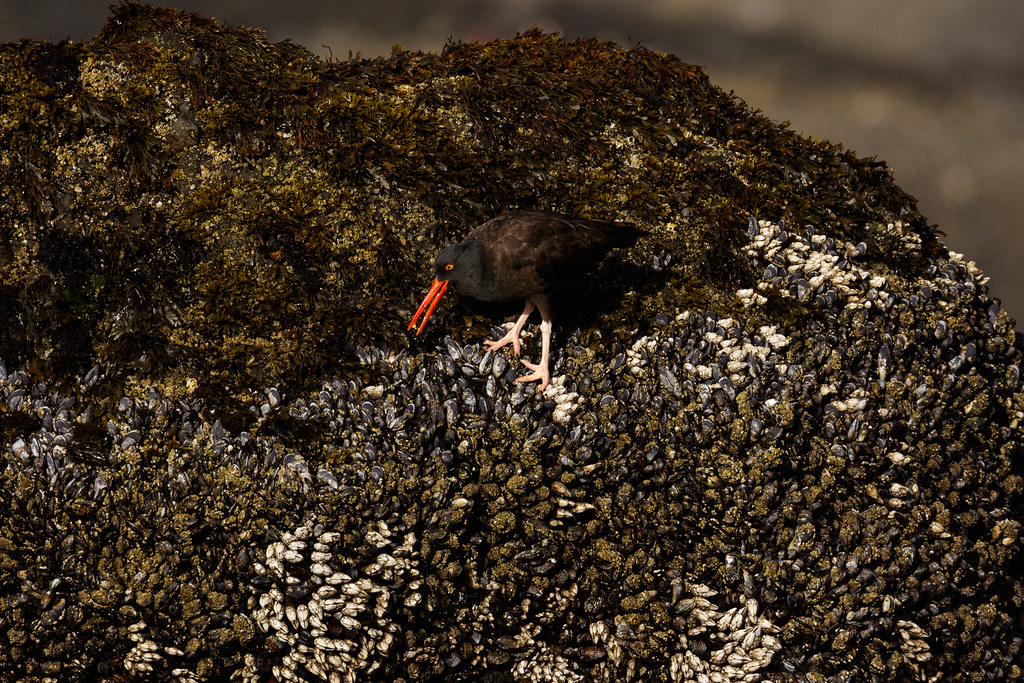
Life is precarious in tide pools. Mussels and barnacles that live too low on the rock surface are within reach of predatory starfish. Those too high are at risk of drying out while they wait for the rising tide. And in this case, the high spots also had just enough purchase for a black oystercatcher to walk along their perimeter, feeding as it went. But its target on this day was not the mussels and barnacles but the snails that feed on the algae on their shells, here it is about to swallow the soft part of a snail it has extracted from its shell.
The oppressive summer heat might be the biggest obstacle I had to overcome to be willing to move to the desert, but not far behind was saying goodbye to the coast (and in California, the nearby wetlands). I was rather taken with tide pools and the coast in general on visits to the redwoods in California and the rain forests in Washington and decided to make a concerted effort to visit the coast more often, which is why I was at the Oregon coast on this day in early October. A few weeks later I’d find out my team was getting laid off and thus started the process that would take me from the Northwest.
I changed the lock screen on my phone to this picture of a harbor seal as soon as moving to Arizona became a possibility, before it even became a strong possibility, to force myself to think repeatedly about whether I could really give up the coast. I decided I wasn’t ready to say goodbye to the coast, and never would be, but I was ready to say hello to the desert. And to the desert I go.