I Did Not Eat My Hat

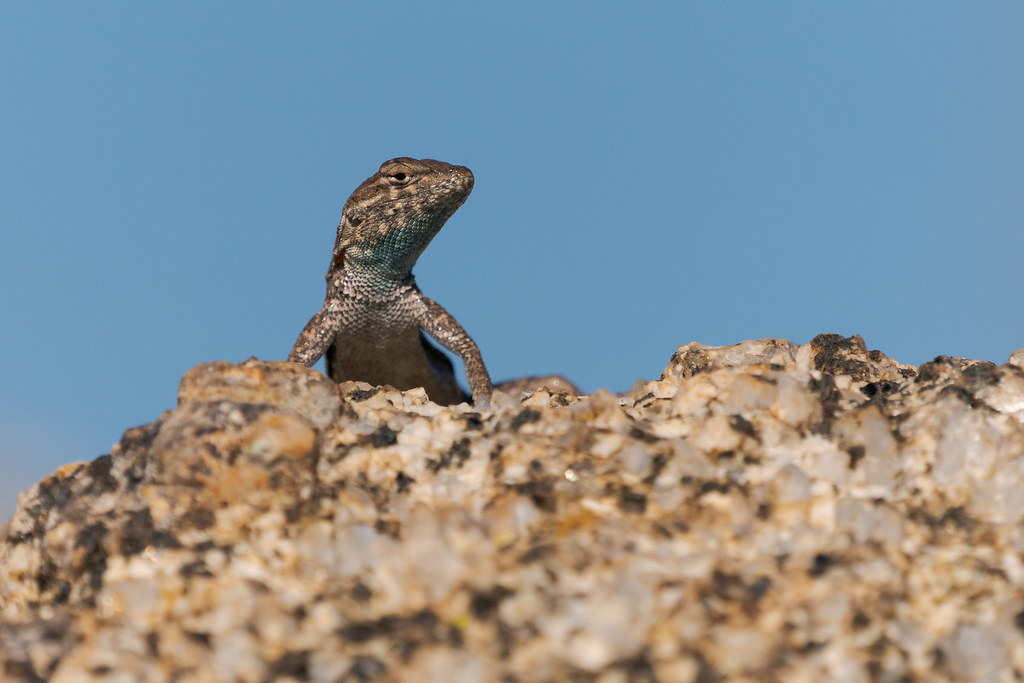
A desert spiny lizard perches on a granite rock along the Rustler Trail in McDowell Sonoran Preserve in Scottsdale, Arizona

I like to think I’m a man of my word but I suppose we all have our limits. Last weekend I hiked out to Balanced Rock for the second time and after taking some pictures noticed in the distance the head of a spiny lizard sticking out from a rock, much like this desert spiny lizard on the Rustler Trail. It was far off and in the shadows but seeing the shape and that the head was darker than the surrounding granite I thought “If that isn’t a spiny lizard I’ll eat my hat.”

I lifted the telephoto lens to my eye to be sure. It wasn’t a spiny lizard. I tell you, the granite can be cruel.

But I didn’t eat my hat.

This spiny lizard is the same as in the linked picture but from the other side of the rock and in different lighting. The granite was in a kinder mood.

Green and Blue in the Desert

A common side-blotched lizards perches on a rock in front of the green of an out-of-focus saguaro

I was sitting below this little common side-blotched lizard, shooting up at it against a blue sky (below), when I realized if I moved the camera slightly I could shift the background to green courtesy of a massive saguaro standing behind it. There is green in the desert, not the ubiquitous saturated greens of the forests of the Northwest but a soft, muted green, always in the saguaros and palo verdes but on many more plants now that the summer monsoons have arrived.

Blue is easy to find in the skies of the desert but some lizards, especially the males, may have blue throats or sides or blue speckled throughout their scales. Blue too is the skin around the eyes of adult white-winged and mourning doves. All of these blues can be seen where I photographed this lizard at The Amphitheater in McDowell Sonoran Preserve, a rock formation on the Cholla Mountain Loop Trail that is one of my favorite places to hike.

A common side-blotched lizards perches on a rock in front of blue skies

Fractured

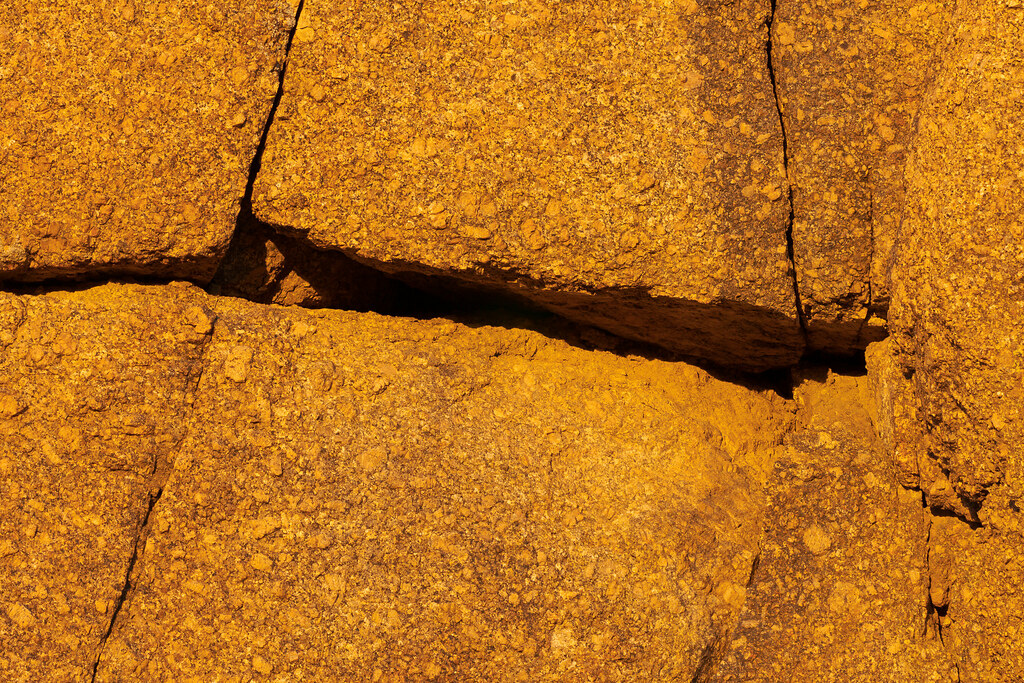
Fractures split a large granite boulder along the Pinnacle Peak Trail in Pinnacle Peak Park in Scottsdale, Arizona

Fractures split a large granite boulder along the Pinnacle Peak Trail. The message could be that you don’t have to be perfect to be strong. To stand true and resist. Or it could be that those from whom you draw strength are wounded in their own way from the stress of the world and need support as well. Or maybe that nothing lasts forever, whether these rocks will outlast me depends on how many millions of years I live, but we are here now, together, and I am thankful for it.

Turning Rocks Into Lizards

A desert spiny lizard peeks out from behind a rock on the Rustler Trail in McDowell Sonoran Preserve in Scottsdale, Arizona

As I hike the pattern recognition part of my brain is constantly scanning for objects that might be wildlife even though they often turn out not to be. I spent a summer in Florida in the mid-90’s and was delighted by the many alligators there, it took years after we moved to Oregon for that part of my brain to stop trying to identify possible alligators when I hiked in marshland. In Yellowstone on a gravel road there was a large rock in the distance that in the periphery resembled a bear. I loved that road and drove it a number of times and as I approached that spot, I’d tell myself not to be fooled even for an instant by what I came to call Bear Rock. But every time the pattern recognition would kick in for a fraction of a second and say “Hey is that a …” before the rest of my brain would reply “I just told you it wasn’t going to be a bear!”

Here in the Sonoran Desert I am fooled by cholla skeletons that look like rattlesnakes, twigs like small lizards, granite protuberances like large lizards. I try to use my mental powers to turn rocks into lizards but usually I fail, rock stays rock. But sometimes I succeed and the rock comes to life, such as this beautiful desert spiny lizard on the Rustler Trail in McDowell Sonoran Preserve. One success is worth a thousand misses.

The Guide’s Pack

A tall saguaro leans over and appears to be asking for a hug from another saguaro, as my Tom Bihn Guide's Pack sits underneath

I bought my backpack, the Tom Bihn Guide’s Pack, four years ago and put it to use right away on a trip to Mount Rainier National Park and Olympic National Park in Washington. We spent our first years together hiking around the Pacific Northwest, not only Rainier and the Olympics but the Columbia River Gorge, the redwoods in California, the Oregon coast, and of course at Ridgefield. Designed and manufactured in nearby Seattle, it was right at home in its home.

Then we moved to the desert.

The Tom Bihn Guide's Pack at Sunrise Peak in the McDowell Sonoran Preserve

My first thought after moving here, unsure how I would handle hiking in the hotter weather, was to take a lighter pack on some short hikes, so for the first couple of hikes I took an old REI daypack I’ve had for over twenty years. I quickly switched to the Guide’s Pack as I realized it was better suited to carry the water I’d need on longer hikes courtesy of its internal frame and hip belt.

Since some of the trails are narrow my first thought was to take off the two removable pockets on the sides and store them in the bag. One of the pockets has an organizer for little things but the other is open, and it turns out it is perfectly sized to carry two 27oz Klean Kanteen water bottles. I carry one 27oz bottle attached to my camera bag, two in the side pocket, and a spare in the bottom of the backpack. But I quickly realized my mistake once I started putting my telephoto lens and camera into the bag when the light started getting harsh, as to get to the water bottles I had to pull out the camera and lens. You have to constantly drink water while hiking here, so easy access to water is critical. I put the pockets back on the sides where they have stayed ever since, and after looking in the mirror I realized they weren’t sticking out as I had imagined anyway.

A dusty Tom Bihn Guide's pack at Brown's Ranch in the McDowell Sonoran Preserve

The bag is getting more and more dusty and that’s a good thing because it means I’ve been hiking more and more. I’ve been out almost 20 times in the two months we’ve been here and can’t wait for the next hike. One of the things I’ve loved about this pack is its looks, the navy parapack material is both durable and gorgeous and is well-matched against the coyote brown bottom and straps. It’s a rucksack design, the top compartment is where I keep my snacks, you can open the zipper and get inside without opening up the pack. Pull back the top and there’s a cavernous compartment inside where I store my hiking poles, my fourth water bottle, a first aid kit, and extra clothing (if needed), and various other things. There are some o-rings inside for attaching stuff sacks, adding some nice organizational capability to the large space.

The Tom Bihn Guide's Pack next to one of the many rock formations in Brown's Ranch in the McDowell Sonoran Preserve

My last adaptation in the desert was to start putting the big lens and camera away when the sunlight starts to get harsh, swapping the lens for trekking poles which make hiking in the desert more enjoyable. How I wish I had four arms so I could carry my tripod and trekking poles too! The tripod I cinch under the bag with some lash straps, that has worked a treat. This is the configuration in the picture below, with the backpack and attached tripod holding up Balanced Rock.

There are lots of nice touches in the bag, such as the loop handle that makes it easier to load the bag into the car or move it about the house. There’s a nice mesh on the back – your back does get sweaty in the desert, for summer hiking I might look for a back with a gap between your back and the backpack. Or maybe a lightweight pack if it proves too hot in the summer for any hike over an hour or two.

I absolutely adore the Guide’s Pack. I love that its beautiful, I love that its well-made and made well, and I love that it’s a great backpack too. It broke my heart to leave the Northwest but getting to know the Sonoran Desert has been an absolute joy. My thanks to the folks at Tom Bihn for making the backpack that let me explore my home in the Northwest, and my new home in the Southwest.


The Tom Bihn Guide's Pack sits underneath Balanced Rock in McDowell Sonoran Preserve