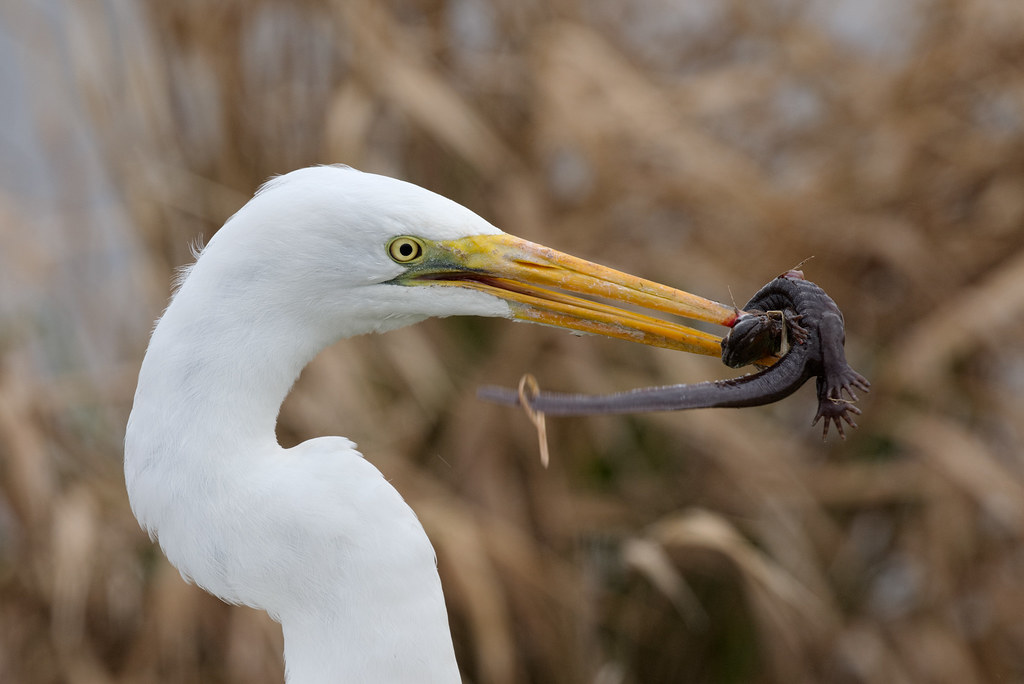
While I normally like to arrive before sunrise, I got a late start to my visit to the refuge in late February, as I was tired and decided to sleep in, arriving after noon. There was a great egret at the edge of Horse Lake, right at the start of the auto tour, so I pulled over and set up to take portraits since it wasn’t on the hunt.
Or so I thought.
Unfortunately my camera wasn’t set up for action as the egret suddenly struck into the water and brought up this northwestern salamander. I’ve rarely seen these lovely salamanders, and only when they’re being eaten, as the terrestrial form (adults can be aquatic or terrestrial) is usually below ground. During breeding season they move to the water to breed, and I believe late February is prime mating season for these salamanders at sea level, so hopefully it had a chance to pass on its genes before the egret caught it. I’ve never seen one this large, I was rather taken aback when I saw what it was.
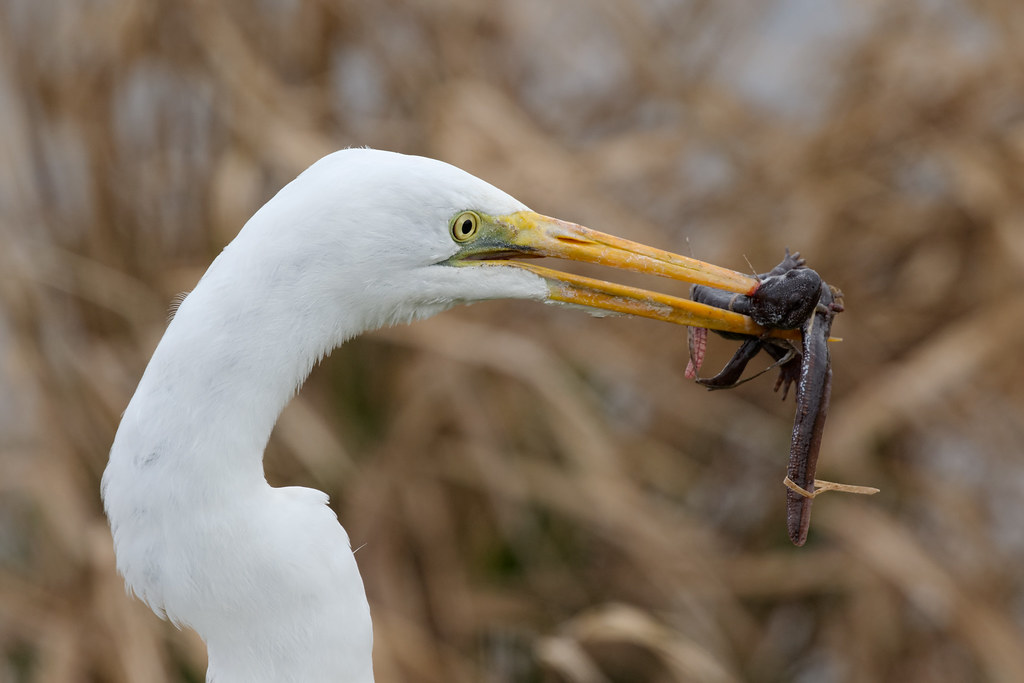
When i first saw the white spots running from the head of the salamander down to its tail, I assumed it was part of its coloration and was confused when I later read that this is not the case. I couldn’t see that it could be any other species, but then I read that the white spots are poison that the salamander releases as a defense mechanism.
I don’t know if it explains something I found a little odd, as when the egret first caught the salamander it brought it out of the water and tossed it several yards away into the grass. It seemed rather upset and agitated with the salamander, perhaps I thought because the salamander’s long tail kept thrashing back towards the egret’s eyes, and I thought to myself, “Well, you are trying to eat it!”, but perhaps it was upset because it got a taste of the poison.
The egret grabbed and tossed the salamander multiple times, I was surprised at how long the little thing put up a fight. The egret’s first strike had opened a hole in the salamander’s side and some of its internal organs had come out, so it was going to die even if it managed to get away, so I wished I could tell it to just give up and its agony would end. Eventually it did stop fighting as much and the egret gave it a good dunking in the water, after which the salamander’s body went limp and its legs hung to its sides. The egret swallowed it in one fell swoop. I wonder now, although probably much too large to be killed by the poison, if it made the egret sick, and perhaps it might give the next salamander a pass.
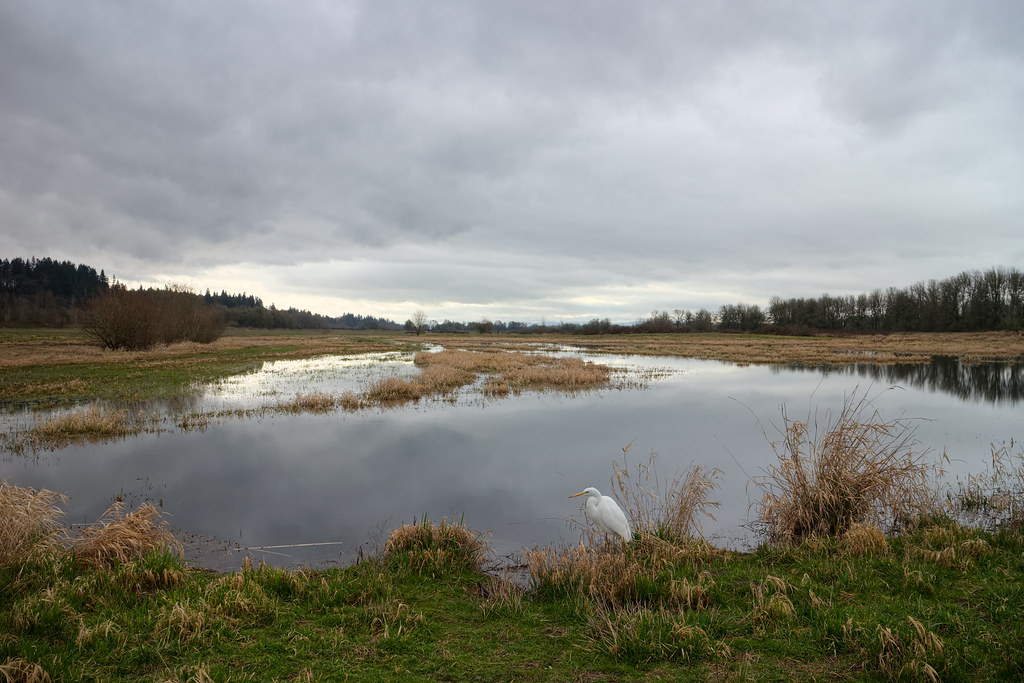
After I got over the thrill of seeing this magnificent little creature and the shock of watching it die, I reflected on how amazing it is that, just feet from where I have spent many, many hours sitting and watching and listening at this pond, an entire world exists under the water that I have little knowledge of and no way to observe. I would have never known this magnificent salamander was there if not for the egret (this wider view of Horse Lake shows the egret not long before it caught the salamander, just over to its left).
Above the water I can watch and learn, but the things below I see only when they are brought out from the water and into the air, usually as they die. That makes me a little sad, but this encounter did encourage me to learn about the salamanders as I knew nothing about them before, apart from the name. Their numbers declined by one that day, but the northwestern salamander population in general is doing well in its range on the western edge of North America, from northern California up through British Columbia.
Maybe one day we’ll meet on friendlier terms. In the meantime it makes me happy knowing they are there, even if I can’t see them.
It also made me happy to see that, a while back, one of my pictures was used for the good of salamanders, as the U.S. Fish & Wildlife Service used my favorite rough-skinned newt picture on their Facebook page to announce some steps they are taking to protect our salamanders from a fungus that is killing them elsewhere. I like how Flickr displays the usage rights I set for my pictures, as I set most of them so they can be used for non-commercial purposes, a long-standing tradition dating back to when I first started putting my pictures online back in the mid-90’s.



 Boolie