The Last Leap

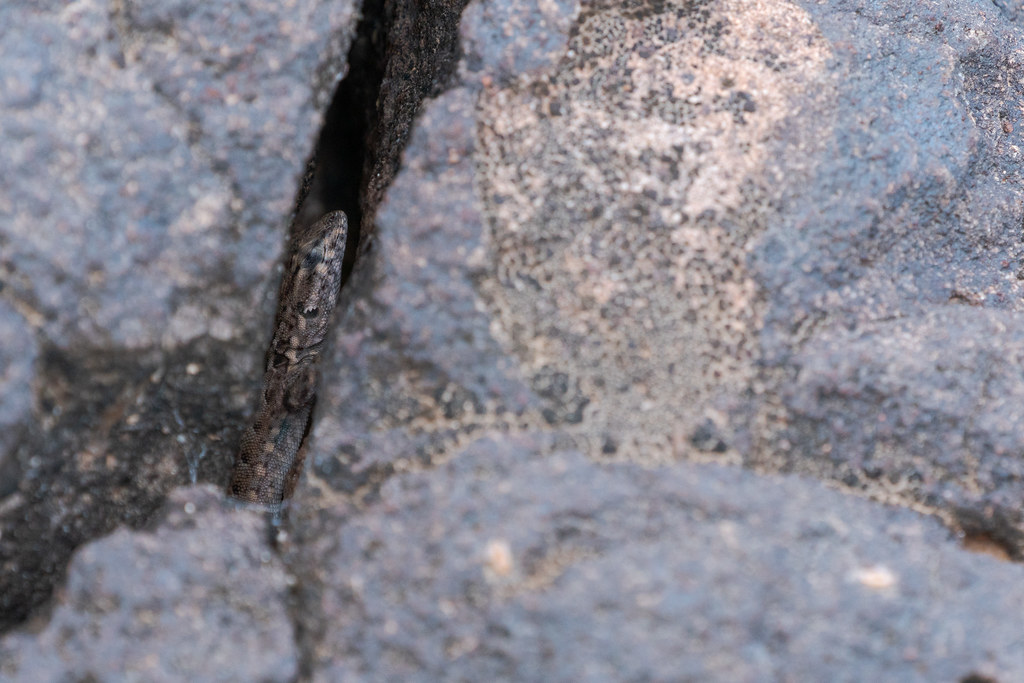
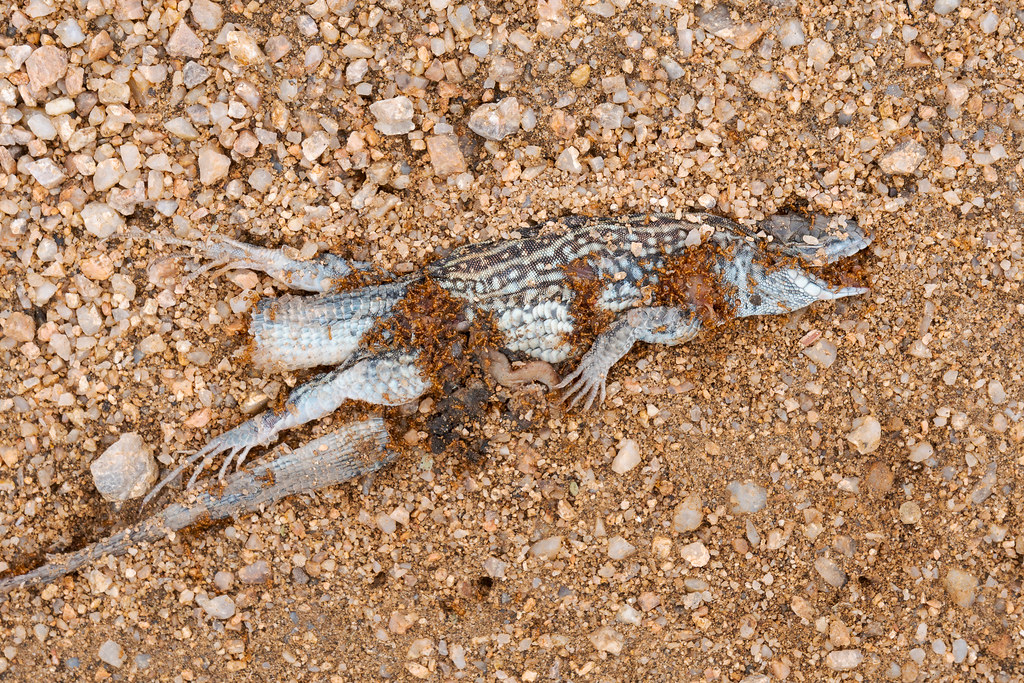
A dead lizard, its separated tail beside it, is swarmed with ants along the Watershed Trail in McDowell Sonoran Preserve

I came across this flattened lizard (a tiger whiptail I think) and took some time deciding if I was going to photograph it or not. Finally I changed lenses and took a picture as a tribute to this once beautiful creature as ants swarmed the lifeless body. The lizard had shed its tail, now lying beside it, in an unsuccessful attempt at saving its life. The trail is heavily used by mountain bikers so perhaps it wasn’t able to get out of the way of a bike or perhaps a predator killed it but got scared off before it could eat its meal. Or perhaps a hiker stepped on it, someone once stepped on a newt I was photographing (fortunately the ground was soft and the newt unharmed).

Sorry little one.

A Little Beauty

A close-up view of a common side-blotched lizard showing the dark blotch behind his front legs as he perches on a granite rock along the Bootlegger Trail in McDowell Sonoran Preserve in Scottsdale, Arizona

One of the difficulties I had when learning to identify lizards after we moved here was getting a feel for the size of lizards based on pictures. Guide books have typical measurements but that isn’t as helpful until you can narrow down the search. I wish there was an app that would let you sort them first by geography and then by size. Over time I’ve gotten much better at identifying most of the common lizards including the one I see most often, the common side-blotched lizard.

I met this one in July on the Bootlegger Trail near Granite Mountain, he’s nicely showing off the dark blotch behind his front legs for which he is named as he perches on his own granite mountain. I’ve been getting a bit worn down the past few weeks and have only gone out hiking once each weekend so I’m going to take a couple of days off this week to hopefully recharge a bit. I saw a handful of these little lizards on the trail this morning but didn’t see any opportunities for pictures so I enjoyed my time with them instead.

As for their size, it can be hard to tell from a telephoto shot like this but thy are tiny, typically 1.5″ to 2.5″ SV (snout-to-vent, which goes from the tip of the nose to the vent near the base of the tail). They mostly eat insects and the like but lots of things eat them, including larger lizards. They are active throughout the year at my elevation (at least on warm winter days) so I’m happy they’ll keep me company when the other reptiles are hibernating.

Life in Miniature

An ornate tree lizard (I think) clinks to the vertical surface of a granite slab on the Piestewa Peak Summit Trail in Phoenix Mountains Preserve in Phoenix, Arizona

An ornate tree lizard (I think) perches on the vertical face of a granite slab, the jagged top a miniature of the mountains that surround. We met on my first visit to Phoenix Mountains Preserve on the Piestewa Peak Summit Trail as it flitted about the rocks, each unique in appearance. I was especially delighted when it returned to this one and arched its tail to match the curve of the granite. I was not as deft on the rocky trail and didn’t make it to the summit, there was a place where the trail got a little too narrow and triggered my fear of heights.

Oh little one, that I could climb as you climb.

I Did Not Eat My Hat

A desert spiny lizard perches on a granite rock along the Rustler Trail in McDowell Sonoran Preserve in Scottsdale, Arizona

I like to think I’m a man of my word but I suppose we all have our limits. Last weekend I hiked out to Balanced Rock for the second time and after taking some pictures noticed in the distance the head of a spiny lizard sticking out from a rock, much like this desert spiny lizard on the Rustler Trail. It was far off and in the shadows but seeing the shape and that the head was darker than the surrounding granite I thought “If that isn’t a spiny lizard I’ll eat my hat.”

I lifted the telephoto lens to my eye to be sure. It wasn’t a spiny lizard. I tell you, the granite can be cruel.

But I didn’t eat my hat.

This spiny lizard is the same as in the linked picture but from the other side of the rock and in different lighting. The granite was in a kinder mood.

Tigers in the Desert

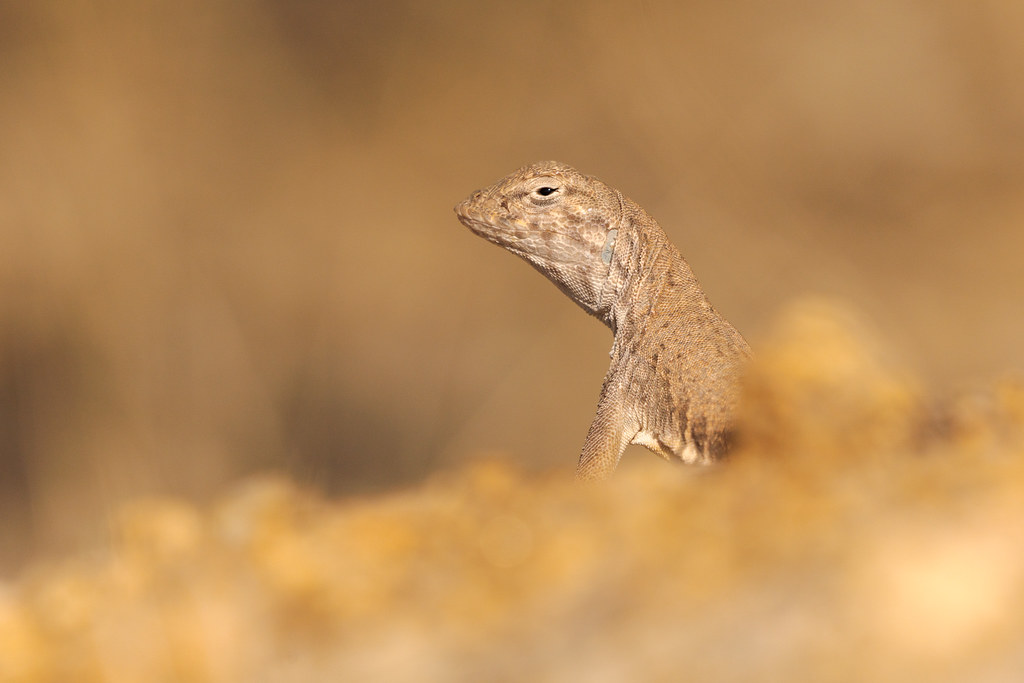
A tiger whiptail along the Hackamore Trail in McDowell Sonoran Preserve

The tiger whiptail is one of the lizards I see most often hiking in the Sonoran Desert. They are frequently on the move looking for insects and small lizards and active in the morning when I’m on the trails, so they more easily catch my eye than some of the other lizards. I arrived in Arizona at the end of March, from what I’ve read the tigers are mostly active from April to August so I may not be seeing them much longer.

Present, Future, Past

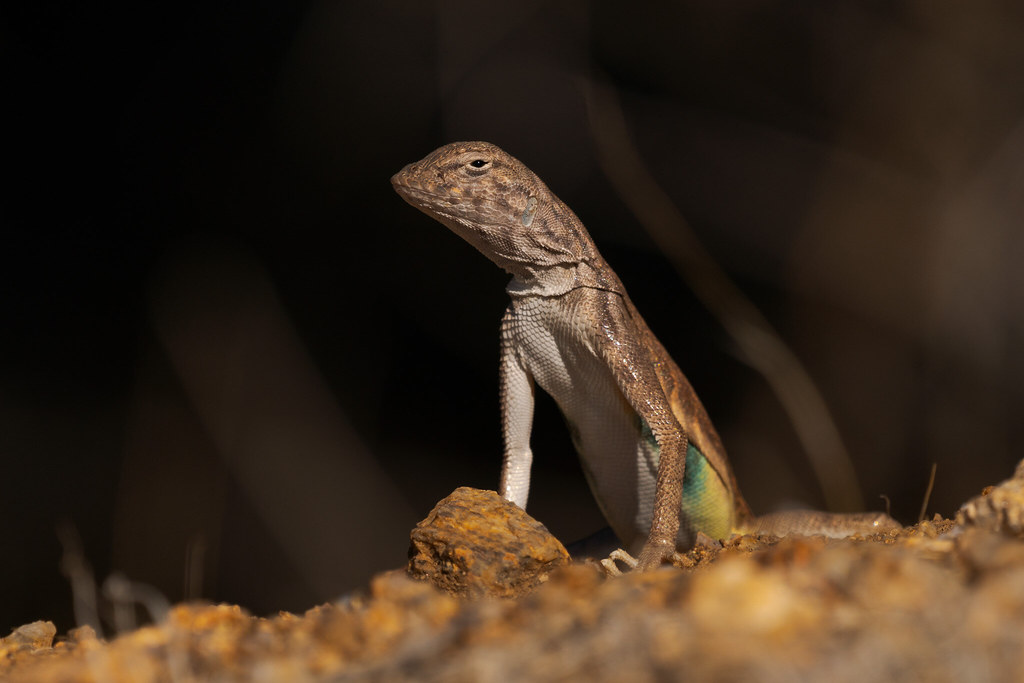
A zebra-tailed lizard viewed from ground level at The Amphitheater in McDowell Sonoran Preserve in Scottsdale, Arizona

With Nikon and Canon about to announce their first serious attempts at the mirrorless market, I’m curious to see what approach the two industry stalwarts take and how Sony responds. I’m hoping to add a second mirrorless camera, not because I haven’t loved my Sony A6500 but because I want to go back to using it for the purpose I bought it, to be my walk around camera and for non-wildlife use. I’ve switched to using it as my wildlife camera as combined with their 100-400mm lens and 1.4x teleconverter it has proven a much better setup for capturing the denizens of the desert than my Canon, like this zebra-tailed lizard at ground level.

I dislike the weight and size of my Canon so on my last hike I only brought the Sony and switched lenses throughout the morning, it made me so happy to put my beloved 24mm lens on it as I photographed desert scenes, then I switched to the telephoto when I saw a mule deer, a Harris’s hawk, a cottontail, then a black-tailed jackrabbit, and for close-ups of a saguaro, a soaptree yucca, a teddy bear cholla. I just don’t want to have to switch lenses! I don’t mind it on occasion but I’ve always preferred to have one camera for telephotos and one for wider shots, and then switch to other lenses as needed.

A day will come when I can’t manage the weight of heavier lenses as I hike, it isn’t approaching but I can see it in the distance. In the meantime I try to get out as much as I can, photograph what I can, but more than anything delight in the moments as they pass, for they pass ever more quickly. I’m thankful for the handful of cameras I’ve had over the decades for the pictures taken, the memories preserved. I’m amazed at what I can do with today’s gear compared to when I started. Here’s hoping my photographic future is as rewarding as the past.

Lighter than Air

A zebra-tailed lizard raises its body off the ground, showing off his long legs and the coloring on his sides

Most of the lizards I see underfoot scurry across the desert floor at a seemingly impossible speed, as though they were lighter than air, none more so than the zebra-tailed lizard. This one had raised up his body off the ground and showed off his long legs and the coloring along his side although you can’t see the vibrant tail for which he is named. Just once I’d love to run like he runs, to know that effortless speed.

Green and Blue in the Desert

A common side-blotched lizards perches on a rock in front of the green of an out-of-focus saguaro

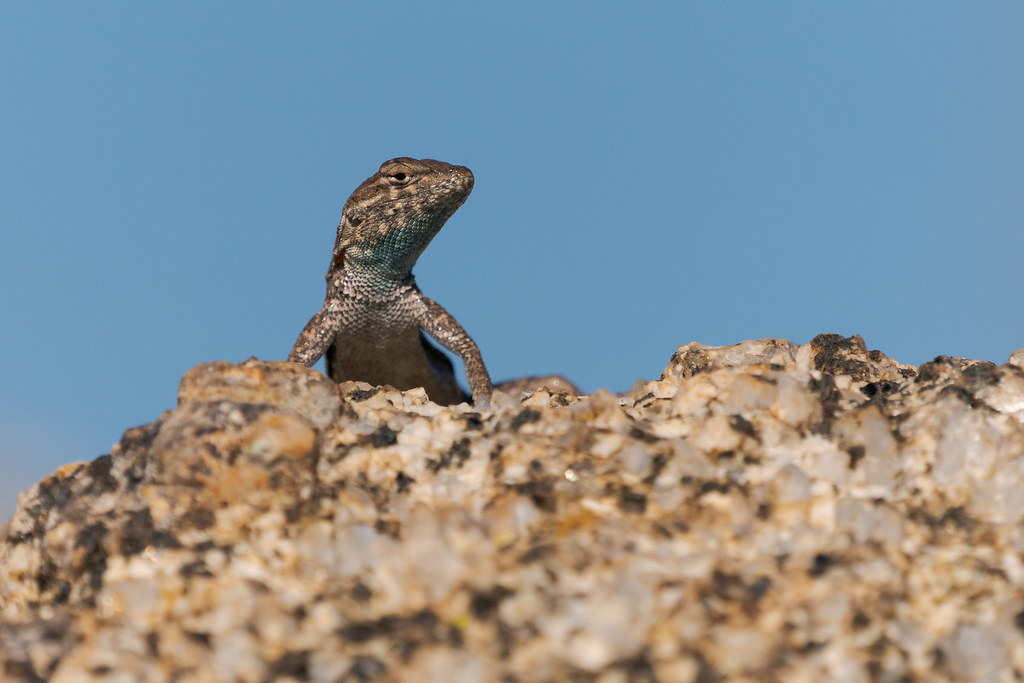
I was sitting below this little common side-blotched lizard, shooting up at it against a blue sky (below), when I realized if I moved the camera slightly I could shift the background to green courtesy of a massive saguaro standing behind it. There is green in the desert, not the ubiquitous saturated greens of the forests of the Northwest but a soft, muted green, always in the saguaros and palo verdes but on many more plants now that the summer monsoons have arrived.

Blue is easy to find in the skies of the desert but some lizards, especially the males, may have blue throats or sides or blue speckled throughout their scales. Blue too is the skin around the eyes of adult white-winged and mourning doves. All of these blues can be seen where I photographed this lizard at The Amphitheater in McDowell Sonoran Preserve, a rock formation on the Cholla Mountain Loop Trail that is one of my favorite places to hike.

A common side-blotched lizards perches on a rock in front of blue skies