The Departed Nurse

An empty space below the roots of a tree is all that remains of a nurse log

Despite its short length, the Hall of Mosses Trail in the Hoh Rain Forest provides nice views of nurse logs, fallen trees that provide a beneficial perch for seedlings to take root. As the young trees grow into giants themselves, their roots reach down around the log and into the soil. In time the log rots away, the emptiness that remains a reminder of how life for one tree began with the death of another.

The Dry Rain Forest

A tree is covered in moss and lichens in the Hoh Rain Forest

I recently got back from a week of hiking in Washington and made my fourth visit to the Hoh Rain Forest. My fourth dry visit to the Hoh Rain Forest. While it rained heavily during much of my trip, it was warm and sunny during my visit to the Hoh, so I’ll make a return trip this winter to all but guarantee a rainy day.

I wonder if tourists would pay me on sunny days to walk behind them with a watering can held above their head, to better get the full rainforest experience.

Sign of Sanity

A Douglas' squirrel sits atop a tree stump on the Hoh River Trail in the Hoh Rain Forest in Olympic National Park

While visiting Olympic National Park in 2004, my wife and I escaped the crowds of the Hall of Mosses Trail and walked down the lovely Hoh River Trail where we met this Douglas’ squirrel. When you spend time photographing something as common as a squirrel at a place as special as the Hoh Rain Forest, some of the other tourists look at you with a mixture of curiosity and pity, as though you’re either slightly mad or slightly a moron.

Both of which might be true, but I enjoy photographing squirrels and do it no matter where I am, especially species like this one that I see less often. While the squirrels I see in my yard in the city are invaders from the east, the Douglas’ squirrel is one of the native tree squirrels in the Northwest.

Roosevelt

A Roosevelt elk bull in the Hoh Rain Forest in Olympic National Park in Washington on September 26, 2008. Original: _IMG_0020.CR2

The race of elk we have in the Pacific Northwest, Roosevelt elk, were named in honor of Theodore Roosevelt. I came across this bull, part of a larger herd, on a rainy morning near the Hoh Rain Forest in Olympic National Park.

While President Cleveland protected some of the forests of the Olympic Peninsula in 1897 by declaring an Olympic Forest Reserve, the protection did not extend to the elk who lived there and in a few years less than 2,000 survived. President Roosevelt (Theodore, not Franklin) established the Mount Olympus National Monument in 1909 to protect the elk but future politicians cut back the acreage to half of its original size. President Roosevelt (Franklin, not Theodore) granted National Park status in 1938 after visiting the area, the status it has retained to the current day, protecting not only the elk that bear the Roosevelt name but also the many plants and animals that are unique to the Olympic Peninsula.

You can find more info about the history of the park in a PDF on the official park site.

Wet Greens

Green plants sway in the gentle current of a shallow stream on the Hall of Mosses Trail in the Hoh Rain Forest in Olympic National Park on September 26, 2008. Original: _MG_0182.CR2

With melting snow and approaching rain, I shoveled out a channel along the side of our street in Portland so all of that water would have some place to go. I know from past experience with fallen leaves that if the area beside our driveway isn’t completely clear we end up with a little lake where the driveway meets the road. The Hoh River in Olympic National Park is also fed by melting snow, but this snow is from glaciers high in the Olympic range that grind rocks into silt that color the runoff a milky blue. I suspect this little stream running through the Hall of Mosses Trail is spring fed, as unlike the Hoh its clear waters showed the brilliant green plants that were swaying in the gentle current.

Unique

The Olympic Marmot

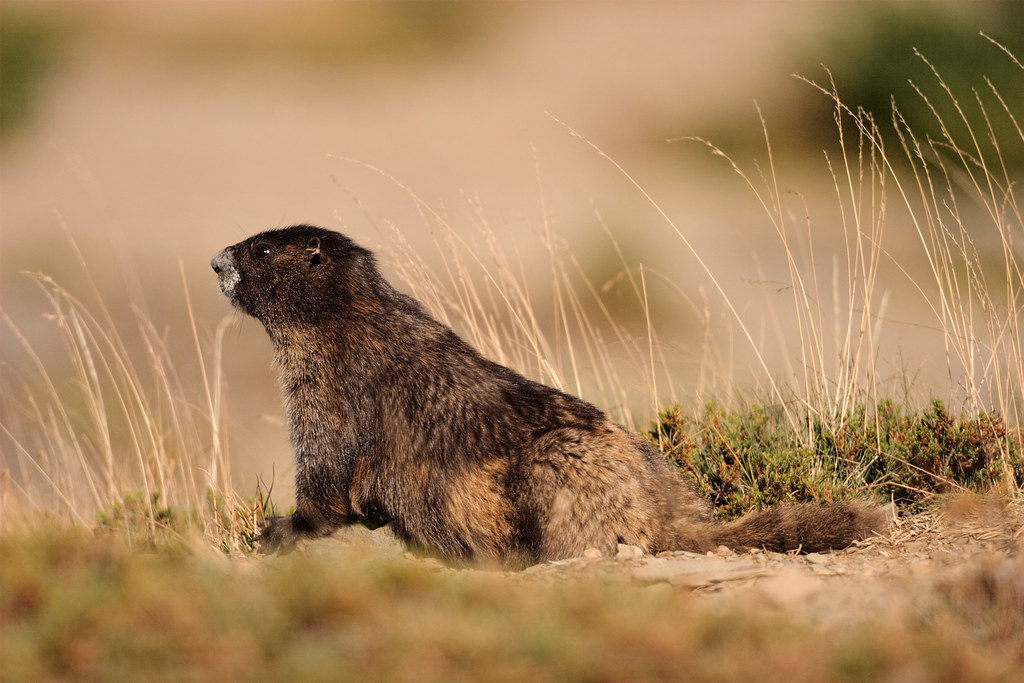
I saw at least four species for the first time on my Washington trip, three of them mammals and two of them marmots. In addition to the hoary marmots I saw at Mount Rainier, I was lucky enough to see Olympic marmots in Olympic National Park, one of the species that is unique to the peninsula. I expected to see them in rock formations along the trails in the Grand and Badger Valleys but neither saw or heard them. I did see a couple on the road between Obstruction Point and Hurricane Ridge, I would have missed them if a friend hadn’t seen them there on an earlier visit. The road is quite narrow with occasional steep dropoffs and made me more nervous than any of the trails I hiked, but in this particular location there was enough room to park on one side of the road and be clearly visible to traffic from both directions.