Ellie of the North(west)

Our dog Ellie stands next to a tree in the snow near the Irving Park dog park

Snow is not common in Portland so when we got some unexpected snow we took Ellie on an extra walk in the afternoon so she could enjoy it. It was snowing on our morning walk and continued during her annual checkup at the vet but had stopped by the time we took her on her second walk. The freezing rain had just started by the time of her evening walk, which by the next morning left everything coated in ice and Ellie refused to go on any more walks until it melted. She hates ice as much as she loves snow.

Her vet visit showed that her thyroid levels are really low, which might account for some things we had chalked up to aging like her reduced stamina. She’s taking medicine now but it’s too soon to see any improvements. I was thankful for my little Subaru while taking her to the vet, as given the rarity of snow we only have all-season tires, and the car handled the snowy streets without complaint. I left it parked the next day as our streets were solid ice, even snow tires wouldn’t have helped then. Thankfully warmer weather returned the next day and the streets cleared up, although the yards and sidewalks took a bit longer.

This picture is taken at the edge of the dog park at Irving Park, one of our stops on our walks in the neighborhood.

Hope Springs Eternal

Our dog Ellie sniffs a pile of acorns

The route Ellie and I take on our walk through Irving Park is lined with old oak trees, so in the fall we are surrounded by ripened acorns that have fallen to the ground. They smell enough like food to Ellie that she wants to sniff them, but not enough like food to try to eat them. Still, she wants to sniff each acorn just to be sure, hope springs eternal when it comes to food with this dog. This morning a storm knocked a bunch of green acorns to the ground and some kids collected them and stuffed them into the largest hole the dogs had dug in the dog park. Ellie of course had to sniff them, although not for long, the green acorns didn’t hold the appeal of the ripened ones.

In the picture below, Ellie again “sniffs” the acorns. I put sniffs in quotes because this was our evening walk and the morning’s sniff had already revealed there was no food to be had, so she wasn’t interested in further inspection. I wanted a different vantage point than the morning picture however so I bribed her by placing one of her treats beside the acorns. We must have been in a vortex that swallowed sound, however, as several times she seemed not to hear me when I gave the “leave it” command and instead ate the treat as soon as I set it down.

Our dog Ellie sniffs a pile of acorns

Holes in the Earth

A hole dug by dogs in the dog park is partially filled with water

We finally got some much needed rain and I wanted to take a picture to celebrate it, but we also got high winds so I couldn’t take any macro pictures like last time. But when I took Ellie up to the dog park I saw this hole that had started to fill with water and it reminded me of another hole in the earth I like photographing, one from Yellowstone National Park (shown below). That one is one of the many geothermal features in the area and is filled with water from below, not above.

There are a few of these holes in the dog park, and since Ellie likes to run beside me in the park, I have to navigate around the holes so that neither one of us steps in one and twists an ankle (she watches me more than the way ahead, trusting me not to lead her astray). The parks folks fill them in occasionally but some dogs like to dig, so new holes always appear. They’ve been spreading sand at this end of the park the past few years and it’s a big help during the winter when rain is not hard to come by, as the sand drains well and it gives Ellie and I a safe area to run in. In the old days she’d still want to run out into the grass, but only one of us has a body built for running in such muddy circumstances, and these days even she isn’t quite as steady on her feet as age begins to take its toll.

I never imagined the dog park would remind me of my beloved Yellowstone so today’s visit made me smile almost as much as the goofball dog who waited patiently for me to take the picture, and of course expected a treat as her reward.

A geothermal feature filled with water in Yellowstone National Park

A Surprise in the Salvia

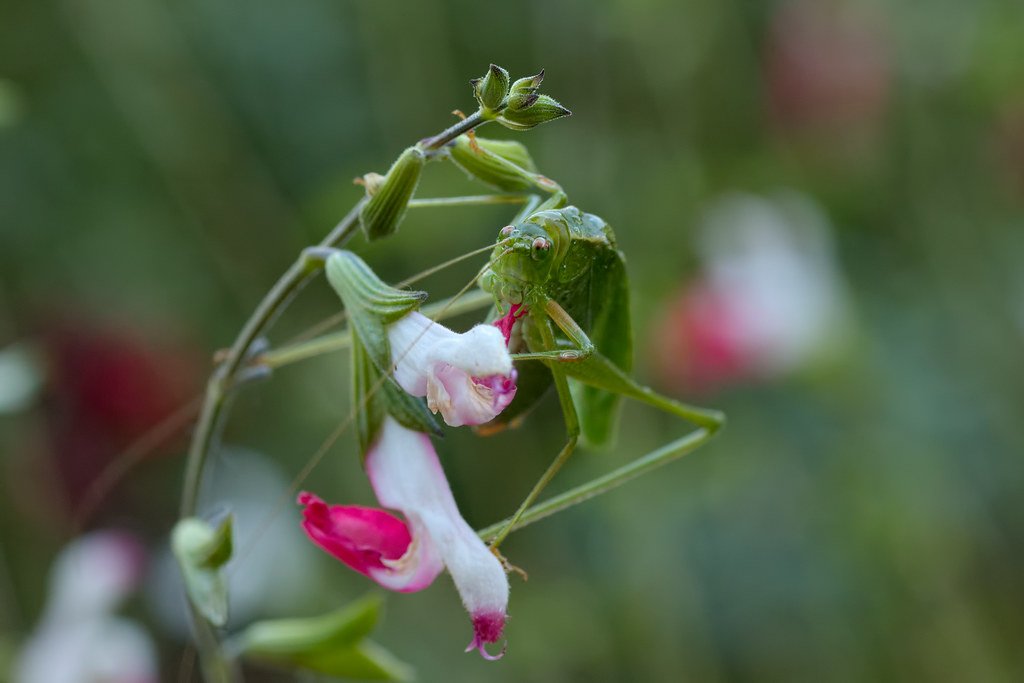
A katydid prepares to jump from the salvia branch it is clinging to

I normally like to photograph the insects and flowers in our garden the same way I shoot animals and plants when I’m hiking, which is to photograph them how I find them. In this case though the water drops on this katydid came not from rain but from me. It’s been a brutal summer here in Portland so even though our plants our drought tolerant to deal with the normally dry Northwest summers, I’ve been giving them an occasional drink of water since they missed out on the rains that usually last through June.

While watering the wildflower garden I saw something jump from the plant I was watering into our bee balm. I dropped the hose and ran over to see what it was, expecting a moth, and was delighted to instead find my favorite insect to photograph, a katydid. I had the chance to photograph them from 2006 to 2009 but hadn’t seen one since, so I put aside the watering and ran inside to grab my camera and tripod and macro lens and try for some pictures, even though the breeze was going to make things difficult.

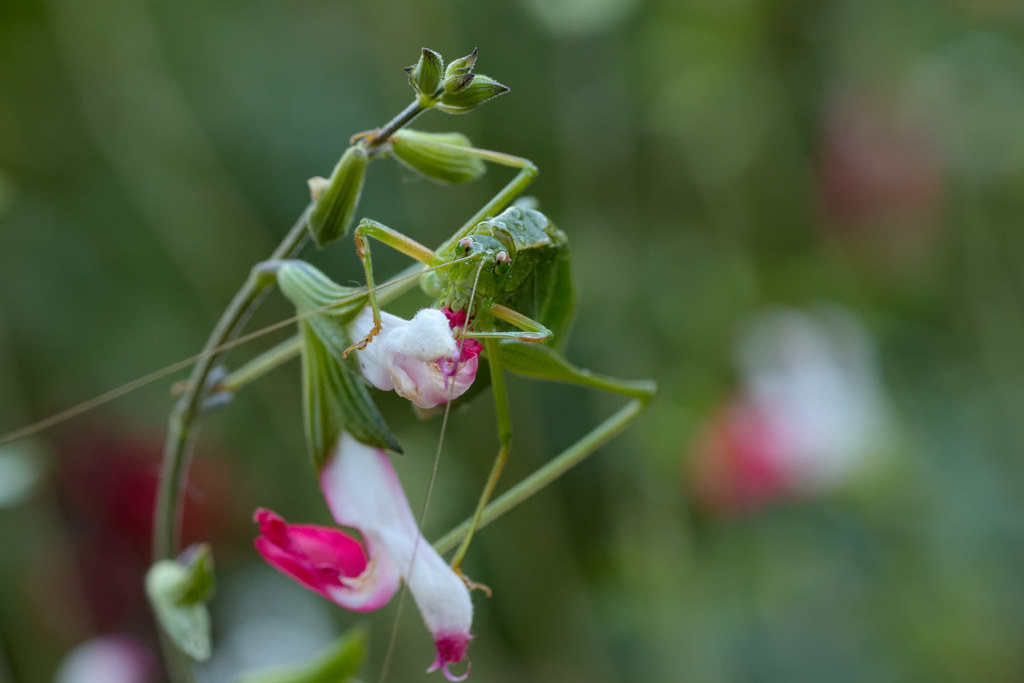
I was a bit crushed when I got back to the bee balm and discovered the katydid was gone. But it hadn’t gone far, as I saw it moving on the nearby salvia and settled in for some pictures. In the top picture it is about to jump from one branch to another, its two front legs in open space balancing in the wind while the back four maintain purchase on the salvia. In the bottom two pictures it is using its mandibles to cut off pieces of the flower to eat. It was hard to get any pictures as the breeze was blowing the flowers around, I did my best to manually focus whenever the katydid came back into view and hoped for the best.

I planted the salvia for the hummingbirds, and the bees and butterflies like them too, so I was delighted to see the katydid enjoy them too. The katydid’s enjoyment is more destructive than the others, but no worries, there are plenty of blossoms to choose from. I hope it can forgive the disturbance of my watering, as the same water that upset it nurtures the flowers it loves to eat.

A katydid pulls on a salvia blossom as it prepares to cut it with its mandibles to eat it

A katydid cuts a salvia blossom with its mandibles as it prepares to eat it

Extreme Baseball

Four mounds of dirt await being spread onto a baseball diamond

Baseball is trying out some new rules in an effort to stay relevant to the youth of today. I’m not sure about the 5 Mound Rule, where four tall pitcher mounds have been added behind the normal one, allowing 5 batters to be pitched to at once. But I do like how the fifth mound partially blocks second base, sure to introduce some much needed somersaulting into the game.

Signs of Optimism

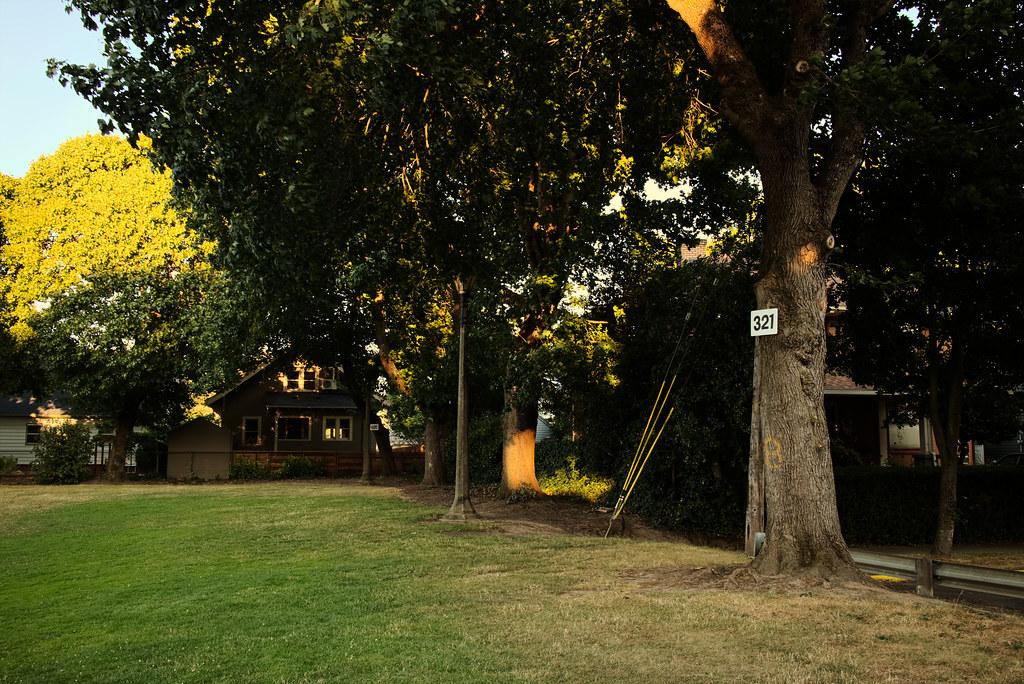
Trees in Irving Park with signs indicating the distance from home plate

During the dry months, this is where Ellie and I enter Irving Park every day on our walks. The park offers a number of recreational opportunities for the neighborhood, as in addition to the dog park there are basketball courts, tennis courts, a playground, picnic tables, open fields, and baseball diamonds. As in surrounding Irvington, many old trees provide shade and character throughout the park. Sometimes the baseball diamonds are not in the best of shape and there are no fences in the outfield, but the types of teams that play here aren’t likely to be hitting any home runs.

So I had to smile when someone put up these little signs on a few of the trees at the edge of the park, indicating the distance to home plate. Nothing wrong with a little optimism.

Hot Cake

An old truck parked on a Portland street with the words Hot Cake painted on the side

While not heavily travelled, Siskiyou is the busiest street Ellie and I cross on our walks, so long ago when training her I started giving her a treat if she’d wait for my command before we crossed. We frequently pass this old truck, owned by a resident on a nearby block, parked here as it’s a cross street with easier access and more available parking than the other streets. It’s often piled high with junk that I assume is awaiting transport to a recycling center. While I’m thankful it’s not parked in front of my house as it’s a bit of an eyesore, I was amused when I noticed it had ‘Hot Cake’ painted on one side, and I’m almost developing an affection for the old thing.

I’m less fond of it when it is parked near the intersection as it completely blocks us from the view of traffic, so I take Ellie to a different intersection to cross if there are any approaching vehicles.

Water Slide

Raindrops cover the surface of the flowe of a black-and-blue salvia

After an unusually hot and dry summer, we got some much needed rain this weekend so I grabbed my macro lens for some pictures of the flowers and insects in our garden covered in raindrops. This is a close-up of one of the flowers of our black-and-blue salvia. I ended up with a sore back from standing or sitting in uncomfortable positions to get the macro shots that I wanted, I find it rather unfortunate that Canon didn’t put an articulating LCD on the back of the 7D Mark II, which I would use constantly for macro or pet photography.

I pre-ordered the Sony A7R II back when it was first announced and I need to decide in the next week or so if I should cancel the order. I would vastly prefer a mirrorless camera for macro work, and they have a stunning new macro lens for their system, but while the LCD tilts it isn’t fully articulated.

Cape Fuchsia

A close-up view of the flower of a cape fuchsia

When we bought our house years ago there was a plant out front with gorgeous red flowers that was struggling. I guessed it wasn’t getting enough sun and it seemed like it would be hummingbird friendly, so when we started a wildflower garden in the backyard in memory of my mother-in-law and the hummingbirds that swarmed her feeders, I decided to try transplant some of the suckers of the plant and see if any survived. I didn’t have any potting soil handy so they went from clay to clay. I kept them watered during the dry summer and was stunned to see that they all did fine and now we have two thriving sections of what I discovered are cape fuchsias.

Despite the name and appearance of the flower, they aren’t true fuchsias. While not native to the Northwest (they come from South Africa), they do well during our dry summers and wet winters and are thriving even during our unusually dry and hot summer. The hummingbirds love them and they require little attention from me and have proven to be a lovely addition to our wildflower garden. I normally dislike suckering plants but these are easy to keep under control, and I even use one section of them as a buffer between the wildflowers and the raspberries, which are rather obnoxious in how they sucker and spread.