The Small Diver

The Small Diver

Bufflehead are one of our smallest ducks and fairly shy so it’s always a treat when they swim in close. This male swam across the smooth surface of Rest Lake with his tail splayed flat, as a diving duck he can use his tail to push down against the surface of the water when he dives either in search of food or to flee from one of the resident bald eagles.

Closely Monitored

Closely Monitored

This doe is part of the first wave of Columbian white-tailed deer that were brought to Ridgefield National Wildlife Refuge in 2013 with the goal of establishing a permanent herd at the refuge. A second wave is planned for 2014 and a third in 2015 if needed. That’s her fawn behind her, the first generation of Columbian whitetails born at the refuge. I wasn’t going to put this image up as the dark blobs from the out-of-focus teasel are a bit distracting, but I like how clearly it shows her radio collar and ear tags and how closely monitored her movements are.

Watched & Watching

Watched & Watching

I headed up to Ridgefield National Wildlife Refuge yesterday for the first time in nearly a year, wondering what changes I might see, but the most unexpected change was one I saw in my rear view mirror. I had stopped along Rest Lake to photograph a couple of bitterns that were hunting near the road, but I kept having to move up to let traffic behind me through, before backing up to resume my watch.

The bitterns were soon gone but a great blue heron was slowly working its way in my direction, so I settled in to see how close it would come. I frequently checked my rear view mirror to watch for approaching cars but none came. But then in the mirror there was a slow movement of brown from one side of the road to the other, and when I swiveled my head around to look got my first glimpse of a Columbian white-tailed deer. Two of them actually, a doe and her fawn.

The doe had bright yellow tags in each ear and a large radio collar around each neck, she was one of thirty-seven that were emergency translocated earlier this year from another refuge in Washington (and one of twenty-nine that survived). Her fawn, though, belongs to the first generation born at Ridgefield. It and the other deer will be closely watched to see how they survive in their new home, as the Columbian whitetail was only recently downlisted from endangered to threatened status.

But at the moment, it was just the two of us watching each other, each seemingly as surprised as the other by the encounter.
Peace

A close-up view of the head and shoulders of a coyote

My favorite coyote picture, taken over a year ago in January of 2012.

Coyotes have a complicated and controversial relationship with our modern world, and I’m not sure how this pack will fare now that subdivisions have replaced the meadows on the hills above the refuge. I see them near the road sometimes as I drive into town before sunrise, but I see them as roadkill too. And there will be conflicts with barbed-wire fences and dogs and cats.

But on this morning, as it hunted for voles with its mate, and as a few snowflakes began to fall, all was peaceful. Only the three of us were around, and since I stayed quiet in my car, they let me watch at my leisure as they worked the length of the dike.

A peaceful morning for me, if not for the voles.

A Mystery

An American bittern stands in the water next to Rest Lake at Ridgefield National Wildlife Refuge in Ridgefield, Washington

This is one of my favorite bittern pictures as it shows the way I often wind down a day at Ridgefield, watching bitterns near the end of the auto tour before I have to leave to beat the closing of the automated gate, the setting sun leaving the bittern to hunt in shadow. These last moments always make me wonder — what do bitterns do in the dark?

Clues

A close-up view of the rear foot of a nutria

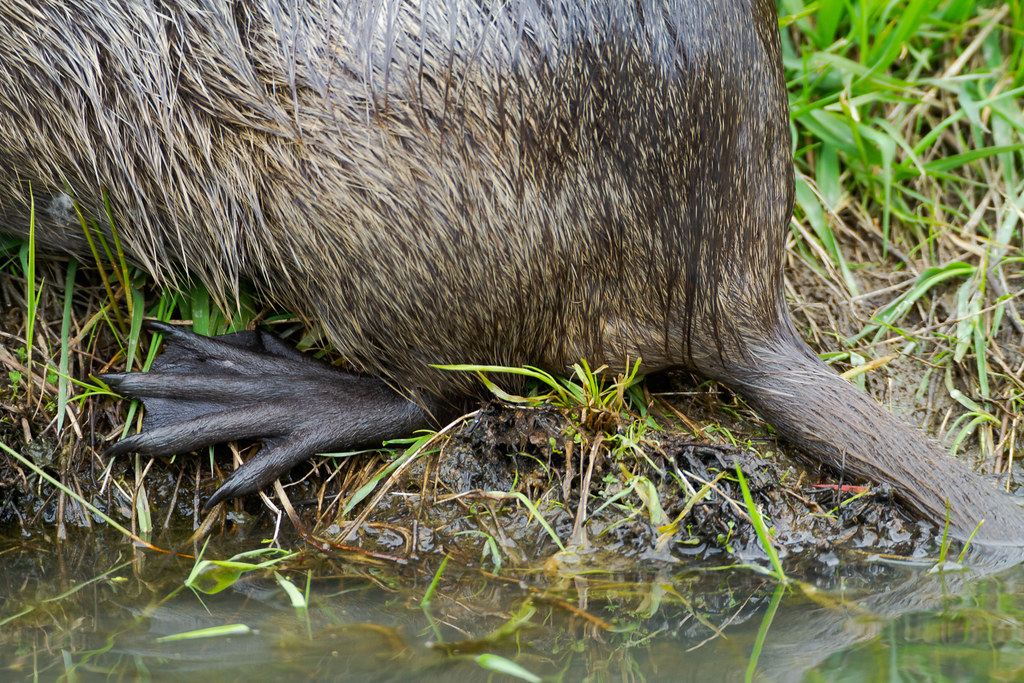
Nutria are by far the most commonly seen of the aquatic rodents at Ridgefield, with muskrats being relatively common, beavers not common at all. There are enough clues in this picture to identify which of these rodents this is. The tail is the most obvious indicator, but the rear foot all by itself holds enough clues. A muskrat has white claws while those of a nutria and beaver are dark. Both beavers and nutria have heavily webbed rear feet, but all five of the beaver’s toes are webbed, on a nutria only the inner four.

Which begs the question: why?

I don’t know the answer but I do know this is a nutria.