Diverse Divers

A male bufflehead starts to dive under water at sunset

Visit Ridgefield in the winter and you’ll see waterfowl diving under the water to feed, such as this bufflehead at sunset above, or the coot below, its red eye visible just above the water. I like to sit and watch them and have been struck by the many differences in the bodies of coots and diving ducks, even though they both spend much of their lives diving underwater to feed. There are differences in their bills, and their feet (ducks having fully-webbed feet, coots not), but my favorite difference is most visible when they dive.
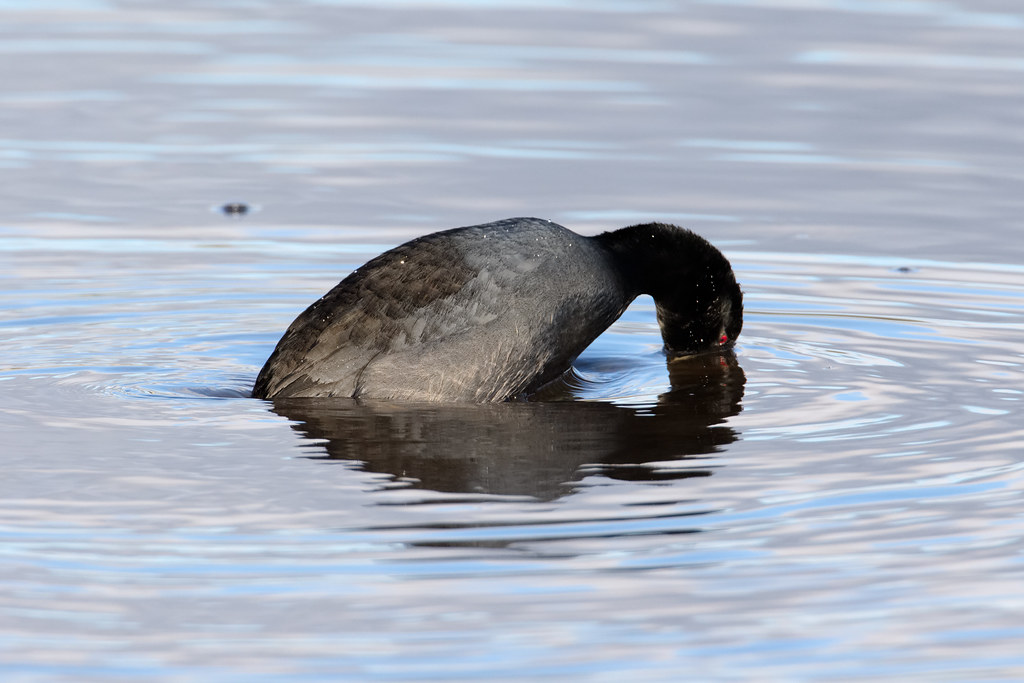
An American coot starts to dive under the water, its red eye visible just above the surface of the lake

Both diving ducks and coots spring forward and break the surface tension of the water with their beaks, but ducks leave a vortex behind them at the start of the dive while coots do not, a difference that begins with their ends. Diving ducks like the bufflehead have broad tails that they spread out horizontally on the water before they dive, enabling them to push their tails down and themselves forward as they start their dive. You can see the pattern of their tail feathers, shown below as water flips off the bufflehead’s tail as he finishes the dive, in the water behind the duck in the first picture.

A male bufflehead's tail flips water as he dives under the water

Compare the bufflehead’s tail above to the coot’s below and you’ll see the coot has a stubby little tail and can’t use it to push forward like the diving ducks can. While it might seem that the diving ducks have solved the diving problem much more efficiently than the coots, I should point out that the coots at Ridgefield far outnumber any species of diving duck at the refuge.

The tail end of an American coot's dive

A trait they share in common is that they have to get a long run across the water to take to the air, so if a bald eagle attacks, they prefer to dive under the water as a means of escape. It’s usually effective, but sometimes you’ll see an eagle keep flying over a duck or coot repeatedly until its prey tires and surfaces at just the wrong moment and is captured in the eagle’s talons. I’ve seen eagles with a variety of waterfowl in their talons, but coots more than any others, not surprising given their large numbers.

We Three Cranes

Three sandhill cranes fly in formation

Three sandhill cranes, part of a much larger flock, fly in formation over Rest Lake at the end of a cold winter’s day. The skies above Ridgefield can be noisy in the winter, usually from the large flocks of cackling geese and tundra swans that overwinter at the refuge, but particularly early or late in the day sandhills may join the chorus.

The Quiet Blue Horse

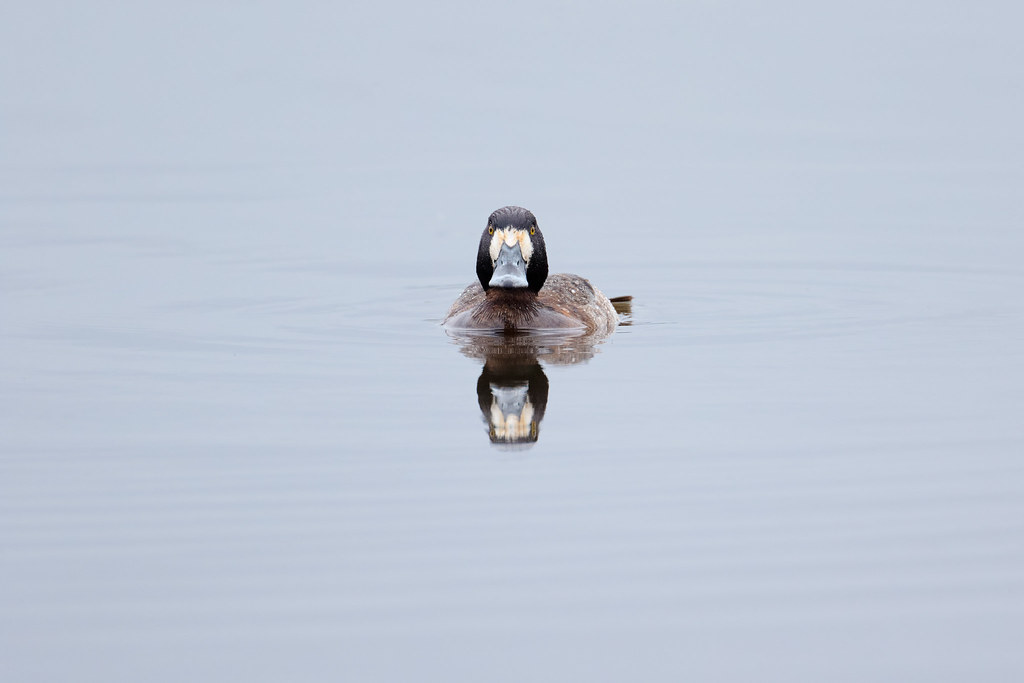
A female lesser scaup prepares to dive on a winter day

There is much of me in this simple portrait of what may be my favorite duck. Not lesser scaup in general, but this particular duck. Over the past handful of years I’ve spent many hours sitting at Horse Lake watching a female lesser scaup dive for food. I don’t know that it’s the same individual from year to year, or even visit to visit, but I’m a little disappointed if I drive by and she’s not there.

Many photographers only like to shoot on sunny days but I also love days like this, the typical winter day of the Northwest, heavy overcast with an occasional gentle rain. I often won’t go to the refuge on sunny days since it brings out the crowds, but if it’s raining I can sometimes sit quietly and enjoy the subtle beauty of this seasonal pond without the constant noise of cars driving by (or idling while parked behind me). The scaup often hangs out on the far side of the pond but if there isn’t much traffic she’ll swim over and feed near the road.

While there are often other ducks present, she’s usually the only scaup. Perhaps she enjoys the solitude of the place as much as I do. She’s tucked her feathers tightly against her head, a sure sign that even though she just surfaced, she’s about to dive underwater to feed again.

Constant Movement

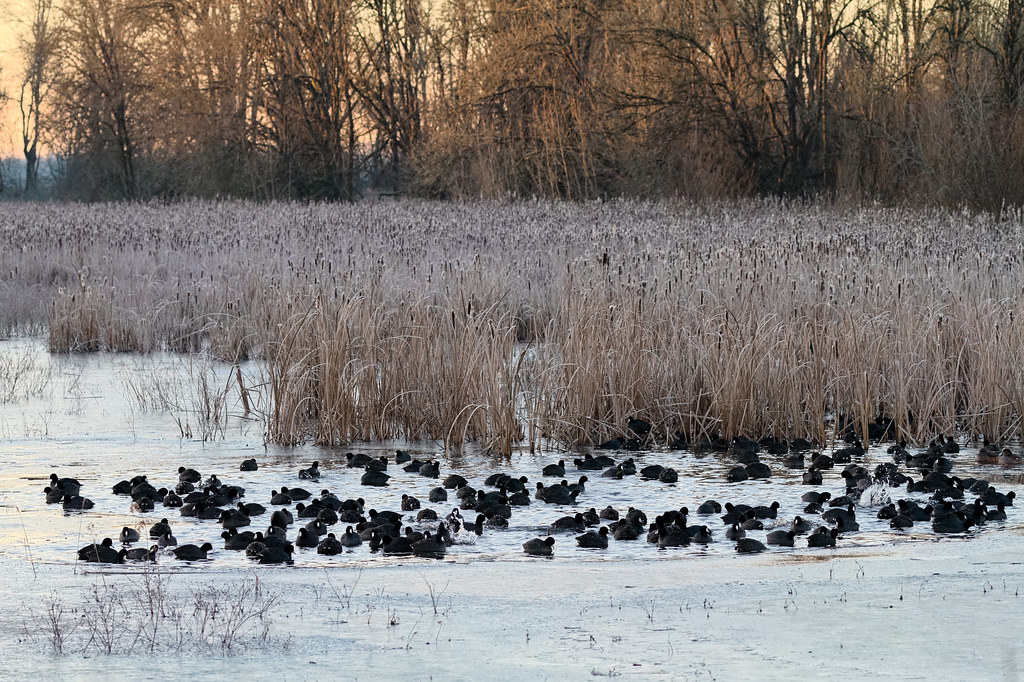
A group of American coots feeds in an open area of a frozen lake

A cold snap at the end of 2014 left many of the ponds and lakes at Ridgefield frozen over, but this group of American coots was helping keep a section of South Quigley Lake open with their constant movement as they dove under water in search of plants to eat. There’s a culvert near here that runs under the road and keeps water flowing between the north and south lakes, so the water here tends to stay open longer than the other parts of the lake.

The handful of splashes in the picture are from coots diving under the water, in the splash on the far right one of the coot’s legs is visible sticking up above the water. There’s also a pair of American wigeon on the far right, they frequently will try and take some of the plants that a coot brings to the surface, but on this morning they seemed content to just hang out with the coots and enjoy the safety in numbers as well as the open water. The sun was just starting to rise on this New Year’s morning, there’s a hill above the refuge that blocks the sun right at sunrise but it was just starting to crest the hill and illuminate the trees at the far side of the lake.

Wingtips

A head-on view of a young bald eagle as it flies at Ridgefield National Wildlife Refuge in Ridgefield, Washington on January 1, 2016. Original: _L1A9073.CR2

Just your typical “Say, you didn’t bring any of your delicious cats with you, did you?” bald eagle flyby.

This young bald eagle had been heading in a direction to take it over to my left but it changed course and headed straight toward me. This was the last picture I could take showing its full body as with its long wings it was already wingtip-to-wingtip in the frame. The eagle was flying much too fast for me to change lenses as it flew closer, and it did fly quite close to my car before turning to follow the edge of the lake.

I’ve noticed many times before how the birds that soar above Ridgefield’s meadows and lakes have their flight feathers spread apart at the wingtips, both vertically (as you can see in this head-on view) and horizontally, but this time I was finally compelled to do a little reading to see if there was a benefit to it or if the birds lacked the structures necessary to keep them locked together under the pressures of flight. It appears that the spread feathers affect the vortices that form behind the wings when they’re providing lift, reducing drag as the bird soars through the air.

📷: Canon 7D II | Canon 500mm f/4L IS USM + 1.4x III
🗓️: January 1, 2016

The Fallen

A barn swallow sings while perching

When I arrived at Ridgefield in late 2013, after an absence of nearly a year, I lamented how many of the snags near the road in Long Lake had fallen over as they were a great place in spring to photograph songbirds up close. This more distant snag was still standing and offered a lovely background hinting at the surrounding environment with the blue of the water and the green plants at the edge of the lake and the brown grass of the meadow beyond. In the spring of 2014 I was watching barn swallows hunting for insects over the lake when this one perched for a moment and chirped to its compatriots still in the skies.

This snag has since fallen and there are no more near the road. I once saw a Jedi knight lift a sunken X-wing fighter out of a swamp, so I remain hopeful that one will visit Ridgefield and set some of the fallen snags upright once more.

Last Light

A great egret hunts for bullfrogs in the fading light

A great egret hunts in the last light of the day. The sun was setting but its direct rays were already blocked in this channel, leaving a nice soft light. I didn’t expect the egret to catch much but it caught three bullfrogs in quick succession. I don’t know how many more it caught before calling it quits as at that point I had to leave both because the light was gone and to get out of the refuge before the automatic gate closed for the night.

Hooded White Horse

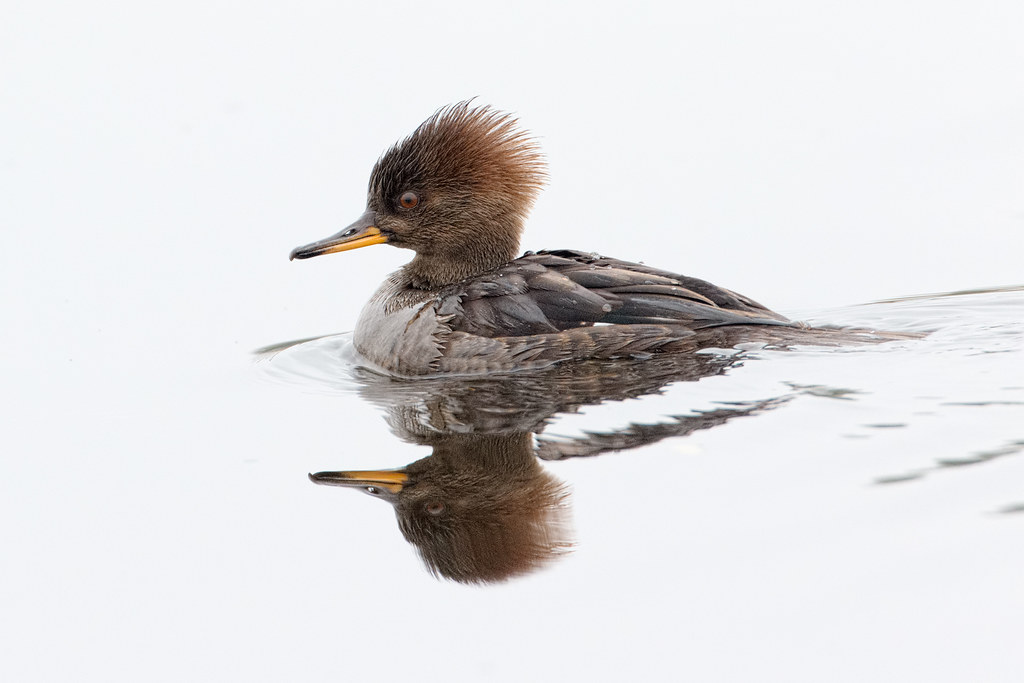
A female hooded merganser swims on Horse Lake

Reflections on a cloudy day turned the surface of Horse Lake white when I exposed for a female hooded merganser as she swam past my car. The auto tour at Ridgefield is one of my favorite places in the Northwest as you get to see such lovely wild animals like this up close and behaving naturally, frequently without disturbing them.