Aubergine

A close-up view of the Aubergine ballistic nylon fabric in the Tom Bihn Aeronaut 45

I ordered Tom Bihn’s Aeronaut 45 in December with an Aubergine exterior and Wasabi interior. I was hoping to first use it on a trip to the Hoh Rain Forest, as I’m determined to finally visit when it’s actually raining, but life intervened. I’m still hoping to get up there this spring, but in the meantime I took a macro shot of the ballistic nylon fabric.

Little Respect

Rick Cameron stands in front of Fairy Falls, a small waterfall in the Columbia River Gorge

I took a much needed day off from work to go hiking in the Columbia River Gorge. I got a bit of a late start and intended to hike from Wahkeena Falls to Angel’s Rest but I was having so much fun taking pictures on the way up that by the time I got to Fairy Falls I decided to take a few self-portraits with my new backpack and head back down. The tricky part was standing still for nearly a second, especially since I couldn’t hear when the shutter clicked due to the waterfall so I had to guess at when it was OK to move.

The Columbia River Gorge has a variety of spectacular waterfalls but little Fairy Falls is one of my favorites, I find it so relaxing that every time I see it I think how nice it would be to have even a small version of it in my backyard.

Mr. Boolie Goes to Washington

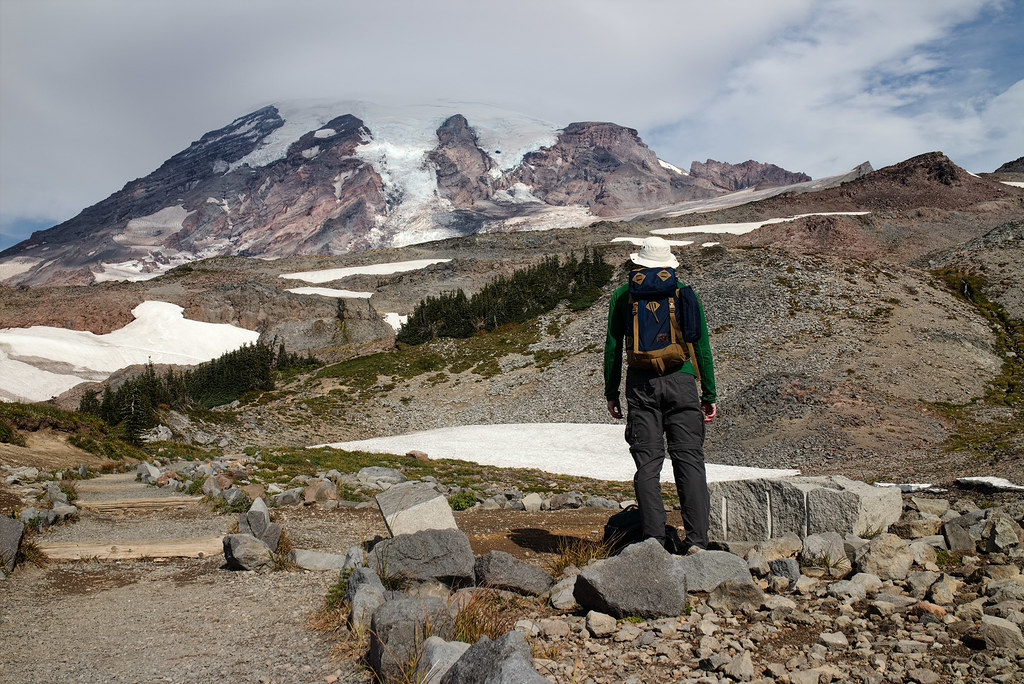
Rick Cameron stands in front of Mount Rainier

I was trying out a lot of new hiking gear on my weeklong hiking trip in September to Mount Rainier National Park and Olympic National Park. In the picture above, the hiking pants and hat are old, but everything else I’m wearing is new right down to my socks and shoes and undies, and it all worked out rather well. The green wool hoody I’m wearing, an Ibex Hooded Indie, I loved so much when I got home I ordered two more for myself and another for my wife.

The backpack is The Guide’s Pack from Tom Bihn, this was my first time hiking with it and it did great. In the pack were more new items, including an Ibex wool coat (the Shak Lite) and an Outdoor Research rain shell (the Foray), both of which I was wearing earlier in the morning but took off as the sun came out, and both of which got tested over the next few days as the rain and cooler weather rolled in. I can’t speak yet to how they will wear with time, but so far I’m sold on the Ibex wool layers, they’re thin and easy to pack but dried quickly and kept me warm when it was cool but I didn’t overheat in warmer weather. This was my first time not wearing cotton layers and I was surprised at how much more comfortable I was, to the point that I began to feel rather foolish for not having moved away from cotton years ago. The Foray rain shell also did well, not a drop of rain got through and it seemed to breathe better than my previous coat.

My shirts were some new synthetic shirts from a variety of outdoor companies as well as one wool shirt from Ibex, and those too I was pretty happy with. Cotton is still the softest but these performed much better on the trail when I started to sweat and were still plenty comfortable.

Funnily enough it wasn’t my new gear that failed me, but rather my trusted old hiking shoes, I learned the hard way that they aren’t as waterproof as they once were. Fortunately I had brought some other new shoes that I pressed into service, even though I had planned for them to be more general purpose shoes. I’ll pick up some new waterproof hiking shoes this fall.

The Tom Bihn Guide's Pack holding a Canon 500mm lens

The rucksack design of the Guide’s Pack allows it to swallow a variety of loads. I ordered it thinking I’d pack it with my normal hiking gear, but when it arrived I realized it could hold my Canon 500mm telephoto lens. I hiked with the big lens quite a bit on this trip, too much to be honest, as it weighs 8.5 pounds and I wasn’t in good enough hiking shape for that much weight. The backpack has a frame which helped with the weight, but with all the elevation changes I ended up a bit too tired on some days. Normally I’ll carry a more moderate load as I realize this heavy of a load could shorten the life of both the bag and its wearer, but it’s nice to know I can take it on trails where I expect to see a lot of wildlife. Which on this trip meant trails where from past experience I expected to see pikas and marmots and I came away with some pretty nice pictures thanks to the new bag.

Still, I’d like to limit how often I carry that heavy of a lens and will look for something a little more portable than the 500mm lens but that can replace my aging 100-400mm lens, as it is in need of repairs but I’m hesitant to spend much money on it as it lacks some features of more modern lenses (including weather proofing).
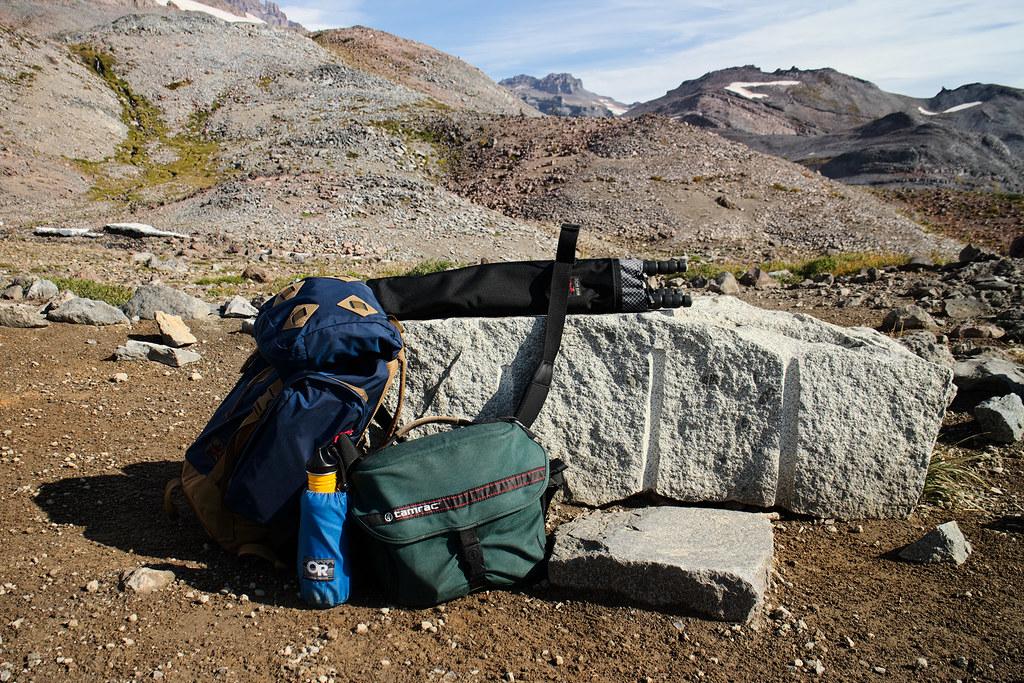
Bags for carrying camera gear on a hike

This was my normal hiking setup in terms of the bags I carried, what varied was how much camera gear I carried on any particular hike. The Tripod Quiver (also from Tom Bihn, and also new for this trip) held my Gitzo carbon fiber tripod, while the backpack held either my Canon 500mm lens or the 100-400mm lens, plus extra coats and clothes and food. The Tamrac camera bag held my 100-400mm lens when it wasn’t in the backpack, my Canon 7D SLR, and my Canon M mirrorless camera, plus a water bottle for easy access (new water bottles for the trip too).

I had intended to take the new bags on short hikes closer to home before the trip but ran out of time, so they got pressed into heavy duty service immediately. Not to worry, they both worked out great. I got constantly drenched on multiple days and while the dampness did eventually penetrate the bag, I had everything inside in smaller bags so everything stayed dry. I will probably look into a rain cover for future use, even though I typically don’t have to hike in such a steady rain, but it would be nice to have for emergencies.

One thing I wish I had more of was stuff sacks for the extra coats and clothing I kept in the bag. I had one for one of my layers and attached the bag with key straps to the o-rings in the bag, which made it easy to find and access when I wanted to put on the jacket. But I didn’t have stuff sacks for the other layers and their zippers scratched the paint on the big white lens. Easy enough to rectify on my next Tom Bihn order.

The Tripod Quiver I originally intended to attach to the backpack but found that carrying it on its own with the Absolute Strap was both comfortable and convenient. I took the tripod on every hike, something I’ve been loathe to do in the past, so that worked out nicely.

All in all the new gear worked out well and made for more enjoyable hiking.

The Tamrac camera bag certainly wasn’t new, I bought it the mid-1990’s and it has been with me on every hike since. Like the Tom Bihn bags, it was made here in the United States, and even outlived the company that made it. I was in graduate school when I bought it based on some research, as even though it wasn’t very expensive, every dollar was precious back then. Even so I never would have believed it would be my hiking partner two decades later, but here we are. It fits nicely in overhead bins of even puddle jumpers, so it’s easy to take on trips.

The Tom Bihn Guide's Pack in front of Mount Rainier

Since it can sometimes be hard to judge the size of things when online shopping, I thought I’d provide this helpful size comparison of the Tom Bihn Guide’s Pack. Based on my preliminary observations, I’d say it’s somewhat larger than an iPhone and somewhat smaller than Mount Rainier.

The Tom Bihn Guide's Pack in my room at the Paradise Inn

Up above the tree line on Mount Rainier there’s a fine dirt everywhere so my beautiful new bag didn’t stay clean very long, as this shot from my room in the Paradise Inn shows. Which is good, because I haven’t been hiking enough the past couple of years and it’s a sign things are headed in the right direction. A dirty bag on the trails is better than a clean one in the closet.

The Tom Bihn Guide's Pack and Tripod Quiver on Rialto Beach

I was waiting for the sunset at Rialto Beach near the end of the trip and took a quick shot of the two new bags. The next morning I went to the Hoh Rain Forest and then drove back to my home in Portland. I’m not quite done getting bags, I’ve got my eye on an Aeronaut 45 for longer trips instead of my rolling suitcase, as at most of the places I stayed I had to carry the suitcase and the duffel/backpack style of the Aeronauts would have been much more convenient, and maybe an Aeronaut 30 and/or a Smart Alec for shorter trips.

Monumental

Rick Cameron poses in front of Mount Rainier

As I imagine future generations will want to erect a statue in my honor, I thoughtfully posed in advance to ease the design process. I was thinking it could be 200 feet tall and sit where the Willamette flows into the Columbia, turning so I’m always facing the sun. Statues of my pets could rise and fall in the river in the order we lived together, so that Templeton’s ears would break the surface of the water at sunrise, followed by Scout’s a while later. When Templeton descends back into the river, Emma and Sam would start to rise, and so on.

In this picture I’m in front of Mount Rainier, but don’t put the statue there, that would be a little ostentatious.

The Tom Bihn ID: An 11-Year Review

[Update March 26, 2016: I posted a follow-up to this review, with my ID now at twelve (and a half) and still my daily bag.]

[Update February 10, 2017: I retired this ID after thirteen years and replaced it with a newer one.]

My Steadfast Companion

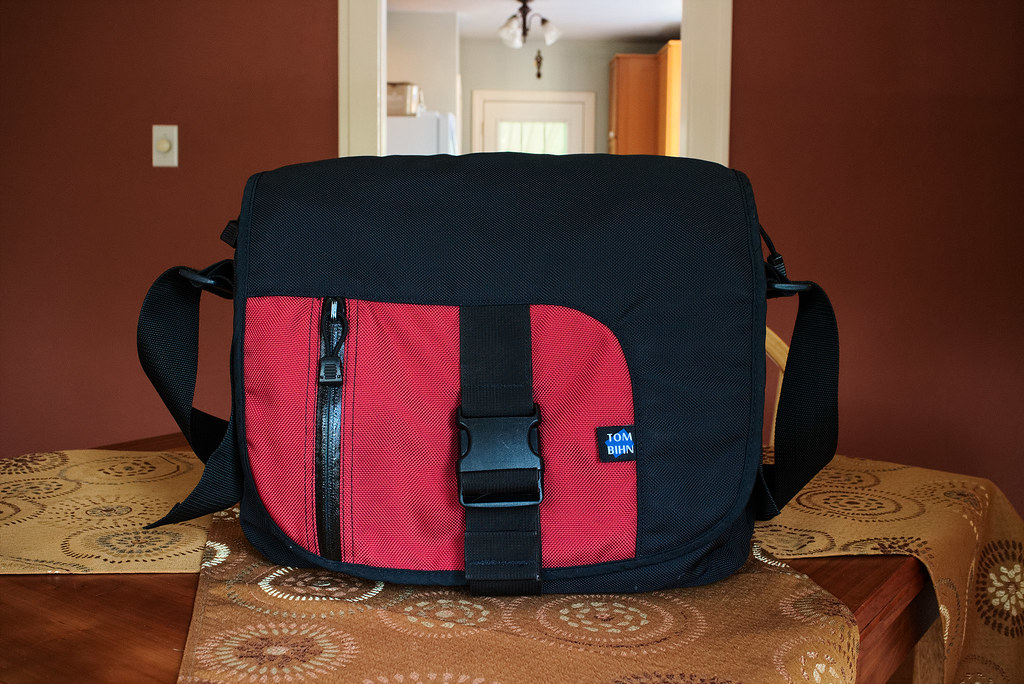
Is there much point to reviewing an 11-year old bag, especially one that has been updated and improved since I bought it? Perhaps not, but this is as much a love letter to the company that made it — Tom Bihn — as it is a review of my ID messenger bag. After being exposed to cheap laptop bags from local stores and the Willy Loman bags that are the bane of the corporate world, the ID was a revelation.

We moved to Portland in 2002 from further south in Oregon and I traded a long car commute for walking and a ride on the light rail. To be more productive on the train, I bought my first laptop, a 12″ iBook, and carried it in a laptop backpack we picked up from an office supply store. I was shocked at how quickly the backpack fell apart. So when I upgraded to a 12″ Powerbook in November of 2003, I decided to get a better bag as well. I wanted to try a messenger bag for the crowded train as I had been witness (and victim) too many times to the horrors of inadvertent backpack whackage from one rider to another.

I didn’t want a heavy bag since all of the weight would be on one shoulder, but it needed to be big enough to store a fleece and a raincoat for the variable spring and fall weather. My search led me to the Tom Bihn ID. At the time I was a bit nervous at the cost, $85 for the ID itself and $50 for the Brain Cell laptop case that attaches inside it, as it was more than I had ever spent on a bag (today the ID sells for $160, the Brain Cell $65). But it seemed like a great bag from a great company so I ordered the ID in Black/Crimson/Steel, hoping it would last me a few years.

A few years turned into eleven.

Little Touches

While I’ve been driving to work the past few years, most of my time with the bag has been spent walking or on the train. It’s about a 20 minute walk home from the train station and, living in Portland, I’ve been rained on countless times, from light drizzles to out-and-out downpours. Snowed on a few times. One day I even trudged home in a freezing rain, finally arriving home to find the bag completely encased in a thin sheet of ice. But nothing has ever gotten wet.

Brains! Brains!

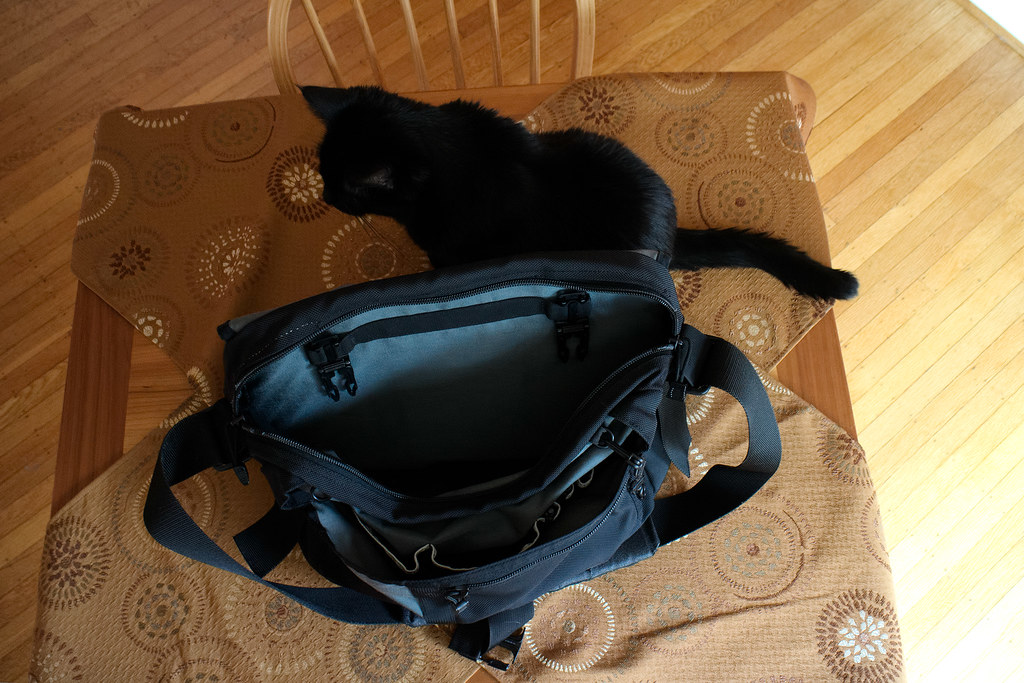
The main reason I settled on the ID as my messenger bag is that you can attach a Brain Cell inside to hold a laptop. The Brain Cell has corrugated plastic providing protection on the sides but more importantly suspends the laptop so it doesn’t touch the ground when you set the bag down. The Brain Cell itself is suspended in the ID, so my laptops have always been nicely protected even though they go out and about every day. My first Brain Cell was sized specifically for my 12″ Powerbook, but six months later I replaced it with a larger one when I upgraded to a 15″ Powerbook, and that Brain Cell has held all my laptops since.

Adaptable

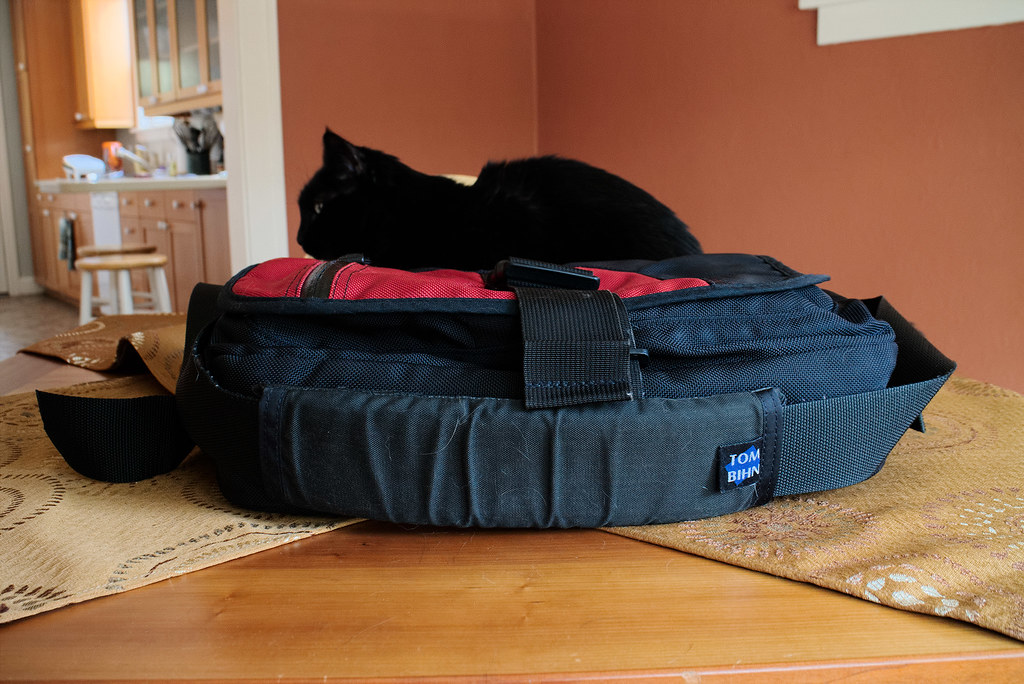
For nearly every day I’ve owned the ID, I’ve kept the Brain Cell attached in the main compartment to hold my laptop, as transporting my laptop is primarily how I use the bag. However the Brain Cell is removable as shown here, and I do use it this way occasionally to transport bulkier items. That’s our cat Emma beside the bag. She hates it when I try to take her picture but photobombs every picture she can. She’s a complicated girl, our sweet Em.

The bag has a few scars after its years of loyal service. There are a couple of scuff marks near the bottom of the bag. The thickly padded shoulder strap makes for comfortable carrying but the underside of the pad is flaking off after a decade of heavy use. But I thought the ID might be on its last legs late last year when the stitching around the rear zipper started coming apart in a few places. I rely on that zipper to pull in the corners of the laptop pocket and keep them safely under the outer flap when it rains (a feature I wish all messenger bags would adopt). Thankfully my wife was able to fix those sections but all she had was white thread, which you can see on the back left corner. I consider it a badge of honor.

The Thin Bag

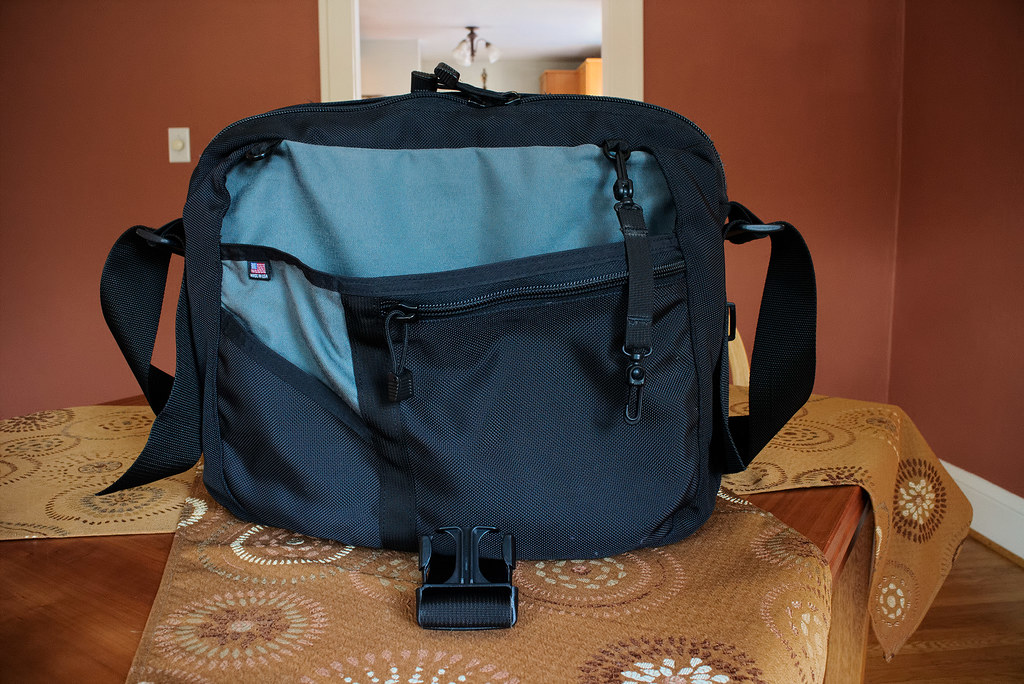
One of the things I love about the ID is the buckle & strap on the front that cinches the bag down into a thin profile when it isn’t heavily loaded, but quickly allows the bag to expand to hold coats and the like. One of the prongs on the big buckle broke a few years ago, and although it still closed securely I did replace it recently with a new one I ordered from the factory, just in case the other prong ever broke.

There are so many nice touches in the bag, I could go on and on, such as the o-rings for attaching key straps, the zippered front pocket for securing small items, the comfortable grab handle, the water-resistant zipper on the exposed pocket on the main flap. Newer bags also get an iPhone pocket, but I can’t hold it against mine for not having one, as back then there were no iPhones.

The one thing I haven’t used much is the water bottle pocket in front, it’s a little too small and short for many of my bottles, but this has been addressed in newer designs by moving the pocket outside the main body of the bag. The lines of the bag aren’t as clean but I think this is a much better place for it.

Goodies

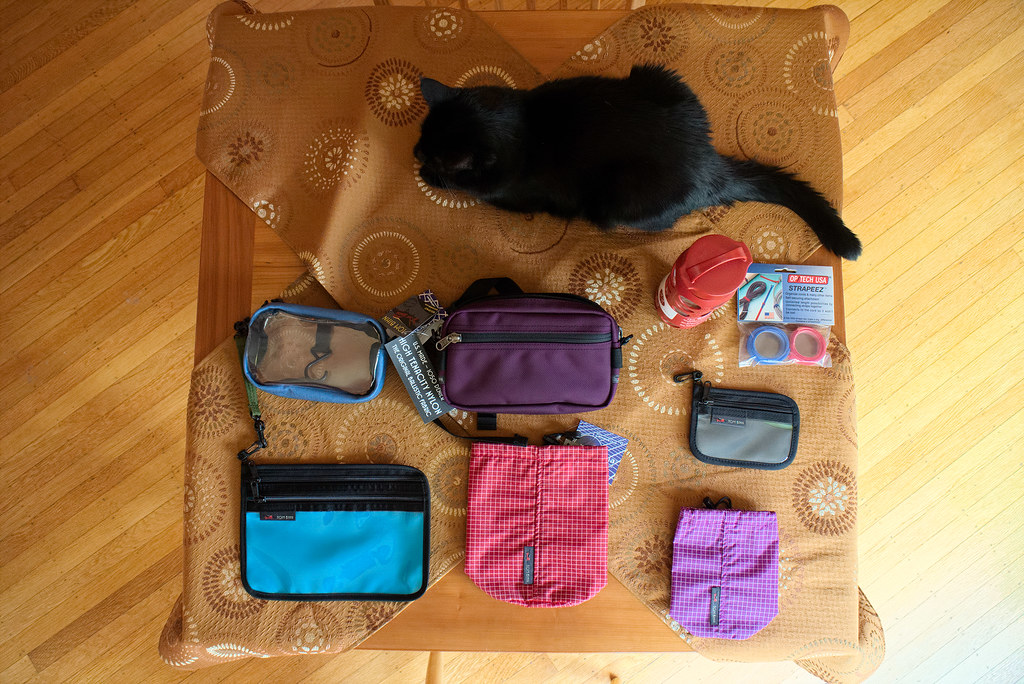
My biggest complaint is not with the bag but with me. Tom Bihn makes an assortment of small bags and organizers that clip to the o-rings inside the bag which would have come in handy for train and air travel, but I never availed myself of them. Better late than never, I recently ordered several bags (with Emma still hanging around for pictures). Going clockwise from the upper left we have a Storm 3D Clear Organizer Cube with an 8″ Olive Key Strap attached, an Aubergine/Wasabi Side Effect, a red Lifefactory 22oz glass water bottle, blue & red Op Tech Strapeez cable ties, a Forest Clear Organizer Wallet, an Ultraviolet Travel Stuff Sack (size 1), an Iberian Travel Stuff Sack (size 2), and a Turquoise Double Organizer Pouch (medium).

Tom Bihn designs and manufactures a variety of bags a bit to my north in Seattle, all with the same quality and thoughtfulness that went into the ID (I’ll soon be ordering a backpack and later a travel bag). So if you find one you like, I can’t recommend them highly enough.

They’re the best.