Blue on Blue

A close-up view of the face of a juvenile great blue heron

I laughed while editing this picture when I realized I spent more time with this young great blue heron during the winter and spring than any other being not living in my house. Alas it wasn’t true, I spent much more time with my friends at work, but true enough.

It’s rare that I get to know a particular bird, even visiting Ridgefield so consistently it is difficult to be sure a bird I see one day is the same one I saw in the same location previously. But this juvenile never strayed far from Horse and Long Lakes during the winter and spring. It was fun to see it learn the ropes, avoiding the territory of the older herons, fleeing the madness and mayhem that wandering too close to a red-winged blackbird nest brings.

Sometimes I just watched rather than take pictures, these lakes can draw a crowd as they sit at the start of the auto tour. And bringing out the big lens can attract even more attention, too much of which might cause the heron to take flight. But on this early morning in late February we were alone, the young blue heron in the soft blue light, giving me a look I had long hoped for.

A Reward Paid in Black-and-White

A pied-billed grebe starts to sink down into Long Lake at Ridgefield National Wildlife Refuge

Another reward for spending all of Mother’s Day at Ridgefield was a chance to photograph this pied-billed grebe in breeding plumage in Long Lake. These grebes are so commonly seen at Ridgefield that it’s a rare visit when I don’t spot one, but they are both small and shy and thus have generally eluded my lens. I got some nice pictures of them this winter, but on this day I got my opportunity to photograph one with a pied bill (they only have it in their breeding plumage).

And to top it off it’s doing my favorite pied-billed trait, sinking slowly into the water before diving!

There is an audio guide that goes along with the auto tour at Ridgefield, and while the audio at this point is difficult to make out it seems to me they suggest that the pied-billed name comes from the black ring on the bill resembling a pie stain (such as you might find ringing a child’s mouth after it eats a piece of pie). I’m not sure if I’m not hearing it correctly or if they are being a bit tongue-in-cheek (not that I would ever do such a thing here!), but I believe the name comes from the old English usage meaning black-and-white (as in the magpie), and which eventually came to mean multi-colored.

Thus I think the name is more Pied Piper than Purple Pieman.

On the Trail of the Boolie

Ridgefield_Annotated

My wife recently picked up car chargers for our iPhones so last weekend I used the MotionX-GPS app on the iPhone to record GPS data of my movements during a day at Ridgefield. This takes a hard toll on the battery, and since I was there for 13 hours I couldn’t have pulled it off without the charger.

What I want is to merge the data with my pictures so that I can get a visual map of where I took my pictures, an idea I first had many years ago during visits to both Ridgefield and Yellowstone. The pieces are all falling into place now although I haven’t yet learned how to tie it all together. Next I need to learn how to merge the GPS data with the pictures, then I can use Apple’s Aperture to display the locations for each picture on a map.

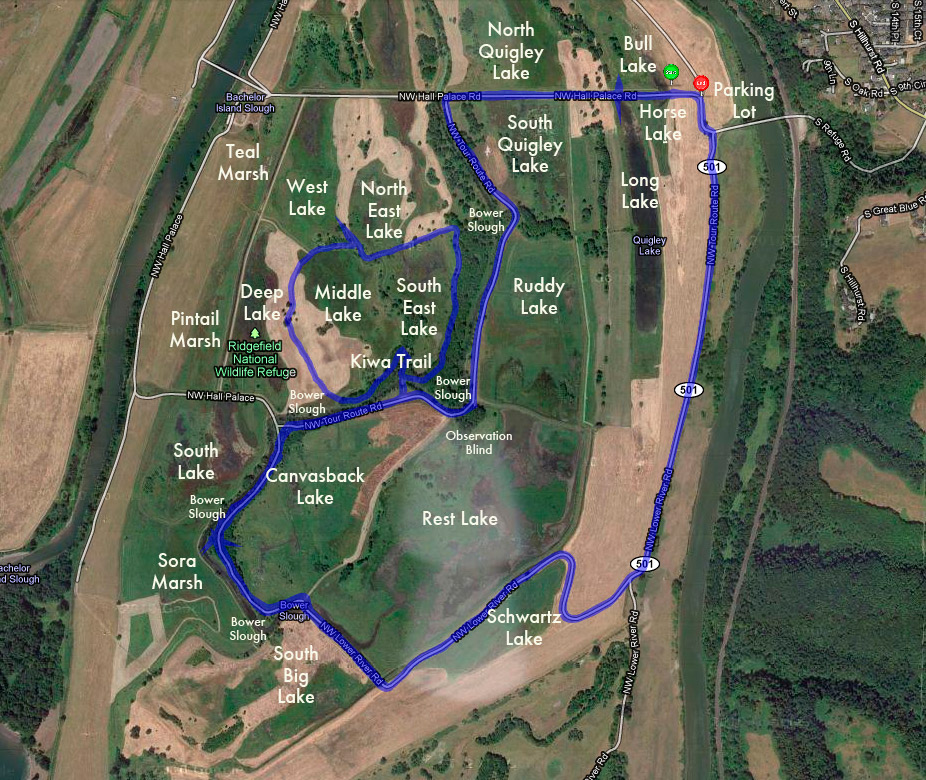
The picture above is the GPS data overlaid on a satellite image of Ridgefield and shows how I spent 13 hours on June 19, 2011. I’ve annotated it with the names of lakes and marshes at Ridgefield. I’m not exactly sure where Bower Slough starts and ends as there is a series of dikes and canals, but this is my best guess. Google Maps only labeled one lake and they got it wrong, they have Long Lake incorrectly named as Quigley Lake.

At first I was a little confused by the satellite photo as there didn’t appear to be much water visible, but this would make sense if the picture was snapped during the summer. Many of the lakes are seasonal and even during the spring the shallower lakes fill with vegetation.

The GPS trace shows two main loops with the green and red dots showing where I started and stopped the recording. The larger loop on the right is the auto tour where I spend so much of my free time, the smaller loop on the left is the Kiwa Trail, a short hiking trail that opens up during the summer. Traffic flows counter-clockwise around the auto tour, most of it is one-way but the first stretch does allow for two-way traffic.

Many of the lakes to my eye are really ponds, or even large puddles, but what does it matter? Some of my favorite places to sit and watch are some of the smallest lakes. Some like South Quigley Lake and Rest Lake were favorite spots from my very first visit, while others like Horse Lake and Long Lake took me a while to learn their rhythms and charms and only recently have become favorites.

The Wonderful Wet

IMG_1132

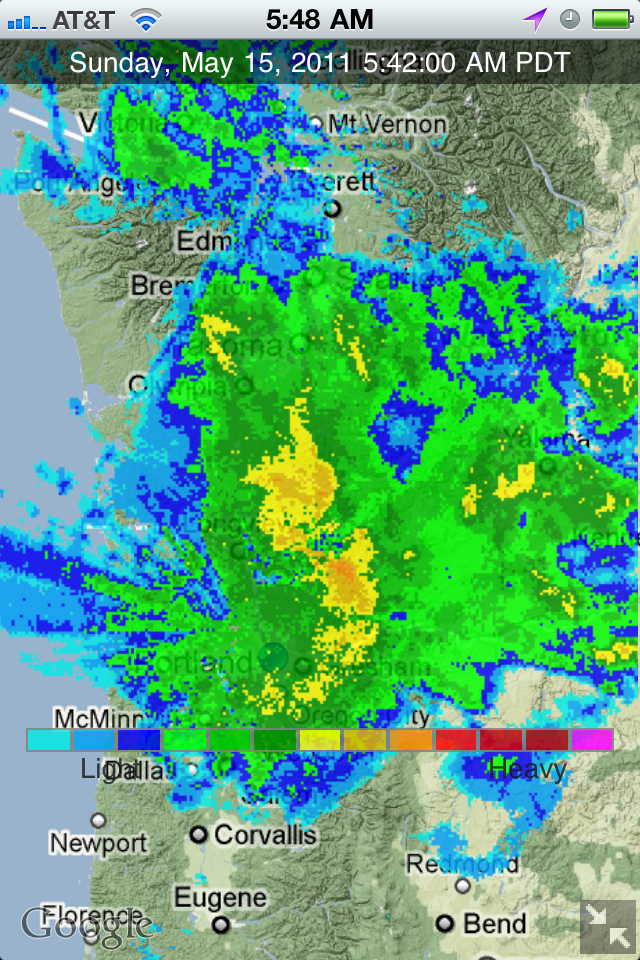
The iPhone is one of the best devices I’ve ever owned. One little thing I love is the ability to set multiple repeating alarms. I have one for 7:00 a.m. on weekdays to get me up for work, and another for 5:00 a.m. on the weekends to get me up for Ridgefield. Another thing I love is the ability to carry around weather maps in my pocket. And oh how I loved the weather map on the morning of May 15th!

I love photographing wildlife in the rain (and snow and frost and fog) and the beauty of the auto tour is I can do it from the relative warmth of a dry car seat. Not everyone shares my love for the rain of course and I didn’t see another car on the refuge for the first couple of hours. It rained much of the day and traffic on the tour was fairly low despite being in the midst of spring migration.

I kept an eye on the weather maps during the day to try to be at a favorite location when the best weather (in this case, the heaviest rain) hit. Even so, I got caught out by a sudden downpour. I had just finished driving past the lakes and started onto the large meadows at the end of the tour where there isn’t much to see at this time of year. So I couldn’t believe my luck when I saw this bittern in the tall grass of the meadow near Schwartz Lake, where I’ve not seen bitterns before, the green grass nicely showing off the pouring rain.

I stayed all day from sunrise to sunset (assuming there was a sunrise and sunset), you’ll see a number of pictures in the coming days and weeks of the Ridgefield rain.

The Wonderful Wet

Brisk!

An Eagle Drinks

Winter is a good time for viewing eagles at Ridgefield but this young bald eagle at Schwartz Lake was the only eagle I saw during my visit on January 16th. I didn’t expect to have much time for pictures when I pulled the car over as I feared the eagle would spook when the next car came past. But the steady rain kept traffic on the auto tour so low that no one else came by and since the eagle was in no hurry, I was able to watch it for quite a while. Most of the time it just stood on a submerged log, but a few times it leaned down for a drink before finally flying off to a nearby tree.

Schwartz Lake (like most lakes at Ridgefield) is quite small and shallow since it is really just a flooded field. The water levels of many of the lakes are managed to mimic the floodplains of the Columbia before the dams were built, flooding during the winter and drying out by summer.

An Eagle Splashes

The Start of the Year

An American bittern brings a terrified vole from the grasses down to the water's edge to dunk it before swallowing it, but the water was frozen. Taken at Rest Lake at Ridgefield National Wildlife Refuge in Ridgefield, Washington on January 1, 2011. Original: _MG_2172.cr2

Although I failed in my quest to find a bittern in the frost on the last day of 2010, the first day of 2011 rewarded me with a bittern on the ice — a hunting bittern on the ice. The day started out promising when I glimpsed a blacktail buck on the drive down through the canyon and onto the refuge at Ridgefield, but after putting on a show the day before the rest of the animals seemed to be sleeping in. While the early hours weren’t crowded, as the morning wore on the visitors picked up rapidly and the big lens attracted a small crowd whenever I stopped.

On the far side of the refuge, I like to drive slowly along Rest Lake to look for bitterns, so I pulled over to let an approaching car past so that I could move at my own pace. Even as I was pulling over I noticed this bittern down below in the frozen channel and settled in to watch. Within moments the bittern struck into the grass and brought out this terrified vole. Bitterns often like to dunk their prey in the water and so it gingerly stepped down the rim of ice, struggling not to slip, and then dunked the vole into the water. Or tried to at least, but failed, since the water in this section was still frozen. It seemed mystified for a moment and stood motionless before eating its meal undunked.

After taking a few environmental portraits of the bittern on the ice, I moved ahead just slightly to another nice location and waited for the bittern to come past. But a Land Rover came up behind me and the couple got out of their car (a no-no on the auto tour during the winter) to set up their scope to view the distant ducks and swans. Not surprisingly I didn’t see the bittern again.

When I got to the end of the auto tour, I was going to go around again but my heart sank when I saw a nearly solid line of cars between Horse and South Quigley Lakes. I learned my lesson from Christmas day, when I should have left when it got over-crowded but didn’t, and headed home. Ellie got an extra walk and playtime in the park, and extra hedgehogging as well, so all-in-all a fantastic start to the year for everyone but the vole.

An American bittern tries to dunk a terrified vole through the ice at Rest Lake at Ridgefield National Wildlife Refuge in Ridgefield, Washington on January 1, 2011. Original: _MG_2182.cr2

Pride Goes Before Two Falls

A close-up view of an eastern cottontail near the auto tour at Ridgefield National Wildlife Refuge

Pride goes before destruction, a haughty spirit before a fall.
Proverbs 16:18

A while back my teleconverter started overexposing everything by a stop, so I had to remember to deliberately underexpose to prevent from blowing out the image, something I often forgot to do. Being a night owl, I was particularly pleased with myself when I arrived near sunrise at Ridgefield and, when photographing this cottontail beside the auto tour, actually remembered to dial in the underexposure. A few moments later I got my comeuppance. As I watched a muskrat swimming with its child, I realized that while I had remembered to compensate for my faulty teleconverter, I wasn’t actually using it so all I ended up doing was needlessly underexposing my images.

On a later visit I realized the converter was flaring badly under strong backlighting and ruined some images. Strike two.But the coup de grâce was yet to come. While hiking along the auto tour, I watched helplessly as the camera separated from the lens and fell six feet to the muddy ground. On closer inspection it was the converter that had separated from the lens but I didn’t think much of it, I assumed I had accidentally bumped the release latch.

But it happened again a few minutes later, this time the camera clanged off the hard-packed dirt road hard enough that the batteries went flying from the flash. I suspect the teleconverter worked itself free just with the jostling motion of hiking. While the camera appears to have survived both falls with no damage save some scratches, I knew it was time to replace my old friend.

This Tamron teleconverter and my Tamrac bag are my oldest pieces of photography gear, I bought them in the early days so they’re almost 15 years old and have literally been along for every hike I’ve gone on during that time. The bag wears the crown alone from now on.

So long, old friend, and thanks for the memories.