
One of the podcasts I listen to, Enough by Patrick Rhone and Myke Hurley, has been asking their guests what applications they would install if they had to get by with a MacBook Air (and its 64 GB of storage) as their main computer. After listening to the their choices I took a look at my own and a couple of small things surprised me.
The first was that when I looked at my list of installed applications I didn’t have as many third party applications as I expected. This is partly because I’ve used a laptop as my main computer for many years, and up until the latest was always hard pressed for hard disk space, but it’s partly a conscious choice. Since switching to the Mac years ago I’ve used Apple’s applications by default and only look elsewhere when I find them confining.
The second was that I looked at each application in my dock and thought about how often I use these apps today to make sure they still make sense to be there. As a result I ended up taking Photoshop out of the dock, marking the first time since I got into photography it hasn’t owned a prime location in the dock or Windows task bar.
The Workflow
Here’s a rough list of my workflow moving pictures from field-to-web, and the tools I’m currently using at each step:
- Take notes in the field (Moleskine and uni-ball)
- Download pictures from memory card to computer (Photo Mechanic)
- Backup up the hard drive (SuperDuper!)
- Make a first pass at choosing which pictures will be edited or rejected (Photo Mechanic)
- Make a final pass at choosing which pictures will be edited or rejected (Aperture)
- Edit the pictures (Aperture)
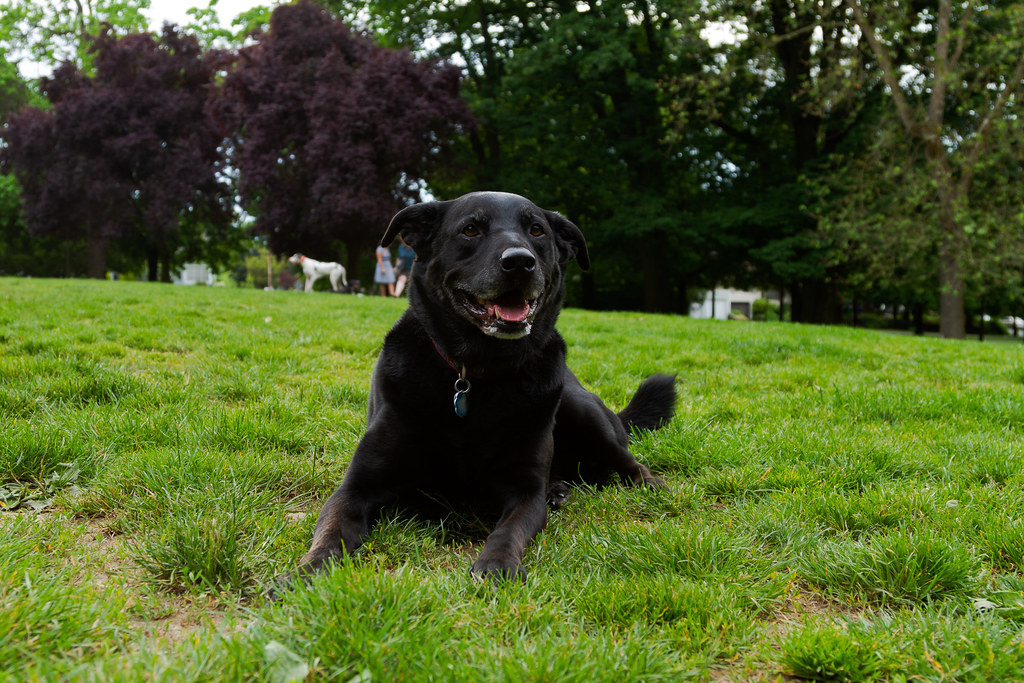
- Hedgehogging (Ellie) and belly rubs (Scout, Emma, Sam)
- Goof around (Safari, NetNewsWire Lite, iTunes)
- Resize to create web and thumbnail versions (Photoshop)
- Upload the web and thumbnail versions (Photo Mechanic and Transmit)
- Update the website (BBEdit) or blog (MarsEdit)
The Moleskine & the uni-balls
I’ll start with the new pens and paper I purchased for taking notes while taking pictures before moving on to the software. The uni-ball pens use gel ink and write much more smoothly and consistently than my old pens. So far I prefer using the finer Signo RT Gel (0.38mm point) for writing in the Moleskine and the wider Signo 207 Gel (0.5mm point) for general use.
The large red Moleskine notebook is beautifully crafted to the point I was a little concerned I wouldn’t risk exposing it to the same weather conditions as the previous cheap notebook. But it poured rain my second day out with it and even in the car I knew I couldn’t keep it from getting a little wet, so I was happy to see I was as willing to let the new gear suffer the slings and arrows of rainy fortune as the old.
I would like to try some Field Notes notebooks before my next big hiking trip, they are much smaller and thinner and better suited to long day hikes, but not as well suited to my days at Ridgefield.
OS X Lion
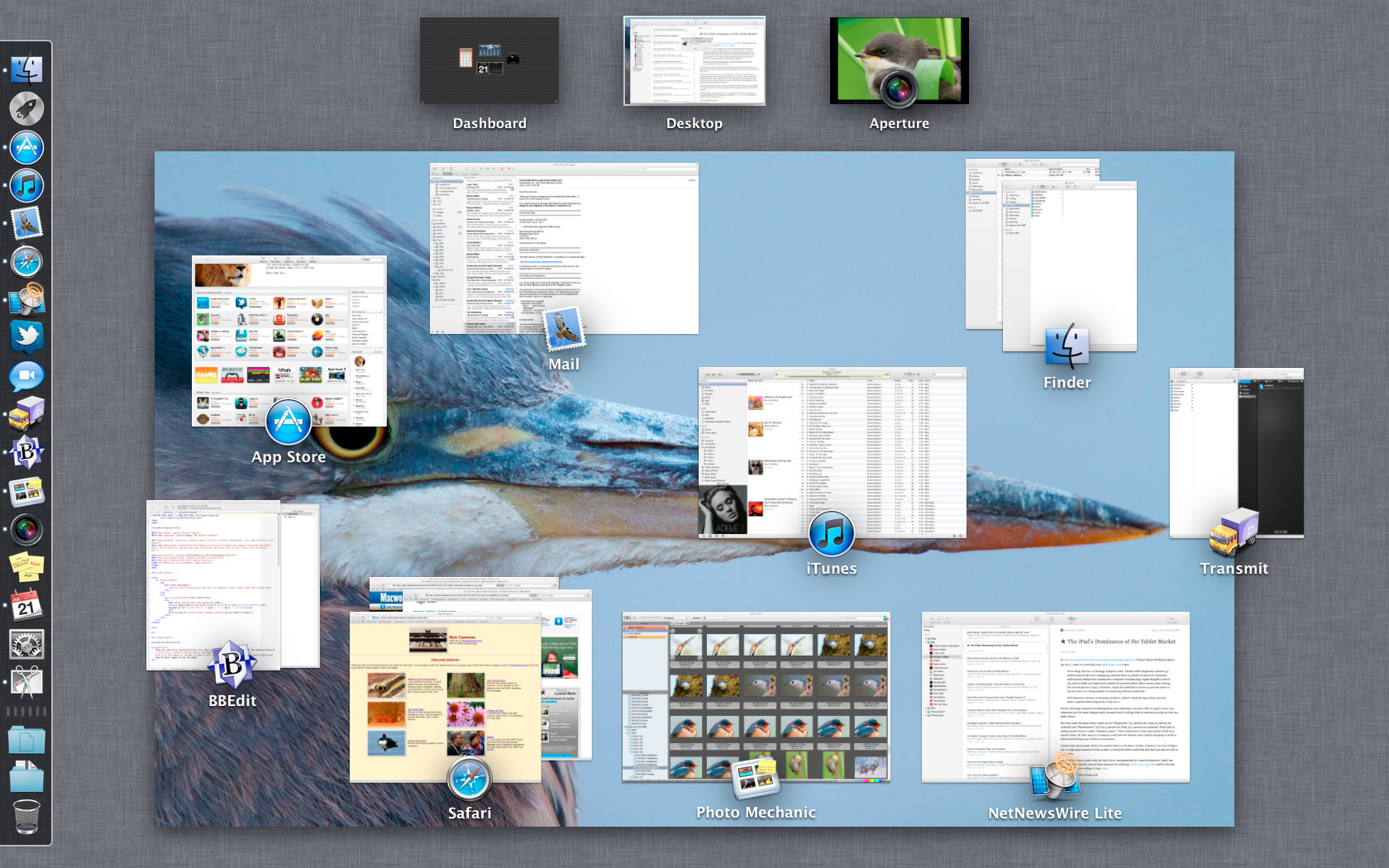
I discussed upgrading to Lion a bit in the previous post, but I’ll mention it again as the screenshot shows the new Mission Control feature, where you can see little snapshots of many of the tools I’ll discuss. Plus a few sneak peaks of pictures that will be coming online soon (starting with my current desktop picture of a young heron I watched throughout the winter and spring).
Mac App Store
One of my favorite applications on the Mac is the Mac App Store itself. When I upgraded laptops four months ago, I decided to do a clean install for once. All I had to do was enter my Apple ID and Aperture and all the other apps I bought at the App Store installed like magic. Simple. Beautiful.
Contrast that with installing Photoshop.
After finding the install disc and letting it run, it asked for a serial number, which in and of itself isn’t too bad as its on the disk case, but does get tiresome when you have to do it for app after app. But then because I was doing a clean install and didn’t have Photoshop already on my system, and since my CS5 version is an upgrade version, it also wanted a serial number from an earlier version.
Oh corks!
I had forgotten about this step as I usually don’t do a clean install of the OS. With a brief bit of panic I started searching to see if I still had one of the older DVD’s around. I’ve upgraded Photoshop through many versions over the years and used to keep all of the boxes lined up in my bookcase, but in a rare bit of office cleaning I got rid of most of them. Fortunately I didn’t throw out the previous versions discs and was able to enter its serial number as well. I’m sure a phone call to Adobe would have sorted it out soon enough if I had lost the older serial number, but it illustrates why I now buy all my software through the App Store when possible.
Photo Mechanic
I’ve used Photo Mechanic for the past five years to download my images from a card reader and quickly sort out the rejects from the keepers. I’ve been looking to move away from Photo Mechanic as its target audience is photo journalists and I don’t need any of that functionality, but while Aperture does have the ability to download pictures and compare them, so far I’m still much better and faster at doing this in Photo Mechanic.
I’ve also come to use it as my general purpose image viewer so I nearly always have Photo Mechanic fired up for one use or another.
Aperture
I’ve written before about how I fell backwards into using Aperture, the photo processing program from Apple. I’m still learning the ropes but getting more comfortable with it, using multiple libraries is rather clumsy but otherwise there is a lot to like. I especially like the way it handles RAW images from my Canon 7D and how easily it works when I hook up my laptop to my external display.
There’s a sneak peak of an upcoming picture in the Aperture icon on the screenshot above (it’s up near the top since it is running in full-screen mode), I still have a lot of sorting and editing to do before this picture comes online, but the little tree swallow was one of my favorite (and most anxious) encounters.
My biggest worry with Aperture is Apple’s long-term commitment to it, it’s not central to their business which gives me pause, but for now I love the way it handles my 7D’s files so it is my photo app of choice.
Photoshop CS5
I took Photoshop out of my dock a week or so ago with a heavy dose of nostalgic regret. I started using Photoshop 4.0 back in college and it has occupied a prized spot in my Windows task bar or Mac dock ever since. But since I switched to Aperture for my photo processing, I primarily only use Photoshop for resizing images for the web, and I since I send the files directly from Aperture there isn’t a need for it in my dock anymore.
I do use Photoshop for other things at times, but it is a professional application with a professional price so now that I’m not relying on Camera Raw for my photo processing, I’m not sure if I’ll keep upgrading it or not. It’s a little similar to what will happen when we upgrade the Civic: I’ve driven a stick shift since I bought my first car in college, but on the next car I’d prefer a continuously-variable transmission instead.
Time marches on, needs and desires change, and thus sometimes my tools must too.
BBEdit
Something that hasn’t changed much, to my discredit, is my main site at racphoto.com which still revels in its mid-90’s look. I’ve hand coded it since the beginning and since my knowledge of web design hasn’t evolved much since then, neither has the site. Another thing that hasn’t changed is the program I use for writing the HTML code, BBEdit from Bare Bones Software. I started using it back when I first got my Mac and have used it ever since.
I would like to upgrade the look and functionality of my site at some point but the driver will probably be when I get an iPad, as navigating the site with fingers isn’t so easy. I’ll need to decide then whether to keep writing it myself or go with a pre-made site like Squarespace, or perhaps even WordPress. But for now, HTML and BBEdit it is.
Safari
Safari didn’t exist back when I switched to the Mac but it’s been my primary browser from the day that it did. I keep Google’s Chrome browser on my system since I don’t have Flash installed on my computer, so I use Chrome’s built-in Flash for the rare times I need it (primarily Amazon’s music and video services). I keep Firefox installed too, mostly for testing purposes.
Safari is even better in Lion so it remains my browser of choice.
Transmit
When it’s time to upload images for the blog or website I drag them from Photo Mechanic into one of my all-time favorite programs, Transmit, from Portland-based Panic. Back when I thought I was going to be leaving the Mac, one of the reasons I decided to keep using my MacBook for everything but photo processing was Transmit. On the one hand it makes no sense to not want to abandon a platform because of an FTP program, even one as nice as Transmit, but part of it is that they seem to be a great little company and I’m happy to support them. And part of it is well-designed apps like this just make my computing experience simpler, and more enjoyable.
And that’s enough.
I’ve been using Transmit since 2004, I had been on the Mac for a little while at that point and was using a freeware FTP program that I wasn’t very happy with. Then someone recommended Transmit, I downloaded the trial, and I think I set the record for the fastest time I’ve gone from trying out some software to deciding to buy it. I upgrade every time a new version comes out without even thinking about it, it’s always worth it.
NetNewsWire Lite
I can be a bit scatter-brained so I rely on automatic feeds to tell me when my favorite sites get updated, and I’ve always used NetNewsWire for this task. When the new Lite version popped up on the App Store, it replaced the older but more full-featured version I had been using.
Another one of those programs that makes me happy to be on the Mac, great software from great developers.
DoublePane
You can’t see this from the screenshot, but I recently got DoublePane from the App Store and I love it. It does something I think you can do in Windows 7 by default, which is to use keyboard shortcuts to snap a window to the left or right half of the screen. Just the thing when I’m ready to upload images, I can snap Photo Mechanic to the left half of the display, Transmit to the right, then drag images from one to the other. Then with another keyboard shortcut, Photo Mechanic is back at full size.
A fantastic little time saver and highly recommended if you need to use windows side-by-side.
SuperDuper!
Also not visible in the screenshot above is SuperDuper! from Shirt Pocket. I use it daily to create a bootable clone of my laptop’s hard disk onto an external disk, as well as special situations like before I upgraded to Lion. I haven’t tried Time Machine yet, which serves a similar but different purpose, but SuperDuper has given me peace of mind for if and when my laptop hard drive falters.
Another great piece of software from a long-time developer on the Mac. There’s a theme here.
Mail
I’m not a power user of mail apps, I used Outlook Express when I was on the PC and have used Apple’s Mail ever since I switched. It got a major upgrade with the Lion release and I’m still finding my way around it, but I like what I’ve seen so far.
iTunes
Not specifically related to photography but iTunes so completely transformed the way I listen to music (for the better) that I couldn’t help giving it a plug. It tries to do too much these days but when it comes to music, I love it and use it constantly when I’m listening to music or podcasts as I edit my pictures or write my posts.
MarsEdit
MarsEdit also isn’t in the screenshot but that’s because I was evaluating it while writing this post. It’s an offline editor for blog posts, and it made writing this post so much so easier than the web browser version provided by WordPress that I bought it from the Mac App Store before finishing this post.
And with that, I’m finishing this post.






 Boolie