Objects In Camera Are Further Than They Appear

A close-up of the head and neck of a western diamondback rattlesnake on the Latigo Trail in McDowell Sonoran Preserve in Scottsdale, Arizona on June 2, 2024. Original: _A674804.ARW

While waiting for the diamondback to fully leave the trail, I took a water break and continued on. I was surprised to see it was still there on the other side of the bush and even more surprised by what was blocking its path. There are many creatures that will kill and eat a rattlesnake but I don’t think the desert cottontail is on that list. The rabbit had hopped across the trail while I was waiting, I was a little surprised since it clearly saw me and it must have seen the snake.

I took some quick pictures, zoomed all the way in on the snake, all the way out on the rabbit. I continued up the trail as I felt I was too close to not impact the outcome of the standoff, whatever it may be (I don’t think the snake was interested in the rabbit). When I passed back by, the only sign of the brief encounter was the thin strip in the sand where the snake first crossed the trail.

📷: Sony A6700 | Sony 100-400mm | Sony 1.4X
🗓️: June 2, 2024

A desert cottontail leans forward with ears at full attention as it watches a rattlesnake (not in the picture) on the Latigo Trail in McDowell Sonoran Preserve in Scottsdale, Arizona on June 2, 2024. Original: _A674804.ARW

Little Baby Bunny

A desert cottontail bunny hides under a bush and behind a rock on the Powerline Road No. 2 in McDowell Sonoran Preserve in Scottsdale, Arizona on April 15, 2023. Original: _RAC4398.ARW

Back in April Bear and I came across this tiny desert cottontail hiding in the middle of the trail. I happened to have my telephoto zoom that day which was fortunate, even though Bear wasn’t showing any interest I was able to keep my distance and grab a quick picture and continue on our way. I almost walked right by except I caught a glimpse of the eyes, staying well hidden is a good skill since there’s a pretty long list of predators in the desert that would eat the tiny thing.

In the Wash

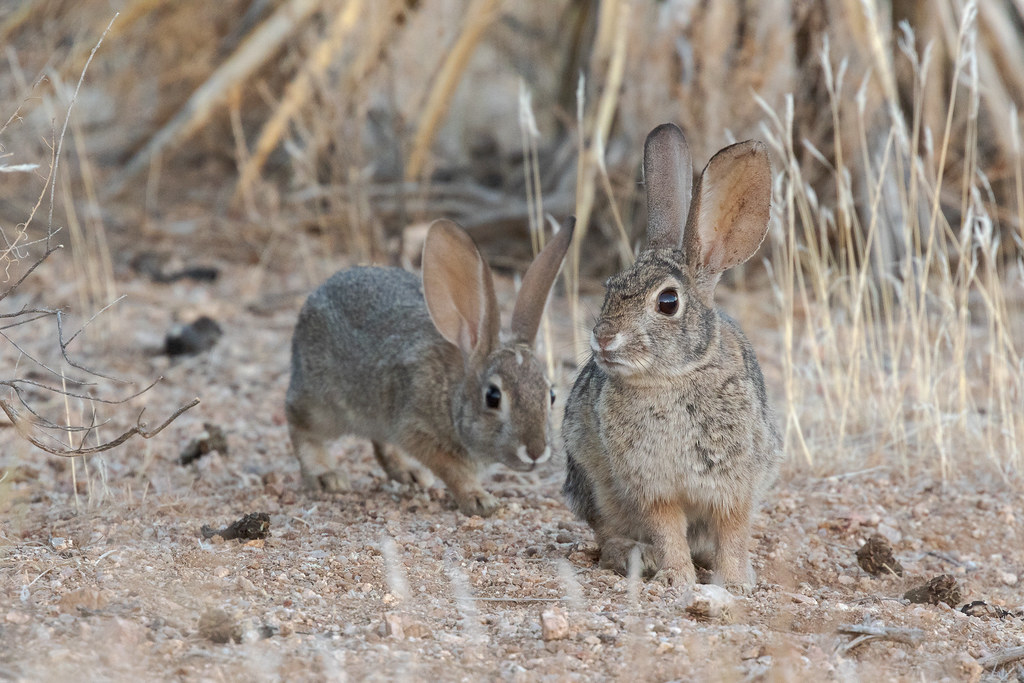
An environmental portrait of a desert cottontail sitting in Apache Wash in Phoenix Sonoran Preserve in Phoenix, Arizona

Most of the desert washes I cross when I hike are fairly small but not so Apache Wash, there are signs as you approach warning you not to enter when flooded and the large debris scattered around tells you why. It was damp on the morning I crossed on my first visit to Phoenix Sonoran Preserve but the rains and thus the danger had long since passed the day before, so I and a pair of desert cottontails enjoyed the quiet before the sun came up.

An close-up portrait of a desert cottontail sitting in Apache Wash in Phoenix Sonoran Preserve in Phoenix, Arizona

Safe in the Arms of the Cholla

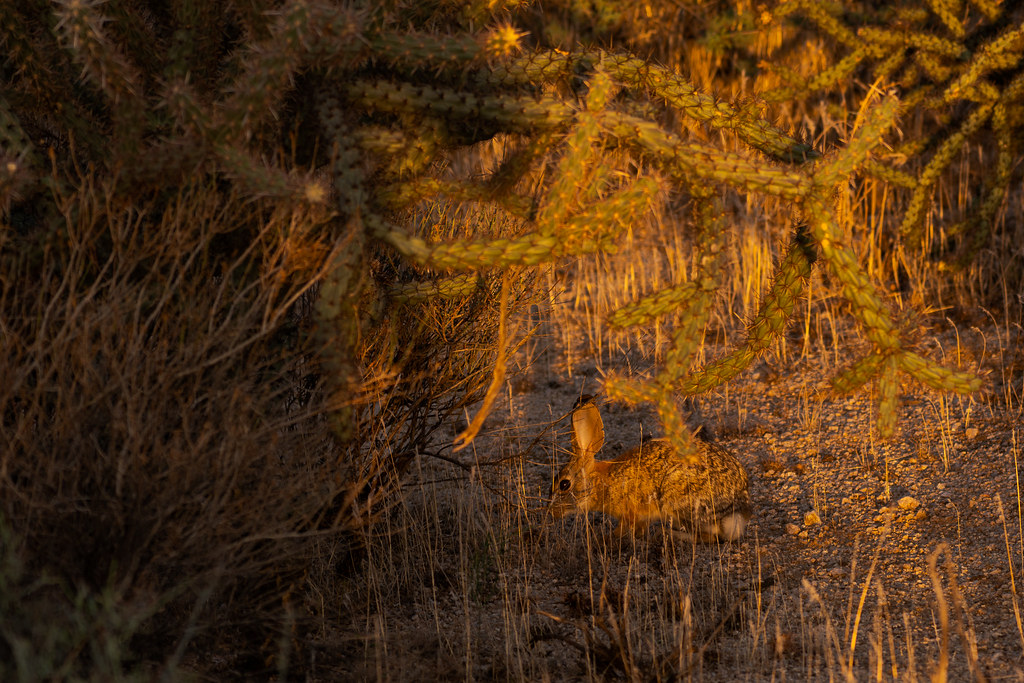
A desert cottontail nibbles grasses at sunrise near a buckhorn cholla along the Chuckwagon Trail in McDowell Sonoran Preserve in Scottsdale, Arizona

The rising sun, so easily blocked by hills and saguaros and even myself, does what I cannot, slip through the outstretched arms of a buckhorn cholla to embrace a cottontail as it feeds beside the Chuckwagon Trail. It is mine but to observe, to record, to be grateful.

Spirits

A black-tailed jackrabbit is visible through the desert scrub at the trailhead to Brown's Ranch in McDowell Sonoran Preserve

I am amazed how effortlessly and silently mammals move through their home while I stumble down the trail. The jackrabbits seem like spirits floating through the desert, I often first notice the black tips of their tall ears moving while the rabbit itself is blocked from sight by the many plants of the scrubland. This lovely creature I found not on the trails but at the trailhead of Brown’s Ranch, we shared a quiet moment before sunup.

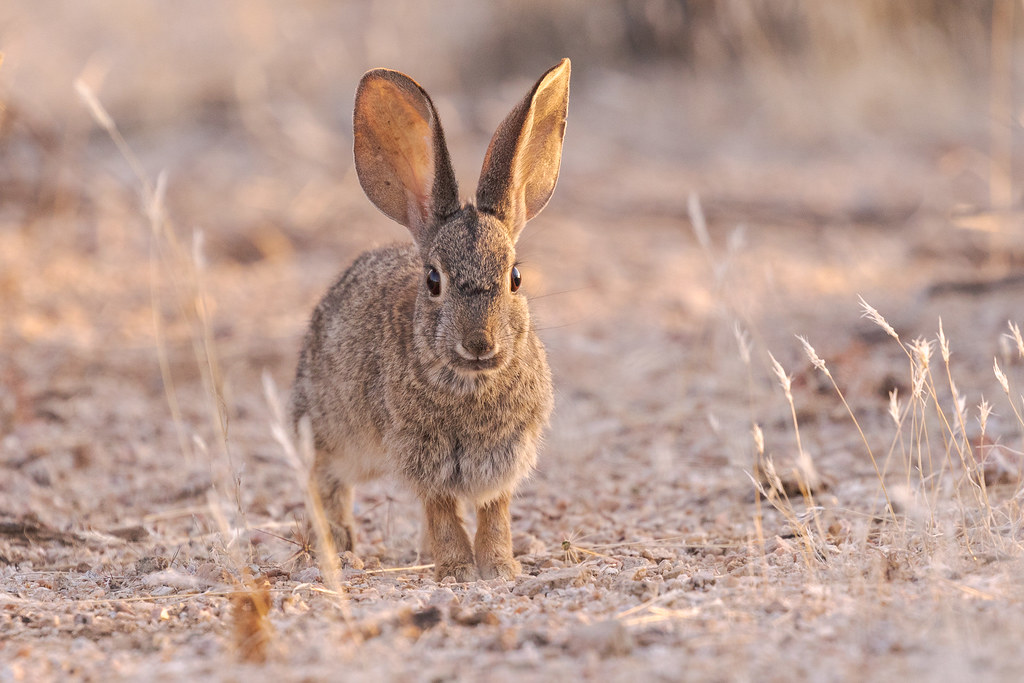
The rabbit you are most likely to see at the trailhead, and on the trail, is the desert cottontail (below). They too move silently through the desert but are so much smaller than the jackrabbits that you see them when you see them, there are no tall black tips dancing in the early light to catch your eye. Like all the mammals your best bet to see them is to arrive early, here also at the trailhead but just as the sun began peeking through to send one of us onto the trails and one to bed.

Walking in the Sonoran Desert at sunrise, seeing the desert both wake up and go to sleep, is a joy and a treasure even to this lifelong night owl.

A desert cottontail looks straight at me as it is partially lit by the rising sun at the trailhead to Brown's Ranch in McDowell Sonoran Preserve

Soft Browns

A desert cottontail eats dried grasses in the soft light before the sun was up on a warm spring morning in the Brown's Ranch section of McDowell Sonoran Preserve in Scottsdale, Arizona

A desert cottontail eats dried grasses in the soft light before the sun was up on a warm spring morning. I was back on the trails this morning after taking a couple of weeks off to let a sore left knee heal and didn’t see a single cottontail (or jackrabbit), most of the time I see at least one if not a handful so either today I was unlucky or perhaps they are not as visible in the summer. I meant to go hiking yesterday but forgot to set my alarm so I walked the pup instead, Ellie and I saw four cottontails on a short walk in the neighborhood.

Sniffing the Saguaro

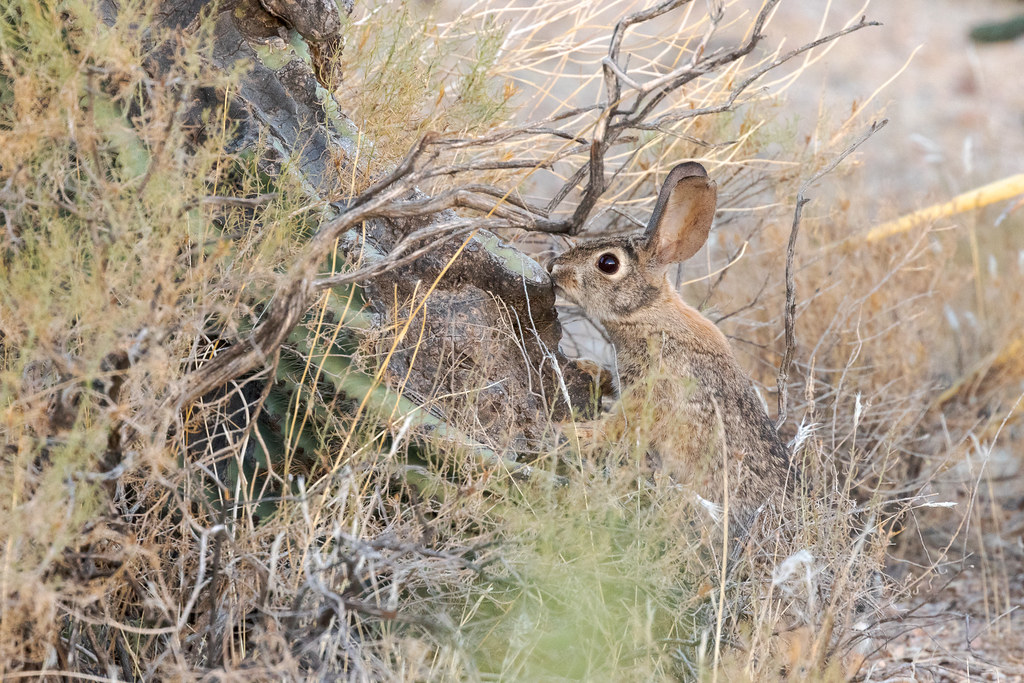
A desert cottontail sniffs the base of an old saguaro in McDowell Sonoran Preserve

This cottontail kept sniffing the base of the old saguaro and hopping up where there were no spines, hopping down, and sniffing some more. Cottontails are the mammal I see most frequently both in the desert and in our neighborhood. Fortunately our dog Ellie pays them no mind, she’s never cared about wildlife even in her younger years. Although we still see them on our walks it’s been a week or two since one has been in our backyard, is there a number I can call to complain about this?