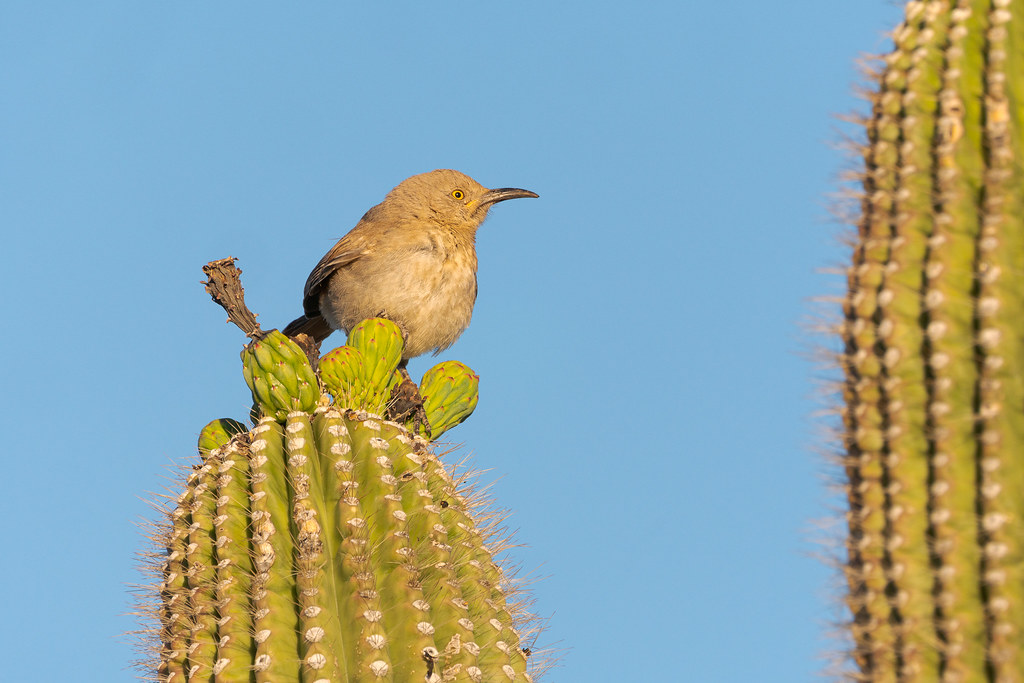
This curve-billed thrasher flew in while I was watching some woodpeckers. Thrashers are a yard bird for me, one is eating just a few feet away now, but this one I met on the Latigo Trail.
Tag: McDowell Sonoran Preserve
Flowers for Breakfast
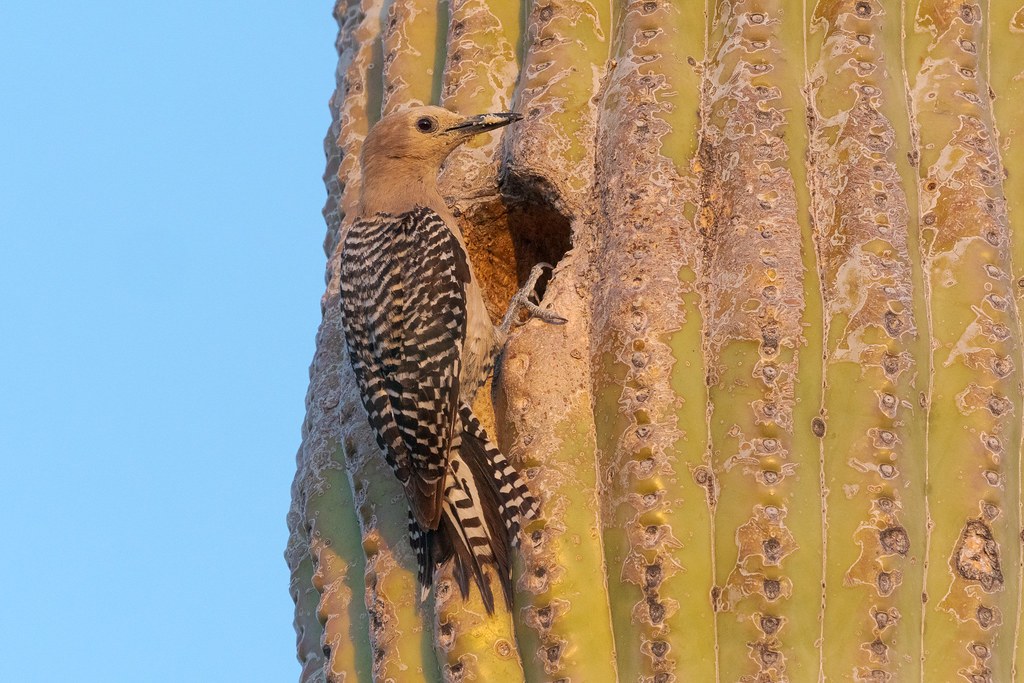
A female Gila woodpecker perches beside her nest with a beak stuffed not only with what might be a bee but stamens from saguaro blossoms, illuminated by soft light as the sun just starts to break over the mountains. The stamens produce the pollen that is covering her face. I knew they fed their young insects and spiders but it appeared they were feeding them the stamens too, as not only did they leave the nest with beaks empty but sometimes it appeared as their beaks were full of nothing but stamens.
The White Rump
I frequently see both gilded flickers and Gila woodpeckers flying through the desert, the easiest way I distinguish the two woodpeckers in flight is to look for where the white is, flickers with their white rumps and Gilas with their white wing patches. With a closer look you can see not only his glorious red mustache but also a hint of the yellow ‘gilding’ under his wings that gives these birds their names. This lovely fellow perching on an ocotillo was feeding one of his hungry and noisy youngsters beside the Latigo Trail in the Pima Dynamite area of McDowell Sonoran Preserve. I hung back as they moved up the trail ahead of me as I didn’t want the young one to miss a meal.
Prickly, Lovely
I’m still early in my learning what plants grow in the Sonoran Desert, even after having lived here a year I’m mostly in the “I think that’s a tree” stage of identification. Keep that in mind when I say I think this lovely if prickly plant is a Southwestern prickly poppy. I appreciated how it so thoughtfully bloomed that I could show both the beauty in its flower and the abundance of prickles everywhere else. I recently picked up a guide to the wildflowers of McDowell Sonoran Preserve by Marianne Skov Jensen (@ezpixels on Instagram), they sell it (and the overall field guide which I also bought) at some of the trailheads on the weekends. It will greatly speed up my learning process, it’s extensively photographed and was clearly a labor of love.
The second shot below is similar but with shallower depth of field, it emphasizes the flower more but it doesn’t show as well how the plant is covered in prickles.
Explosion
The shape of the branches of this blooming palo verde made it seem to me as though it was literally exploding with color. I had to hoof it out there to arrive as the sun was about to clear the slopes of Cone Mountain behind me, I only had a brief moment for pictures as immediately after this shot clouds obscured the sun and the light was gone.
My Liege
Shut-eye
Blooming Buckhorn, Tasty Trees
The buckhorn cholla were in full bloom in mid-May and this family of mule deer took full advantage of the soft treats. While other animals will also eat the flowers the deer have a height advantage so they can reach flowers the others can’t. The deer also fed on palo verde flowers, the trees blooming alongside both the cholla and soaptree yucca.
The Tipping Point
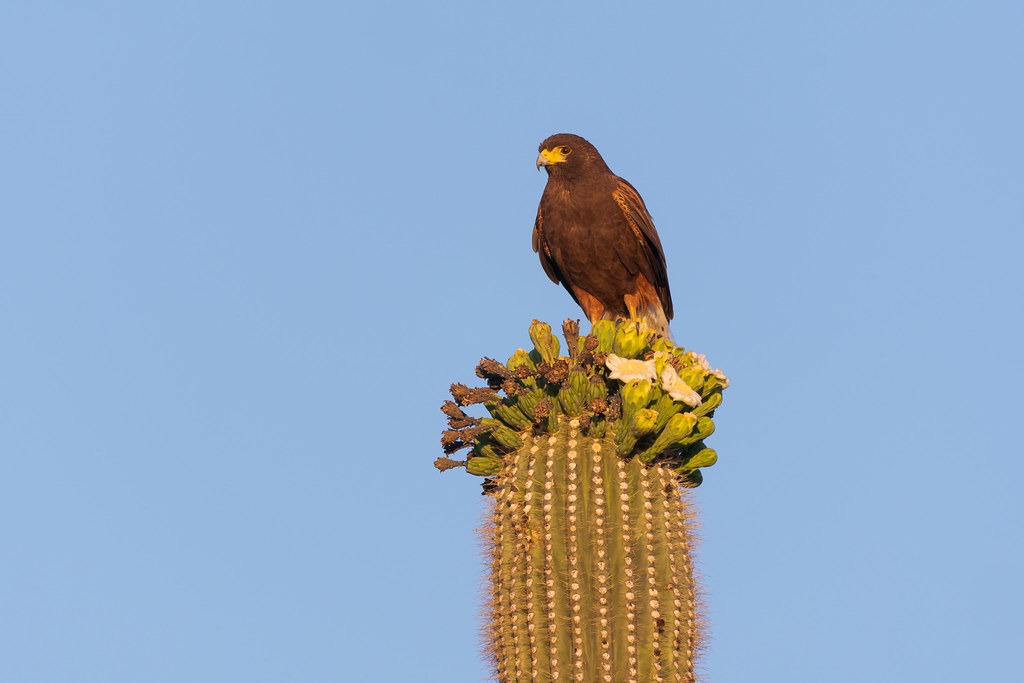
A Harris’s hawk calls out as the rising sun begins to tip over the distant mountains, partially illuminating the desert with its soft light. From this angle and in this light you can barely see the distinctive chestnut patches on its shoulders and legs, but you can get a glimpse of the large white patch at the base of the tail and the white band at the tip.
After it flew off I continued up the trail, and when I rounded a corner five minutes later the hawk and I met again (I assume it’s the same one, it would be easier if they wore name tags). The rising sun having fully cleared the mountains and the hawk completely lit in the morning light, you can better see the distinctive chestnut patches. This is the same saguaro (and maybe the same hawk) I photographed shortly before sunrise a week prior.
I Have the High Ground
A male brown-headed cowbird was singing atop an old saguaro when it flared out its wings and then arched its back and pointed its head into the air. The reason soon became clear as another beak came into view, followed by the rest of the head. A second male had flown onto the opposite side and was inching its way up from below. It flew off pretty quickly and the original male gave chase.