Dove Tales

A white-winged dove perches in a tree near sunset

I’ve taken many pictures of white-winged doves out on the trails but this one is from our backyard as the sun sank low in the sky. If I could only see them one place my preference would be to see them in the wild, but I’m thankful I get to see them at home as well. We get four dove species in our yard (five if you include pigeons), not just white-wings but mourning doves, Eurasian collared-doves (a pair), and on rare occasion a single Inca dove. Seeing them together I can get a feel for their different sizes, as well as see the young after they’ve fledged (none nest in our yard). Mostly though I just enjoy seeing and listening to them every day.

We are not the only ones mesmerized by the doves. All three cats are currently watching out the sliding glass door into the backyard. Trixie in particular loves watching them, a mourning dove has been brave enough to come close to the house and Trixie starts chirping like Emma used to, her tail whipping back and forth furiously. I wish Emma had lived long enough to make it to Arizona with us, she was our most devoted bird-watcher.

Look How Far the Light Came

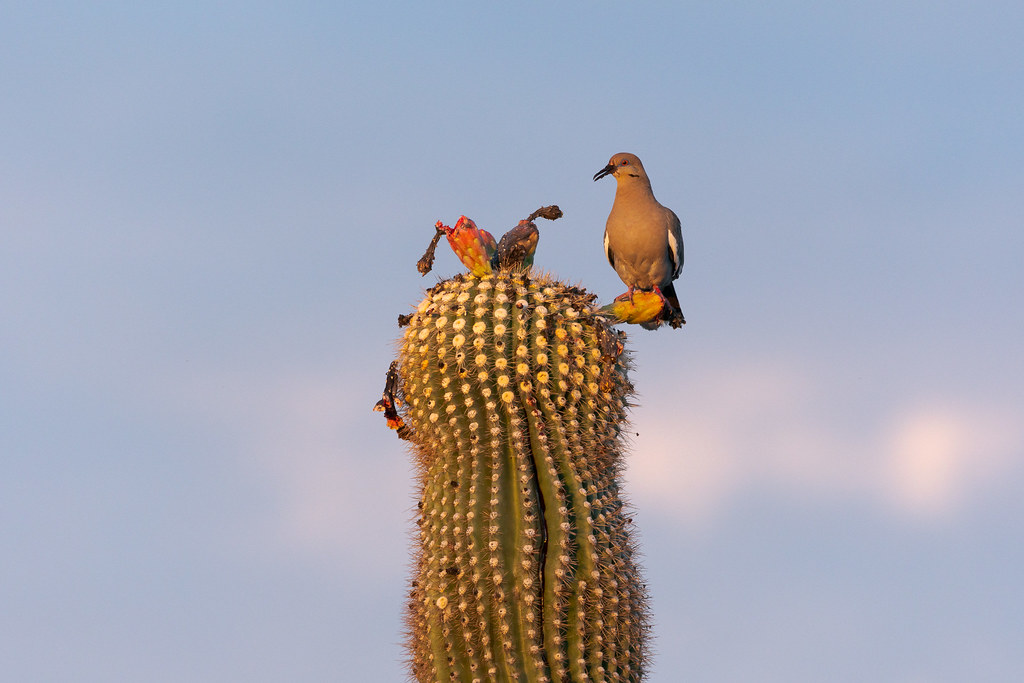
A white-winged dove straddles two pieces of fruit on a saguaro cactus on the Latigo Trail in McDowell Sonoran Preserve in Scottsdale, Arizona

Look how far the light came
To paint you
This way
Bruce Cockburn “Look How Far”

It was 5:30 a.m. on July 4th as I walked along the Latigo Trail, most of the desert still in darkness. I stopped when the rising sun fell upon this tall saguaro and the white-winged dove feeding on its fruit. Minutes later the clouds in the east obscured the sun and its rays no longer fell upon the clouds in the west nor the cactus before me, save for the tip top where the dove stood. A moment later all was in shadow. I was struck by how much had to occur for me to be standing there, to catch the light that traveled many millions of miles in mere minutes, to behold its beauty and bear witness to its passing.

Red, White, and Blue

A white-winged dove, its face covered in the red juice of saguaro fruit, perches atop a saguaro illuminated by the rising sun by the Latigo Trail in McDowell Sonoran Preserve

I spent the morning of the 4th of July amidst a double splendor of red, white, and blue. The rays of the rising sun illuminated the top of the cactus amidst blue skies, white clouds, and the ripened red fruit of the saguaro. Eating that fruit was a white-winged dove, with the white wing patches for which it is named, a blue eye ring, and red eyes. And on this morning, as with all the other doves since the fruit ripened, a face covered with the red juice and pulp of the saguaro’s fruit, as they stick their entire heads in to get every last bit of this short-lived bounty of food.

Rock Climbing

A Harris's antelope squirrel stands up as it looks out from a rock in McDowell Sonoran Preserve in Scottsdale, Arizona

I love this little spot on the Vaquero Trail. I first started stopping here to look for the Harris’s antelope squirrels that use the rocks as a lookout, replete with a surrounding network of holes leading underground. It’s a nice spot for a water break and a little breakfast and in that quiet I’ve seen a variety of other desert wildlife, from birds to mammals to reptiles. Including a remarkably beautiful creature I didn’t know existed and which I hope didn’t eat my beloved little squirrels.

White-Winged Love

A white-winged dove perches atop a saguaro cactus, it's face covered in pollen

In case you were wondering what a white-winged dove looks like when it isn’t plunged headlong into a saguaro blossom, here you can see most of the bird apart from its feet. The golden color to the entire front of its head is from pollen, making readily apparent how the birds pollinate the saguaros as they stick their heads in the flowers from one cactus to the next. Much to my delight white-wings are one of the most common birds in our backyard so I get to see them every day of the week.

Face Full of Flowers

A white-winged dove sticks its entire face into a saguaro blossom as it feeds in McDowell Sonoran Preserve in Scottsdale, Arizona

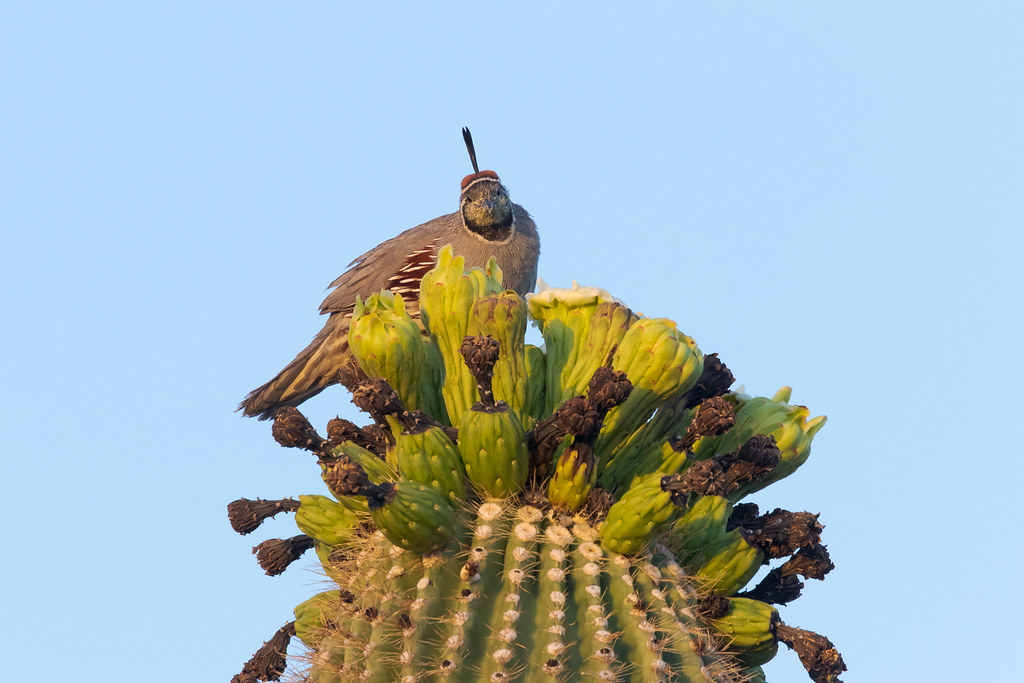
A white-winged dove sticks its entire face into a saguaro blossom as it feeds. It’s face was covered in pollen, as were many of the birds in my pictures from this time, such as the Gambel’s quail below. The birds and bats and bees took full advantage of the suddenly plentiful blooms, dining quickly as they flew from one flower to the next, pollination in action. The blooms are mostly gone now, this morning I saw only two flowers during several hours of hiking, and one of those was pretty wilted.

The face of a male Gambel's quail is covered in pollen from saguaro blossoms in McDowell Sonoran Preserve in Scottsdale, Arizona

Sunrise Falcon

An American kestrel perches on a saguaro cactus at sunrise along the Vaquero Trail in the McDowell Sonoran Preserve in Scottsdale, Arizona

The alarm went off at 3:41 a.m. this morning, the start of a three day weekend. I’ve been a bit worn out and my stomach has bothered me a couple of days this week but I nevertheless crawled out of bed, if a bit reluctantly, as high clouds were predicted instead of the usual clear skies and I was curious to see what the sunrise might bring. I was on the trails before the sun but it looked like there wouldn’t be much color in the skies as the sun rose, and there wasn’t, save for one small portion of the sky. Unable to get the picture I hoped for I instead took my delight in the serenity of the desert morning.

Heading up the Vaquero Trail to where I had seen antelope squirrels the week before I stopped when I saw an American kestrel perched on a saguaro in the distance, one leg held in the air, silhouetted against the patch of orange sky. The little falcon didn’t stay long nor did the color but I got my sunrise picture after all, just not the one I was expecting, the first of several surprises the desert had in store for me this morning. The little appendages sticking out from the saguaro are spent flowers on top of the fruits developing below, handy perches above the cactus spines.

No Time to Rest

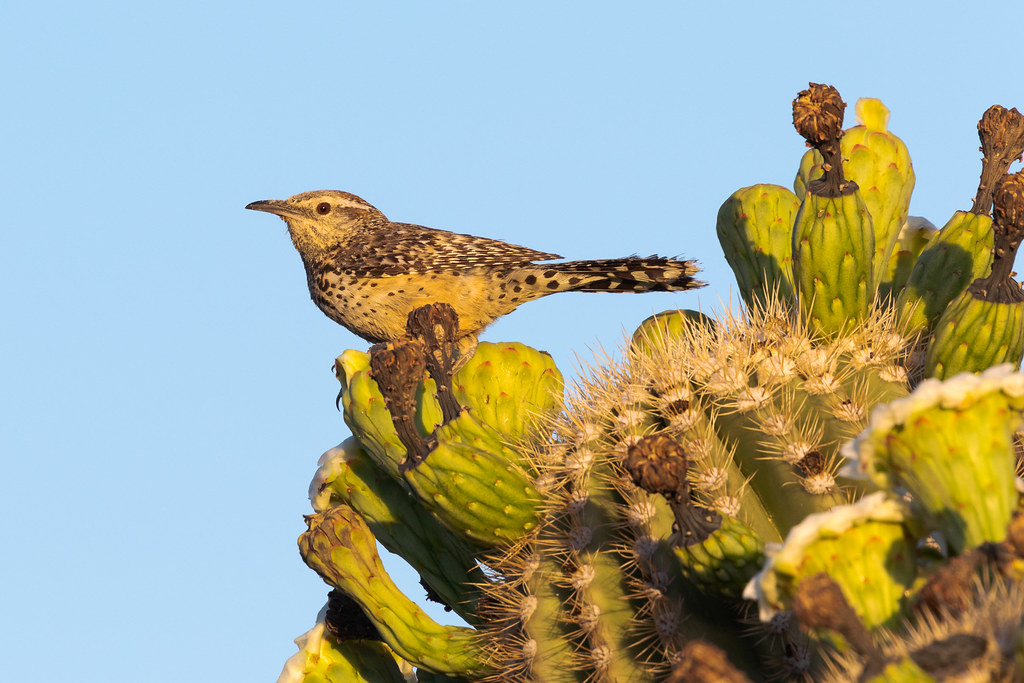
A cactus wren, its face covered in pollen, pauses on a saguaro while feeding its young

A cactus wren paused momentarily above its nest (not visible) while it and its mate constantly flew in and out feeding insects to their young. They were comfortable with my presence so I was able to watch them for a while as the sun quickly rose but I didn’t take many pictures since they paused so briefly. It’s face is covered in pollen from saguaro blossoms, I had seen several other species of birds face down in the flowers but the wrens seemed too busy feeding their young to feed themselves. The next week I did witness one quickly eating from a blossom but they didn’t take the time to gorge themselves like the finches and doves and quail.

As worn out as I am I’ve been getting up before sunrise to hike on all my days off as these springtime activities will soon be but a memory. The heat is quickly rising, summer will quickly follow, then it will be time to rest. Or at least nap, I’d still like to hike as much as the temperatures allow.

Almost Ended in Tears

A Harris's antelope squirrel in a bush looks out over the Sonoran Desert along the Vaquero Trail in the Brown's Ranch section of McDowell Sonoran Preserve in Scottsdale, Arizona

Moving to Arizona has required a number of minor adjustments to my clothing and gear. I dress up a bit more for work here so I had to get all new work clothes. Our rental house has a pool which meant ordering swimsuits, swim shirts, goggles, and towels. The desert meant meant a new hat designed to shed heat (and a second one I just ordered to stay in the car for days like today when I forget mine), new hiking shoes, new socks, and an extra pair of hiking pants. More water bottles. Shorts to wear around the house.

I think it’s about to force one more change, a more major one, at least in terms of expense. On the auto tour at Ridgefield I mostly used my big 500mm telephoto lens, but that’s way too heavy for hiking for hours in the desert. I’ve been using a lens I adore, my Canon 100-400mm zoom, and the Canon 1.4x teleconverter. The weak link is the camera I have to attach to, my Canon 7D II, a camera which in general I like apart from it being an SLR instead of mirrorless, the lack of an articulating touch screen, the weight, and the poor video (I do like it, it has many good points). But now there’s this: the autofocus works great with the 100-400 by itself but not with the teleconverter attached.

It’s not useless, and I’d put up with it if I had no choice, but a while back Sony introduced a similar 100-400 lens. The autofocus on my Sony camera would work well with the lens even with their teleconverter attached, plus I’d avoid the problem that almost cost me this shot: the optical viewfinder. I had been shooting this Harris’s antelope squirrel in the shade when it bounded across the trail and climbed this bush to survey the landscape. I was shooting in manual to deal with the difficult exposure but forget to change the settings for the sunlight the squirrel was now in. This would have been obvious in a mirrorless camera, fortunately I eventually realized my mistake and got a picture before it climbed back down.

It would mean switching to the Canon for wider angles until I have a second Sony body (I’d wait until they bring out an upgraded version of what I have now), which will mean more weight in the short term, but in the long term both less weight and a better fit for how I hike in the desert.

Not the Usual Suspects

A young male Bullock's oriole perches atop a blooming saguaro cactus in the Brown's Ranch section of McDowell Sonoran Preserve in Scottsdale, Arizona

In my short time here there are a handful of birds I’ve gotten used to seeing on the saguaros: Gila woodpeckers, gilded flickers, house finches, cactus wrens, and curve-billed thrashers. But I sometimes see more than the usual suspects, such as this splash of color that momentarily swooped into view early Saturday morning. He’s a young Bullock’s oriole, he’ll be even more colorful and vibrant in a year. I’ve only see this species a couple of times before, both during my years in Portland, so here’s hoping we meet more often in Arizona.