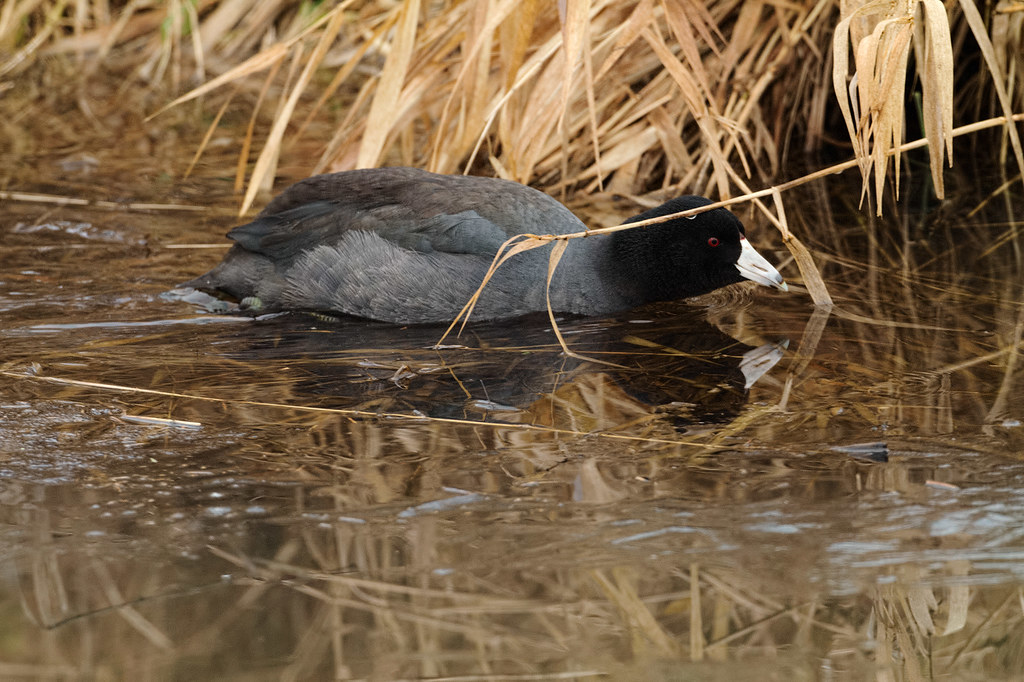
An American coot ducks under a plant stem as it swims down a narrow section of open water in a channel that has mostly frozen over with a thin layer of ice.
Tag: River S Unit
Surprise Ending
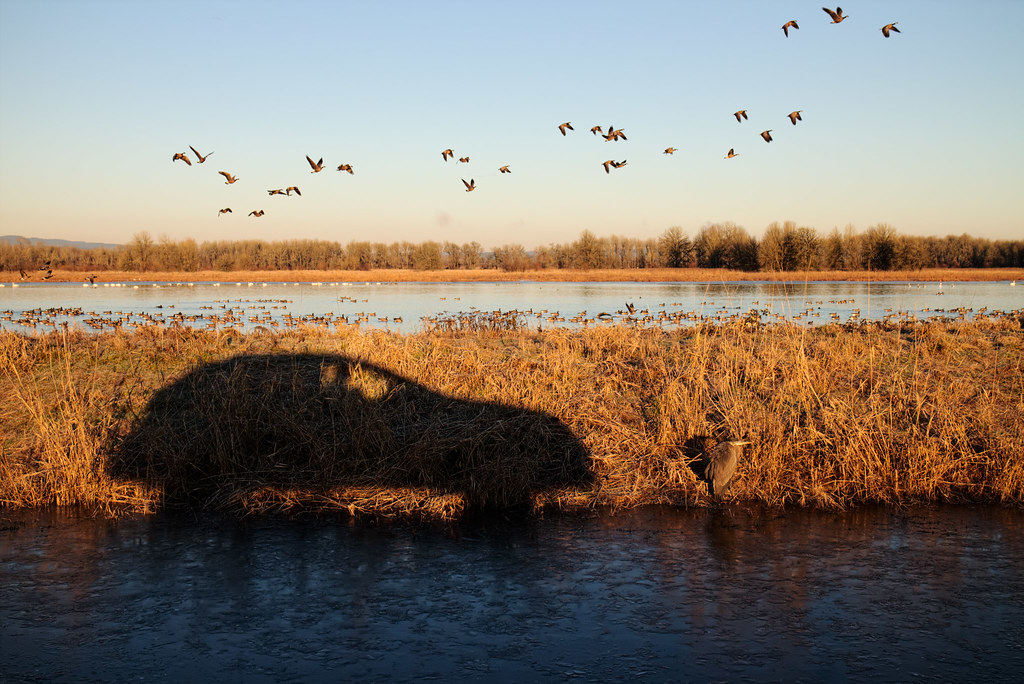
I spent New Year’s Eve at Ridgefield from sunrise to sunset. It was sunny and cold throughout the day and the shallower ponds had partially frozen. Near the end of the day I was parked near the start of the auto tour so it would be easy to leave before the gate closed. A great egret was hunting bullfrogs in the shallow channel beside the road and I expected it would be my last wildlife sighting of the year. Not a bad way to end the year.
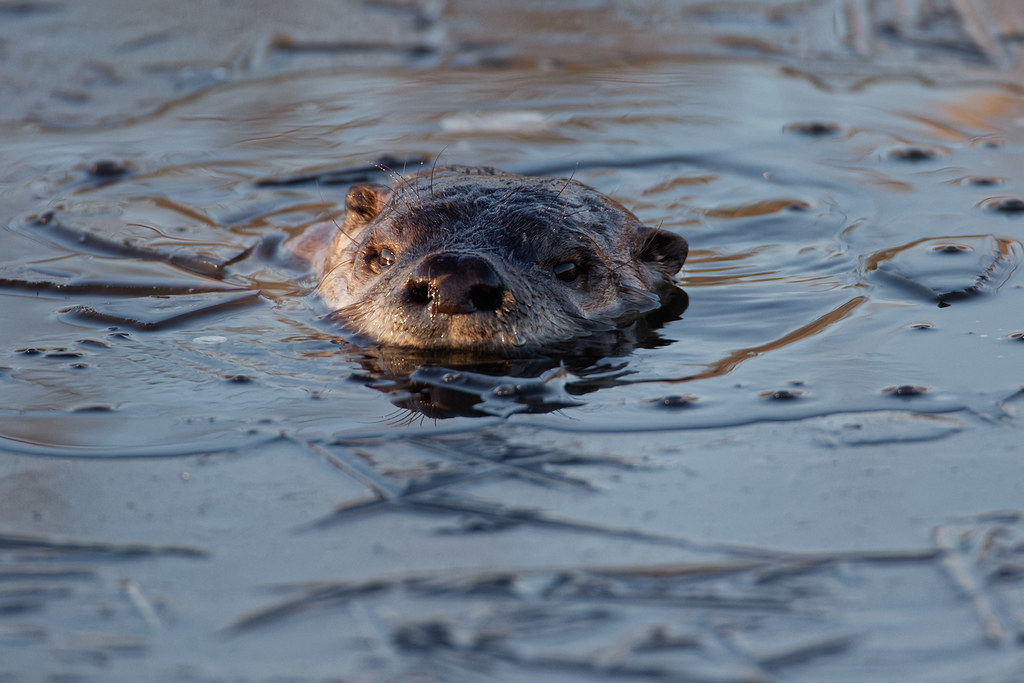
But then I heard a loud crack in the ice and looked down to see that a river otter had punched though the ice to come up for air. It didn’t stay long before submerging and swimming out of sight, but it made me laugh, Ridgefield giving me one last surprise to close out the year.
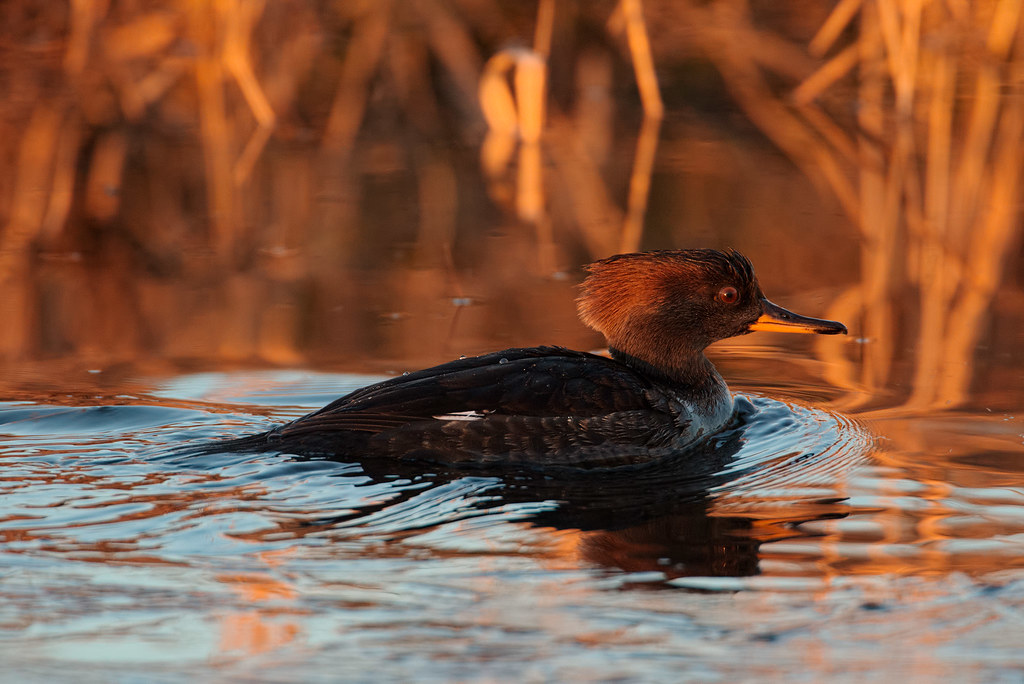
The egret had moved on, the otter had swum away, so I was about to pack up my camera for the trip home when a couple of hooded mergansers swam by in open water beside the ice, beautiful in the last light of the day. My goodness but the refuge was putting on a display. After a quick scan to make sure bigfoot wasn’t hiding in the bushes, I packed up my camera and headed home.
On the Hunt
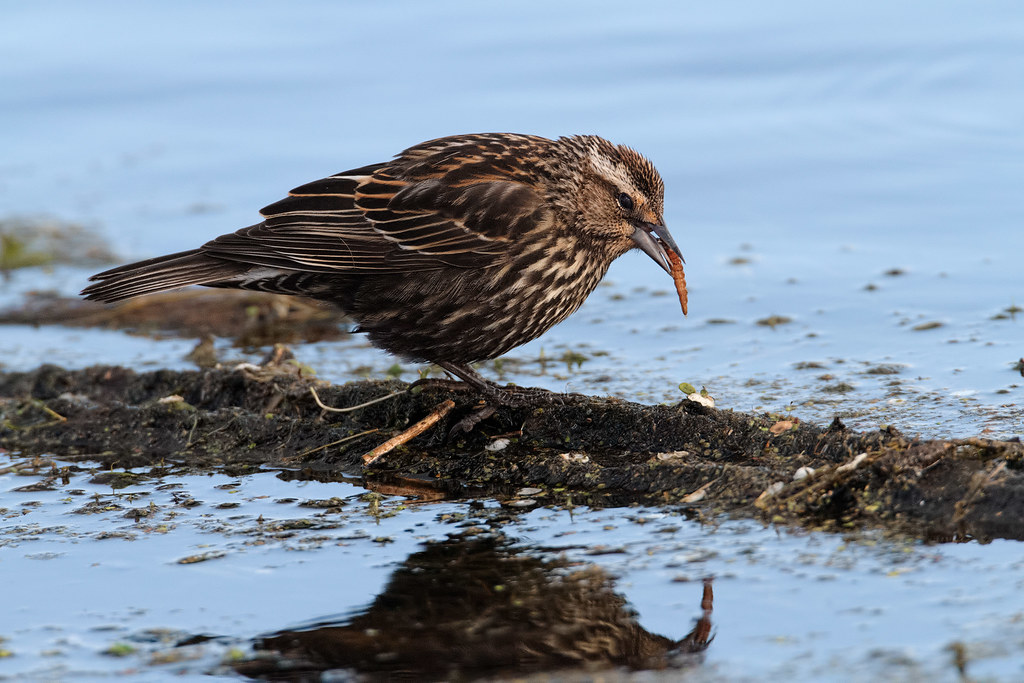
There’s a spot in Long Lake where floating branches accumulate at the edge of the lake by a culvert. Both red-winged blackbirds (like this female holding what I presume is an insect larva) and song sparrows frequently hunt in this little section, looking for insects hidden in the plants and mud. The blackbird searches with its beak, as shown below, while the sparrow typically uses its feet. I’ve spent hours watching them on the hunt, as its also a good spot to watch mergansers hunt for fish just a bit further out, and a couple of times a river otter has swum up gone through the culvert to the other side of the road.
Mammals vs. Dinosaurs
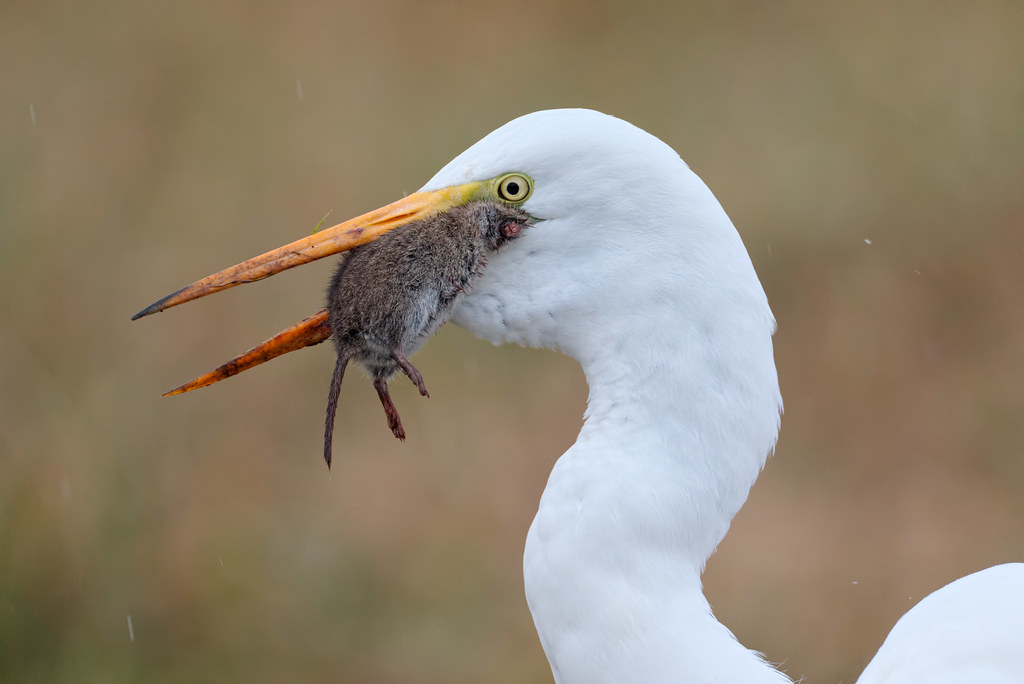
I’ve met people who think it preposterous that birds descended from dinosaurs, a theory that dates back to the 19th century and the discovery of an Archaeopteryx fossil, as they think of birds as being small and cheerful. They might change their minds if they spent some time watching an egret hunt for voles.
As I’ve photographed birds over the years I was struck by how many of the feathers on a bird’s body aren’t actually used for flight. I began to wonder which came first, feathers for flight or feathers in general? This article by Luis Chiappe on dinosaurs and birds gives the answer (spoiler alert: it’s not flight). I’ve only started reading the article but it’s written in plain language and has a lot of information (and importantly, references) on the link between dinosaurs and birds, and how most paleontologists believe that some dinosaur species survived and evolved into the birds we know and love today.
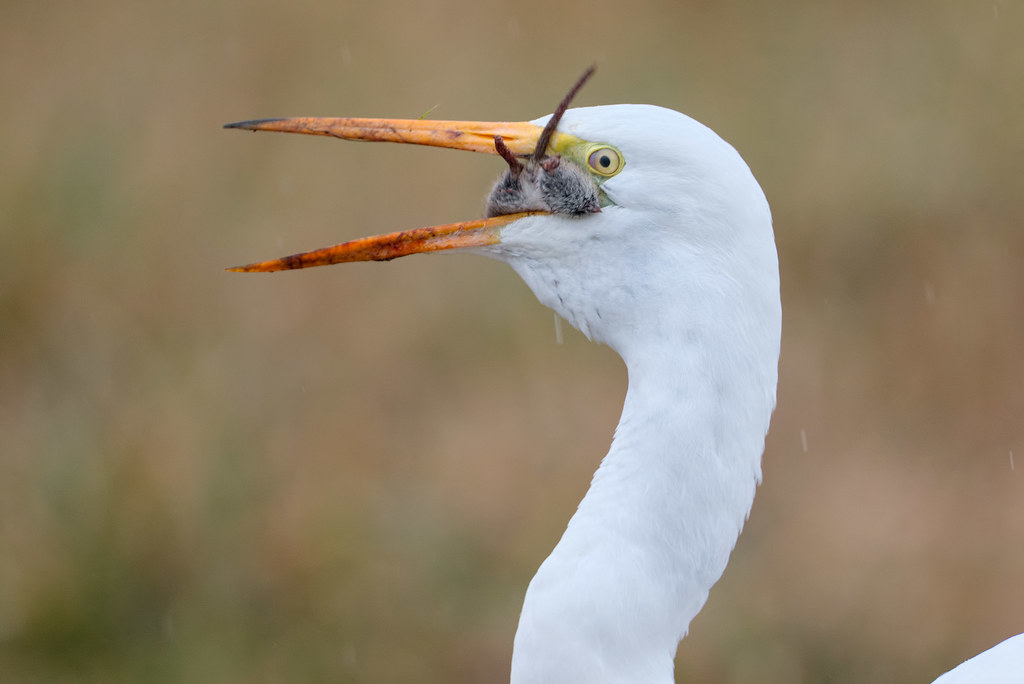
I suppose it’s all splitting hairs to this vole, within seconds of being swallowed on a rainy January afternoon. I sometimes shoot hunting egrets and herons and bitterns with my biggest lens, to show that one life is ending in order for another to continue, and sadly I’ve only ever been able to photograph these voles in the last seconds of their short lives. I keep hoping one day to get a photograph of a vole just sitting in a meadow but for some reason they don’t stay above ground very long.
Ring Ripples
A male ring-necked duck relaxes on a winter morning as raindrops create ripples in the water. Taken on the last day of an almost three week vacation over the Christmas break. I made a note in my journal about how much I enjoyed watching him before he swam off when more cars arrived, as Emma’s health was worrisome and the refuge was a nice distraction while my wife was home with Emma. Emma died a few days later and I wasn’t in the mood to edit the pictures from this trip (particularly an egret picture I’ll post later), but it is easier now with a little more distance.
The Blackbird
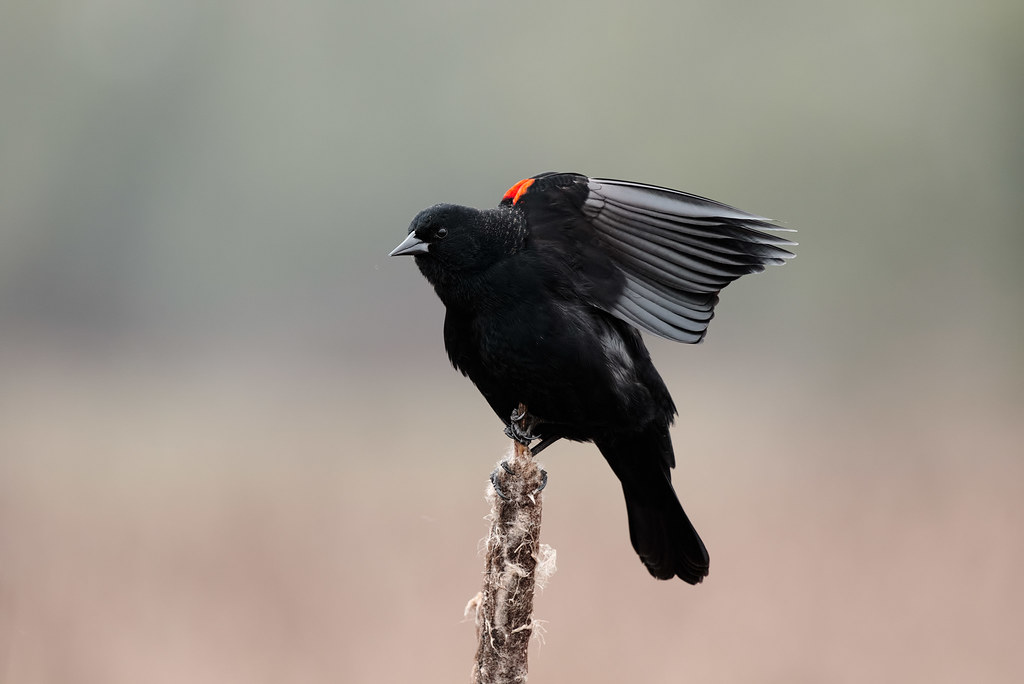
I didn’t leave the house for the first few days after Emma died, apart from taking Ellie on her walks, but by the fourth day I decided to head up to Ridgefield for a little bit. I made a note in my journal when I got there that my heart wasn’t in it and I didn’t know if I’d stay more than a few minutes, but spending some time with this blackbird lifted my spirits and I stayed for several hours. I stopped at South Quigley Lake when I saw him sitting on a cattail that was taller than all the others around it, as it gave me a lovely view of a lovely bird. I didn’t expect him to stay long, they are often flitting to and fro in the marsh, but he stayed there for a long while, preening and stretching and occasionally singing.
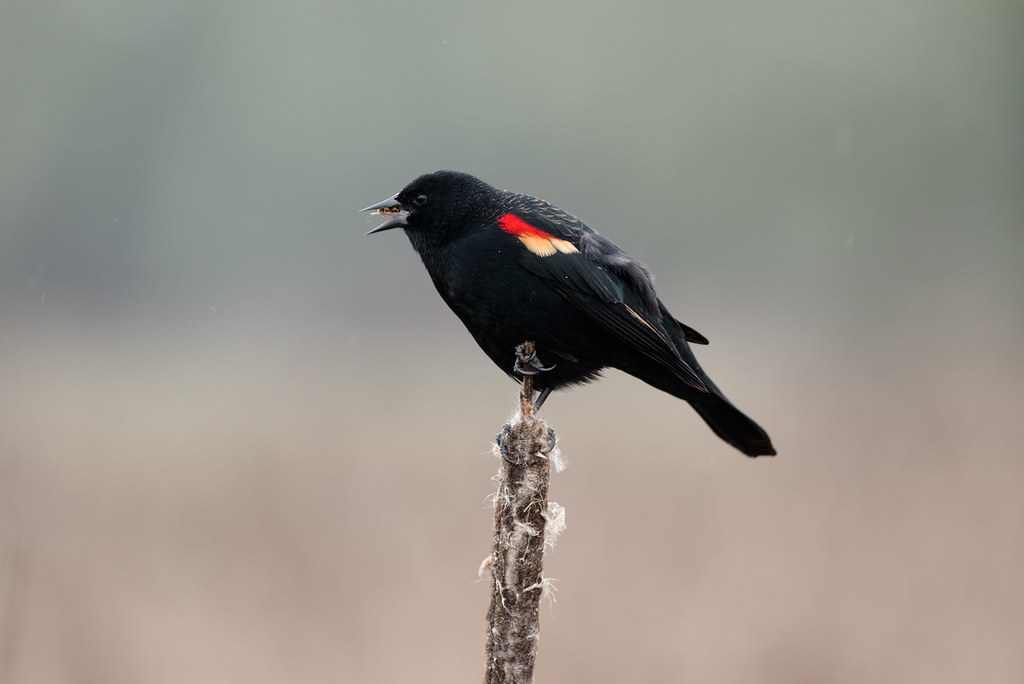
I’m well aware that some of my favorite creatures eat some of my favorite creatures in order to survive, I spent much of the Christmas break watching herons and egrets and bitterns eat all manner of small creatures near the shoreline, but I was reeling from Emma’s death and not in the mood to see something die. I deliberately avoided watching those predators on this visit but I was reminded of how often life and death are on display at the refuge when the blackbird suddenly leaned down and plucked an insect from the cattail. He has it pinned to the roof of his mouth with his tongue, headfirst, and is about to swallow it.
The auto tour takes a sharp left turn after you pass South Quigley Lake and you can see a blue car right behind the blackbird in this photo. There was less traffic though than I expected and so for the most part it was a peaceful afternoon, just what I wanted. While watching the blackbird a couple of times I spotted a Virginia rail darting through the cattails, and later I saw a doe and fawn of the Columbian white-tailed deer that were transplanted to the refuge (the doe was transplanted, the fawn was born at the refuge). It was nice to see sandhill cranes and a river otter too.
Soon thereafter Sam would get sick, and then some of the other pets, and then we got Trixie, and I’ve been busy enough and tired enough that I haven’t gone back out since. Now that Trixie is all settled in, I’ll be returning to the refuge before too long.
I’m Flying, I’m Flying!
Lunch for One
A hooded merganser swallows a fish she just caught in the shallows of Long Lake. She’s swimming away not from me but rather the other mergansers in her group who would be more than happy at the chance for a free meal. Once she surfaces with the fish she’s got to get it oriented head-first, lengthwise down her long thin bill, and toss it back and swallow it. The still squirming fish sometimes gets dropped even when alone, much less in a crowd, so a little private space is always welcome.
A Closer Look
Not only was I fortunate to be able to photograph great egrets numerous times in December, but even on this day I had several opportunities, including full-body portraits as one caught numerous bullfrogs. There were times I saw egrets very close to the road but in each case someone else had stopped and, rather than risk spooking the bird, I continued past.
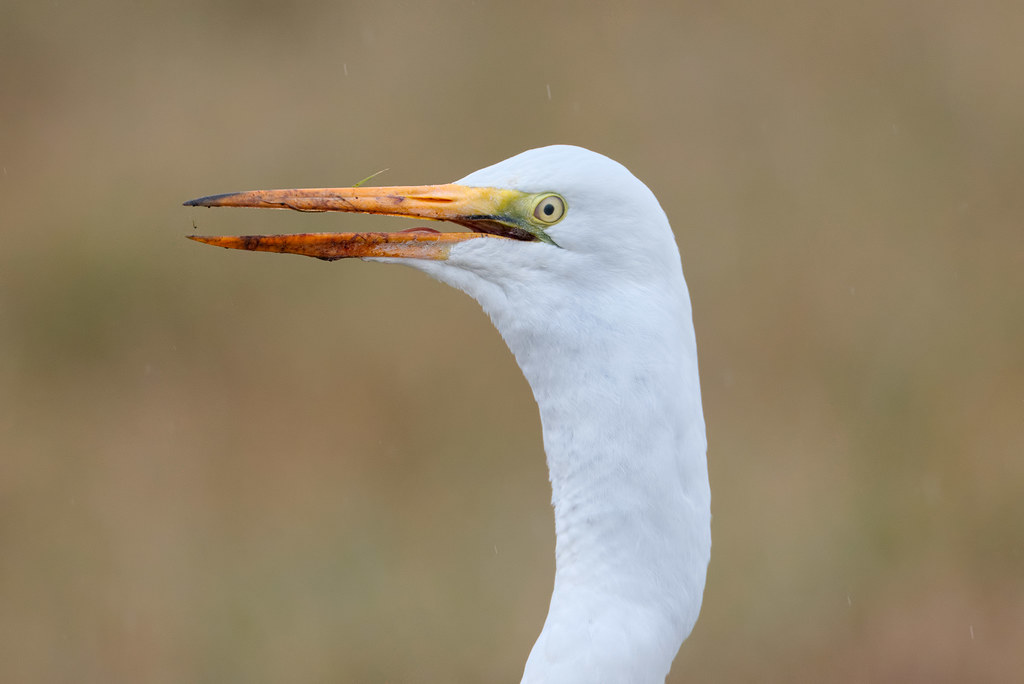
Late in the day I got my chance at a close look when I came across this egret at Rest Lake. It was mostly watching the water for frogs but occasionally if another car came past it would gently turn its head in my direction. That rarely happened as there was a sudden lull in traffic, but I spent a lovely twenty minutes watching it at close range before it finally took flight to chase off another egret that had flown in a ways down the shore.
An End to Hibernation
Bullfrogs hibernate during the winter so their metabolism slows significantly and they aren’t very active but they don’t bury themselves in the mud the way a turtle might. Many bullfrogs at Ridgefield found their hibernation cut short this winter by the herons and egrets and bitterns that worked the shallow channels and ponds of the refuge.
This egret in particular was just walking up and down one such channel, avoiding a great blue heron doing the same, striking at bullfrog after bullfrog, following a familiar process between catching the frog and eating it. First, the frog would be dunked quickly into the water, as shown above. Next, the egret would spin the frog rapidly, presumably causing massive internal injuries to the frog, as shown in the following two pictures. In the first picture, the egret has closed the nictitating membrane in its eyes, a transparent third eyelid that protects the eye from damage while still allowing the egret to see, as water spins off the frog and its clawed feet flail about, while in the second picture the membrane has been retracted.
Then the egret would toss the frog into the air, catching it in a different place on its body, and either repeat the process again if it caught it by a leg, or perhaps crush it in its beak if it caught it by the body. This would happen multiple times until I gather the frog had died or given up fighting, although with the egret constantly keeping the frog moving it was hard to tell exactly when or if the frog itself stopped moving.
The final step was to position the frog head first in its beak and swallow it whole. Bullfrogs are voracious predators and, as they aren’t native to the area, have had a big impact on some of the other small creatures in the ponds and sloughs. However I’ve seen the bullfrogs themselves become prey for the larger predators of the refuge, including not just egrets and herons and bitterns but otters, raccoons, and grebes.