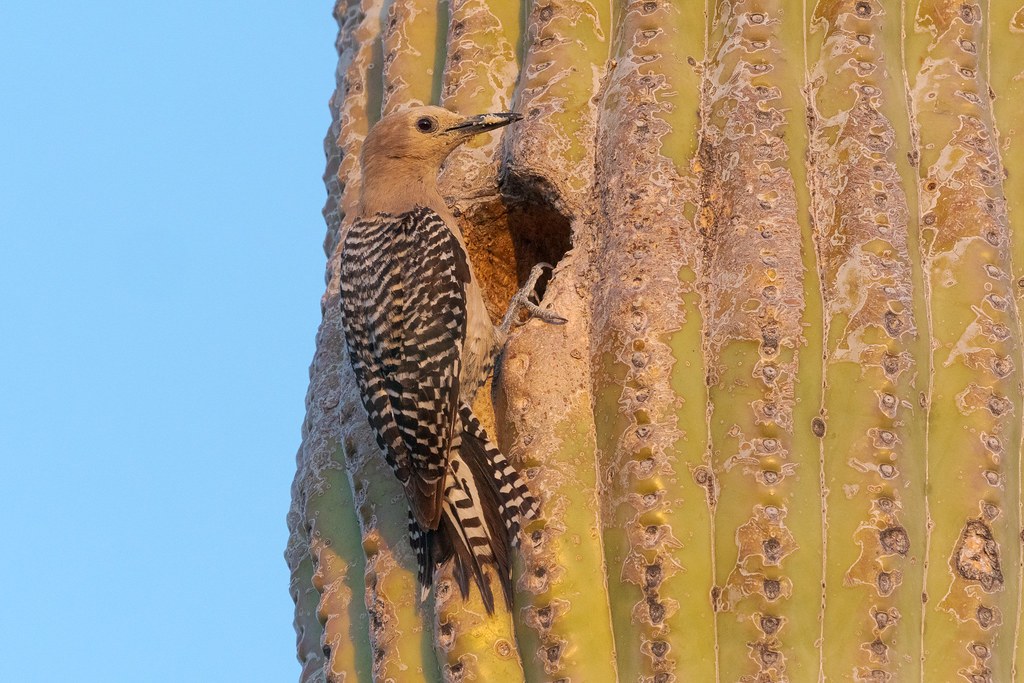
Usually I see woodpecker nests in vertical saguaro arms but this male and his mate had chosen an angled arm. At 5:20 am with the sun about to rise they were already bringing food to the nest, in this case a moth. Given the angle to the sun I wasn’t sure if the light would illuminate them when the sun came up or if the saguaro would cast them in shadow, and I still don’t know, as while they brought food to the nest at first they started holding back. Raising young is precarious and stressful enough so while I suspected they would quickly come to not see me as a threat I didn’t want to risk it and continued up the trail.
Tag: saguaro
Father’s Day?
I’ve never seen a bird not defend its nest so I couldn’t comprehend what I was seeing. With one Harris’s hawk on its nest in a saguaro, multiple other adults were perched nearby, in trees, on saguaros, on large electrical towers. They called out repeatedly but to my untrained eyes and ears it seemed like they were keeping in touch rather than warning to keep away.
What was I seeing? Perhaps what I needed to see, what I wished for rather than what was, with Ellie’s death still stinging. But in this case both as I learned later Harris’s hawks live in family groups, even during nesting season with new life about to come into the world.
A week ago after sunup this adult flew to the nest, one leg outstretched to find purchase on a saguaro blossom while the other clutched twigs to spruce up the nest, as the two nestlings watched from the nest (they’re hard to see). Was it the father arriving? The mother? A sibling?
This morning one of the young hawks was continuously jumping from one arm to the other, working on its balance and testing its wings. I didn’t see the other until it flew over and landed awkwardly in a palo verde below the nest, having already fledged.
What joy these hawks, this family, have brought to me this spring as they add two more to their number.

Drip Drip Drip
Water seemed suspended in time as it dripped from the flower buds at the end of a horizontal arm of a saguaro, but I suspect the frozen drips must have been sap. I didn’t know saguaros budded like this when we moved here so I was delighted to discover buds fairly close to the ground that I could observe up close.
Spring Sing
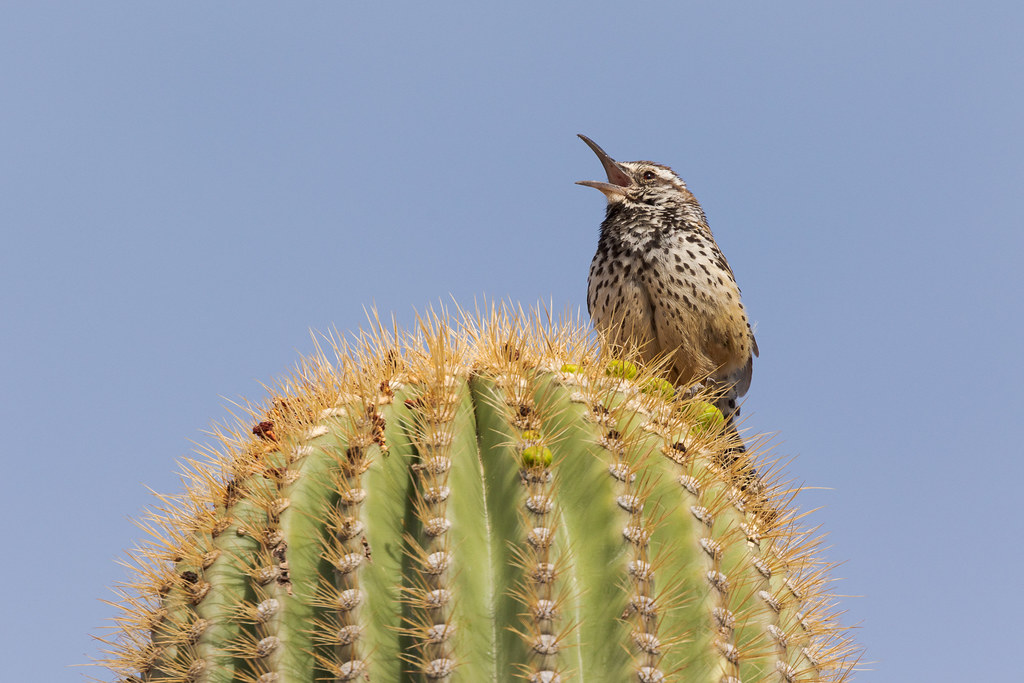
A cactus wren sings atop a saguaro at the end of April in 2018. It was also the end of our first month in Arizona and my second trip to Brown’s Ranch, having visited the day before as well. The cactus wren was the first bird I saw on my first hike after we moved here, at nearby Pinnacle Peak, also singing from a saguaro but before the sun had risen. They were nesting at the Brown’s Ranch trailhead and I assumed would always be so easy to see so close but I’ve had less luck this year.
At least on the trails, at home one was beside me a few minutes ago as it worked the porch for food. A couple of weeks ago two wren parents were also close by on the porch, feeding their hungry and boisterous chick as it fluttered its wings to draw attention the way so many young birds do. As one parent fed the little thing I heard a thud at a nearby window and my heart sank thinking the other adult had flown into it. But then I laughed when I realized the sound came from the other side of the window and the source was our youngest cat Trixie who could no longer hold back her desire to be introduced to the young family.
Occupied! Occupied!
As the female Gila woodpecker brought a moth to the nest, she had to wait to go in as the male was still in the nest. Though she was positioned right below the entrance, she only had to tilt her head to the side to give him room as when leaving they jump out of the hole before spreading their wings and flying off. I’ve seen so many moths brought to woodpecker nests it’s a wonder any remain to fly about the desert. Below is the same bird, but different moth, taken 5 minutes later.
The Curve
Flowers for Breakfast
A female Gila woodpecker perches beside her nest with a beak stuffed not only with what might be a bee but stamens from saguaro blossoms, illuminated by soft light as the sun just starts to break over the mountains. The stamens produce the pollen that is covering her face. I knew they fed their young insects and spiders but it appeared they were feeding them the stamens too, as not only did they leave the nest with beaks empty but sometimes it appeared as their beaks were full of nothing but stamens.
Shut-eye
The Tipping Point
A Harris’s hawk calls out as the rising sun begins to tip over the distant mountains, partially illuminating the desert with its soft light. From this angle and in this light you can barely see the distinctive chestnut patches on its shoulders and legs, but you can get a glimpse of the large white patch at the base of the tail and the white band at the tip.
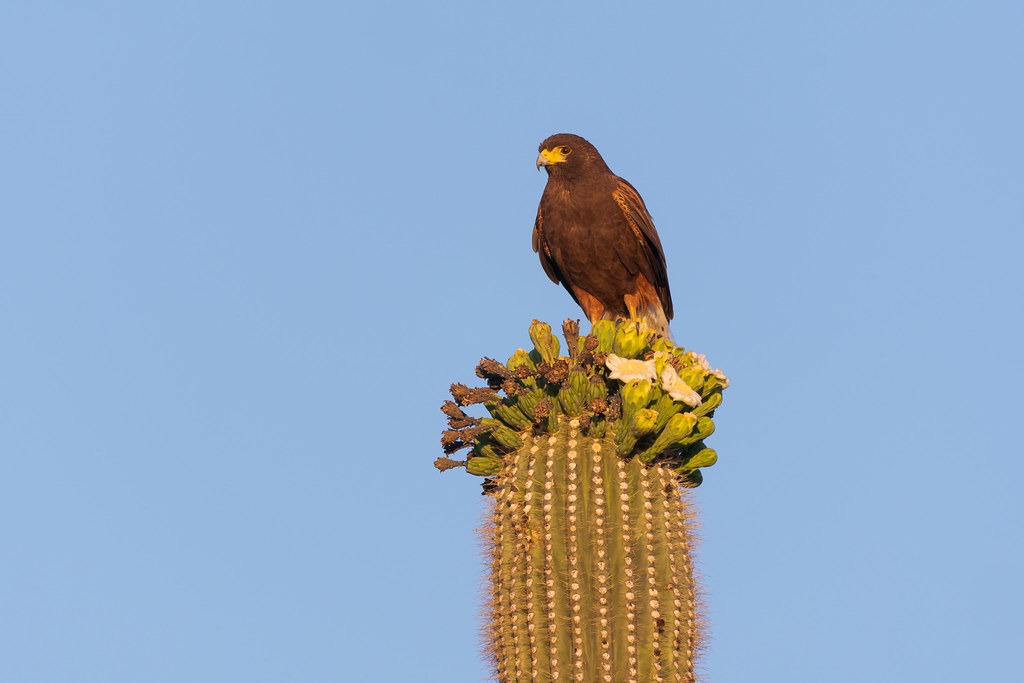
After it flew off I continued up the trail, and when I rounded a corner five minutes later the hawk and I met again (I assume it’s the same one, it would be easier if they wore name tags). The rising sun having fully cleared the mountains and the hawk completely lit in the morning light, you can better see the distinctive chestnut patches. This is the same saguaro (and maybe the same hawk) I photographed shortly before sunrise a week prior.
I Have the High Ground
A male brown-headed cowbird was singing atop an old saguaro when it flared out its wings and then arched its back and pointed its head into the air. The reason soon became clear as another beak came into view, followed by the rest of the head. A second male had flown onto the opposite side and was inching its way up from below. It flew off pretty quickly and the original male gave chase.