The Desert Cottontail

A desert cottontail sits on the base of a large saguaro cactus

All part of my goal to photograph everything sitting on a saguaro, although in truth I never expected to see anything but birds on them given the sharp spines. Early one morning I came across two desert cottontails feeding near a large saguaro shortly before the sun rose high enough to illuminate the desert floor. I noticed this one kept sniffing the base of the cactus and jumping onto it where there were no spines. I got lucky when the rabbit jumped up one last time right as the sun fell upon us, as it only stayed for a moment before the pair hopped off into the shadows and out of sight.

Red, White, and Blue

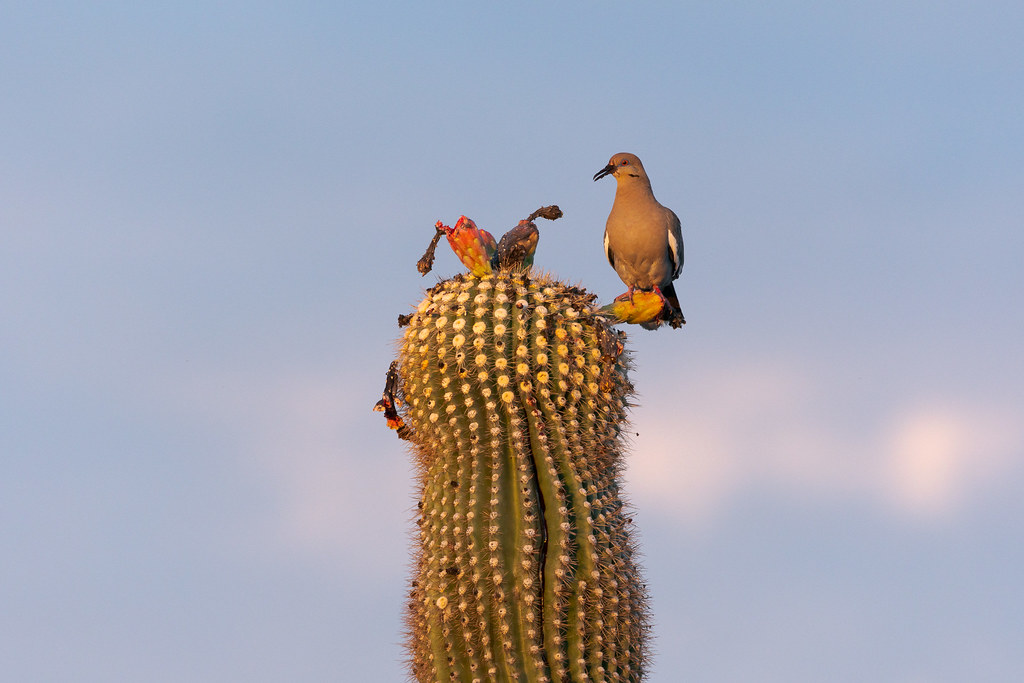
A white-winged dove, its face covered in the red juice of saguaro fruit, perches atop a saguaro illuminated by the rising sun by the Latigo Trail in McDowell Sonoran Preserve

I spent the morning of the 4th of July amidst a double splendor of red, white, and blue. The rays of the rising sun illuminated the top of the cactus amidst blue skies, white clouds, and the ripened red fruit of the saguaro. Eating that fruit was a white-winged dove, with the white wing patches for which it is named, a blue eye ring, and red eyes. And on this morning, as with all the other doves since the fruit ripened, a face covered with the red juice and pulp of the saguaro’s fruit, as they stick their entire heads in to get every last bit of this short-lived bounty of food.

The Warriors

A damage saguaro still grows tall at Pinnacle Peak Park in Scottsdale, Arizona

The old saguaros are warriors. It’s remarkable they can survive in this climate at all, astounding they can do it while sustaining heavy damage. I don’t know how recent the damage to the base of this cactus is but as you can tell from its long shadow it is still growing at a great height with a couple of the iconic arms near the top (the arms usually don’t start growing for 50 to 100 years, depending on the amount of rain). I saw one saguaro that had fallen over and little remained except a short stump, but enough of the internal plumbing and root system survived that a new arm was growing. I hope they prove a metaphor for my country, for all the damage it has sustained and with more to come, I hope the promise of America overcomes its reality.

A Cactus Home

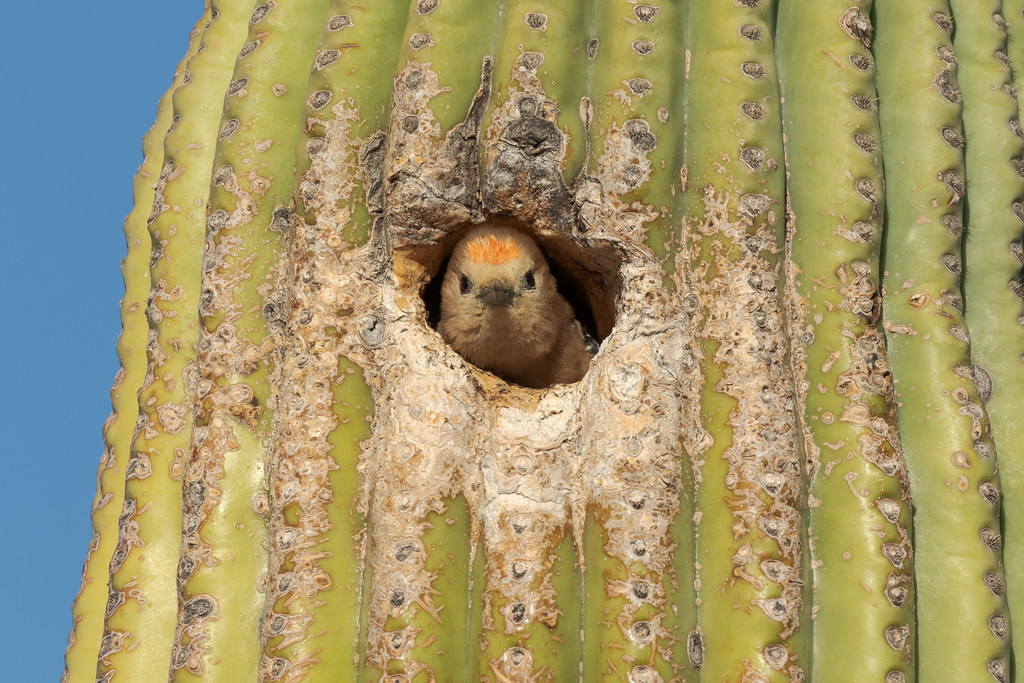
A Cactus Home

I hoped for this picture since I first learned that woodpeckers like the Gila woodpecker make their nests in cavities they drill into saguaros. I wasn’t sure how frequent a sight it would be until we moved here and thankfully I had the chance to watch a couple of different Gila woodpecker families this spring. This male and its mate made their hole facing the rising sun but it was a bit too long of a hike to get there right at sunrise. But I spent several early mornings watching in amazement as they brought an endless stream of insects and spiders to the nest.

White-Winged Love

A white-winged dove perches atop a saguaro cactus, it's face covered in pollen

In case you were wondering what a white-winged dove looks like when it isn’t plunged headlong into a saguaro blossom, here you can see most of the bird apart from its feet. The golden color to the entire front of its head is from pollen, making readily apparent how the birds pollinate the saguaros as they stick their heads in the flowers from one cactus to the next. Much to my delight white-wings are one of the most common birds in our backyard so I get to see them every day of the week.

Face Full of Flowers

A white-winged dove sticks its entire face into a saguaro blossom as it feeds in McDowell Sonoran Preserve in Scottsdale, Arizona

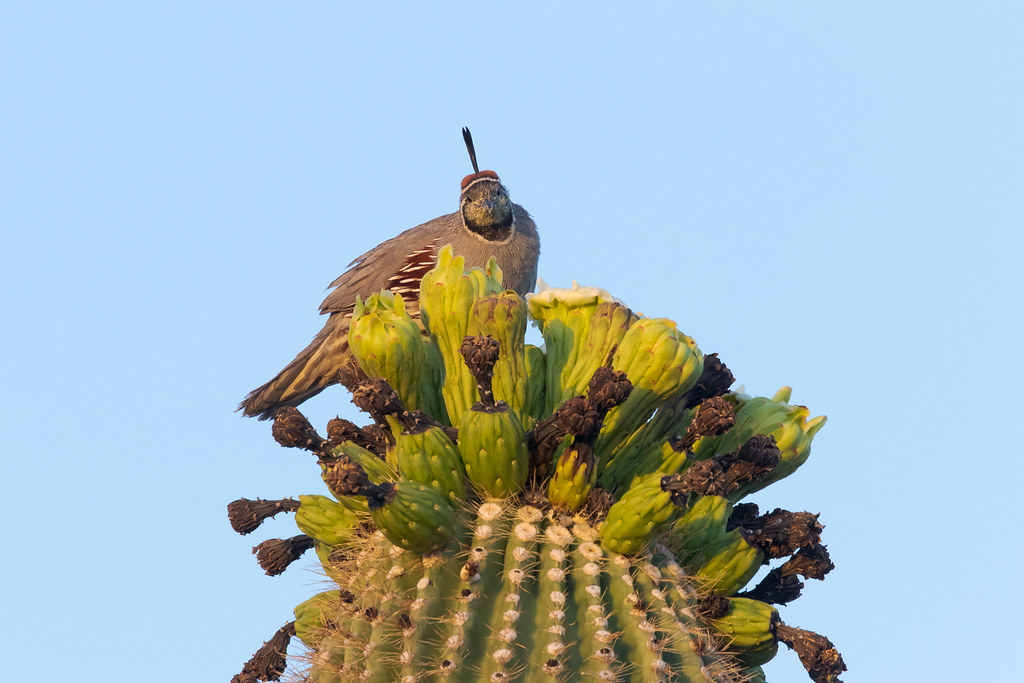
A white-winged dove sticks its entire face into a saguaro blossom as it feeds. It’s face was covered in pollen, as were many of the birds in my pictures from this time, such as the Gambel’s quail below. The birds and bats and bees took full advantage of the suddenly plentiful blooms, dining quickly as they flew from one flower to the next, pollination in action. The blooms are mostly gone now, this morning I saw only two flowers during several hours of hiking, and one of those was pretty wilted.

The face of a male Gambel's quail is covered in pollen from saguaro blossoms in McDowell Sonoran Preserve in Scottsdale, Arizona

Sunrise Falcon

An American kestrel perches on a saguaro cactus at sunrise along the Vaquero Trail in the McDowell Sonoran Preserve in Scottsdale, Arizona

The alarm went off at 3:41 a.m. this morning, the start of a three day weekend. I’ve been a bit worn out and my stomach has bothered me a couple of days this week but I nevertheless crawled out of bed, if a bit reluctantly, as high clouds were predicted instead of the usual clear skies and I was curious to see what the sunrise might bring. I was on the trails before the sun but it looked like there wouldn’t be much color in the skies as the sun rose, and there wasn’t, save for one small portion of the sky. Unable to get the picture I hoped for I instead took my delight in the serenity of the desert morning.

Heading up the Vaquero Trail to where I had seen antelope squirrels the week before I stopped when I saw an American kestrel perched on a saguaro in the distance, one leg held in the air, silhouetted against the patch of orange sky. The little falcon didn’t stay long nor did the color but I got my sunrise picture after all, just not the one I was expecting, the first of several surprises the desert had in store for me this morning. The little appendages sticking out from the saguaro are spent flowers on top of the fruits developing below, handy perches above the cactus spines.

Mother’s Day Bouquet

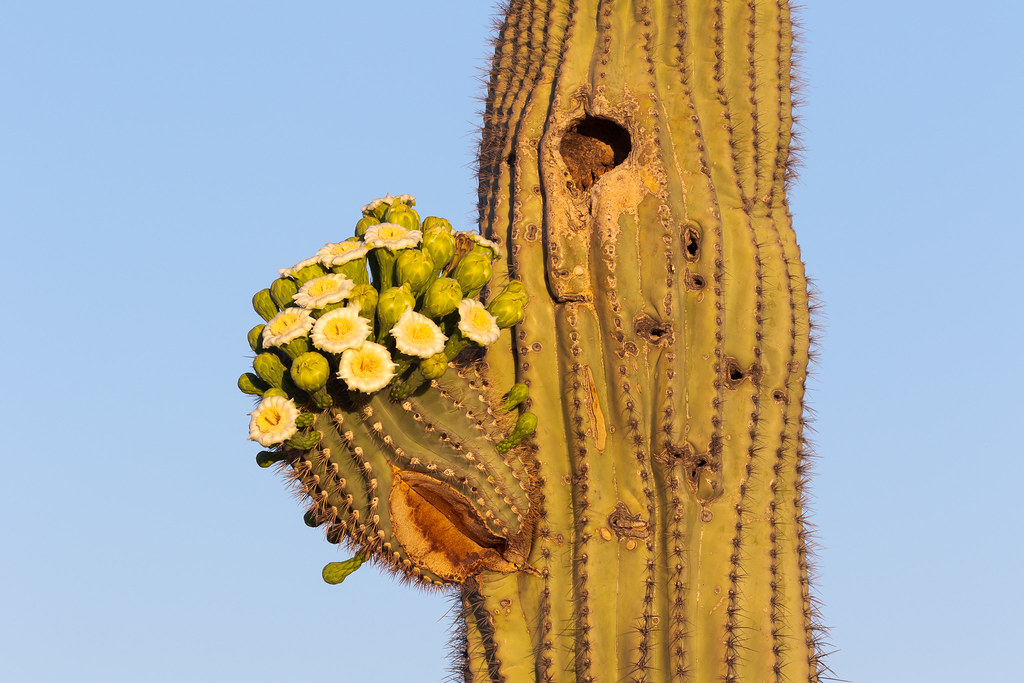
Sagurao blossoms near sunrise on an off-map trail at Brown's Ranch in McDowell Sonoran Preserve in Scottsdale, Arizona

This saguaro offered up a bouquet of flowers near sunrise on Mother’s Day. I had hopes of photographing it again with all the flowers open but by the time I could return the following Saturday, all of the blossoms were gone and I learned another fact about my new home. The flowers only last about a day, first opening at night to attract bats with their nectar and closing the following afternoon after the bees and birds have had their fill. If pollinated during that short window, the fruit below will develop during the summer.

Putting Down Roots

Putting Down Roots

My first impression after hiking with saguaros was of redwoods. Of massive lifeforms with an outsized impact on their environment. Of warriors, long-lived giants, their struggles written on their skin. Yet for all of that a surprisingly shallow root system. Saguaros have a central tap root that grows down but the rest of their roots radiate outward a handful of inches below the surface, soaking up every bit of rainwater they can. Sometimes erosion exposes these shallow roots, as on this old saguaro at sunrise on the Vaquero Trail, Brown’s Mountain rising in the background.

Shallow Roots