You Should Have Called First!

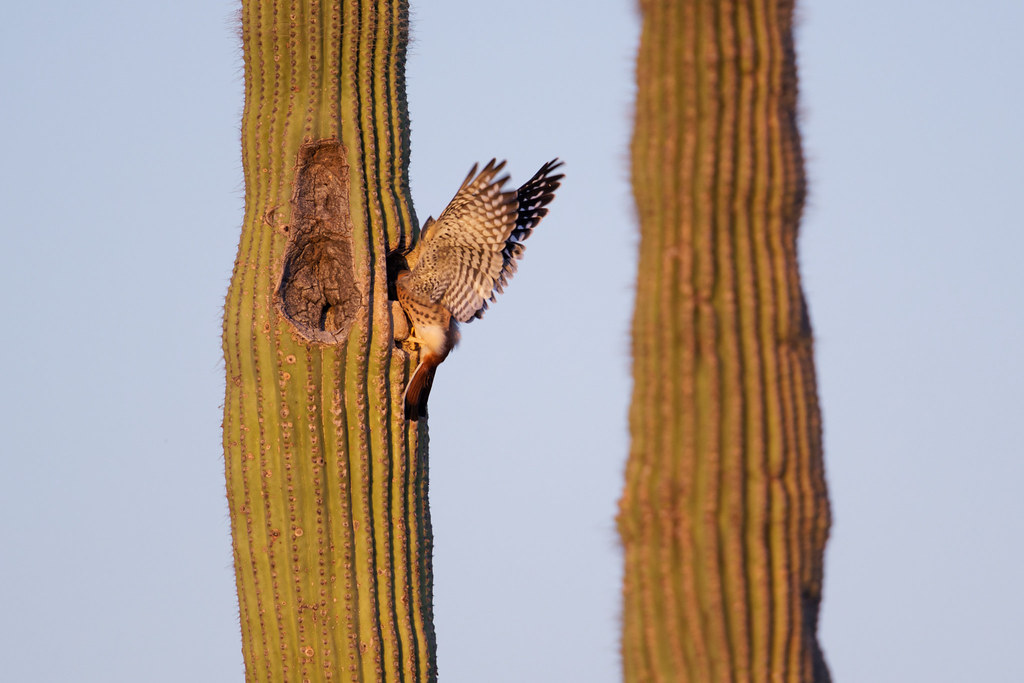
A male kestrel prepares to land at his nest in a saguaro but is surprised to find one of the nestlings looking out from the nest entrance. Taken near sunset at George Doc Cavalliere Park in Scottsdale, Arizona on June 6, 2021. Original: _RAC3468.arw

A male kestrel arrives at his nest in a saguaro to feed the last of his young that had not yet fledged but was surprised to find him sitting in the entrance hole. Strong winds blew as the sun was about to set but kestrels are agile fliers with a strong grip, so even though he had to fall backwards to avoid crashing into the youngster he was able to flare out his wings while grasping the cactus with his talons and maintain his purchase. He not only recovered with remarkable grace but soon leaned in and fed his hungry charge before flying off to look for the next meal.

I bet next time he calls first to let junior know he’s on his way.

A male kestrel starts to fall backwards after being surprised to find one of the nestlings looking out from the nest entrance in a saguaro. Taken near sunset at George Doc Cavalliere Park in Scottsdale, Arizona on June 6, 2021. Original: _RAC3477.arw

A male kestrel recovers after being surprised to find one of the nestlings looking out from the nest entrance in a saguaro. Taken near sunset at George Doc Cavalliere Park in Scottsdale, Arizona on June 6, 2021. Original: _RAC3483.arw

A male kestrel flares out his wings to maintain his balance as he leans into his nest in a saguaro to feed a nestling. Taken near sunset at George Doc Cavalliere Park in Scottsdale, Arizona on June 6, 2021. Original: _RAC3486.arw

Morning Surprise

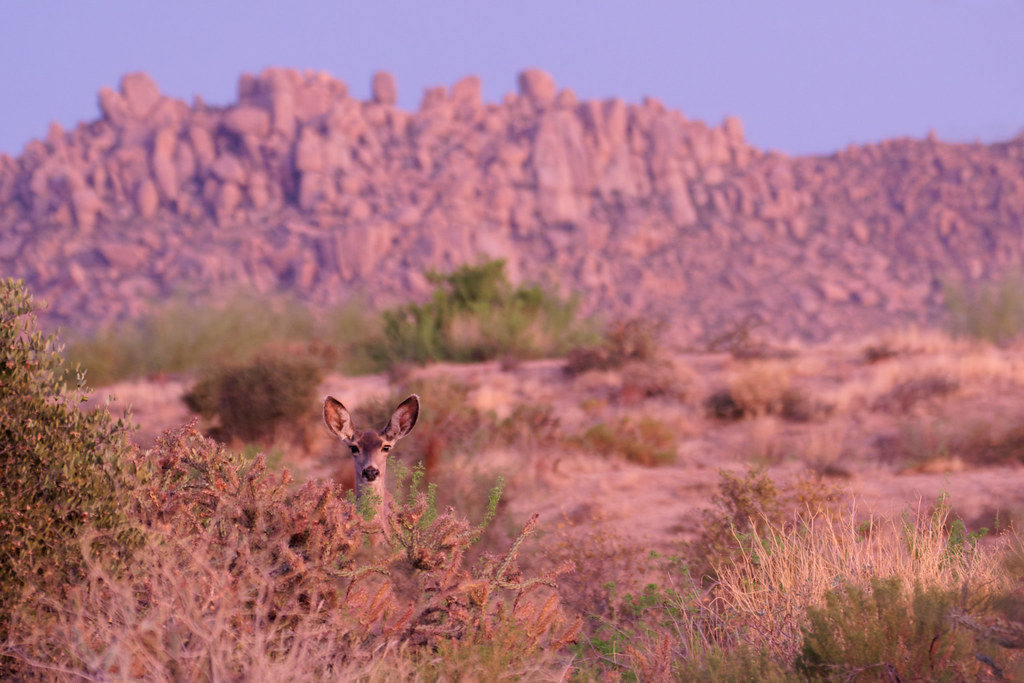
A young mule deer looks out from the Sonoran Desert with Troon Mountain in the background in pink light before sunrise on the Marcus Landslide Trail in McDowell Sonoran Preserve in Scottsdale, Arizona on May 1, 2021. Original: _RAC8010.arw

At the start of May I got up early and went to a favorite trail I hadn’t been to in a while. I soon came across mule deer so close to the trail I could have photographed them with a wide angle lens, but it was rather dark yet so rather than risk startling them I continued on towards the scene I planned to photograph at sunrise.

Further on the dim light suddenly intensified and turned pink, not nearly as strongly as the time when I was visiting my favorite saguaro but I couldn’t figure out why it was happening at all. The sun was still below the mountains and there were no clouds I could see to reflect the light, but perhaps the mountains hid more than just the rising sun. I looked around for something to shoot and had to smile when I saw the family of deer were occasionally visible through the desert scrub. I was far enough away now to need a telephoto lens but I was pleased I could include Troon Mountain in the background, as somewhere betwixt us and the mountain sits my home.

I watched from afar as the deer drifted in and out of view until they disappeared for good. The pink light stayed but for a moment before turning yellow, then a sickly white, then dying away until the sun at last cleared the hills. I tarried too long with the deer to have any chance of reaching my original destination so I went a little further down the trail to my favorite rock formation and soaked in the moment when the light suddenly floods across the desert.

It’s a little embarrassing that after a few years in the desert I can still struggle so to predict the sunlight, my excuse that I love rainy days and spent decades in an area with a plethora of them only goes so far, but it’s alright if I never get much better.

Sometimes it’s nice to be surprised.

Happy Father’s Day!

A male gilded flicker regurgitates food into the mouth of a hungry nestling shortly before sunset at George Doc Cavalliere Park in Scottsdale, Arizona on May 30, 2021. Original: _RAC2058.arw

Happy Father’s Day to my father of the year, this gilded flicker nesting near the top of a saguaro. It was my first time watching a flicker raise a family so I was a bit confused when, unlike Gila woodpeckers, the adults arrived at the nest with empty beaks. As the nestlings grew old enough to lean out of the nest I understood why, they were regurgitating food into the always-hungry mouths of the little ones.

A male gilded flicker prepares to feed a hungry nestling shortly after sunset at George Doc Cavalliere Park in Scottsdale, Arizona on May 31, 2021. Original: _RAC2048.arw

The nest was in a nearby park, best visible late in the day, so on weekends I’d stop by to watch this tireless provider feeding his babies before and after the sun set. I brought out my Canon 500mm telephoto for these pictures, the autofocus doesn’t work very well on my Sony cameras but it’s amazing it works at all given it’s a 15 year old Canon lens attached to a Sigma converter attached to a Sony camera, a combo they were not designed for. I often shot with the electronic shutter so I wouldn’t make any noise.

For a while I was concerned something had happened to the mother as I only ever saw this male (a bit of his red mustache is visible in the picture below as he feeds the last nestling) but it turned out to be a coincidence of timing as eventually I would see her too. The top picture is right before the sun set, the bottom two just after (on the following day).

A male gilded flicker regurgitates food into the mouth of a hungry nestling shortly after sunset at George Doc Cavalliere Park in Scottsdale, Arizona on May 31, 2021. Original: _RAC2500.arw

A Faithful Father

A male gilded flicker perches outside his nest in a saguaro at George Doc Cavalliere Park in Scottsdale, Arizona on May 8, 2021. Original: _RAC8770.arw

My favorite times to be in the desert are around sunrise and sunset, transfixed by how rapidly the light rises and falls, changing not only in intensity but color. I love the moment as the sun fades when a little diffuse red light mixes in with the heavier scattered blues, similar to the light here. But the sun, while low in the sky, had not yet set, instead blocked by a band of smoke in the northwest from a burning desert. While a depressing sign of things to come in the drought-stricken West, there was hope before me too. Flower buds on an old saguaro, soon to burst into blossom. And a faithful flicker father landing at his nest, squeaking voices inside welcoming him home.

Red Mustache

A male gilded flicker peers out from the top of a saguaro covered in flower buds at George Doc Cavalliere Park in Scottsdale, Arizona on May 8, 2021. Original: _RAC8820.arw

A few weeks back flower buds dotted the tops of saguaro arms with the occasional early bloomers producing a flower or two. Normally the flowers are white but this one appeared to have a red mustache, perhaps a trick of the light as the sun dipped behind the mountains and only a little direct light fell upon the high points of the desert.

A Plethora of Perches

A young Harris's hawk looks out from atop an old saguaro at sunset on the Latigo Trail in McDowell Sonoran Preserve in Scottsdale, Arizona on May 9, 2021. Original: _RAC8897.arw

An old giant provides a plethora of perches for a young Harris’s hawk to choose from as it scans the desert floor at sunset. This time of year the perches are relatively soft courtesy of the large flower buds (and by now, flowers themselves). Apparently Audubon would name the birds for his friend and supporter Edward Harris but when he first drew one for his book Birds of America he called them the Louisiana hawk. The University of Pittsburgh has the entire collection online but be forewarned, it can be a real time sink.

There is a movement to rename birds named after people, something I’d like to see. I’d rather see birds named after their nature (especially for these hawks, their social network since it’s so unusual) rather than an homage to a human, regardless of whether the person should be remembered or forgotten or somewhere in between. Interestingly Wikipedia notes, among other things, Audubon may have stolen the Harris’s hawk specimen he used as a model for his drawing.

We humans are complicated creatures.

Hawkland

An environmental portrait of a young Harris's hawk atop an old saguaro as it looks out over an expanse of desert, Cholla Mountain visible in the distance, as the sun sets on the Latigo Trail at McDowell Sonoran Preserve in Scottsdale, Arizona on May 9, 2021. Original: _CAM1682.arw

Most of the desert falls into shadow as the setting sun clings to the saguaros and mountains; a young Harris’s hawk looks out over its home from atop one of the old giants. Looking north towards Cholla Mountain there aren’t a lot of saguaros but there are around me, a short walk to my right leads to my favorite. Walking left leads to an area chock-a-block full of them and all the wildlife they support. Nearby too is the neighborhood entrance I’m heading towards with the park about to close, it’s not my neighborhood but we live close by and my wife was picking me up, having dropped me off earlier for an evening hike before the encroaching summer heat puts an end to those.

Great Scott’s!

A male Scott's oriole sings from his perch atop the flower buds of a saguaro on the Rustler Trail in McDowell Sonoran Preserve in Scottsdale, Arizona on May 2, 2021. Original: _RAC8508.arw

Last weekend I stopped at the end of the Rustler Trail for a water break, trying to decide which way to meander on the network of trails, when an oriole flew into the ocotillo in front of me to feed from its flowers. Caught flat-footed holding a water bottle I didn’t want to make any sudden moves towards the camera, we both needed refreshment, but I did get a chance for pictures when he flew off to a distant saguaro and sang to me from the flower buds before disappearing down the trail.

I made a mental note to add Bullock’s oriole to my bird list for the day even though I was surprised his plumage was so yellow. It was only when I got home and looked at the pictures that I had a little laugh at myself when I noticed his head and shoulders were solid black and, while clearly an oriole, he looked nothing like a Bullock’s. In my defense I had gotten up two days in a row for a sunrise hike, the first time this year, so the old gray cells were not in finest form.

I fired up Sibley’s on the iPad and discovered my friend was a Scott’s oriole, a new species for me and thus a new species in my attempt to photograph every animal of the Sonoran Desert atop a saguaro (though I have to say, the mammals aren’t cooperating).

I ended up hiking the Upper Ranch Trail to the Rustler Trail to the Latigo Trail to the Hackamore Trail to the Tarantula Trail to the West Express Trail, returning via the Hackamore Trail to Cone Mountain Trail to Upper Ranch Trail. It was my first time on the West Express, there are formal trails in this part of the preserve now instead of the temporary off-map trails that were there before.

A Little Convincing

A curve-billed thrasher with its feathers flared looks down into the cavity of a broken saguaro in Scottsdale, Arizona on March 20, 2021. Original: _RAC5168.arw

This might as well be a portrait of me each spring when I try to convince myself the pool is warm enough and I should just jump in and start swimming. I don’t like being cold in the slightest so it always takes a bit of convincing. Always nice to find a thrasher in an expressive pose as it can be hard to convey their personalities in pictures.

A curve-billed thrasher sings from the cavity of a broken saguaro in Scottsdale, Arizona on March 20, 2021. Original: _RAC5219.arw

A curve-billed thrasher sings from the cavity of a broken saguaro in Scottsdale, Arizona on March 20, 2021. Original: _RAC5182.arw

Dirty Paws

A clean pair of Hoka One One Speedgoat 4 trail running shoes at Cavalliere Park in Scottsdale, Arizona on April 17, 2021. Original: _CAM0814.arw

I’ve been really happy with the Hoka One One Challenger trail running shoes I bought a couple of months back so I recently picked up a pair from their more trail-oriented line, the Speedgoats, to use on longer hikes when my feet get a bit sore in my regular hiking shoes. REI had several colors in my size and I liked them all, two fairly subtle and this pair in Superman’s colors. I debated which pair to order but decided on the playful colors even though I knew from experience the desert would quickly mute them. I have two identical pairs of my regular hiking shoes, one in black and one in tan, and it takes more than a quick glance to distinguish them.

The picture above was from their first hike to the top of the hill at Cavalliere Park, it’s good for testing new shoes since the short loop never takes you too far from the car but it also has a hill with these jagged rocks at the top to test out the footing. Last weekend I took them on a 4 mile hike in the morning on gentle terrain and a 6 mile hike in the afternoon with some elevation changes. The picture below is from the high point of the afternoon hike where the Quartz and Flat Rock trails meet at Cave Creek Regional Park, a thick coat of dust dulling the colors in the evening light.

Love them so far, I think they’ll be a nice addition to my little family of hiking shoes.

A dusty pair of Hoka One One Speedgoat 4 trail running shoes on the Quartz Trail at Cave Creek Regional Park in Cave Creek, Arizona on April 25, 2021. Original: _CAM1048.arw