
A closer view of the desert spiny lizard that shows the spines on its scales and the delightful splashes of color.
Scratcher of heads, rubber of bellies
A closer view of the desert spiny lizard that shows the spines on its scales and the delightful splashes of color.

Most of the time I see Harris’s antelope squirrels at a distance as they scurry about their desert home. Sometimes I get lucky and get to watch one up close for a while, it’s always a treat to earn their trust. This little fellow had just finished eating a cactus fruit, you can see some of the green rind he discarded at his feet. The antelopes are smaller than the other ground squirrels in our neck of the desert, the rock squirrel, and different in appearance as well.
I didn’t do any hiking on any of my three days off this weekend as my chronic bowel issues have been bothering me a bit of late and its too risky to take to the trails since I don’t have much warning when trouble is brewing. And while we don’t have any ground squirrels in our neighborhood I nevertheless did see an antelope yesterday as my wife and I attended a few open houses. One house literally had my favorite part of my favorite park behind its backyard and as we pulled up an antelope squirrel (not this one, but he was at the same preserve) ran out of the rocks of the house across the street.
We’re not ready to buy yet, just trying to get a feel for the neighborhoods, and I’m not sure I’d want that long of a commute to work even if it meant I could literally walk out the door to a nearby trail, or a trivial drive to the trailhead I visit most often. But it has me thinking.

A saguaro at first light on the Chuckwagon Trail. The old ones don’t have so many spines left at their base.

A rock squirrel calls out atop a large granite boulder near Granite Mountain. It had a piece of saguaro fruit but instead of eating it was sending out the alarm for much of the time I watched it during a food and water break. At first I thought it was complaining about me to the other nearby squirrels, even though I was far down the hill, but it kept looking in other directions and went quiet for a while before starting up again. It has lots of enemies in the desert, most of whom would not have been visible from my vantage point, but I haven’t spent much time with these squirrels yet to get a feel if it was sending out an alarm or claiming this spot as its own.

One of the difficulties I had when learning to identify lizards after we moved here was getting a feel for the size of lizards based on pictures. Guide books have typical measurements but that isn’t as helpful until you can narrow down the search. I wish there was an app that would let you sort them first by geography and then by size. Over time I’ve gotten much better at identifying most of the common lizards including the one I see most often, the common side-blotched lizard.
I met this one in July on the Bootlegger Trail near Granite Mountain, he’s nicely showing off the dark blotch behind his front legs for which he is named as he perches on his own granite mountain. I’ve been getting a bit worn down the past few weeks and have only gone out hiking once each weekend so I’m going to take a couple of days off this week to hopefully recharge a bit. I saw a handful of these little lizards on the trail this morning but didn’t see any opportunities for pictures so I enjoyed my time with them instead.
As for their size, it can be hard to tell from a telephoto shot like this but thy are tiny, typically 1.5″ to 2.5″ SV (snout-to-vent, which goes from the tip of the nose to the vent near the base of the tail). They mostly eat insects and the like but lots of things eat them, including larger lizards. They are active throughout the year at my elevation (at least on warm winter days) so I’m happy they’ll keep me company when the other reptiles are hibernating.

If you’re ever captured by a villain who’s going to punish you by tossing you into a thorny desert plant of your choosing, pick the crucifixion thorn (canotia). Despite the fearsome name, the thorns aren’t too sharp and are dense enough that they will likely break your fall more than break your bones. Do not choose the adorably-named teddy bear cholla, its spines are sharp, its spines are many, and the joints break easily so you will carry your pain with you after you escape its embrace.
It does however make a lovely subject in the early morning light.
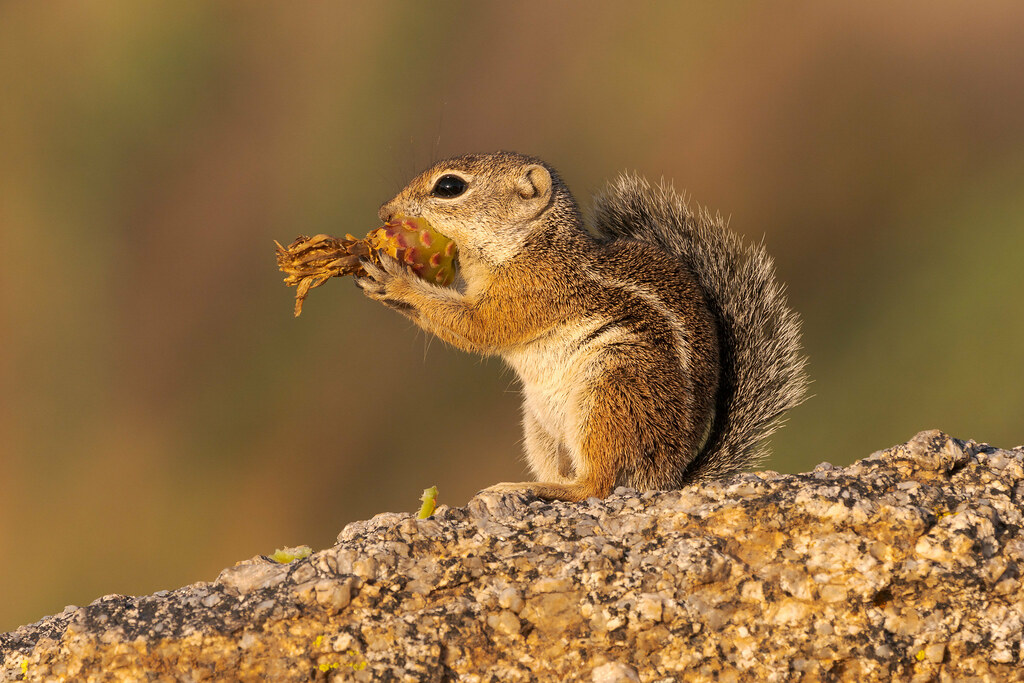
A Harris’s antelope squirrel eats a cactus fruit (not sure what kind, compass barrel cactus perhaps?) by sticking its face into the center of the fruit.

I like to think I’m a man of my word but I suppose we all have our limits. Last weekend I hiked out to Balanced Rock for the second time and after taking some pictures noticed in the distance the head of a spiny lizard sticking out from a rock, much like this desert spiny lizard on the Rustler Trail. It was far off and in the shadows but seeing the shape and that the head was darker than the surrounding granite I thought “If that isn’t a spiny lizard I’ll eat my hat.”
I lifted the telephoto lens to my eye to be sure. It wasn’t a spiny lizard. I tell you, the granite can be cruel.
But I didn’t eat my hat.
This spiny lizard is the same as in the linked picture but from the other side of the rock and in different lighting. The granite was in a kinder mood.

I love having pictures of my cars at the places I hike but I almost never remember to take them. This photo at Granite Mountain Trailhead in McDowell Sonoran Preserve (the park I visit most here in Arizona, though I usually go to the Brown’s Ranch Trailhead) joins my pictures from Ridgefield National Wildlife Refuge (the park I visited most in the Northwest), Mount Rainier National Park, Olympic National Park, Redwood National and State Parks, and our home in Portland where Ellie and I started our walks through our wonderful old neighborhood of Irvington.
I bought the Crosstrek new when they arrived in America in 2012, it was the perfect car for me in the Northwest and still a pretty good fit for me in the Southwest. Now that I’m back to driving to work I would like some of the technology available today, especially adaptive cruise control, blind spot monitoring, a better stereo, and Apple CarPlay. I’ve toyed with the idea of trading it in for an electric or plug-in hybrid as my commute could be done either entirely or mostly in electric mode with a plug-in, I’d love the quieter operation. Some of the electrics allow you to pre-cool the car remotely which would be nice when I leave after work (and even before work in the summer) and especially when I’m returning from a morning hike. But I love just about everything else about this little car, it still puts a smile on my face when I get in, so I’m not yet ready to surrender the keys.

A black-tailed jackrabbit eats from a buckhorn cholla, one of the types of cactus commonly seen in the Sonoran Desert.
 Boolie