In case you were wondering what a white-winged dove looks like when it isn’t plunged headlong into a saguaro blossom, here you can see most of the bird apart from its feet. The golden color to the entire front of its head is from pollen, making readily apparent how the birds pollinate the saguaros as they stick their heads in the flowers from one cactus to the next. Much to my delight white-wings are one of the most common birds in our backyard so I get to see them every day of the week.
Tag: Sonoran Desert
Face Full of Flowers
A white-winged dove sticks its entire face into a saguaro blossom as it feeds. It’s face was covered in pollen, as were many of the birds in my pictures from this time, such as the Gambel’s quail below. The birds and bats and bees took full advantage of the suddenly plentiful blooms, dining quickly as they flew from one flower to the next, pollination in action. The blooms are mostly gone now, this morning I saw only two flowers during several hours of hiking, and one of those was pretty wilted.
Comings and Goings
I first learned of the Harris’s antelope squirrel from a sign on the Bajada Nature Trail a couple of weeks after we moved here, and funnily enough got my first brief look at one just a few minutes later. After seeing one of the little ground squirrels up close on the Vaquero Trail I did a little research to learn if their home range was small (it is) and if they liked to look out from higher vantage points like the one I had observed (they do).
Knowing that, I decided to hike the Vaquero Trail again and kept my eyes peeled when I approached the area of my previous sighting. And there it was up on the rocks! Up on a small hill it had a complete view of its surroundings and would have seen me before I saw it. Unfortunately I had forgotten my 100-400mm lens at home but I returned the next morning and there it was again! I had settled on using my Canon 100-400mm lens with a 1.4X teleconverter as my wildlife hiking setup, which presented a problem, as on my Canon body I could only use the center focus point, and the autofocus wasn’t that reliable in low light. Attached to my Sony body the autofocus was sometimes quick but not reliably, but I could also use it for video and for manual focus.
I shot the squirrel with both setups, starting with the Canon before switching to the Sony. Fortunately the AF was working well when a second squirrel popped up behind the first! The experience cinched a decision I had been mulling for a while now and that afternoon my wife and I went down to Tempe Camera and purchased the Sony 100-400mm lens and Sony 1.4X teleconverter. The new lens proved its mettle as soon as I arrived at the preserve the next morning, and on multiple hikes since, but those are stories for another day.

Sunrise Falcon
The alarm went off at 3:41 a.m. this morning, the start of a three day weekend. I’ve been a bit worn out and my stomach has bothered me a couple of days this week but I nevertheless crawled out of bed, if a bit reluctantly, as high clouds were predicted instead of the usual clear skies and I was curious to see what the sunrise might bring. I was on the trails before the sun but it looked like there wouldn’t be much color in the skies as the sun rose, and there wasn’t, save for one small portion of the sky. Unable to get the picture I hoped for I instead took my delight in the serenity of the desert morning.
Heading up the Vaquero Trail to where I had seen antelope squirrels the week before I stopped when I saw an American kestrel perched on a saguaro in the distance, one leg held in the air, silhouetted against the patch of orange sky. The little falcon didn’t stay long nor did the color but I got my sunrise picture after all, just not the one I was expecting, the first of several surprises the desert had in store for me this morning. The little appendages sticking out from the saguaro are spent flowers on top of the fruits developing below, handy perches above the cactus spines.
Mother’s Day Bouquet
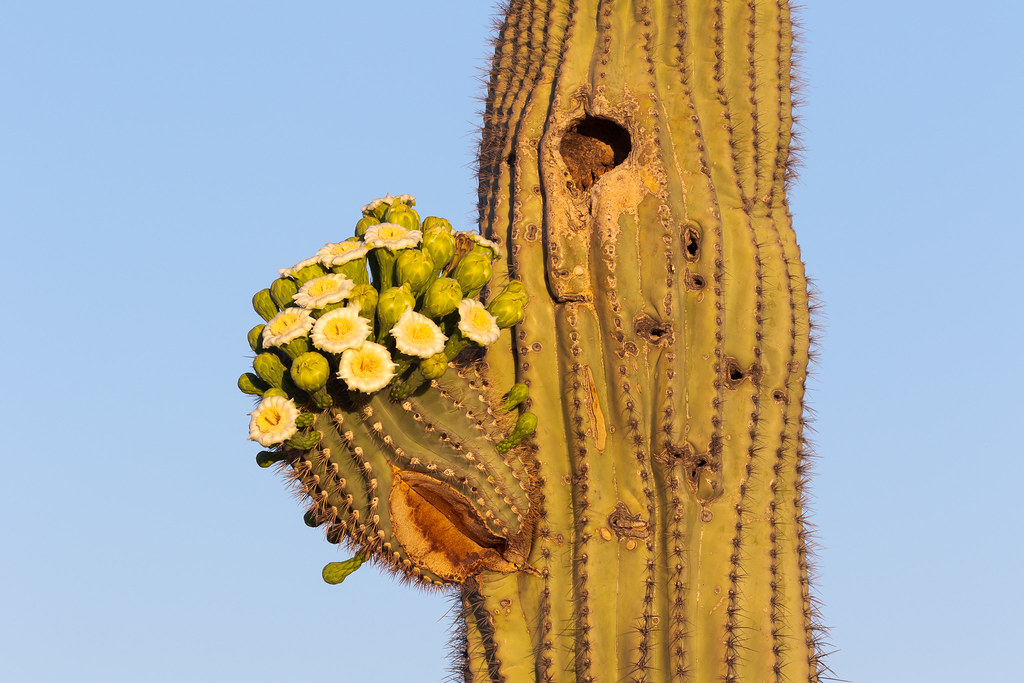
This saguaro offered up a bouquet of flowers near sunrise on Mother’s Day. I had hopes of photographing it again with all the flowers open but by the time I could return the following Saturday, all of the blossoms were gone and I learned another fact about my new home. The flowers only last about a day, first opening at night to attract bats with their nectar and closing the following afternoon after the bees and birds have had their fill. If pollinated during that short window, the fruit below will develop during the summer.
A Tale of No Tail
This lovely little creature is a common side-blotched lizard. It doesn’t get a fun name like the Gila monster but the name is descriptive enough, they are both common and have a dark spot right behind their front legs (making them one of the few lizards I can currently identify). What you might notice once you can get past its beauty is that it is missing its tail. Many lizards can shed their tails if a predator grabs hold of it, remarkable in and of itself, but even more remarkably the tail can regrow (potentially with different coloration than the original).
Putting Down Roots
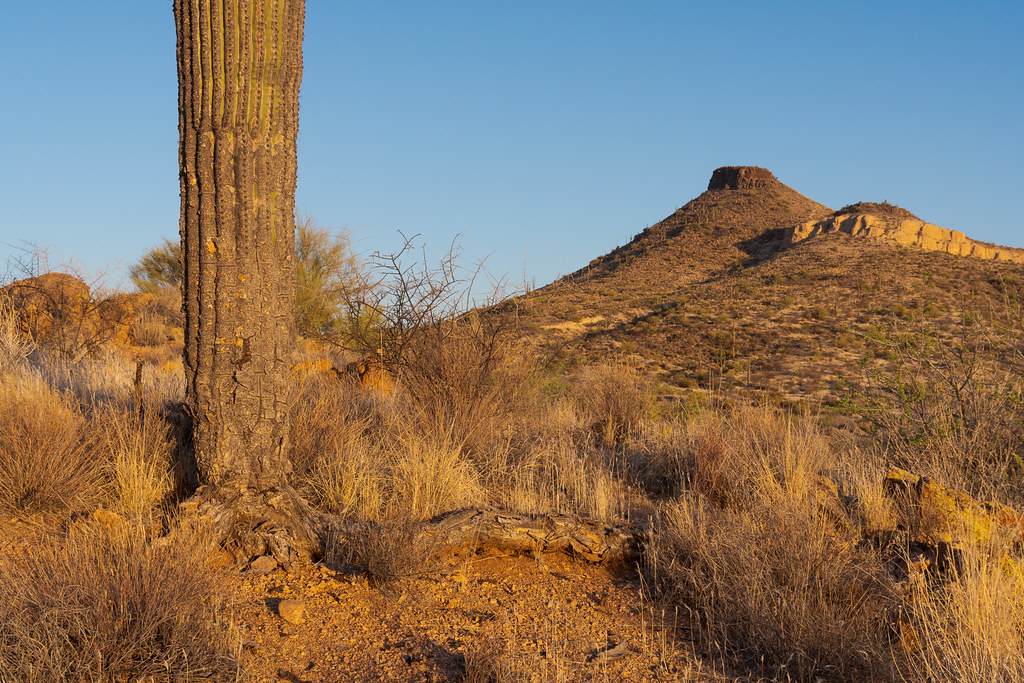
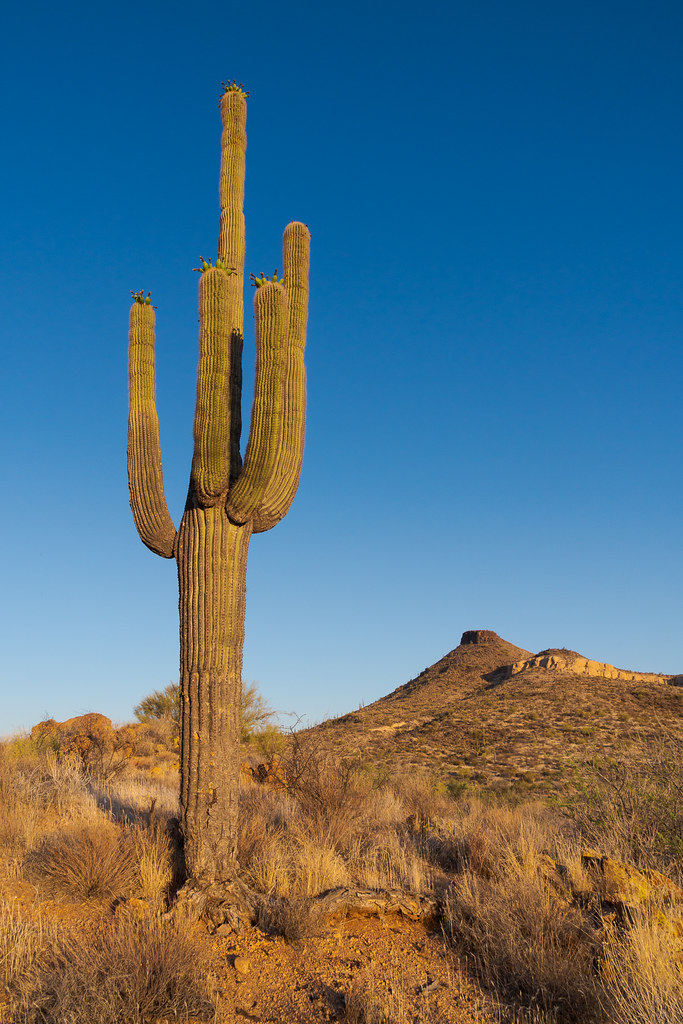
My first impression after hiking with saguaros was of redwoods. Of massive lifeforms with an outsized impact on their environment. Of warriors, long-lived giants, their struggles written on their skin. Yet for all of that a surprisingly shallow root system. Saguaros have a central tap root that grows down but the rest of their roots radiate outward a handful of inches below the surface, soaking up every bit of rainwater they can. Sometimes erosion exposes these shallow roots, as on this old saguaro at sunrise on the Vaquero Trail, Brown’s Mountain rising in the background.
No Time to Rest
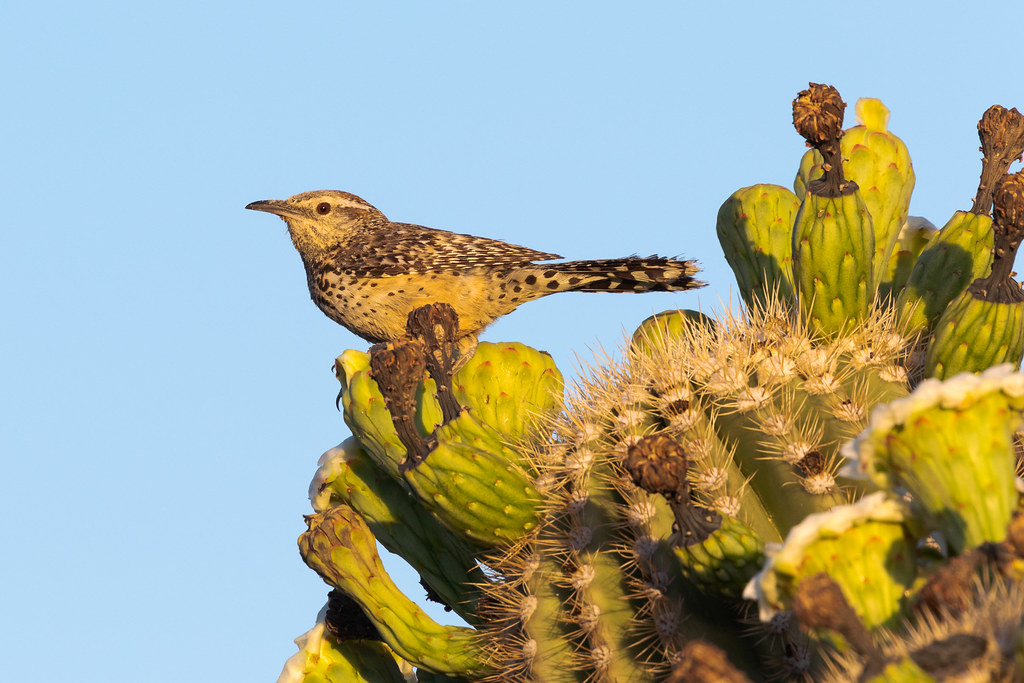
A cactus wren paused momentarily above its nest (not visible) while it and its mate constantly flew in and out feeding insects to their young. They were comfortable with my presence so I was able to watch them for a while as the sun quickly rose but I didn’t take many pictures since they paused so briefly. It’s face is covered in pollen from saguaro blossoms, I had seen several other species of birds face down in the flowers but the wrens seemed too busy feeding their young to feed themselves. The next week I did witness one quickly eating from a blossom but they didn’t take the time to gorge themselves like the finches and doves and quail.
As worn out as I am I’ve been getting up before sunrise to hike on all my days off as these springtime activities will soon be but a memory. The heat is quickly rising, summer will quickly follow, then it will be time to rest. Or at least nap, I’d still like to hike as much as the temperatures allow.
Calling Me Home
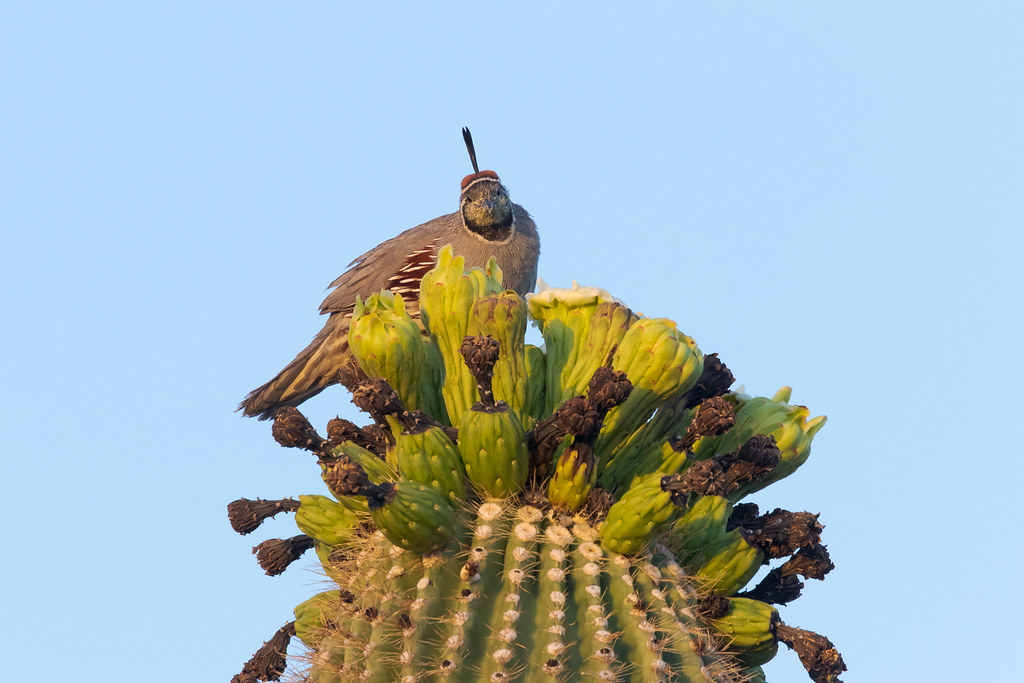
One of the birds I most wanted to photograph when we arrived in Arizona was the Gambel’s quail. Not because they are rare – we saw them in the neighborhood when we were looking at our rental house – but because they called me home. It was our vacation in New Mexico a decade ago that got me excited about living in the Southwest, and my encounter with Gambel’s quail there was one of the highlights of the trip, their serenade at sunrise. So it was a special delight to photograph this male and female up on the saguaros as the sun rose, dining on the cactus blossoms, in our shared desert home. Home in a larger sense, though I see them every day in my backyard these quail were at Brown’s Ranch in McDowell Sonoran Preserve.
Almost Ended in Tears
Moving to Arizona has required a number of minor adjustments to my clothing and gear. I dress up a bit more for work here so I had to get all new work clothes. Our rental house has a pool which meant ordering swimsuits, swim shirts, goggles, and towels. The desert meant meant a new hat designed to shed heat (and a second one I just ordered to stay in the car for days like today when I forget mine), new hiking shoes, new socks, and an extra pair of hiking pants. More water bottles. Shorts to wear around the house.
I think it’s about to force one more change, a more major one, at least in terms of expense. On the auto tour at Ridgefield I mostly used my big 500mm telephoto lens, but that’s way too heavy for hiking for hours in the desert. I’ve been using a lens I adore, my Canon 100-400mm zoom, and the Canon 1.4x teleconverter. The weak link is the camera I have to attach to, my Canon 7D II, a camera which in general I like apart from it being an SLR instead of mirrorless, the lack of an articulating touch screen, the weight, and the poor video (I do like it, it has many good points). But now there’s this: the autofocus works great with the 100-400 by itself but not with the teleconverter attached.
It’s not useless, and I’d put up with it if I had no choice, but a while back Sony introduced a similar 100-400 lens. The autofocus on my Sony camera would work well with the lens even with their teleconverter attached, plus I’d avoid the problem that almost cost me this shot: the optical viewfinder. I had been shooting this Harris’s antelope squirrel in the shade when it bounded across the trail and climbed this bush to survey the landscape. I was shooting in manual to deal with the difficult exposure but forget to change the settings for the sunlight the squirrel was now in. This would have been obvious in a mirrorless camera, fortunately I eventually realized my mistake and got a picture before it climbed back down.
It would mean switching to the Canon for wider angles until I have a second Sony body (I’d wait until they bring out an upgraded version of what I have now), which will mean more weight in the short term, but in the long term both less weight and a better fit for how I hike in the desert.