Savannah Stretches

A savannah sparrow stretches while perching on a cattail at South Quigley Lake in Ridgefield National Wildlife Refuge in Ridgefield, Washington on October 1, 2017. Original: _DSC0640.CR2

These pictures remind me of spring as I so loved sitting beside a lush meadow and listening to the savannah sparrows sing. They were taken in the fall though, the green backdrop courtesy of the wonderland that is the Pacific Northwest.

📷: Sony A6500 | Canon 500mm | Canon 1.4X
🗓️: October 1, 2017

A savannah sparrow perches on a cattail at South Quigley Lake in Ridgefield National Wildlife Refuge in Ridgefield, Washington on October 1, 2017. Original: _DSC0610.CR2

A Welcome Return

A male phainopepla stretches while perched atop an ocotillo on the Chuckwagon Trail in McDowell Sonoran Preserve in Scottsdale, Arizona on October 27, 2023. Original: _RAC9485.ARW

I would have thought most desert animals would go into hiding during the hottest months and only emerge when the temperatures cooled but for some of my favorites it’s the other way round, so the arrival of more comfortable weather carries some sadness alongside. A notable exception are phainopepla who fly in for the fall and fill me with such delight, they’re here in numbers now and quietly encourage me on my hikes from many a palo verde or ocotillo. Yesterday this male was stretching and showing off the white bars on the underside of his primary wing feathers, I almost got a shot with his wings fully extended above his head but the tiny buffer on my Sony filled and it couldn’t take any more pictures.

Morning Calisthenics

A northern harrier stretches its wings backward while perched on a stump I called 'The Cactus Tree' at Ridgefield National Wildlife Refuge in Ridgefield, Washington in December 2009

A northern harrier stretches its wings on a foggy winter morning in 2009. I had seen it an hour earlier in this same spot but I don’t know if it spent the hour there or only returned to a favored perch. I’m happy I got some pictures of the stump I called “The Cactus Tree” as in subsequent days it fell over into the swamp.

Home in the Heights

A Harris's hawk nestling spreads its wings as it practices for flight by moving from one arm of the saguaro holding its nest to another, taken at sunrise on the Chuckwagon Trail in McDowell Sonoran Preserve in Scottsdale, Arizona in June 2019

When I hiked to this Harris’s hawk nest back in June I noticed one of the chicks had fledged and this one was getting close, practicing by hopping from one arm of the saguaro to another, already at it when I arrived before the sun was even up, with the adults occasionally bringing in something to eat. I nicknamed it Trixie as it would eat just a few bites before returning to flight practice, then go back for a few bites, much like our youngest cat who likes to nibble at her food then play play play, repeat repeat repeat.

In the low light before sunrise, knowing it would be hard to freeze the motion of the young bird constantly on the move, I did what I had been meaning to do on several previous visits, zoom out to give a view of the saguaro holding the nest. The cactus doesn’t have the classic look of the tall central spire but does have an ample space to hold the nest. If you look at the teddy bear cholla in front of the saguaro (the light colored cholla in between the darker buckhorn cholla) there’s a nest of a smaller bird.

An environmental portrait of a Harris's hawk nestling practicing for flight by moving from one arm of the saguaro holding its nest to another, taken before sunrise on the Chuckwagon Trail in McDowell Sonoran Preserve in Scottsdale, Arizona in June 2019

I was rather surprised when we moved here to see so many birds nesting in the various types of cactus as it seemed a rather inhospitable place to build a home. But it must give them a fair amount of protection from ground predators that can climb trees but can’t deal with the cactus spines, but if a fledgling falls from the nest it doesn’t have far to fall. Contrast that with the red-tailed hawk’s nest I saw up on the canyon walls, where a slip off the narrow ledge would result in a deadly fall, or the bald eagle’s nest in Washington that was high up in a massive tree.

I had intended to hike past this nest on the Chuckwagon Trail and then take a familiar loop back to the car, but after spending the first part of the morning watching this young bird building its agility and its confidence, I got distracted by a handful of lizards in a rock formation just up the trail, so with the morning wearing on I just took the Chuckwagon back to the trailhead. Although I didn’t get as much exercise as intended it was a positive result, Ellie had died two months earlier and it was a sign of how much I had healed that I could sit still for so long, an impossibility in the weeks after she died.

The Morning Stretch

A Harris's hawk stretches while perching on a dead tree, surrounded by palo verde blossoms fore and aft, near the Chuckwagon Trail in McDowell Sonoran Preserve in Scottsdale, Arizona in June 2019

I met this Harris’s hawk shortly before sunrise, it was mostly sleeping perched high in a dead tree. With the palo verdes blooming, there was one spot on the trail where if I lowered my tripod to a particular height I could frame the hawk using blossoms on trees between us and blossoms on the trees behind. The picture is a bit of a lie in that it gives the impression the hawk is in a dense section of trees but in truth it was in the open, I’ll post other pictures later that give a more accurate depiction of why it chose this perch.

I framed the shot for the pose when the hawk was resting but when it suddenly stretched after the sun came up most of the time its head was obscured behind the yellow blossoms, up until it reached the peak of its stretch and it came into full view again, showing off its chestnut shoulders and legs and the large white patch at the base of its tail and the white strip at the tip. I thought it was going to go to the bathroom, birds often do before they take flight, but it was just a morning stretch. Do all animals have their equivalent? Our cats do it after waking up from a nap, our dog Ellie did too and something about it always made me laugh.

Decision Time

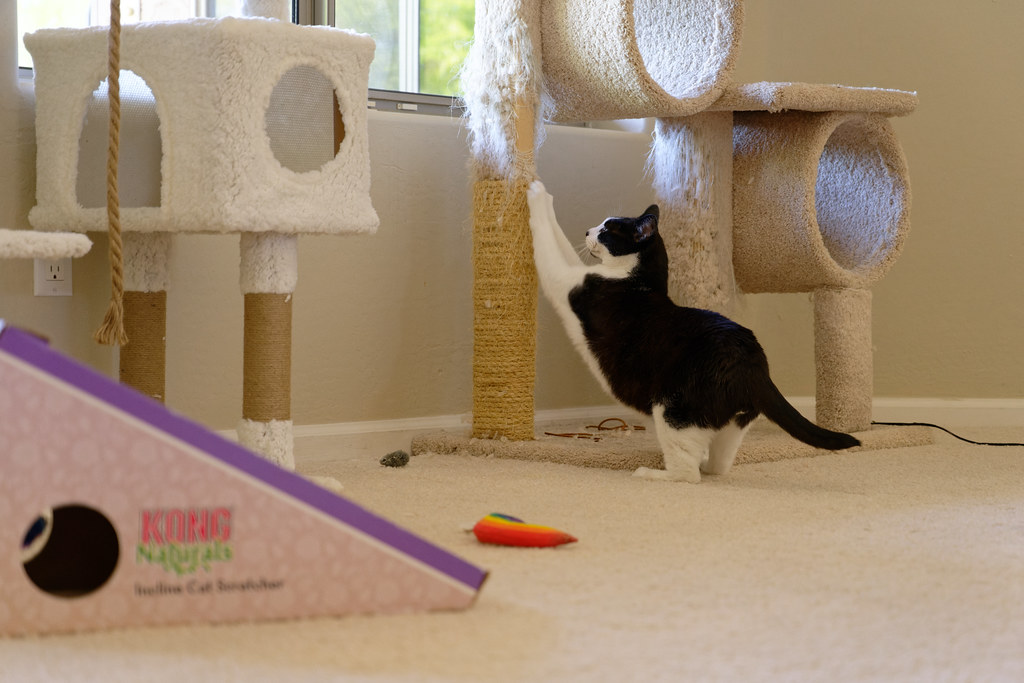
Our cat Boo stretches out on top of the cat tree

Back in June I pre-ordered Sony’s just announced A7R II mirrorless camera, guessing that its ground-breaking features might otherwise make it hard to come by in the early days, but also knowing that I had plenty of time to cancel before it shipped in August. I got an email from Amazon that the camera is going to ship in the middle of the week, the first date they are available in the US, so it’s time to decide if I should cancel or not.

I expected there would be plenty of reviews by now to help me make up my mind (the camera is already shipping in the UK for crying out loud) but the non-disclosure agreements must not be up until later in the week because there has been little information available since the initial announcement. I think Sony is even holding a press event here in Portland on Wednesday but reclusive cat bloggers must not have been high on their invite list.

I’ll sleep on it but I’m leaning towards canceling the order given the expense (I’d switch all of my non-wildlife shooting to Sony’s system). But I’ve been flip-flopping all over the place the past week as while there is much I like about my little Canon M, there is much I don’t, and the Sony solves some of my biggest complaints with the M.

For example, I grabbed the M this afternoon when I saw Boo stretched out and about to fall asleep on top of the cat tree, as it nicely contrasted how differently he sleeps than tidy little Scout who preceded him, but I had to stand scrunched in the corner of the room with the camera near my heart, snapping pictures before he changed his pose. The camera’s buffer fills quickly so I couldn’t take a shot when he yawned, not that the slow autofocus could have tracked him, but without image stabilization even this static shot yielded a bunch of unsharp pictures and thankfully one sharp one.

The Sony has built-in image stabilization, a high-res full frame sensor that would allow faster shutter speeds, is more responsive, and has a much better autofocus system. It can also do nice video (4K even).

But that price tag …