I rarely get to see rough-legged hawks but it’s such a treat every time I do, I love their coloration. I think this one from 2004 may be a juvenile, four years later I got to see an adult on several occasions and wondered if it was the same bird. Sadly I haven’t gotten a good look at once since.
Blog
The Approaching Light
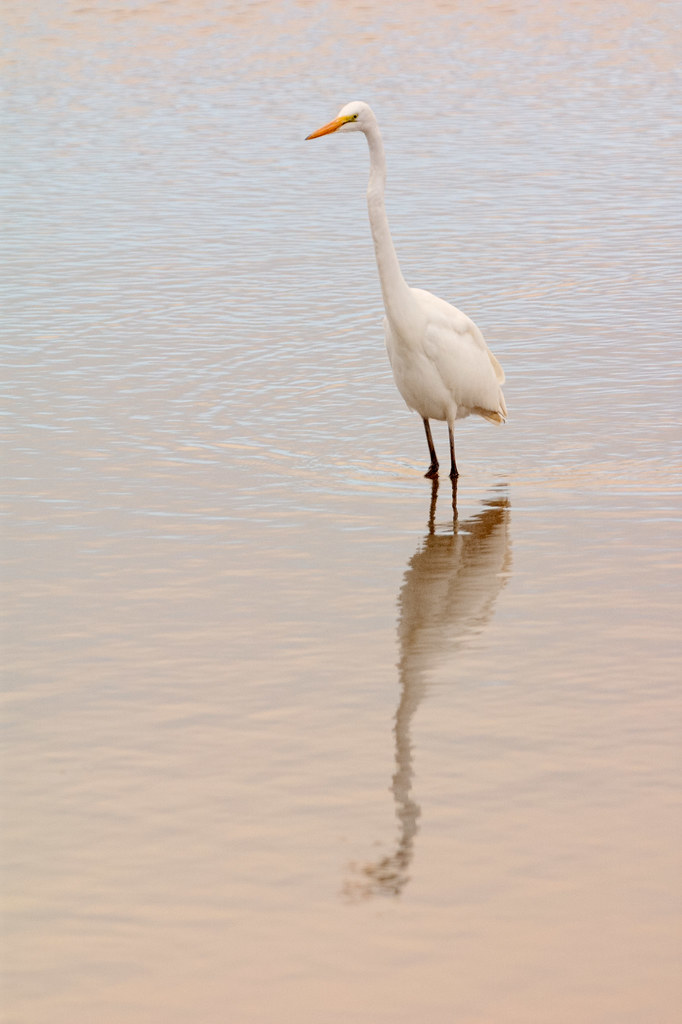
A cold snap at the end of the year meant the new year dawned to frost and ice. I started New Year’s morning the way I had New Year’s Eve, watching egrets and herons at Ridgefield. I had arrived before the sun and had been sitting watching this heron when I was struck by how the rising sun was already illuminating the far side of the marsh. Within minutes it would crest the hill and bring us the warmth of its light as well.
As I watched the animals that morning I knew our sweet little cat Emma was in a fight for her life but I didn’t know we only had a week left together. And of course I couldn’t know that on this day, or perhaps a day or two before, a little kitten was being rescued far away in southern Oregon, and that a few weeks later she’d be transferred to Portland and welcomed into our home, bringing us light at the end of a dark and depressing month.
The Ice Walker
I love photographing coots, one of the most commonly seen birds at Ridgefield, as I find it fascinating how they do many of the things that diving ducks do yet their bodies differ in many ways. I was shocked the first time I saw their almost comically large feet and was surprised to see that they aren’t webbed like a duck. We had a cold snap to start the year and some of the smaller ponds froze over, leaving the coots a bit exposed as their best defense against an aerial eagle attack is to dive under the water.
My Former Home
When we lived near Salem, Baskett Slough was my home refuge and the place I visited the most. In fact it may have been the first place I visited after we moved to Oregon but my memory is a little fuzzy on that point. However I’ve rarely been back since we moved to Portland as it’s now quite a drive, and my allegiance has shifted across the Columbia to Ridgefield.
Sleepmate
Circle Feeding
Sam in a Sunbeam
Sam enjoys the warmth of the sun as he naps in our living room.
Our snuggly Sam has mostly returned to form after a difficult couple of years when he lost both of his older sisters, he has been glommed all over me this weekend and when I get up steals my spot, then when I return lets me pick him up and he goes right back to snuggling. The one thing we’re working on is that he’s not ready to let his new sister Trixie snuggle up with him. Bless her heart, she keeps trying and will approach submissively so he can lick her head, but he’s still rather agitated and will end up nipping her and moving away. There has been some progress and I think he’ll come around, we’ve had some snuggly cats before but Sam is in a class of his own. I think he’ll appreciate the extra snuggling partner that he hasn’t had since Scout died.
The Trixie Marmot?
Looking back at these Olympic marmot pictures I was struck by how they resemble our tortoiseshell cat, Trixie. In cats the mixed brown & black fur pattern can occur in females (or rarely in males with two XX chromosomes) where the primary color varies randomly from cell to cell, but in the marmots I think their coats are changing from light brown early in the season to dark brown near the end, and the marmots I saw on this occasion in the fall were in the process of transition.
The Olympic Marmot
I’ve only ever seen Olympic marmots once, near the road on the way back from Obstruction Point after a day of hiking at Hurricane Ridge. The marmots are endemic to the Olympic Peninsula in Washington, the National Park service has more info if you’re interested.