The past couple of years I’ve been watching some old movies I haven’t seen before, using Turner Classic Movies to catch up on some old gems. Last night I TiVo’ed Ingmar Bergman’s “The Seventh Seal”, which has been on my watch list for some time. I haven’t watched it yet and since I try to not find out anything about a movie before I watch it, even the basics of the plot, I don’t know if the movie is about harbor seals, elephant seals, or leopard seals. With seven seals, maybe all of them! Can’t wait to find out!
Blog
Legs Up, Hands On Hearts!
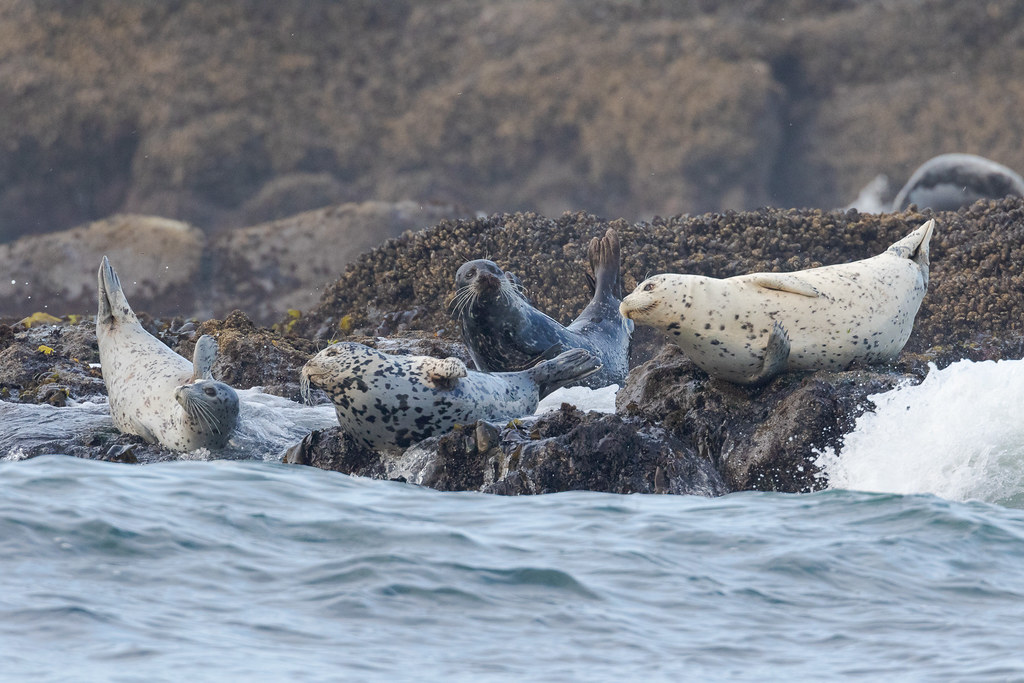
The rising tide brings waves that overwhelm the sleeping locations of the harbor seals, eventually sending them into the water. The bigger seals often held the ground that let them sleep the longest while the younger seals took the first brunt of the wave action. As each wave swept past, they’d raise their legs in unison, allowing the water to sweep over their bodies instead of knocking them into the sea, though in the end the water always wins.
I could spend hours watching the seals, relaxing on land or swimming in the sea, someday I’d love to spend more time in the area. A couple of years ago when it was time to choose between two job offers, the job in California would have put me relatively close to the coast with not just harbor seals but other mammals I haven’t seen before. If the cost of living had been swapped between the two locations perhaps we’d have gone on a different adventure, but thankfully the Sonoran Desert had its own wonders in store.
At Home
A male harlequin duck swims in the crashing surf at Yaquina Head on the Oregon coast, he was not caught unaware in this chaotic environment as this is where he likes to live. It was a delight to watch the ducks thrive in the surging seas alongside the harbor seals, two species so completely different and yet living side-by-side peacefully.
Three Predators: Ash-Throated Flycatcher Edition
An ash-throated flycatcher was about to land in the arms of this saguaro when it noticed the two fuzzy heads in the nest and did a mid-air about face and returned to the trees below. Flycatchers are built to snare insects on the wing so aerial acrobatics are second nature to them. Through it all the saguaro has fruit bursting open up top, offering up both its red pulp and its many seeds to all willing to risk flying above the hawk’s nest. Death comes in many forms in the desert, but so too does life.
Three Predators: Loggerhead Shrike Edition
A loggerhead shrike jumps from the top arm of a saguaro to try to catch some small prey moving about in the desert below. Oblivious to it all, inside the big nest of sticks are two fuzzy heads barely able to hold themselves up, young Harris’s hawks who can’t much move about the nest much less the desert. The shrike is no threat to the youngsters or it wouldn’t have been allowed this close, as unseen in the picture are three other predators, an adult hawk not visible from my vantage point but sitting atop a saguaro nearby, and two more high up on a transmission tower a ways behind me with an expansive view of the desert and any threats that might approach. An adult had been on the nest at sunrise but had left presumably to hunt while the rest of the family kept an eye on their newest arrivals.
Changing Elevation
As the seasons pass some animals change elevation seeking temperatures more to their liking, Samwise no exception. With the full heat of summer coming on our snuggler extraordinaire will often come in for some affection and then flee to the tops of the cat trees where he can stretch out and cool off a bit. Trixie feels no such migratory urges and the little furnace has been stretched out along my legs all morning as we watch Formula 1 practicing in Austria.
There Are Yardbirds, and There Are Yardbirds
A young Harris’s hawk perches atop a house in our neighborhood in April. Last year I noticed all the yardbirds scatter in an instant when an adult landed on our back fence. Hopefully enough green space will remain that the hawks can stay as more and more of the area gets turned into subdivisions, as our neighborhood must have a couple of decades ago (we were settling into our lives in Oregon back then).
Time to Leave
I was nearing the end of my hike when I saw a colorful stick lying across the path. At first delighted as I knew it was going to be a new snake species for me, my heart sank as I approached and it didn’t slither off into the grass. Afraid it had gotten run over, I was a bit confused when I saw its head, mostly hidden in the grass (not visible in this picture), as its eyes were open and bright. I laughed to myself, wondering if it was like when we adopt a cat and at first they hide under the bed, only their tail is sticking out giving away their position. The rear of its body covered so much of the trail that I felt I had to convince it to move along as this trail is heavily used by cyclists who wouldn’t likely see it in time to avoid it. I saw a dried yucca stalk in the grass and thought to tap it nearby, but just the sound of pulling the stalk from the grass sent the snake on its way. I whispered my apologies for having to startle it but best to find a safer place to warm up in the morning light.
This was my second snake sighting this year and my first ever of this species. I don’t know my snakes well and initially thought it was some type of garter snake based on its long thin body adorned in stripes, but something about the shape of its head seemed off. Upon closer inspection (in pictures, not in person) it has a large triangular scale at the front of its head, perhaps an aid when looking for reptile eggs to eat.
Hallelujah Arms
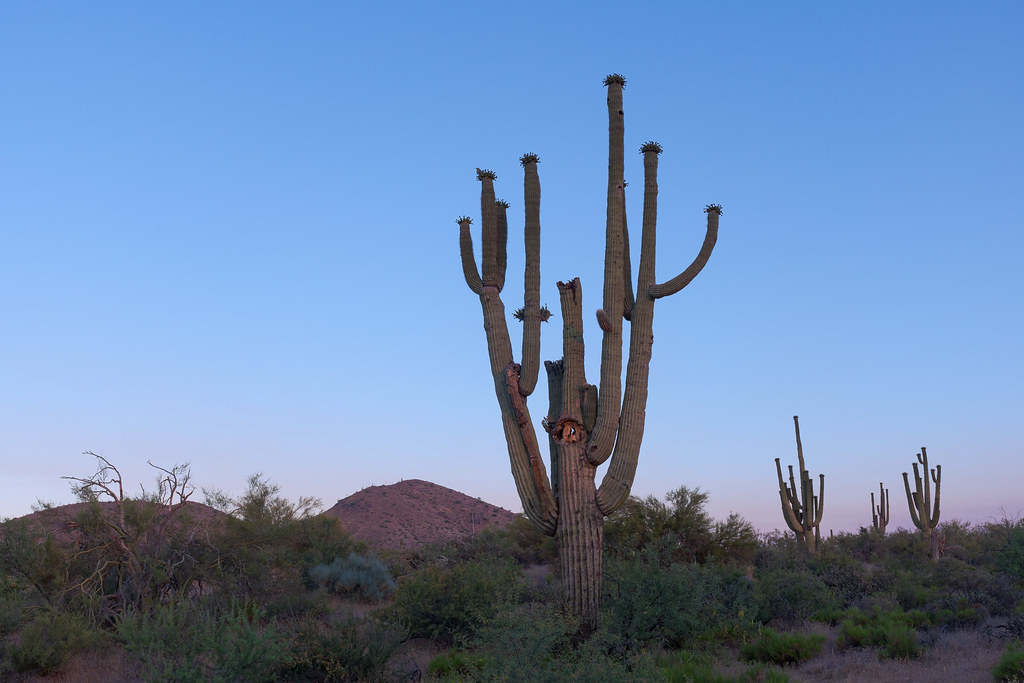
The rising sun illuminates a battered old saguaro, some of its arms shattered in half and some broken off altogether. But it still has a host of hallelujah arms raised towards heaven, all now fruiting and not just hopefully starting new life from its seeds but sustaining the lives of others with its fruit, a prized treat for many birds. In the picture below, taken just before the sun rose, a curve-billed thrasher feeds atop one of the taller arms.
In Death, Supporting Life
Nighthawks were a new species for me when we moved to Arizona. I see them relatively often near the break of day, zooming about low to the ground in erratic flight like massive swallows. When sitting still they can be pretty hard to spot and usually I only manage it if see them land, as in this case when a dead cholla lended its support on a spring morning.