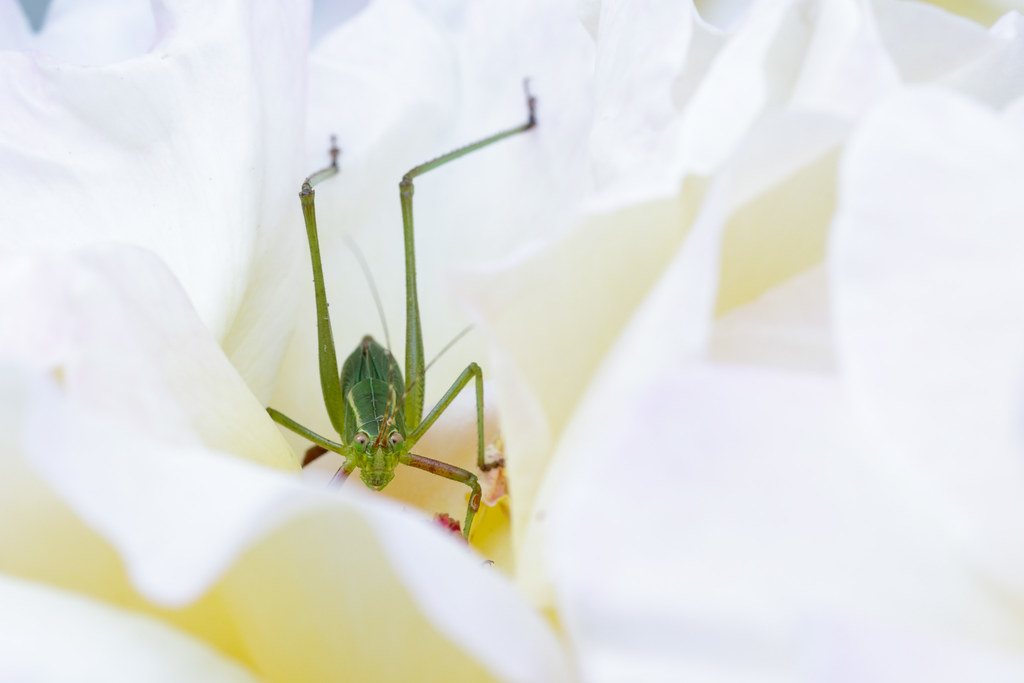
A rose blossom provides both food and sanctuary for an adult katydid.
Scratcher of heads, rubber of bellies
A rose blossom provides both food and sanctuary for an adult katydid.
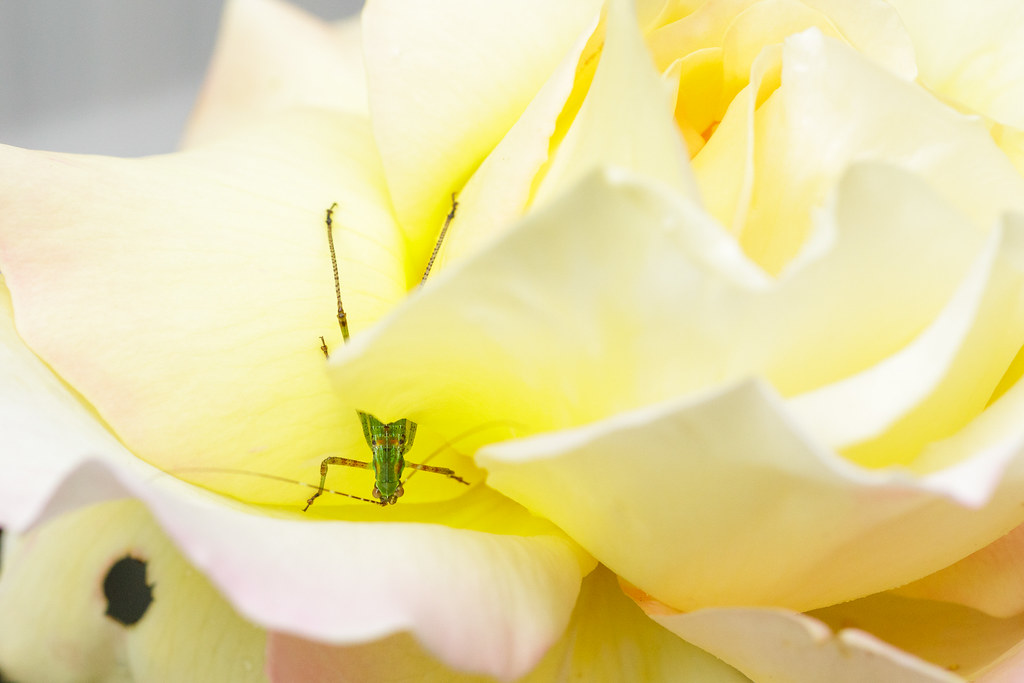
Calisthenics are an important part of a young nymph’s life if it wants to grow up to be an adult katydid.

This fork-tailed bush katydid nymph isn’t large compared to most of the wildlife I shoot, but compared to the aphid that’s walking underneath it, it’s gigantic.
Portland is known as the City of Roses and decades ago a prior owner planted a bunch of roses in our backyard. I’ve always been a bit torn as to whether or not I should keep them. I’m not a huge fan of roses themselves, although we have one variety in particular that I think creates a lovely flower. Some of them aren’t doing so well, but even those that are thriving often get leaves covered in black spots, a consequence of a fungus that thrives in our climate. There’s a natural pesticide that can keep it under control but when possible I prefer to not use pesticides.
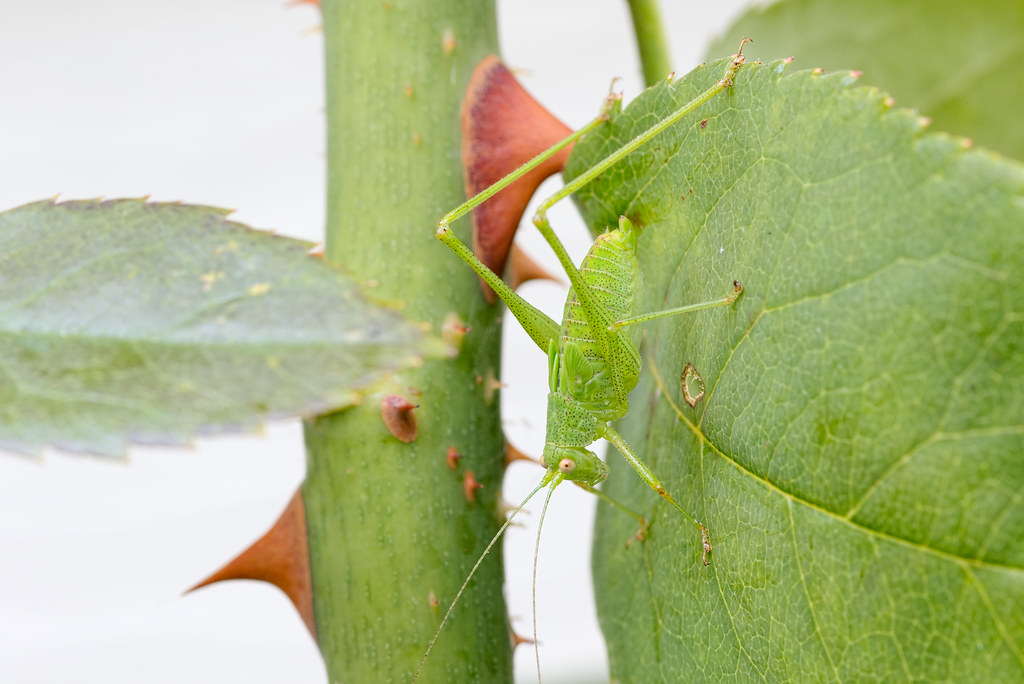
My favorite thing about the roses is the katydids that sometimes live there in the summer, in July we had a handful in one spot, from fairly young nymphs to an adult. The nymphs go through several stages, this female is easily recognizable as a katydid but she is only starting to grow her wings. When full grown they’ll stretch down the length of her body (as you can see on this adult female from last year). When I see one on a bush, I leave nearby spent flowers a little longer than normal so that my friends will have plenty to eat.

I’m not a big fan of roses even though we have a bunch in our back and side yards. I often think of digging them up and replacing them with something both more to my liking and a better fit for our climate, and may do it yet, but I do like that they sometimes host an insect I love to photograph, the fork-tailed bush katydid. I found this male nymph on a rose bush along with several other katydids, two that were younger and one adult. This one was pretty large but still had short little wings. I’ve photographed them multiple times over the years but only now noticed that they don’t stand on the tips of their feet, but on pads further up.
I took a picture from behind as well as it shows the fork that gives them their name (both the top and bottom are forked but the name refers to the top). There are other katydids with forks but this is the only one in Oregon.


I normally like to photograph the insects and flowers in our garden the same way I shoot animals and plants when I’m hiking, which is to photograph them how I find them. In this case though the water drops on this katydid came not from rain but from me. It’s been a brutal summer here in Portland so even though our plants our drought tolerant to deal with the normally dry Northwest summers, I’ve been giving them an occasional drink of water since they missed out on the rains that usually last through June.
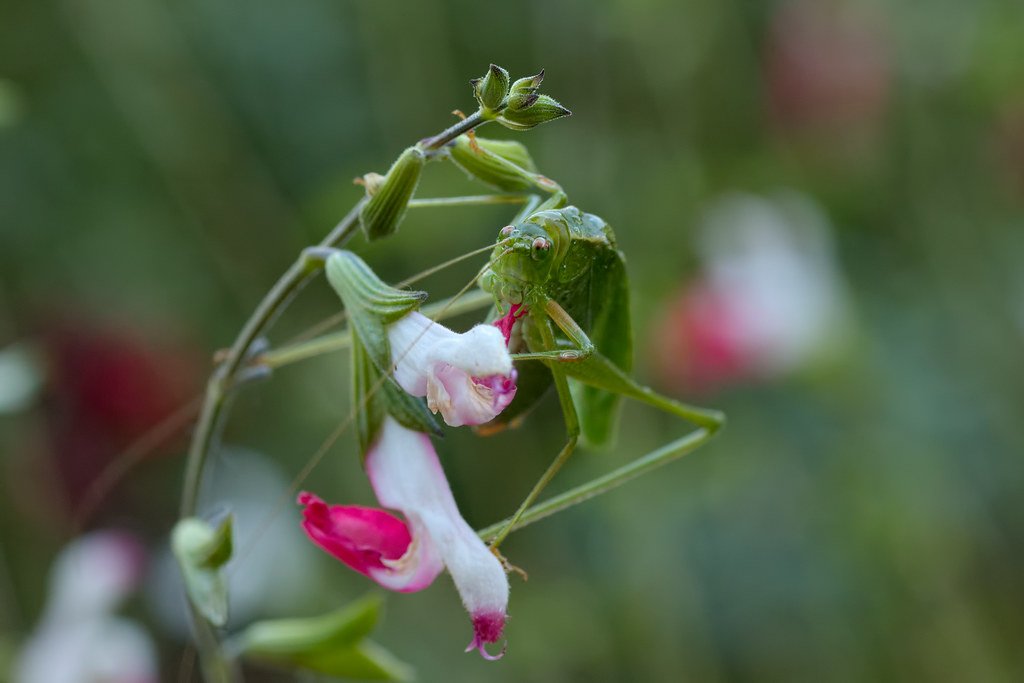
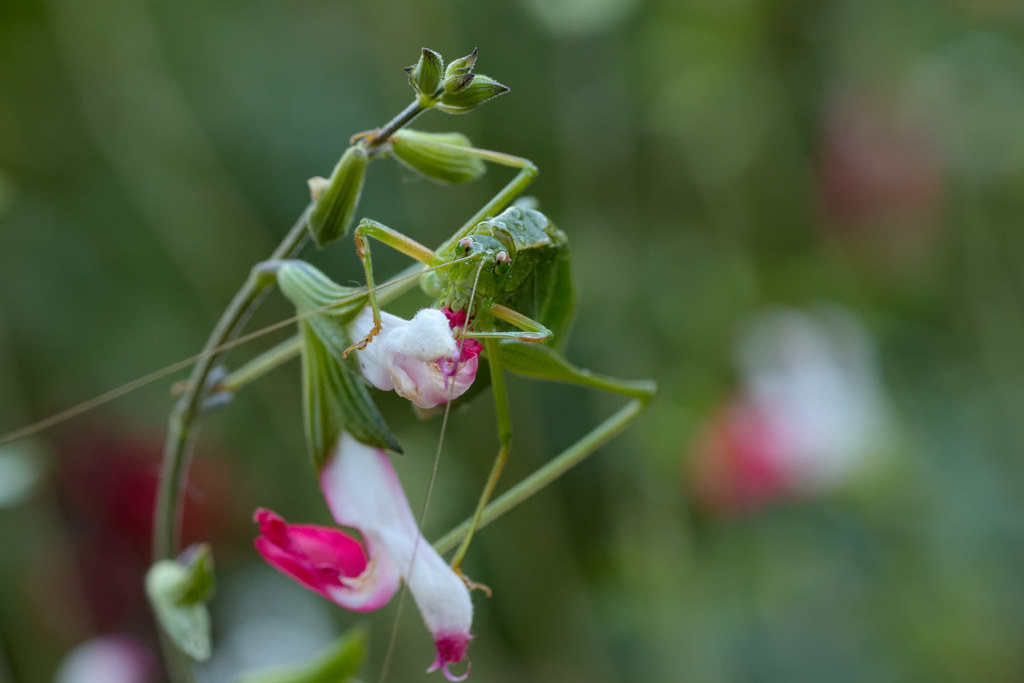
While watering the wildflower garden I saw something jump from the plant I was watering into our bee balm. I dropped the hose and ran over to see what it was, expecting a moth, and was delighted to instead find my favorite insect to photograph, a katydid. I had the chance to photograph them from 2006 to 2009 but hadn’t seen one since, so I put aside the watering and ran inside to grab my camera and tripod and macro lens and try for some pictures, even though the breeze was going to make things difficult.
I was a bit crushed when I got back to the bee balm and discovered the katydid was gone. But it hadn’t gone far, as I saw it moving on the nearby salvia and settled in for some pictures. In the top picture it is about to jump from one branch to another, its two front legs in open space balancing in the wind while the back four maintain purchase on the salvia. In the bottom two pictures it is using its mandibles to cut off pieces of the flower to eat. It was hard to get any pictures as the breeze was blowing the flowers around, I did my best to manually focus whenever the katydid came back into view and hoped for the best.
I planted the salvia for the hummingbirds, and the bees and butterflies like them too, so I was delighted to see the katydid enjoy them too. The katydid’s enjoyment is more destructive than the others, but no worries, there are plenty of blossoms to choose from. I hope it can forgive the disturbance of my watering, as the same water that upset it nurtures the flowers it loves to eat.
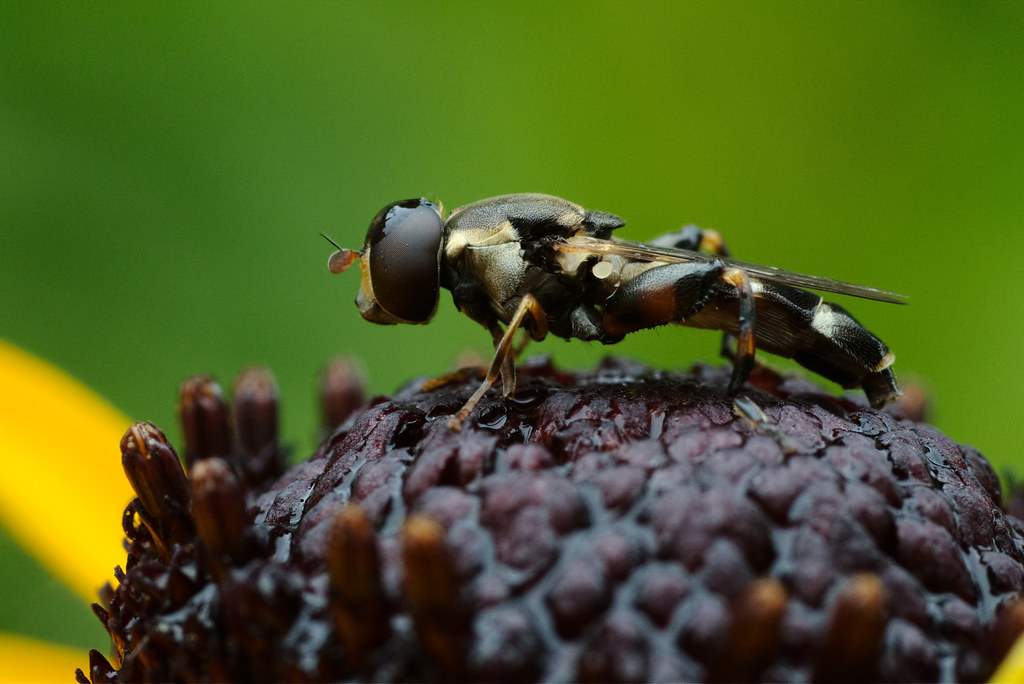
A hoverfly dries out atop a black-eyed susan after a sudden downpour.

After seeing a crab spider on our aster near our front steps, I started looking for her every time I went up or down. I noticed she was frequently on one of the blossoms but by the weekend when I had the time to photograph her again, she was on a flower that was not going to be easy for me to reach. But then I noticed this assassin bug nymph on a nearby blossom and photographed it instead. What a deadly place our beautiful little aster can be! The assassin bug kills other insects by attacking them with its proboscis (you can see it hanging below the face of the nymph) and injecting either venom or digestive juices, and then sucking out the fluids of their prey.

Don’t do it, ye bees and butterflies of the world, for in her inviting arms awaits a deadly embrace! The front two pairs of legs of the goldenrod crab spider like this large female are much longer than the back, as she doesn’t spin a web to catch her prey but rather waits for them to land on her flower, embraces and immobilizes them with a venomous bite, then sucks the fluids from their bodies. While they often hold out all four long legs to grab their prey, In this particular case she’s using two of her long legs to gain extra purchase on the petals of the aster and holds out only her two frontmost legs. From the front of the flower she was invisible save for two tiny feet sticking around the edge of the petals.
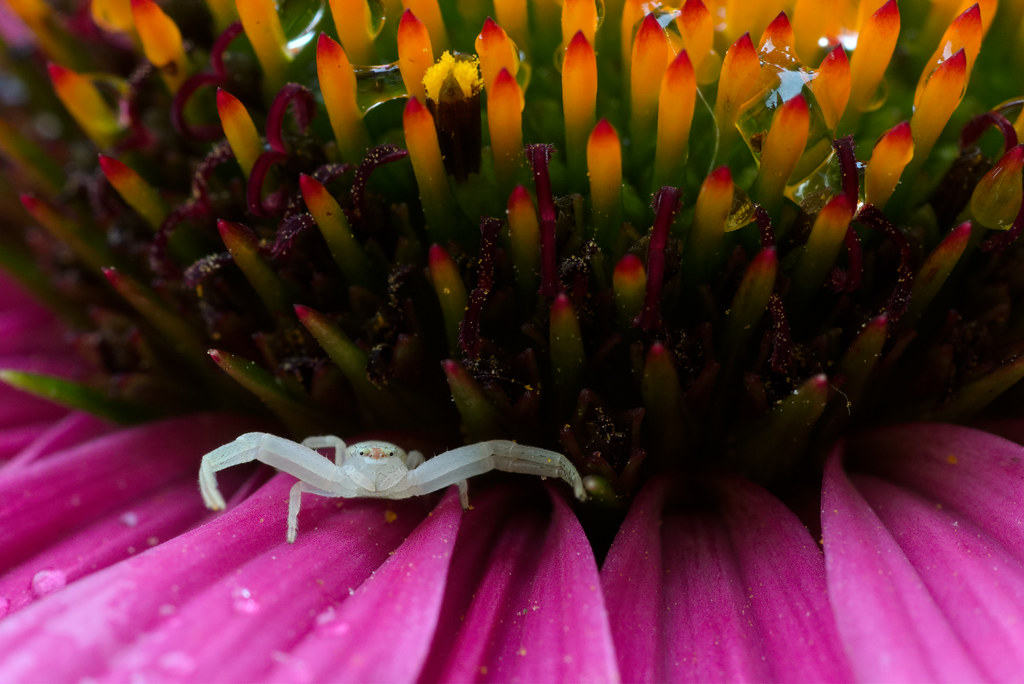
After a much-needed summer shower, I grabbed my macro lens to take some pictures of rain drops on the flowers in our garden and was amused by this little crab spider seemingly defending the last remaining clump of pollen on one of our purple coneflowers. Her life is actually tied to the pollen, as she is lying in wait for a pollinator like a bee to land on the flower so she can kill and eat it.
 Boolie