When I visited Mount Rainier National Park in the fall of 2008, I saw more pikas on the the Pinnacle Peak Trail than I’d ever seen on a single trail before. It would only be a slight exaggeration to say I saw more pikas on that hike than I had seen in my entire life until then. They weren’t all close to the trail, the talus fields are extensive and often lead far from the trail, but some of them were close enough for pictures, including this pika that popped out of a rock wall near sunset.
Category: Mammals
What Are Your Intentions?
Bison are the easiest of the big mammals to see in most of Yellowstone as they sometimes hang out in large groups near the road. They generally leave people alone but seem so docile that inevitably someone will get too close and end up getting hurt. It’s not so easy to underestimate them on the trails, however, where it’s hard to ignore their size and speed. And of course the horns. You are in their domain and there is no car to retreat to.
This was one of a group of bulls that was coming in my direction on the Storm Point Trail. While you are supposed to stay on the trails in Yellowstone, I decided to let the bulls have the right-of-way and stepped into the meadow. However, they soon veered off the trail themselves to go for a romp in the wallows so I was able to safely continue down the trail.
White Claws
Boomers
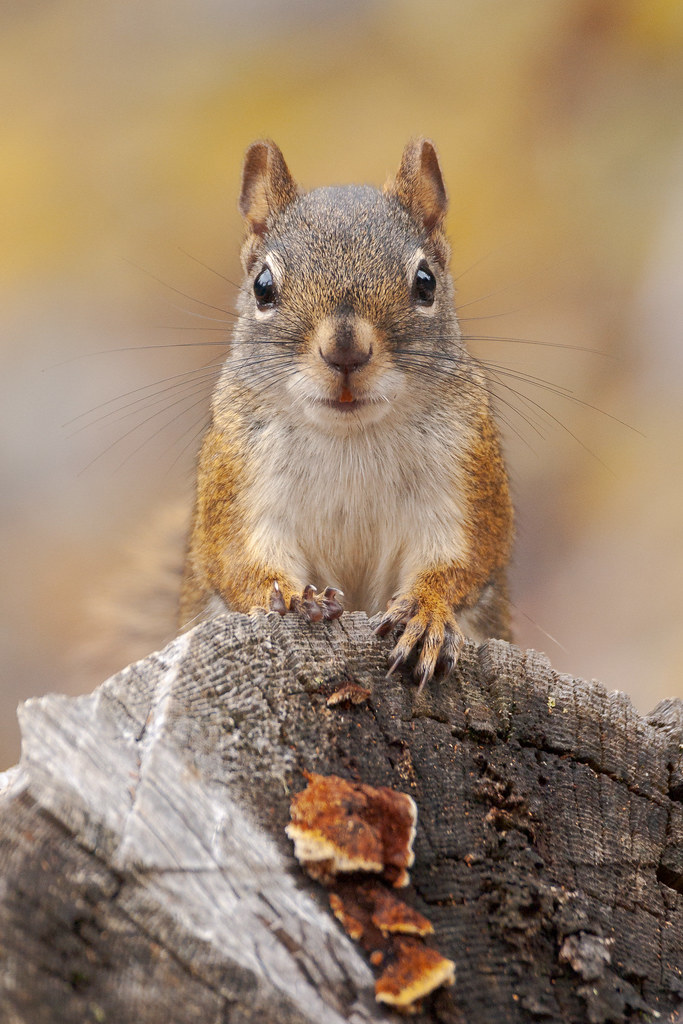
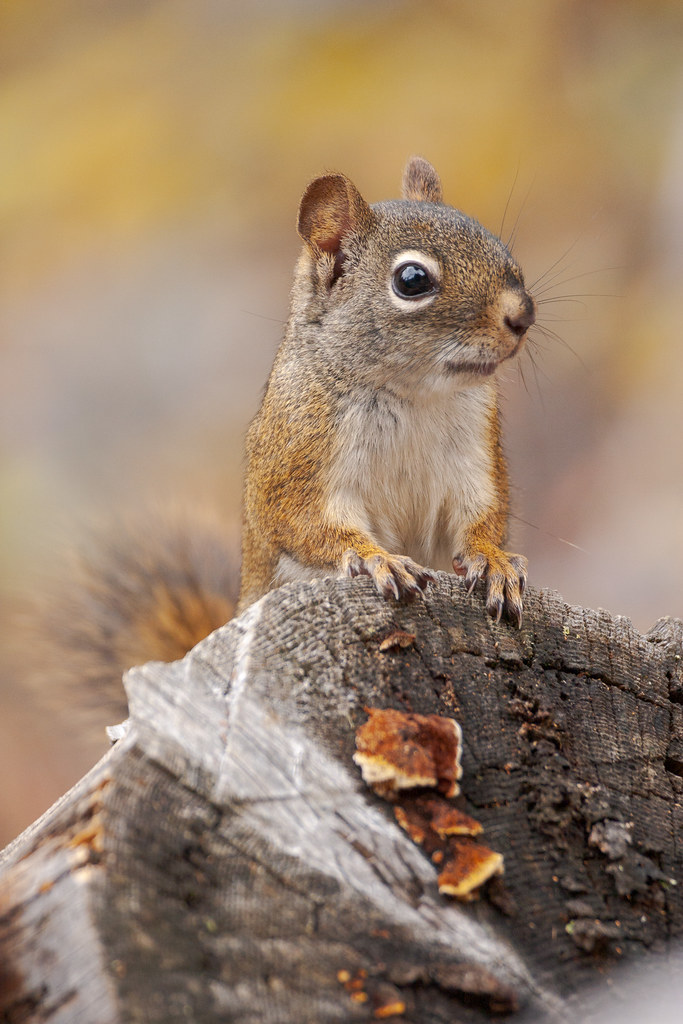
Red squirrels are known as boomers in some areas, a name I love although I don’t know its origin — these little chatterboxes certainly aren’t quiet, but boomy isn’t quite how I’d describe their shrill alarm calls.
I’ve toyed with the idea of having a series of “Greatest Hiking Days Ever” posts that trace in pictures and words my favorite days on the trails from start to finish, and if I do, September 27, 2005 would be a fine place to start. It started with a lovely sunrise in the Tetons, then black bears dining on huckleberries amidst the fall colors, followed by a wonderful hike into Death Canyon where I met this red squirrel and chipmunks and blacktails and even my first pikas, and ended with a moose family in Willow Flats.
There are many things to love in parks as spectacular as Yellowstone and the Tetons, and perhaps squirrels shouldn’t be so high on my list, but I love the chatter and scoldings that rain down from the trees as I hike the forested trails. I heard almost no squirrels on my last trip there a couple of years ago, a personal anecdote in support of the controversial theory of global quieting. I’m not in a position to say if humans are playing a role or if the earth is naturally cycling from noisy to quiet, just that I missed my treetop companions and I hope they are there to welcome me on my next return.
Strange Looking Trees
After a wonderful week of hiking in Wyoming in October 2005, in the last few hours of my last day I decided to take quick jaunts part way down three Yellowstone trails new to me, to get a taste for future visits. I planned an hour for each trail but when I reached the designated time on the the first trail, the Rescue Creek Trail, I wasn’t ready to turn back so I continued on at the cost of only having time to sample one more trail before sunset.
Having reached the new turnaround time, I stopped to drink in the dry landscape and some water. Strange looking trees down the hill caught my eye so I raised my camera for a closer look. The telephoto lens turned my strange trees into six bighorn rams of various ages.
I never made it to any other trails, I spent the remaining hours watching the rams until they wandered up the trail in the opposite direction and I headed back to the car to start the long journey home. One of my all time favorite hiking moments.
Roosevelt
The race of elk we have in the Pacific Northwest, Roosevelt elk, were named in honor of Theodore Roosevelt. I came across this bull, part of a larger herd, on a rainy morning near the Hoh Rain Forest in Olympic National Park.
While President Cleveland protected some of the forests of the Olympic Peninsula in 1897 by declaring an Olympic Forest Reserve, the protection did not extend to the elk who lived there and in a few years less than 2,000 survived. President Roosevelt (Theodore, not Franklin) established the Mount Olympus National Monument in 1909 to protect the elk but future politicians cut back the acreage to half of its original size. President Roosevelt (Franklin, not Theodore) granted National Park status in 1938 after visiting the area, the status it has retained to the current day, protecting not only the elk that bear the Roosevelt name but also the many plants and animals that are unique to the Olympic Peninsula.
You can find more info about the history of the park in a PDF on the official park site.
Jealousy
It’s hard not to be jealous of how well-adapted some animals are to their environment. It was a little humbling to watch these tiny little pikas sprinting across the talus field with plants in their mouths. I don’t think I’d be quite so quick if I had to drag several 12 foot tall trees in my mouth as I ran across a boulder field with rocks as big as a school bus.
Remind Me Why I’m Not Hibernating Yet?
The higher elevations in the Sunrise area of Mount Rainier got a light dusting of snow on the morning of my last day there but it melted when the sun rose. After hiking a bit on the Sourdough Ridge Trail early in the day hoping to see marmots, pikas, or grouse (and not seeing any), I went a little lower in elevation to the trailhead of the Summerland Trail. The trail is an uphill march mostly through a forest before you pop out into a mountain meadow at the very end of the trail, I chose it since there was a chance of seeing hoary marmots and elk in the meadow (the mountain views from the meadow are also spectacular and make up for the lack of views in the forest).
I didn’t see any elk but I did see a few marmots when I first entered the talus field. The afternoon sun didn’t make for good light for pictures but this marmot was shadowed by rocks where the snow hadn’t melted. I followed the trail through the rocks and saw more and more marmots until I realized just how large the colony is at the end of the trail, this was by far the largest marmot colony of any species I’ve come across.
I spent the rest of the afternoon watching the marmots as at least one was usually close to the trail, taking advantage of every passing cloud to improve the light. I had thoughts about staying until sunset but I still had a long hike back down and while I had my headlamp, I was hiking alone and didn’t want to risk it. When the marmots that had been near the trail were no longer around, I took that as my cue and headed back down the trail.
Changeling
Some day I’m going to stop posting pictures of this bear, but today is not that … no actually I think today is that day. Watching the bear in person it was pretty obvious that it was young, I’m no expert on bears but it clearly was at least a year old but not yet a full adult. Looking through my pictures sometimes it appears younger to me and sometimes older, a furry changeling, but I just love its fur coat of many colors.