I Have Departed and I Will Remain

A dead tree stands near a saguaro along the Whiskey Bottle Trail in McDowell Sonoran Preserve in Scottsdale, Arizona

Most of the branches have broken off this long-dead tree but still it reaches for the sky. In life it wouldn’t have approached the heights of the massive saguaros that dominate the landscape but it would have provided welcome shade for young plants trying to gain a foothold in the desert. In death it can provide some shade and shelter, every little bit helps as while the hills and vegetation behind me are providing some protection from the sun at this early hour, as the sun rises there will be little escaping its glare. Yet life flourishes in this desert, it is not the emptiness of sand and rock I imagined in my youth.

Seeing Red in the Desert

Fruit begins to ripen atop a saguaro on the Vaquero Trail in McDowell Sonoran Preserve in Scottsdale, Arizona

I knew even before setting foot in Arizona that my pictures in the desert would draw heavily from a palette of browns rather than the green of the Pacific Northwest. I didn’t know that there would occasionally b red in the desert too, such as the red racer, the house finch, and the northern cardinal. However, for a month or so at the end of spring and the start of summer red explodes across the desert in the fruit of the saguaro.

Fruit splits open atop a saguaro at the Amphitheater in McDowell Sonoran Preserve in Scottsdale, Arizona

Here near The Amphitheater in McDowell Sonoran Preserve a ripe fruit bursts open, exposing the pulp and seeds inside. The fruit is chockfull of seeds, according to the National Park Service there are about 2000 seeds per fruit. Few will develop into a seedling and fewer into an adult saguaro in the harsh desert climate but its not for lack of trying. I noticed multiple birds eating the fruit but mostly it was white-winged doves, who apparently digest the seeds rather than passing them in their waste like some other birds. They end up with so much juice and pulp and seeds on their faces that I imagine some of the seeds will fall to the ground as they preen, so perhaps all is not lost.

Red saguaro fruit along the Upper Ranch Trail in McDowell Sonoran Preserve in Scottsdale, Arizona

As the fruit continues to ripen on the saguaro, even the outside turns red. The dried stalk above them is all that remains of the flowers that grew atop them, the ripened fruit results from flowers that were pollinated. Most of the fruit grows at the top of the saguaro or the ends of its arms but some grows on the sides like the one below that has been cleaned of most of its contents by the denizens of the desert, only a few of the tiny black seeds remain inside.


Saguaro fruit emptied of its contents on the side of a saguaro in Pinnacle Peak Park in Scottsdale, Arizona

Do Not Adjust Your Sets

A wavy pattern in a saguaro cactus along Brown's Ranch Road in McDowell Sonoran Preserve in Scottsdale, Arizona

The early morning light falls on one of my favorite saguaros, I love its wavy pattern and look for it whenever I’m hiking Brown’s Ranch Road. If you’re too young to understand the reference in the title and never experienced adjusting horizontal and vertical hold on a television, consider yourself lucky. In my day …

Disappearing Act

A white-winged dove perches on an ocotillo starting to leaf out after the summer rains in McDowell Sonoran Preserve

This ocotillo had just started leafing out in the middle of July with the arrival of summer thunderstorms in the Sonoran Desert. The white-winged dove perched in the morning light is one of thousands I have seen, they are not only the bird I see most in our backyard but out in the desert as well, never more so when seemingly one or two or three were atop every saguaro as they devoured the ripening fruit. But after a self-imposed two week ban to allow a knee to heal, I returned to the trails twice last weekend and didn’t see a single one. Not one!

From what I’ve read, the white-wings arrived in the desert about the time I did and will be leaving this fall. So I suppose in a month or so they will be gone from our backyard as well. The smaller mourning doves and much smaller Inca doves will appreciate it, the larger white-wings are more aggressive, but our cats and I will miss them.

Yucca

The dried flowers of a soaptree yucca set against a pink and purple sky at sunrise on the Hackamore Trail in McDowell Sonoran Preserve

I don’t love getting up before sunrise but I love being up before sunrise. If only there was a way to enjoy the desert dawn without getting out of bed. I was hiking along the Hackamore Trail with the sun not yet risen and liked the serenity of the dried flowers on the long flower stalk of a soaptree yucca set against the pink and purple western sky. What a blessing it is to be in the desert as the day breaks, may it always bring me joy.

The Warriors

A damage saguaro still grows tall at Pinnacle Peak Park in Scottsdale, Arizona

The old saguaros are warriors. It’s remarkable they can survive in this climate at all, astounding they can do it while sustaining heavy damage. I don’t know how recent the damage to the base of this cactus is but as you can tell from its long shadow it is still growing at a great height with a couple of the iconic arms near the top (the arms usually don’t start growing for 50 to 100 years, depending on the amount of rain). I saw one saguaro that had fallen over and little remained except a short stump, but enough of the internal plumbing and root system survived that a new arm was growing. I hope they prove a metaphor for my country, for all the damage it has sustained and with more to come, I hope the promise of America overcomes its reality.

Mother’s Day Bouquet

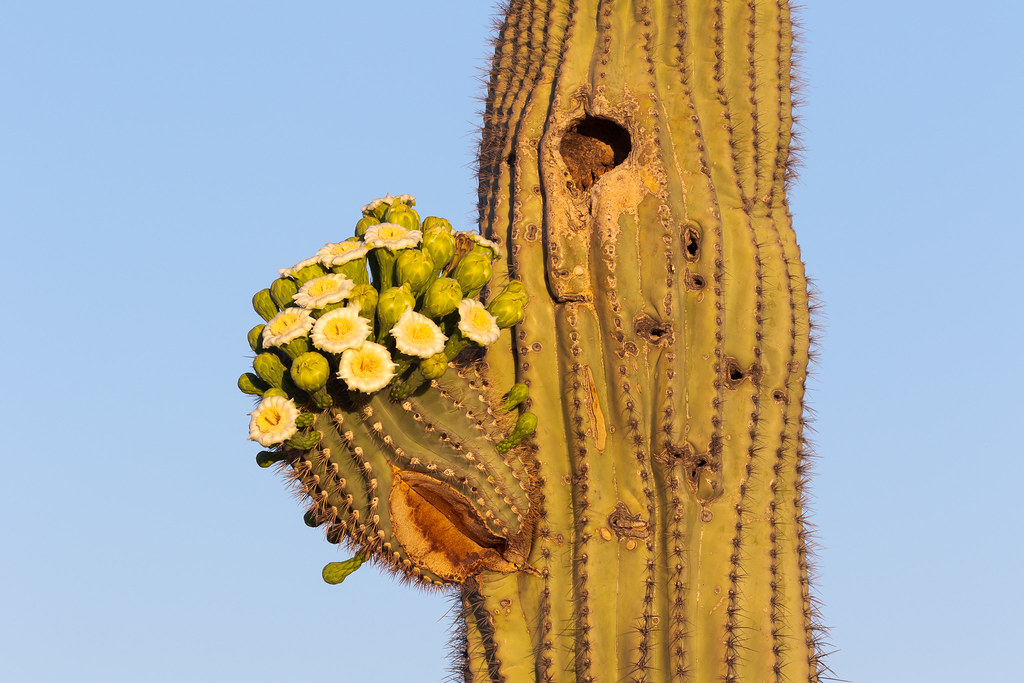
Sagurao blossoms near sunrise on an off-map trail at Brown's Ranch in McDowell Sonoran Preserve in Scottsdale, Arizona

This saguaro offered up a bouquet of flowers near sunrise on Mother’s Day. I had hopes of photographing it again with all the flowers open but by the time I could return the following Saturday, all of the blossoms were gone and I learned another fact about my new home. The flowers only last about a day, first opening at night to attract bats with their nectar and closing the following afternoon after the bees and birds have had their fill. If pollinated during that short window, the fruit below will develop during the summer.