Desert Flora

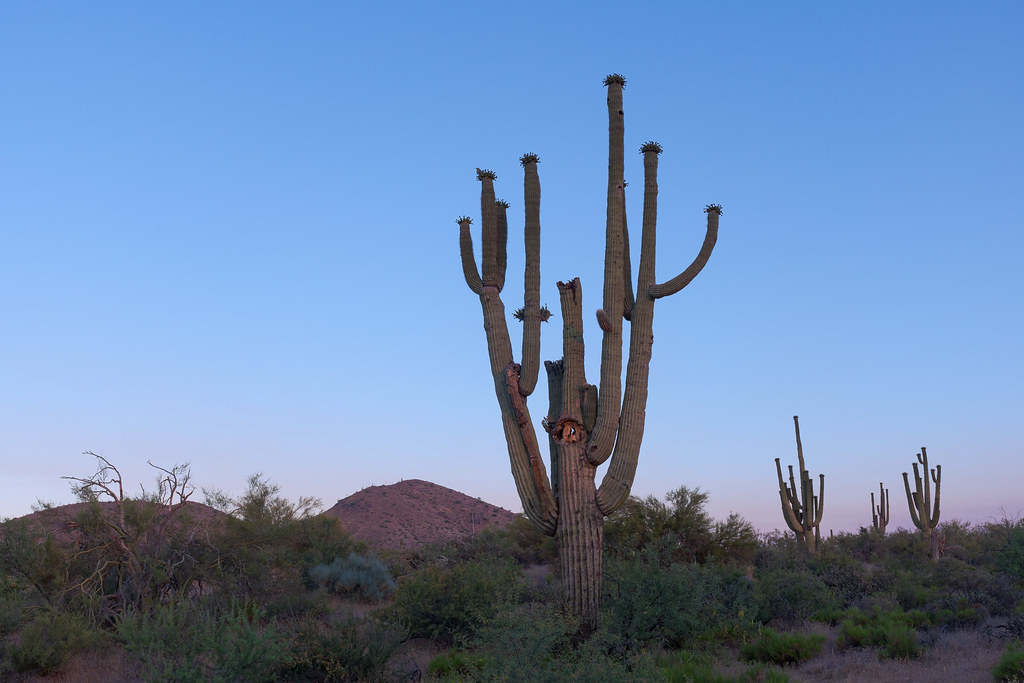
A view at sunset of some of the larger plants of the Sonoran Desert, looking towards Granite Mountain from the Latigo Trail on October 17, 2020. Original: _CAM5616.arw

A view at sunset of some of the larger plants of the Sonoran Desert, looking towards Granite Mountain. I assumed the trails would be packed in the evenings but went since I haven’t been able to get out much in the mornings and to my surprise saw almost no one. Perhaps it’s a quirk of timing where it was still hot in the evenings but not dangerously so, maybe now that it is cooling off it will be more crowded.

Art in the Park

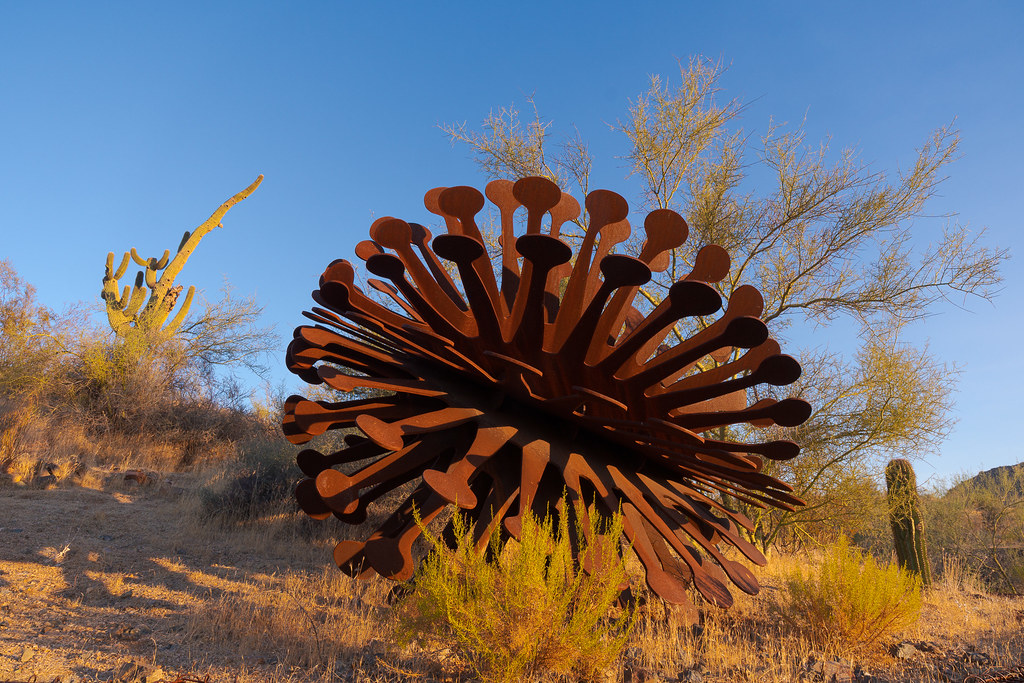
A large seed pod sculpture sits in front of a palo verde and a leaning saguaro at George Doc Cavalliere Park in Scottsdale, Arizona on October 16, 2020. Original: _CAM5533.arw

Dotting the short hiking trail at Cavalliere Park, a multi-use park near our house, are seed pod sculptures by Jeff Zischke. I love how naturally they are placed in the landscape, they remind me of animal sculptures we saw years ago at an Audubon Center in Maine. This is one of the larger ones, sitting just uphill from the basketball courts, near a saguaro as obliging as it is beautiful as it leans over to more easily fit into the picture.

You Don’t Have to be Straight to be Beautiful

An old saguaro full of woodpecker holes leans over at George Doc Cavalliere Park in Scottsdale, Arizona on October 16, 2020. Original: _CAM5573.arw

Two dimensions don’t do justice to how much this battered old beauty leans over, its trunk and surviving arms littered with woodpecker holes. How many families has it sheltered on this little sliver of land, protected from the development that surrounds? I meant to photograph it months ago but got pulled up and down the trail first by a phoebe and then a woodpecker, so I was thankful it still stood in all its perfect glory on a visit at sunset a couple of weeks ago.

Long and Fading

Fading pink skies reflect off the ice surrouning snags in Long Lake at Ridgefield National Wildlife Refuge in Ridgefield, Washington on January 2, 2011. Original: _MG_2459.cr2

At the start of 2011, after taking the previous picture at Horse Lake I moved to adjacent Long Lake, the pink skies fading in intensity despite the trivially short drive. Though side-by-side the differing natures of the lakes meant some wildlife preferred one to the other. Dead snags stood upright across the narrow width of the lake with many of their fallen brethren floating nearby. It was my favorite spot for close looks of teal and grebes and mergansers, with egrets and herons and bitterns hunting the shallows. In the warmer months turtles sunned on the logs, one of the few reptiles in the area. Mammals also made an appearance though not as often: otters fishing, raccoons and coyotes prowling the edges, deer up on the banks. Nutria too but then they were everywhere.

The tallest snag was near the road out-of-frame to the right, one day to my astonishment an adult bald eagle perched there almost right above me. Swallows would stop to rest as they hunted the skies above the lake, while below blackbirds and sparrows searched the marshy shores for insects to feed their young. The tall snag on the left was a favorite spot for kingfishers, as well as taller ones on the right, it was my favorite place to watch them as they dove down from the heights and plunged into the water after small fish.

But time took its toll on the former trees and one by one they began to fall, until on a visit four years later I sadly noted in my journal they were all gone. On a later visit it seemed more of a marshy meadow than a lake though perhaps in the rainy season it would fill up again. I wondered what animals would now call it home but it was not for me to know, change wasn’t just coming to the lake.

The Pink Horse

Pink skies reflect off a frozen Horse Lake at Ridgefield National Wildlife Refuge in Ridgefield, Washington on January 2, 2011. Original: _MG_2265.cr2

One of my favorite places at Ridgefield was Horse Lake, an innocuous seasonal pond at the start of the auto tour. To the left and right of this image grew clumps of tall grasses where bitterns and herons and egrets hunted. Dabblers like teal and pintails and wigeon congregated further left and right. In this open spot if there wasn’t much road traffic, and if you were patient enough, shy divers like scaup and bufflehead swam up to feed. The not-so-shy coots were always around, and often too the skies filled with cackling geese who wintered at the refuge in large numbers.

And once, and only once during my many visits, sunrise lit the skies a vibrant pink that reflected off the frozen pond. My favorite time to visit was on rainy days where you had to take it on faith the sun had risen, towels strewn round the Subaru as I listened to the pitter-patter of raindrops and the chitter-chatter of ducks. Because it was the start of the auto tour, there could be too much traffic for my liking on sunny days, and during the winter about every other day brought duck hunters and volleys of shotgun blasts. But in memory it can always be as peaceful as it was on this day and many others besides, as morning came to my little Horse.

Pink skies at sunrise reflect off a frozen Horse Lake at Ridgefield National Wildlife Refuge in Ridgefield, Washington on January 2, 2011. Original: _MG_2313.cr2

A Little Nod

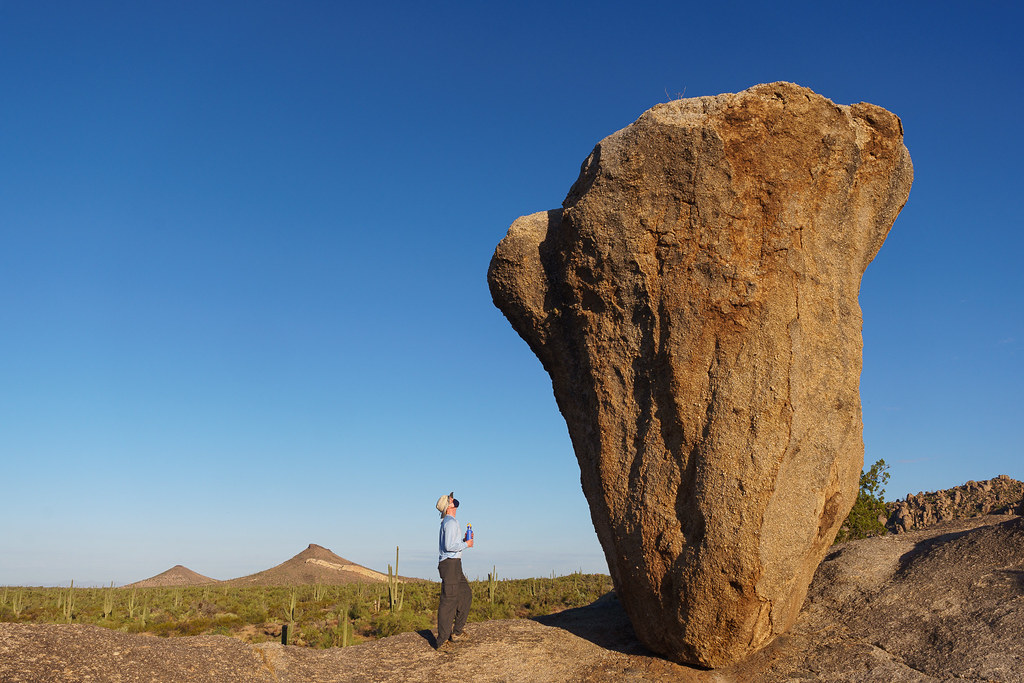
My shadow points towards the southern edge of the Granite Mountain with the moon about to set, the sun starting to rise, at McDowell Sonoran Preserve in Scottsdale, Arizona on October 3, 2020. Original: _CAM5292.arw

Saturday morning for the first time in two months I had enough energy to get up early for a hike in the desert. With the sun rising and the moon about to bid good day I used a gently sloping boulder abutting the trail to add my shadow to the desert’s own, a little nod to my deep appreciation at being back.

Hallelujah Arms

A battered old saguaro on the Morning Vista Trail has fruit atop its many remaining arms, while some of the other arms have been snapped in half or broken off altogether, taken in McDowell Sonoran Preserve in Scottsdale, Arizona in June 2020

The rising sun illuminates a battered old saguaro, some of its arms shattered in half and some broken off altogether. But it still has a host of hallelujah arms raised towards heaven, all now fruiting and not just hopefully starting new life from its seeds but sustaining the lives of others with its fruit, a prized treat for many birds. In the picture below, taken just before the sun rose, a curve-billed thrasher feeds atop one of the taller arms.

A curve-billed thrasher feeds on fruit atop a battered old saguaro on the Morning Vista Trail, taken in McDowell Sonoran Preserve in Scottsdale, Arizona in June 2020