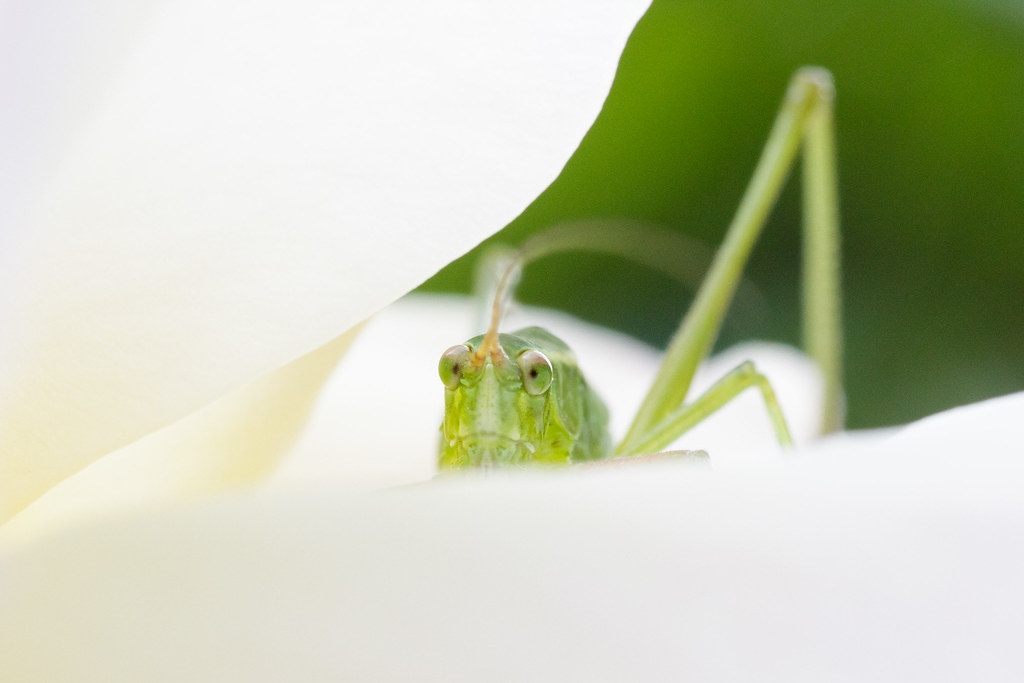
An adult fork-tailed bush katydid nestles in a blossom of one of our rose bushes.
Scratcher of heads, rubber of bellies
An adult fork-tailed bush katydid nestles in a blossom of one of our rose bushes.

Clearly there are two bees. I’m glad we’ve been able to answer this age-old question, let’s move on.
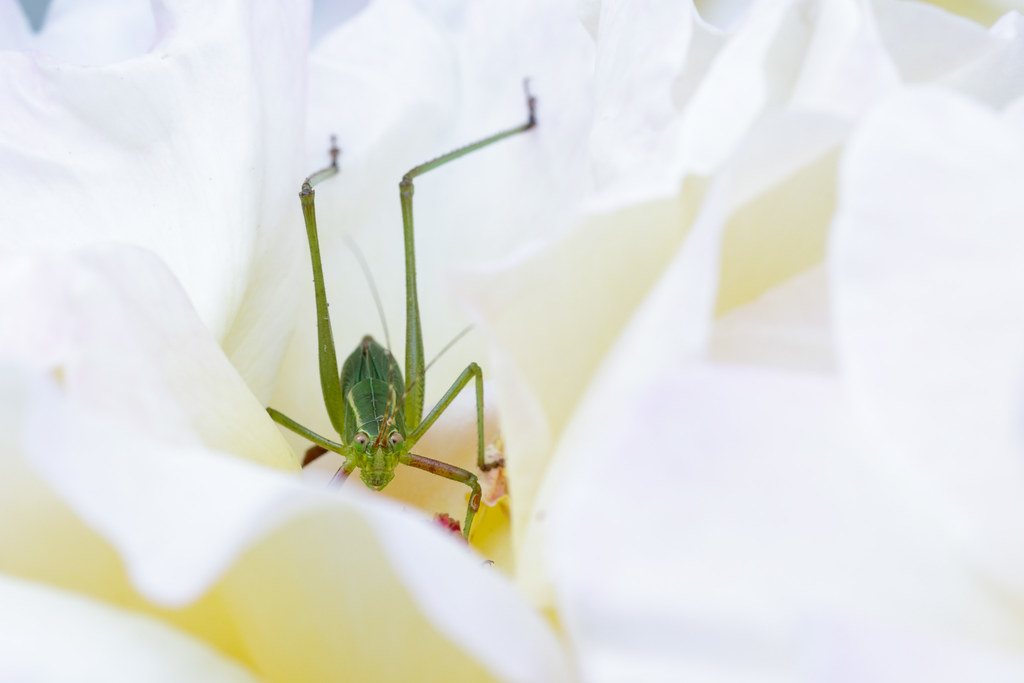
A rose blossom provides both food and sanctuary for an adult katydid.
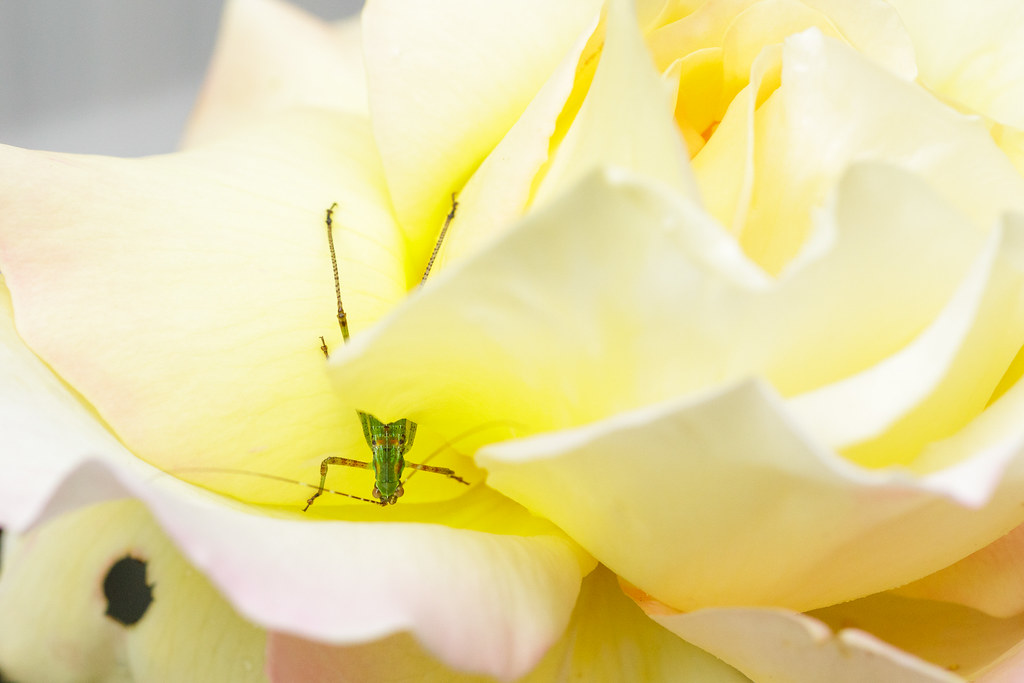
Calisthenics are an important part of a young nymph’s life if it wants to grow up to be an adult katydid.

This fork-tailed bush katydid nymph isn’t large compared to most of the wildlife I shoot, but compared to the aphid that’s walking underneath it, it’s gigantic.
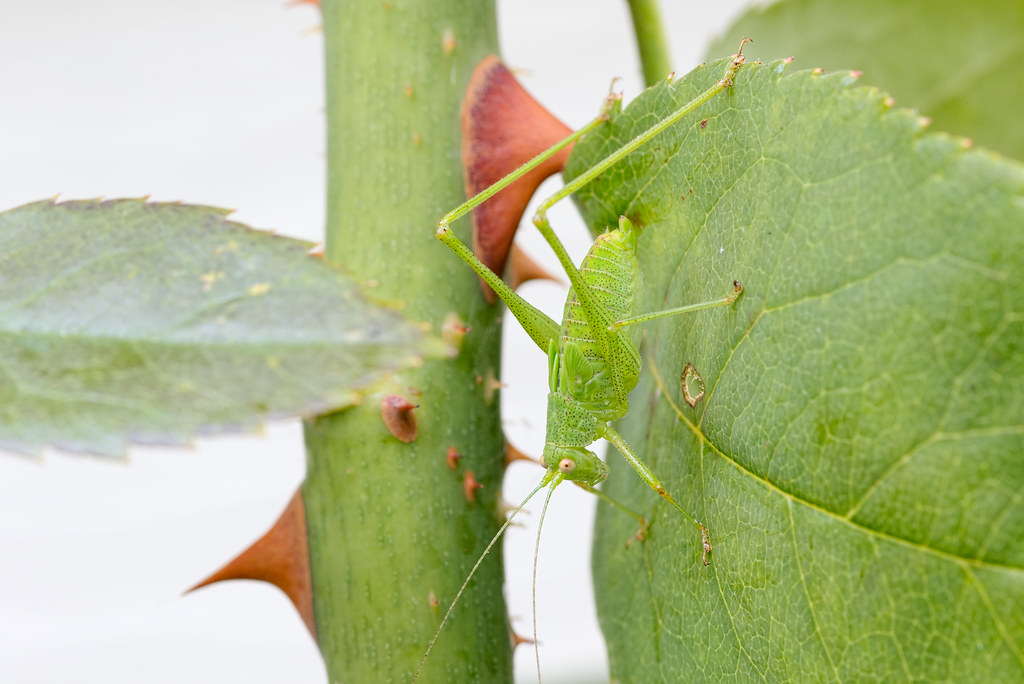
Portland is known as the City of Roses and decades ago a prior owner planted a bunch of roses in our backyard. I’ve always been a bit torn as to whether or not I should keep them. I’m not a huge fan of roses themselves, although we have one variety in particular that I think creates a lovely flower. Some of them aren’t doing so well, but even those that are thriving often get leaves covered in black spots, a consequence of a fungus that thrives in our climate. There’s a natural pesticide that can keep it under control but when possible I prefer to not use pesticides.
My favorite thing about the roses is the katydids that sometimes live there in the summer, in July we had a handful in one spot, from fairly young nymphs to an adult. The nymphs go through several stages, this female is easily recognizable as a katydid but she is only starting to grow her wings. When full grown they’ll stretch down the length of her body (as you can see on this adult female from last year). When I see one on a bush, I leave nearby spent flowers a little longer than normal so that my friends will have plenty to eat.

After seeing a crab spider on our aster near our front steps, I started looking for her every time I went up or down. I noticed she was frequently on one of the blossoms but by the weekend when I had the time to photograph her again, she was on a flower that was not going to be easy for me to reach. But then I noticed this assassin bug nymph on a nearby blossom and photographed it instead. What a deadly place our beautiful little aster can be! The assassin bug kills other insects by attacking them with its proboscis (you can see it hanging below the face of the nymph) and injecting either venom or digestive juices, and then sucking out the fluids of their prey.
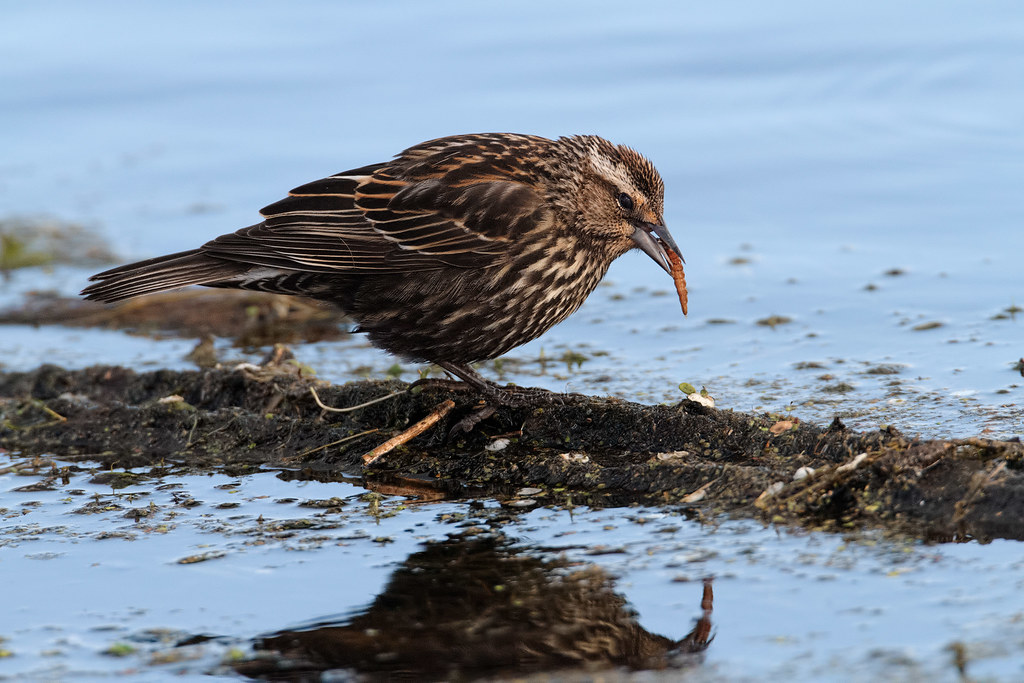
There’s a spot in Long Lake where floating branches accumulate at the edge of the lake by a culvert. Both red-winged blackbirds (like this female holding what I presume is an insect larva) and song sparrows frequently hunt in this little section, looking for insects hidden in the plants and mud. The blackbird searches with its beak, as shown below, while the sparrow typically uses its feet. I’ve spent hours watching them on the hunt, as its also a good spot to watch mergansers hunt for fish just a bit further out, and a couple of times a river otter has swum up gone through the culvert to the other side of the road.


I didn’t leave the house for the first few days after Emma died, apart from taking Ellie on her walks, but by the fourth day I decided to head up to Ridgefield for a little bit. I made a note in my journal when I got there that my heart wasn’t in it and I didn’t know if I’d stay more than a few minutes, but spending some time with this blackbird lifted my spirits and I stayed for several hours. I stopped at South Quigley Lake when I saw him sitting on a cattail that was taller than all the others around it, as it gave me a lovely view of a lovely bird. I didn’t expect him to stay long, they are often flitting to and fro in the marsh, but he stayed there for a long while, preening and stretching and occasionally singing.
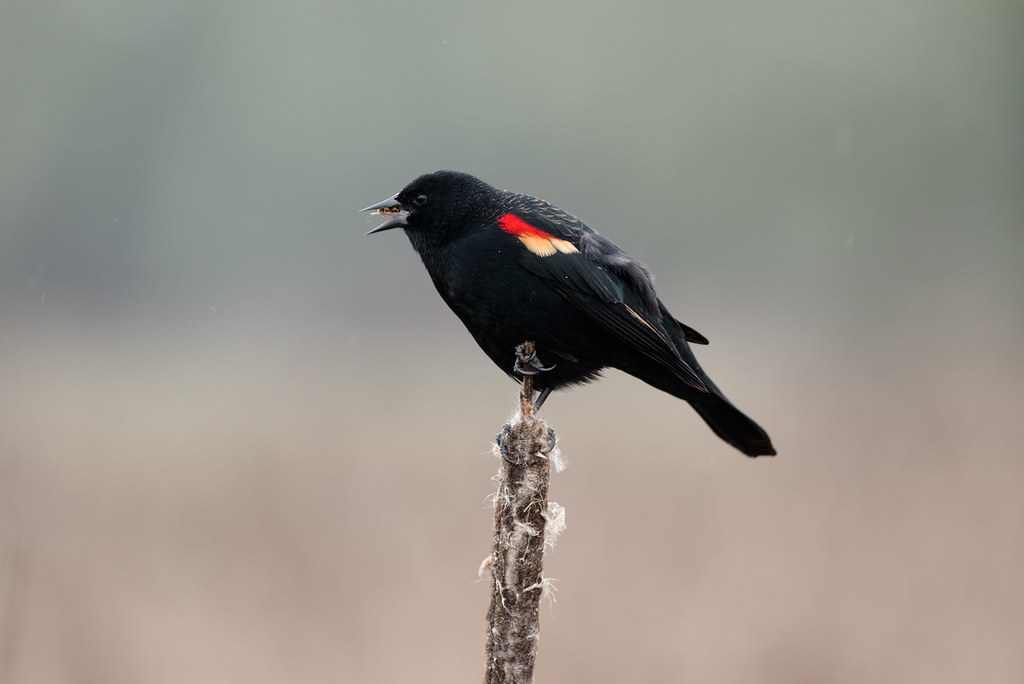
I’m well aware that some of my favorite creatures eat some of my favorite creatures in order to survive, I spent much of the Christmas break watching herons and egrets and bitterns eat all manner of small creatures near the shoreline, but I was reeling from Emma’s death and not in the mood to see something die. I deliberately avoided watching those predators on this visit but I was reminded of how often life and death are on display at the refuge when the blackbird suddenly leaned down and plucked an insect from the cattail. He has it pinned to the roof of his mouth with his tongue, headfirst, and is about to swallow it.

The auto tour takes a sharp left turn after you pass South Quigley Lake and you can see a blue car right behind the blackbird in this photo. There was less traffic though than I expected and so for the most part it was a peaceful afternoon, just what I wanted. While watching the blackbird a couple of times I spotted a Virginia rail darting through the cattails, and later I saw a doe and fawn of the Columbian white-tailed deer that were transplanted to the refuge (the doe was transplanted, the fawn was born at the refuge). It was nice to see sandhill cranes and a river otter too.
Soon thereafter Sam would get sick, and then some of the other pets, and then we got Trixie, and I’ve been busy enough and tired enough that I haven’t gone back out since. Now that Trixie is all settled in, I’ll be returning to the refuge before too long.
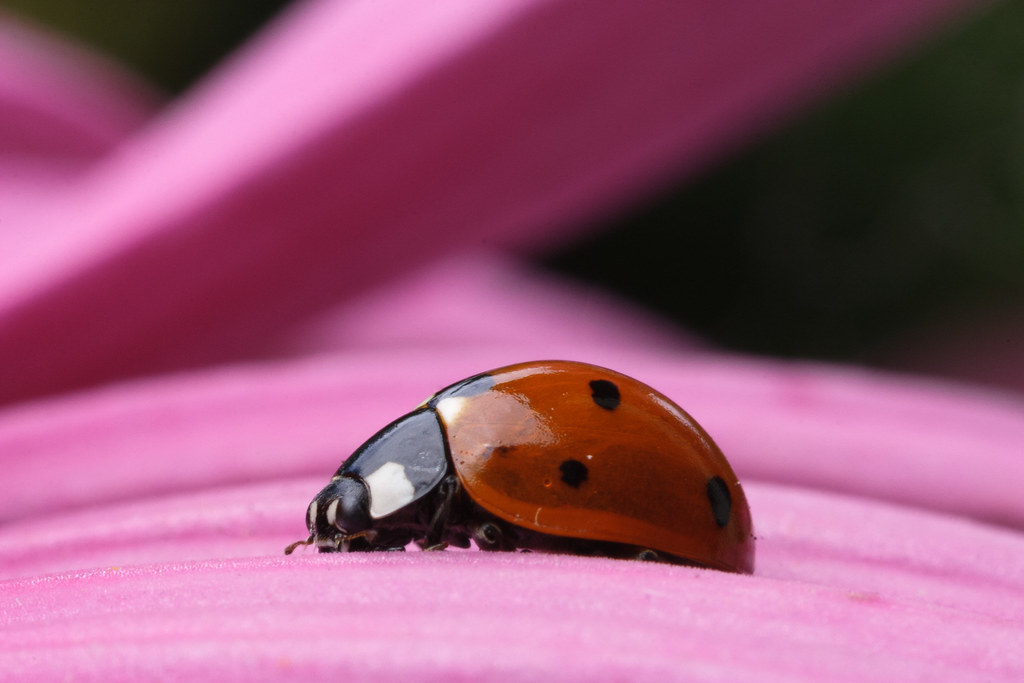
I’ve mentioned before how it sometimes seems that everything you see is an invasive species, such as the cute little ladybugs in my yard that turned out to be an Asian species originally brought to America for pest control. But this little ladybug, fierce and ferocious (if you’re an aphid), is not the same species! Have I finally found one of our native ladybugs? Alas, no, it has two spots too few. The seven-spotted ladybug is closely related to its American cousin the nine-spotted ladybug, but the nine-spot is rarely seen these days. The seven-spot is native to Europe and, like the Asian beetles, was brought over to the States for pest control and then established itself in the wild.
This one established itself on the petals of my purple coneflower. But the aphids are on the roses! The roses! For the love of Sammy, the aphids are on the roses!
Ah well, I’ve gotten a little disoriented in foreign lands myself.
 Boolie