Changing of the Guard

A male Gila woodpecker prepares to leave the nest in a saguaro cactus as the female waits outside with a spider in her beak

A male Gila woodpecker prepares to leave the nest as his partner brings a spider for their hungry children inside the saguaro. Both parents excavate the nest cavity, the cactus will slowly harden the inside to prevent water loss and it is only then that the woodpeckers can use the cavity as a nest. You can see how much of the surrounding surface of the saguaro has been scraped away as they created their home and now land over and over again.

New Homes

A male Gila woodpecker peeks out of his nest in a saguaro with an older nest visible nearby on the Jane Rau Trail in McDowell Sonoran Preserve

It was one year ago today they brought my team in and laid us all off, setting in motion our eventual move from our longtime home in Portland to our new home in Arizona. We’re renting for now but will start looking to buy within a month or two. This Gila woodpecker made his new home near the old, moving slightly around the saguaro. Other small birds sometimes use the old nests after the woodpeckers abandon them. Getting to see such new sights has been part of the fun of moving to such a different location.

A Magical Day

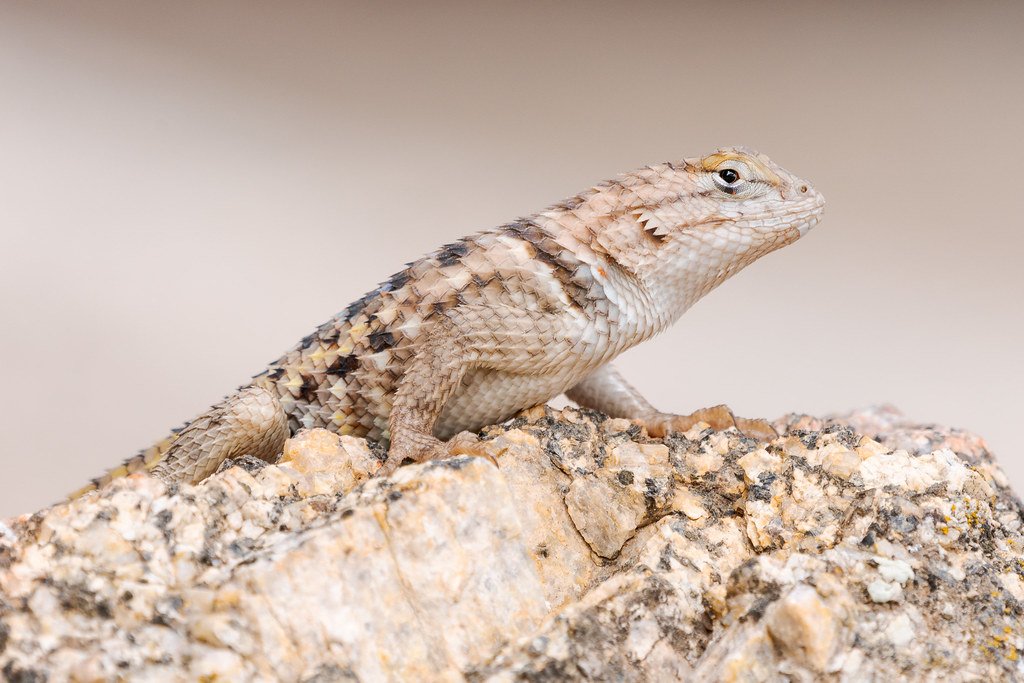
A desert spiny lizard perches on a small rock beside Cathedral Rock in McDowell Sonoran Preserve in Scottsdale, Arizona

I don’t use all caps much in any of my writing, online or otherwise, but my journal for July 8th starts “MAGICAL DAY!!!!!”. The five bangs are unusual too.

It was going to be hot, that I knew. It was already in the mid-80’s before sunrise, the coolest part of the day, even at Brown’s Ranch where it is typically cooler than the city. I was still getting used to hiking in the desert so while I planned to be back before the heat got severe I chose trails I had hiked before and where I had cell phone coverage just to be safe. The chance for a lovely sunrise fizzled as the overnight clouds dissipated as I drove out in the dark. I didn’t see many animals in the early morning light and fumbled with my camera even when I tried for pictures. Some days are like that, I learned long ago not to fight it, I was just happy to know that as long as I got out early I could still hike on the hottest summer days.

I reached my turnaround point at Cathedral Rock and stopped for a water break, taking a group photo for some cyclists who were also out enjoying the summer morning. I saw a desert spiny lizard but couldn’t get a picture as it scampered behind a rock. I had started seeing them on the trails on occasion, despite their size they are rather skittish so I wasn’t expecting any pictures. I sat there for a while, enjoying my new desert home, when the spiny lizard came out again. I didn’t move, taking some pictures from where I sat, and the lovely little thing got more comfortable with me. It scampered over underneath the massive rocks that make up Cathedral Rock and as I slowly approached it let me take some more pictures.

Another group of cyclists came up and I thought the lizard would disappear but instead it came closer to me. At one point it ran right in front of me and snagged an insect off the rock wall a few feet to my left, I didn’t risk any pictures but turned my head enough to watch it eat its breakfast. It stayed near me for quite some time and I took so many pictures even I decided it was enough. I put my Canon camera in my backpack but thankfully still had the Sony out with the long lens attached as I turned around and my lizard had suddenly grown larger and more colorful. I quickly realized another lizard had come out (a male? an adult?) and took pictures of it as well, then walked around a bit, before I decided to head back as the heat was rising quickly. I attached my tripod to my backpack when I noticed the first spiny lizard was now perched on a rock right beside me. Having so completely earned its trust I couldn’t resist more pictures, I took this one sitting on the ground with the lens resting on my legs, relying on the flip-out screen to frame the image.

Then it really was time to go, having spent 2 hours and 15 minutes with the two lizards. It felt good to stretch my legs as I headed back to the trailhead, and though it was 101 degrees as I reached the car I didn’t mind. I had plenty of water, I had plenty of energy, and my heart was full of joy.

The Green Land

A western gull (I think) perches on a large boulder in front of a moss-covered cliff on the beach at Heceta Head on the Oregon coast

A western gull (I think) perches on a large boulder in front of a moss-covered cliff on the beach at Heceta Head on the Oregon coast. A stream was flowing between us, emptying into the Pacific just to my right. The rich greens of western Oregon were something to behold, I miss seeing moss growing on the rocks, on the trees, in the grass. I don’t miss seeing it growing on the roof, on the steps, on the car …

Keep It Down, We’re Trying to Sleep!

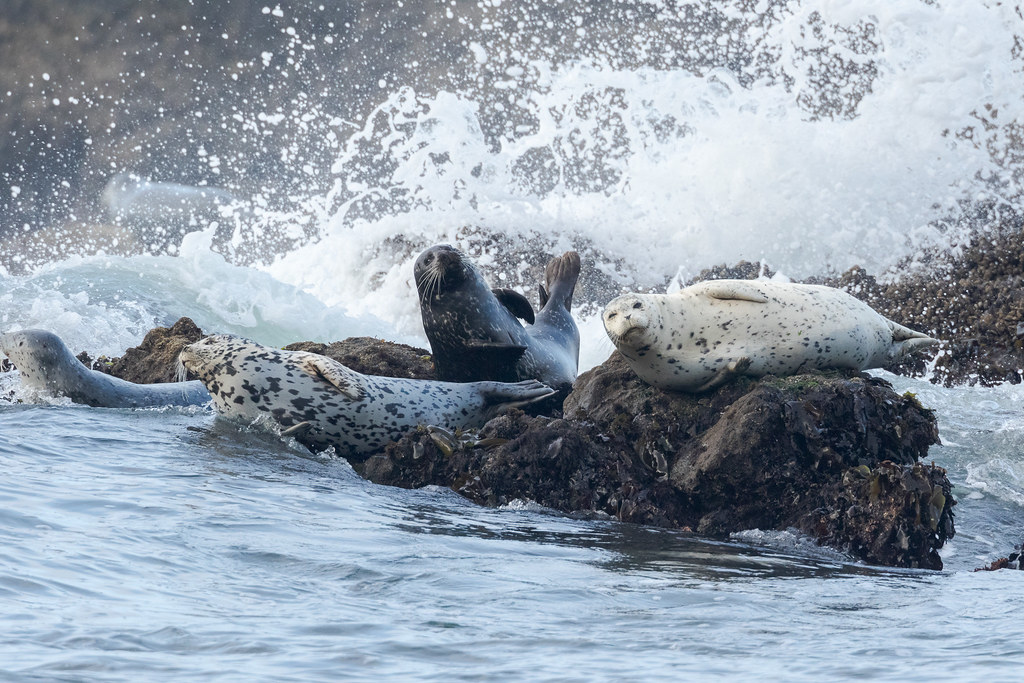
Keep It Down We re Trying to Sleep

Harbor seals eke out as much rest as they can amidst the crashing waves as the Pacific rises to embrace them. I too was awakened recently by gentle but relentless sounds, once by the sound of Boo trying to get out of the bedroom closet he got trapped in, once by the sound of him trying to get into a different closet. The Pacific is mighty and mysterious, but not so much as Boo.

Thrash Song

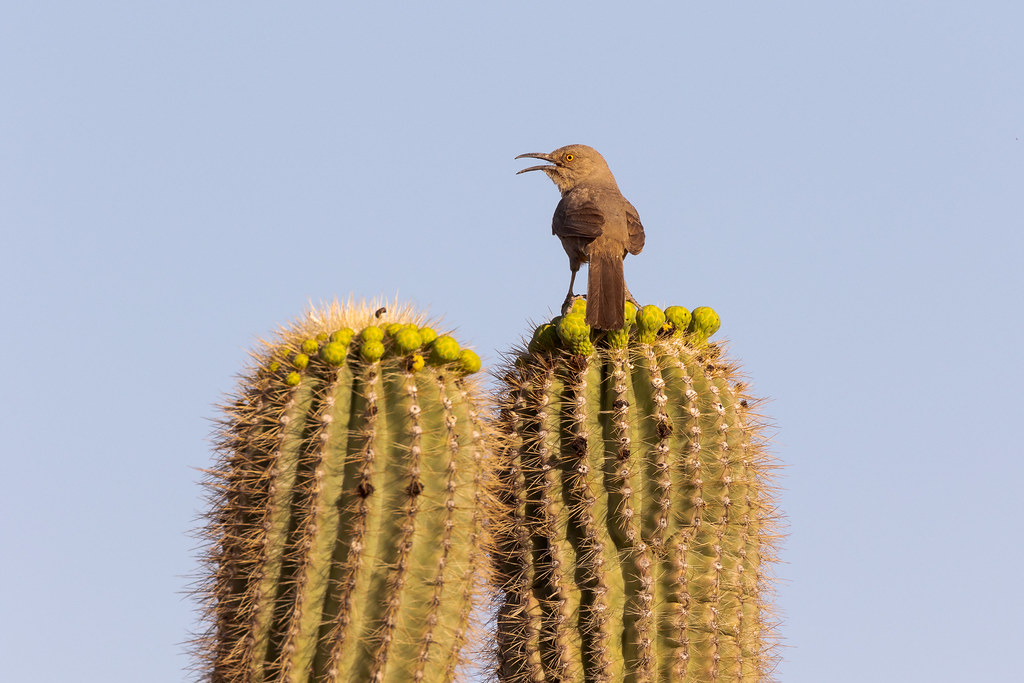
A curve-billed thrasher sings atop a saguaro early on a spring morning along Brown's Ranch Road in McDowell Sonoran Preserve

After a hike up to Inspiration Viewpoint this morning when it was too windy for my liking, the day turned lovely and I’ve spent the rest of the morning and afternoon relaxing on the back porch. At the moment there are house finches and sparrows atop the feeder while below are Gambel’s quail, mourning doves, and Eurasian collared doves. A pair of curve-billed thrashers have been drifting in and out throughout the day, making their presence known with loud whistles. This one I saw singing atop a saguaro six months ago while hiking early one morning on Brown’s Ranch Road in McDowell Sonoran Preserve.

Preen Before Green

An American crow pauses while preening before moss-covered rocks at Heceta Head on the Oregon coast

An American crow pauses while preening before moss-covered rocks on the beach at Heceta Head on the Oregon coast. It’s a bit bittersweet looking back at the pictures I took a year ago on this wonderful trip as it turned out to be my last visit to the coast, a few weeks later my team got laid off and the wheels were set in motion that led us from Oregon. Someday I’d love to go back, the Oregon coast is so wonderful even I’d consider getting on a plane to visit, but for now my interest is in exploring my new home.

One of Three

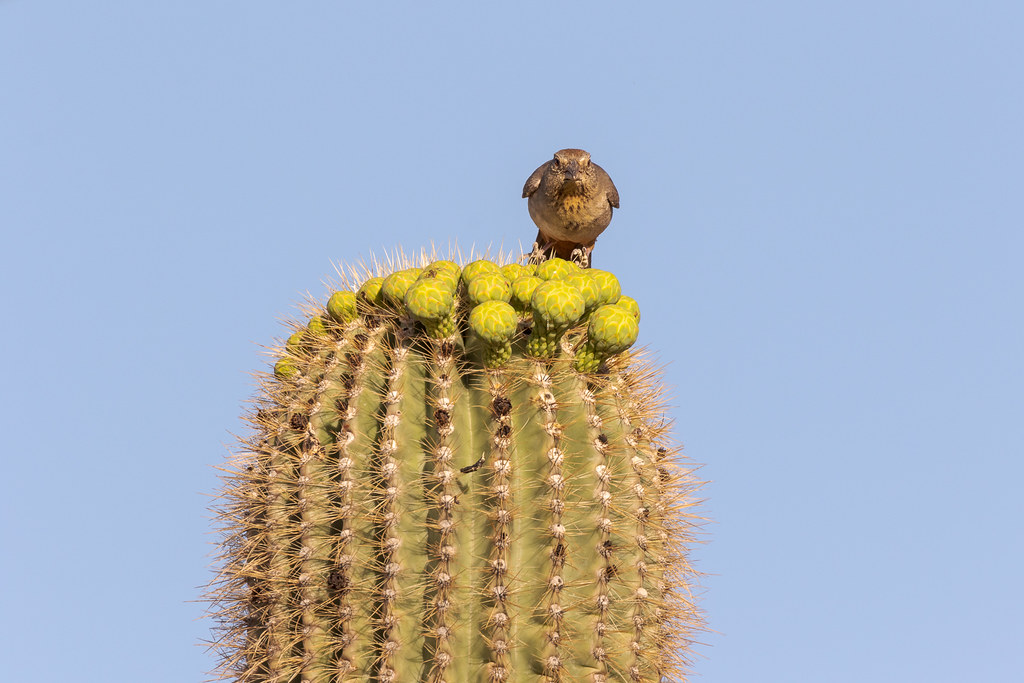
A canyon towhee looks directly at me as it perches atop a saguaro along Brown's Ranch Road in McDowell Sonoran Preserve

We see a lot of overlap between the birds of our backyard and the birds of the desert but not with towhees. I’ve seen three species of towhees in Arizona, Abert’s towhees all summer in our yard and just recently a spotted towhee, but the canyon towhee shown here I only see on the trails.

Little Lovely

A common side-blotched lizard warms itself in the sun on a rock along the Coyote Canyon Trail in McDowell Sonoran Preserve

I hope there are little things in your life that bring you as much joy as these tiny lizards bring to me. The common side-blotched lizard is the lizard I see most although they can be difficult to photograph because of their small size. Most of the time I just watch them sunning themselves or scurrying about and am thankful they are there, and I with them.

Shrike One! Shrike Two!

A loggerhead shrike perches in a tree along an off-map trail near Granite Mountain in McDowell Sonoran Preserve in Scottsdale, Arizona

When I saw this loggerhead shrike on an off-map trail near Granite Mountain I assumed it was my first one in Arizona but not my first one ever, having seen them in Washington. Except I hadn’t, when I got home and checked my notes I realized the shrikes in Washington were northern shrikes so this was both my second shrike and a new species for me. In my defense I rarely saw shrikes there or here.