For the Carolinas

A green heron perches on a barnacle-encrusted log in Huntington Beach State Park in Murrells Inlet, South Carolina

I met one of my favorite birds, a green heron, right before the sun came up at Huntington Beach State Park in South Carolina in the summer of 2007. I loved that little park, any place that gets me up long before the sun has to be pretty special. To all those in the Carolinas and elsewhere in Florence’s path, I hope you will be safe and sound. Look after each other.

Life in Miniature

An ornate tree lizard (I think) clinks to the vertical surface of a granite slab on the Piestewa Peak Summit Trail in Phoenix Mountains Preserve in Phoenix, Arizona

An ornate tree lizard (I think) perches on the vertical face of a granite slab, the jagged top a miniature of the mountains that surround. We met on my first visit to Phoenix Mountains Preserve on the Piestewa Peak Summit Trail as it flitted about the rocks, each unique in appearance. I was especially delighted when it returned to this one and arched its tail to match the curve of the granite. I was not as deft on the rocky trail and didn’t make it to the summit, there was a place where the trail got a little too narrow and triggered my fear of heights.

Oh little one, that I could climb as you climb.

I Did Not Eat My Hat

A desert spiny lizard perches on a granite rock along the Rustler Trail in McDowell Sonoran Preserve in Scottsdale, Arizona

I like to think I’m a man of my word but I suppose we all have our limits. Last weekend I hiked out to Balanced Rock for the second time and after taking some pictures noticed in the distance the head of a spiny lizard sticking out from a rock, much like this desert spiny lizard on the Rustler Trail. It was far off and in the shadows but seeing the shape and that the head was darker than the surrounding granite I thought “If that isn’t a spiny lizard I’ll eat my hat.”

I lifted the telephoto lens to my eye to be sure. It wasn’t a spiny lizard. I tell you, the granite can be cruel.

But I didn’t eat my hat.

This spiny lizard is the same as in the linked picture but from the other side of the rock and in different lighting. The granite was in a kinder mood.

Green and Blue in the Desert

A common side-blotched lizards perches on a rock in front of the green of an out-of-focus saguaro

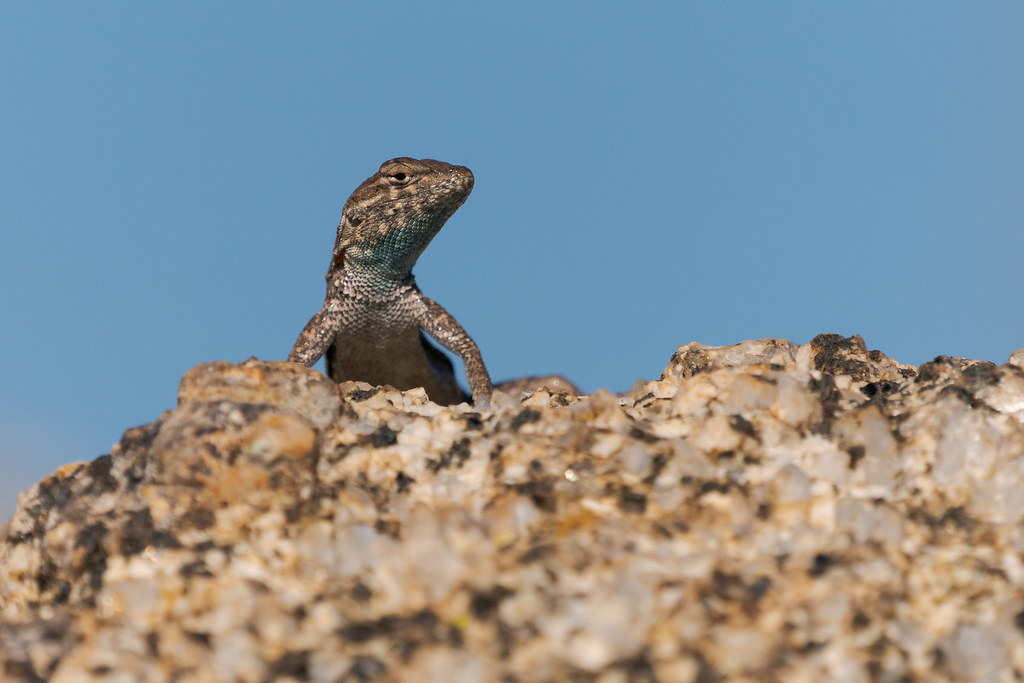
I was sitting below this little common side-blotched lizard, shooting up at it against a blue sky (below), when I realized if I moved the camera slightly I could shift the background to green courtesy of a massive saguaro standing behind it. There is green in the desert, not the ubiquitous saturated greens of the forests of the Northwest but a soft, muted green, always in the saguaros and palo verdes but on many more plants now that the summer monsoons have arrived.

Blue is easy to find in the skies of the desert but some lizards, especially the males, may have blue throats or sides or blue speckled throughout their scales. Blue too is the skin around the eyes of adult white-winged and mourning doves. All of these blues can be seen where I photographed this lizard at The Amphitheater in McDowell Sonoran Preserve, a rock formation on the Cholla Mountain Loop Trail that is one of my favorite places to hike.

A common side-blotched lizards perches on a rock in front of blue skies

Turning Rocks Into Lizards

A desert spiny lizard peeks out from behind a rock on the Rustler Trail in McDowell Sonoran Preserve in Scottsdale, Arizona

As I hike the pattern recognition part of my brain is constantly scanning for objects that might be wildlife even though they often turn out not to be. I spent a summer in Florida in the mid-90’s and was delighted by the many alligators there, it took years after we moved to Oregon for that part of my brain to stop trying to identify possible alligators when I hiked in marshland. In Yellowstone on a gravel road there was a large rock in the distance that in the periphery resembled a bear. I loved that road and drove it a number of times and as I approached that spot, I’d tell myself not to be fooled even for an instant by what I came to call Bear Rock. But every time the pattern recognition would kick in for a fraction of a second and say “Hey is that a …” before the rest of my brain would reply “I just told you it wasn’t going to be a bear!”

Here in the Sonoran Desert I am fooled by cholla skeletons that look like rattlesnakes, twigs like small lizards, granite protuberances like large lizards. I try to use my mental powers to turn rocks into lizards but usually I fail, rock stays rock. But sometimes I succeed and the rock comes to life, such as this beautiful desert spiny lizard on the Rustler Trail in McDowell Sonoran Preserve. One success is worth a thousand misses.

Disappearing Act

A white-winged dove perches on an ocotillo starting to leaf out after the summer rains in McDowell Sonoran Preserve

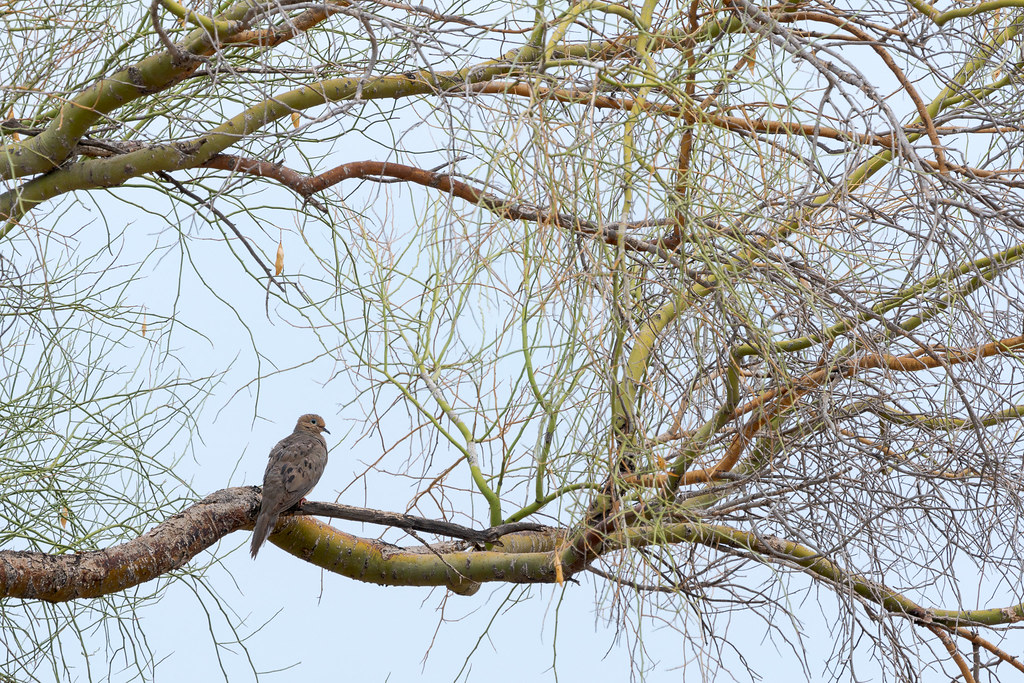
This ocotillo had just started leafing out in the middle of July with the arrival of summer thunderstorms in the Sonoran Desert. The white-winged dove perched in the morning light is one of thousands I have seen, they are not only the bird I see most in our backyard but out in the desert as well, never more so when seemingly one or two or three were atop every saguaro as they devoured the ripening fruit. But after a self-imposed two week ban to allow a knee to heal, I returned to the trails twice last weekend and didn’t see a single one. Not one!

From what I’ve read, the white-wings arrived in the desert about the time I did and will be leaving this fall. So I suppose in a month or so they will be gone from our backyard as well. The smaller mourning doves and much smaller Inca doves will appreciate it, the larger white-wings are more aggressive, but our cats and I will miss them.

The One-eyed Towhee

A canyon towhee is missing one of its eyes at Balanced Rock in McDowell Sonoran Preserve

In May I arrived at Balanced Rock on my first visit to this lovely rock formation in the Granite Mountain section of McDowell Sonoran Preserve. After taking some pictures of Balanced Rock itself, I sat down on a large granite slab for some water and cereal bars before heading back. I put my camera away but brought it back out when a pair of canyon towhees flew in. I could tell something was wrong with one of the eyes of one of the pair but couldn’t tell what as it flitted about until I looked at the pictures: one of its eyes was missing. To me it looks like a congenital defect, as though the eye and the surrounding feathers never formed.

I felt a great deal of sympathy for the little bird as life in the desert is hard enough. But even more I felt admiration as it flew about the rocks and perched in trees with all the grace and alacrity typical of birds despite the limited depth perception. Obviously it had survived into adulthood and apparently found a mate (canyon towhees are typically monogamous and often mate for life). I couldn’t say if its mate helps it find food, or if it supplements its diet with crumbs left behind by hikers like me who stop to eat, or if it feeds just fine on its own, but it seemed healthy.

May you have a long happy life, little one.
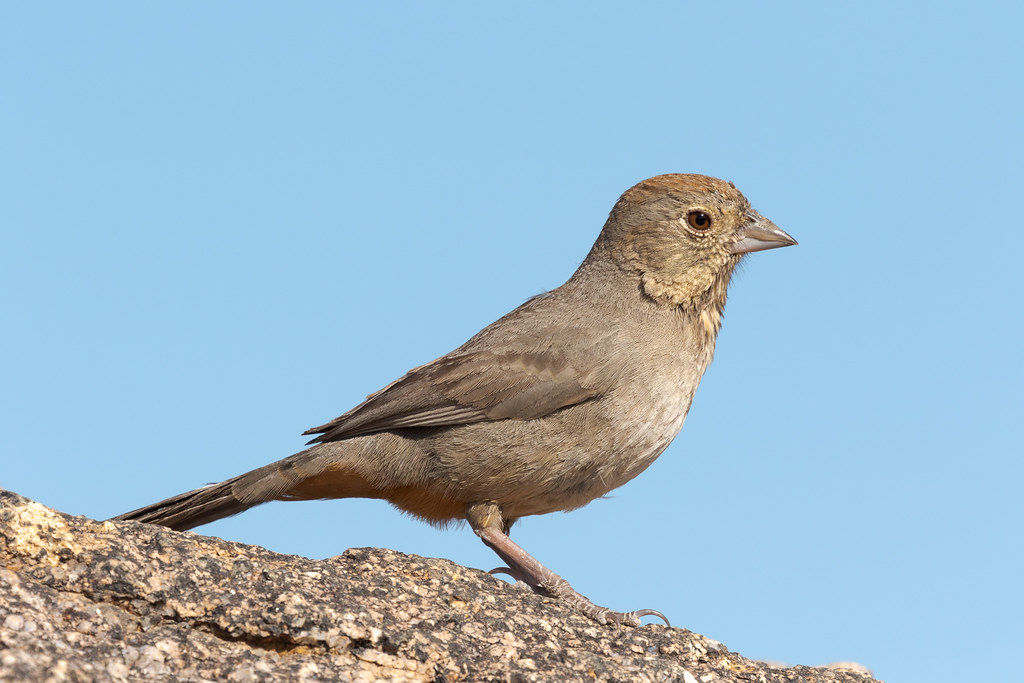
A side view of a canyon towhee at Balanced Rock in McDowell Sonoran Preserve

On the Lookout

A close-up view of a juvenile red-tailed hawk looking directly at me at Ridgefield National Wildlife Refuge

There was a period of time at Ridgefield where I came across what I called Hawk-on-a-Stick, juvenile red-tailed hawks perched on signs around the large meadow that would allow me to view them from close range. They didn’t often look directly look at me, which was a good thing, as it meant they were comfortable with me and on the lookout either for voles in the meadow or older redtails that might chase them away.

Under Tom’s Thumb

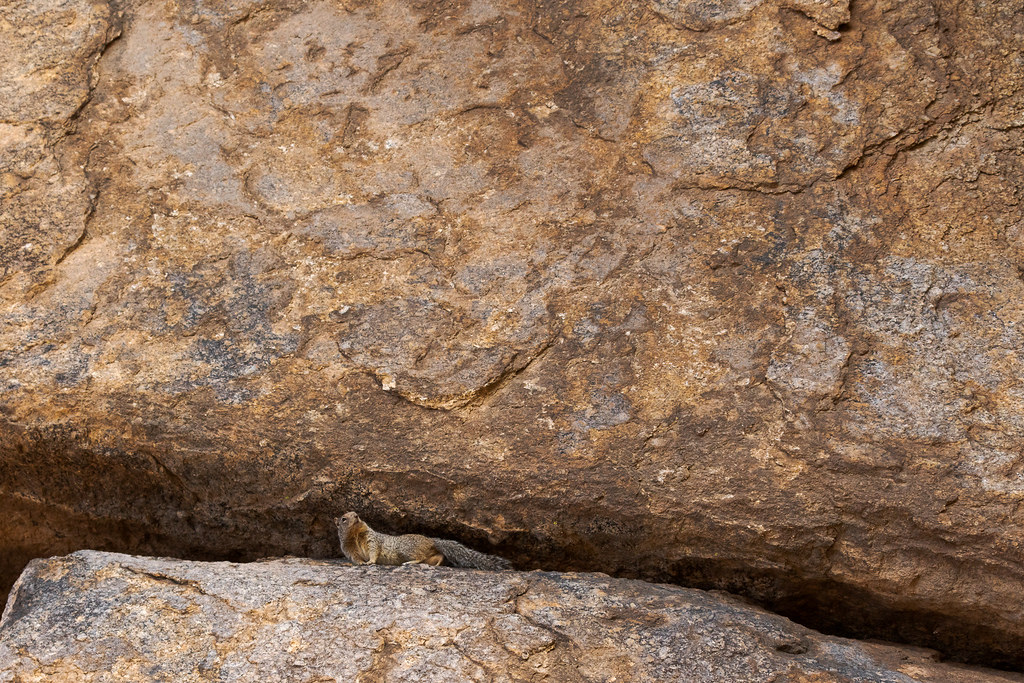
An environmental portrait of a rock squirrel between two massive granite rocks at Tom's Thumb in McDowell Sonoran Preserve

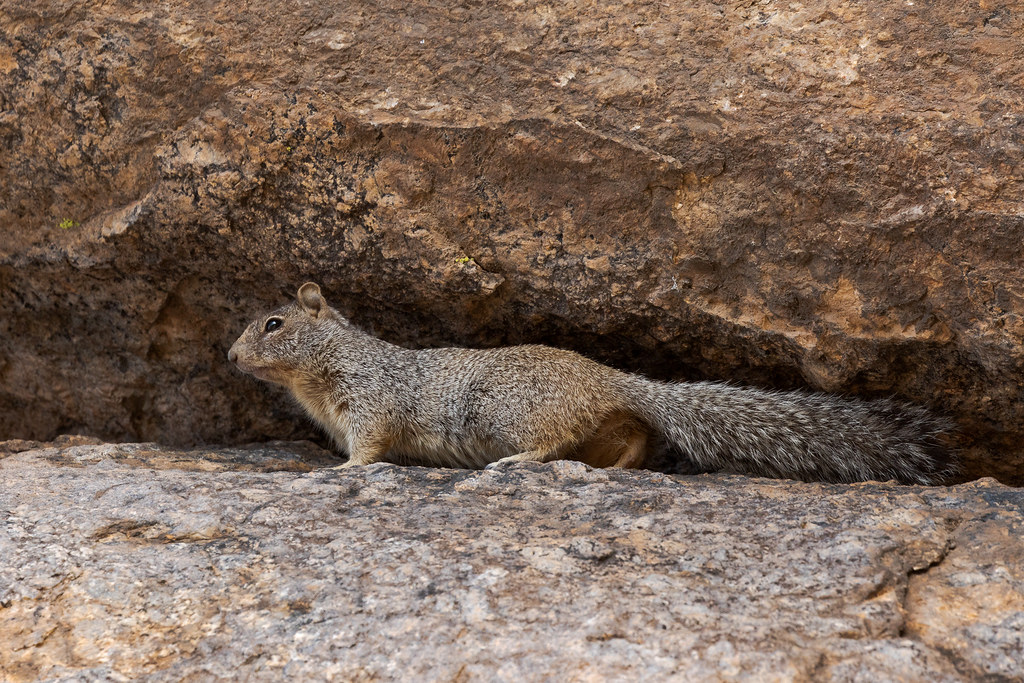
I met this rock squirrel back in April a few weeks after we moved here. One of the reasons I love a telephoto zoom like the 100-400mm lens so much (this is the Canon, I only got the Sony recently) is that you can zoom in and take a traditional portrait of a small animal far away, like the shot below, but you can zoom out and take an environmental portrait as well like the picture above (when the scenery allows it). In this case I vastly prefer the environmental portrait as you get a feel for the massive rock this squirrel is perching under. Given more time I would have preferred an ever wider perspective with a different lens to show that it was perched high off the ground between much more massive granite boulders above and below than you can see here, but the squirrel only paused for a moment as it ran up the rocks at the approach of a dog on the trail.

I was struck by how at ease this rock squirrel was in the rocks as it moved about the narrow passages and great heights as easily and gracefully as a tree squirrel in the trees. I was delighted to find both rock squirrels and Harris’s antelope squirrels in the desert as I had mistakenly surmised I was leaving squirrels behind when we left Oregon. I fell in love with chipmunks and squirrels at an early age, we had a forest behind our house as a child in Michigan, I can’t remember ever not loving them. They’re a rarer treat now than then, but a treasured treat always.

A rock squirrel between two massive granite rocks at Tom's Thumb in McDowell Sonoran Preserve