
A male house finch peeks out from behind a blooming saguaro cactus in the Brown’s Ranch section of McDowell Sonoran Preserve.

Scratcher of heads, rubber of bellies
A male house finch peeks out from behind a blooming saguaro cactus in the Brown’s Ranch section of McDowell Sonoran Preserve.

I’m used to wrens being tiny little birds so I was caught off guard by the size of the cactus wren, here perching on a saguaro in the early morning light. Thankfully they are both common and gregarious as they are a delight to watch as they move about the desert.

We’ve been in Arizona a month now and life in the desert is going pretty well. I am still a fish out of water at work but with each passing week more falls into place and I’ve been able to contribute a bit the past couple of weeks. The same can be said about life in general although I haven’t ventured further afield than driving to work and local hiking trails. I picked up my Arizona drivers license and license plates a while back, which drives home this is home, although with the new plates I did walk past my Subaru when returning from a hike until I realized my mistake.
It’s still spring so we haven’t had to deal with extreme heat – extreme heat for this area anyway, it is already as hot as it ever got in Portland – and while so far I haven’t minded the heat I am having a hard time imagining how it can be 20 degrees hotter, which it will be soon enough. In the meantime I am hiking as often as I can, as it is springtime in the desert and there is much to see and learn. Several varieties of cactus are starting to bloom so soon the desert will be at its most colorful.
This morning brought the 17th new species I’ve identified, a pair of Harris’s hawks along the Hackamore Trail. The one in flight is younger, it still has some of its juvenile coloration but it seems to be taking on the appearance of an adult, like the one perched below. I’ve seen more new species than this but some I can’t yet identify, especially the lizards, but I’ll get better in time. Reptile field guides aren’t nearly as good or plentiful as for birds, and I really wish there was an app, I love how the birding apps let you limit your selection to just the birds you might see in your area. I just ordered another reptile guide to go with the one I have so hopefully that will help.
But even for birds I have questions to be answered. I’ve seen a cactus wren building a nest in the arms of a saguaro, but after seeing these hawks a while later I came across a massive nest in a saguaro’s arms. Do the hawks nest in the saguaros too? There is plenty of time to learn the answer, and I hope with each answer another question follows, for that is part of the joy as I wander and wonder in my new desert home.
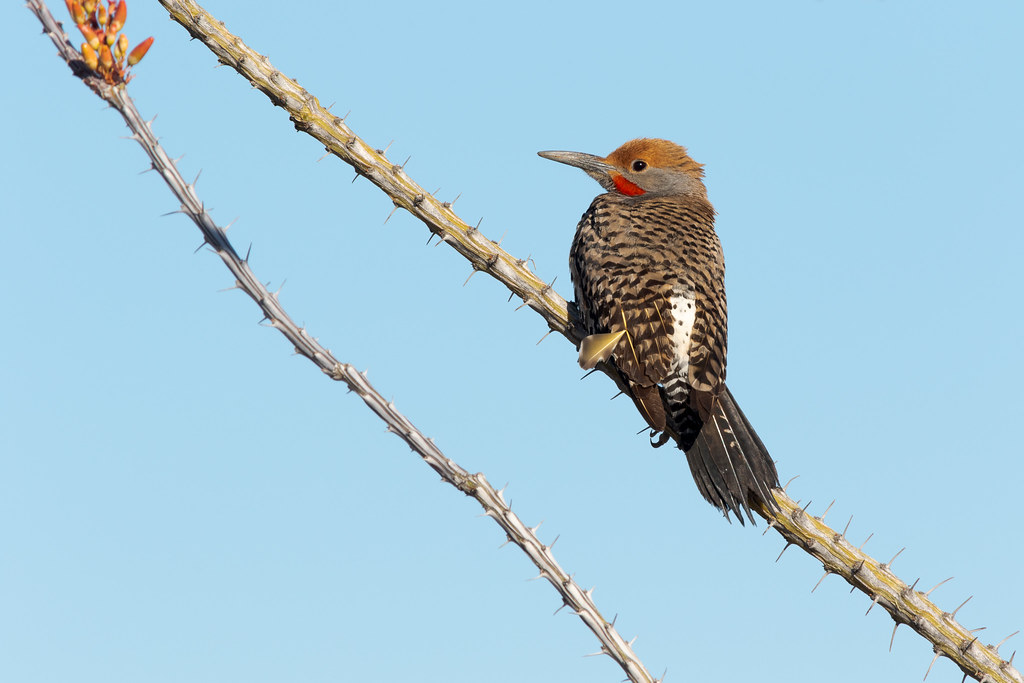
When we moved to Arizona the two birds I hoped to see above all others were both woodpeckers, the Gila woodpecker and the gilded flicker. My interest was piqued early on when we were looking at houses online and I noticed what looked like bird holes in a large saguaro in front of one of the houses and a little research revealed the likely culprits. Woodpeckers are one of my favorite birds, a love born in childhood in our wooded Michigan backyard, a love that never ended even when my daily exposure to them did.
I was delighted to arrive here and not only see both woodpeckers but see them frequently, even in our backyard. My first gilded flicker sighting was in our backyard but I met this male on this morning’s hike on the Hackamore Trail, one of the many interconnected trails in the McDowell Sonoran Preserve. Although I mostly see the woodpeckers on the saguaros where they live, he was perching on the branch of an ocotillo, a beautiful and distinctive plant covered in sharp thorns.

I’m a night owl in a land of early birds. It wasn’t a good feeling when the alarm rang out at 4:30am but it was a great feeling when the sun tipped over the mountains and illuminated the curve-billed thrasher serenading me atop a saguaro. I love how gingerly it appears to be stepping on its prickly perch but in truth the birds fly onto these saguaros with great speed and alacrity.

One of the birds I was hoping to see once we moved to Arizona was the Gila woodpecker. It only took a couple of weeks, and my second time hiking, to find one, courtesy of the Gateway Loop Trail at McDowell Sonoran Preserve. My first Gila was a ways off but after finishing the loop I found this female atop a saguaro on the Bajada Nature Trail. I’ve since seen one in our backyard but wasn’t able to get a picture. The Gila is one of 14 new species for me since we moved here a few weeks ago (11 birds, 1 mammal, and 2 lizards).

A curve-billed thrasher perches atop a saguaro at the Bajada Nature Trail in the McDowell Sonoran Preserve. This was the second thrasher I saw that morning, a new species for me.
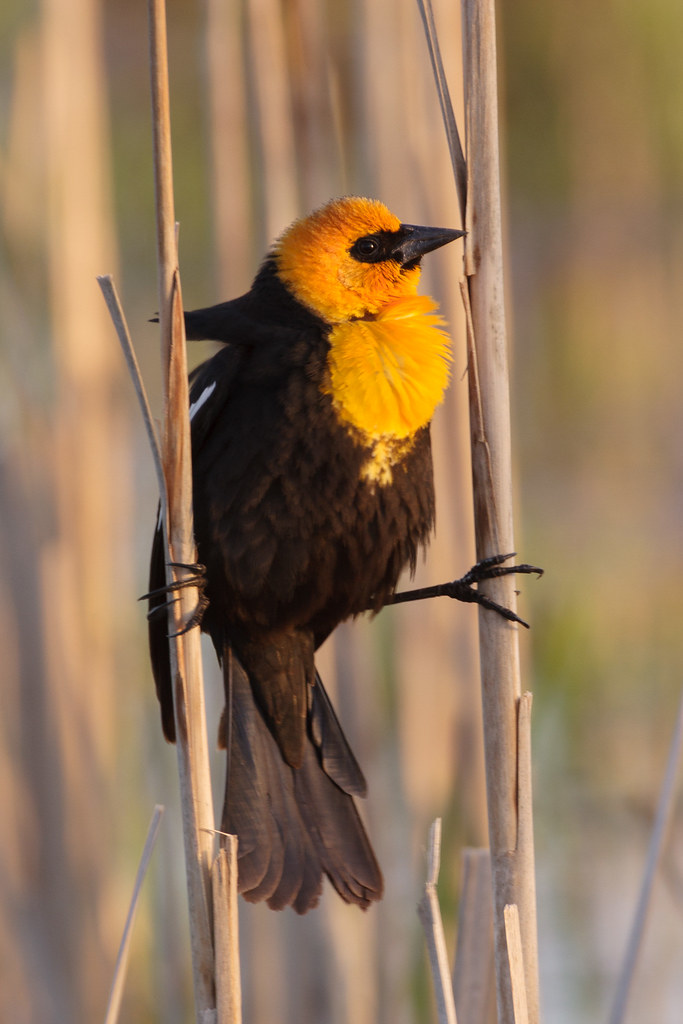
It’s not like Mount Rainier or Olympic National Parks, Ridgefield National Wildlife Refuge, not the sort of place you plan a trip around. It’s not scenic, there are no mountains, no beaches, no waterfalls, no old growth forests. But I spent more time here than anywhere else in the Pacific Northwest. I might have spent more time here than all other parks combined. Not because of what it didn’t have, but because of what it did: the auto tour.
There’s a mostly one-way gravel road that winds through the seasonal ponds and lakes of this unassuming little refuge across the Columbia in Washington where for significant portions of the year you have to stay in your car. Because the animals aren’t spooked so easily if you are in your car compared to when you are not, I watched birds and mammals behave naturally from close distances. I met this yellow-headed blackbird, showing off his acrobatic skills as he straddles two stems, at Rest Lake late on a sunny spring evening.
I stayed dry in the rain and warm in the cold. Relatively warm in the cold, I shut my car off when I stopped and sometimes I stopped for hours. I kept an extra coat to drape over my legs on the cold days, extra towels to drape around the car on wet ones. I started playing around with video towards the end once I got a camera capable of good video but it was too late for me to have taken very many, but those few videos joins thousands of pictures in my archives.
I’d be embarrassed to tell you how many hours I sat in my car and watched bitterns hunting at the edges of the lakes. Or watching herons and coyotes hunting voles in the big meadow at the end of the auto tour. Watching the eagles and swans at Rest Lake. Watching red-winged blackbirds, yellow-headed blackbirds, marsh wrens, song sparrows, common yellowthroats, American goldfinches, all from one spot at South Quigley Lake.
There are a couple of short hiking trails at the refuge, one only open during the warmer months when the cackling geese are gone, but mostly what drew me was the auto tour. Too much so I suppose, I knew I should explore other places more often, if nothing else for the exercise. But I kept having wonderful experiences so I kept coming back.
I haven’t been up as often the past few years, mostly because I was walking Ellie during the hours I would have normally visited the refuge, but Ridgefield I will hold in my heart for all of my days. Goodbye, I love you.

In the Northwest our winters are green as during the rainy season moss grows on everything that sits in shadow. I’m going to miss seeing it grow on trees. I’m not going to miss seeing it grow on my car.

Love the yellow eyes on the brown thrashers, taken in 2006 at Huntington Beach State Park in South Carolina.
 Boolie