
Tag: Rest Lake
An Itch to Scratch
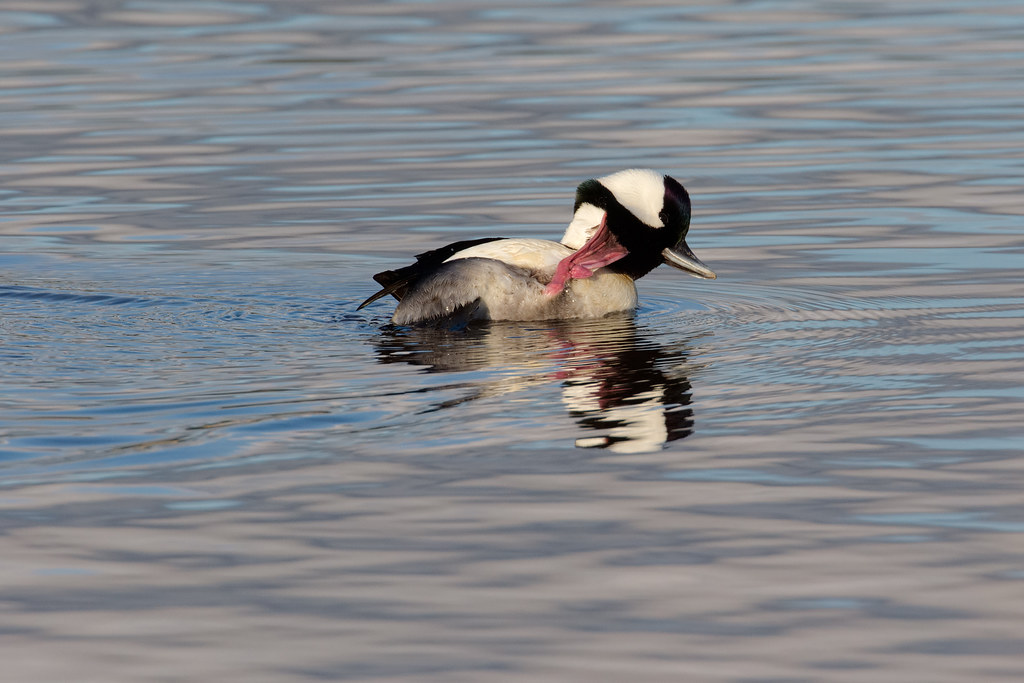
A male bufflehead uses one of his adorable pink feet to scratch an itch while swimming across Rest Lake.
Diverse Divers

Visit Ridgefield in the winter and you’ll see waterfowl diving under the water to feed, such as this bufflehead at sunset above, or the coot below, its red eye visible just above the water. I like to sit and watch them and have been struck by the many differences in the bodies of coots and diving ducks, even though they both spend much of their lives diving underwater to feed. There are differences in their bills, and their feet (ducks having fully-webbed feet, coots not), but my favorite difference is most visible when they dive.
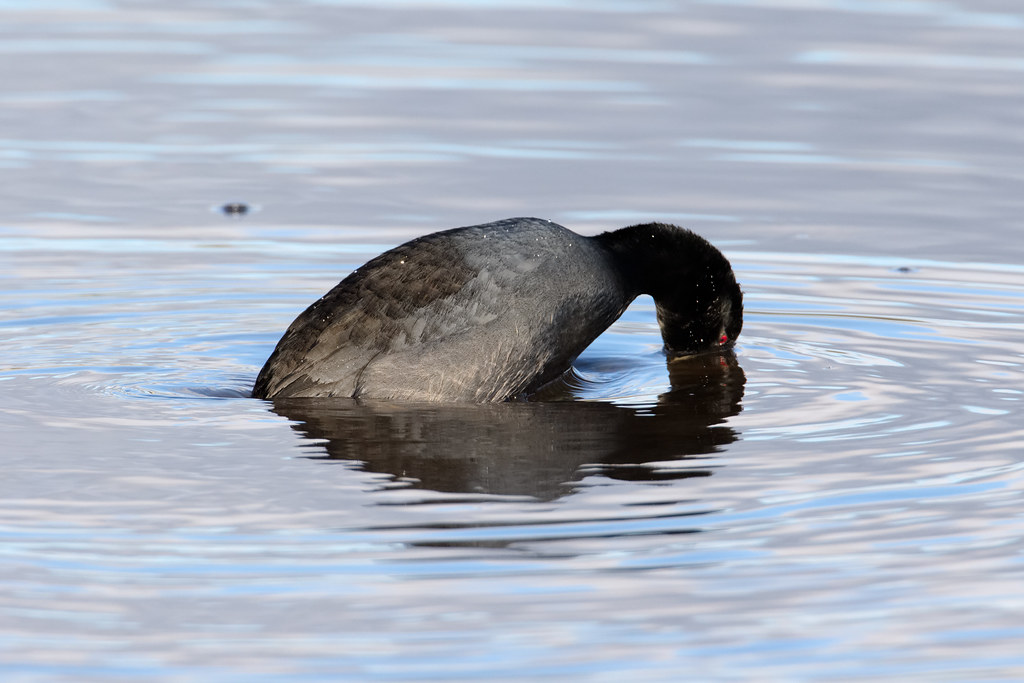
Both diving ducks and coots spring forward and break the surface tension of the water with their beaks, but ducks leave a vortex behind them at the start of the dive while coots do not, a difference that begins with their ends. Diving ducks like the bufflehead have broad tails that they spread out horizontally on the water before they dive, enabling them to push their tails down and themselves forward as they start their dive. You can see the pattern of their tail feathers, shown below as water flips off the bufflehead’s tail as he finishes the dive, in the water behind the duck in the first picture.

Compare the bufflehead’s tail above to the coot’s below and you’ll see the coot has a stubby little tail and can’t use it to push forward like the diving ducks can. While it might seem that the diving ducks have solved the diving problem much more efficiently than the coots, I should point out that the coots at Ridgefield far outnumber any species of diving duck at the refuge.

A trait they share in common is that they have to get a long run across the water to take to the air, so if a bald eagle attacks, they prefer to dive under the water as a means of escape. It’s usually effective, but sometimes you’ll see an eagle keep flying over a duck or coot repeatedly until its prey tires and surfaces at just the wrong moment and is captured in the eagle’s talons. I’ve seen eagles with a variety of waterfowl in their talons, but coots more than any others, not surprising given their large numbers.
On His Own

After circle feeding with a female for much of the afternoon, this male northern shoveler swam near my car at the end of the day, minutes before I left to make sure I was off the refuge before the gate closed. I hate leaving when the light and the subject are so beautiful.
A Green Hand Emerges

A small green hand reaches out from a tree bud as a dormant life awakens. Taken late on a winter afternoon, a reminder: spring is coming.
We Three Cranes

Three sandhill cranes, part of a much larger flock, fly in formation over Rest Lake at the end of a cold winter’s day. The skies above Ridgefield can be noisy in the winter, usually from the large flocks of cackling geese and tundra swans that overwinter at the refuge, but particularly early or late in the day sandhills may join the chorus.
Wingtips

Just your typical “Say, you didn’t bring any of your delicious cats with you, did you?” bald eagle flyby.
This young bald eagle had been heading in a direction to take it over to my left but it changed course and headed straight toward me. This was the last picture I could take showing its full body as with its long wings it was already wingtip-to-wingtip in the frame. The eagle was flying much too fast for me to change lenses as it flew closer, and it did fly quite close to my car before turning to follow the edge of the lake.
I’ve noticed many times before how the birds that soar above Ridgefield’s meadows and lakes have their flight feathers spread apart at the wingtips, both vertically (as you can see in this head-on view) and horizontally, but this time I was finally compelled to do a little reading to see if there was a benefit to it or if the birds lacked the structures necessary to keep them locked together under the pressures of flight. It appears that the spread feathers affect the vortices that form behind the wings when they’re providing lift, reducing drag as the bird soars through the air.
📷: Canon 7D II | Canon 500mm f/4L IS USM + 1.4x III
🗓️: January 1, 2016
Settling In

An American bittern seemingly ready to settle in for the night. It had been hunting up and down the channel in a light afternoon rain, but as the sun peaked out at sunset it settled into the grasses and hunkered down. Which made me wonder, where do bitterns spend the night? I’ve no idea if it was going to stay here for a while, but it was a lovely little parting gift on Christmas of 2014, as after taking these pictures I left for home.
The picture below is a zoomed in version of the bittern. I had upgraded my camera gear not long before, picking up the Canon 7D Mark II camera in late October and the Canon 100-400 mm II lens in mid-December. The new lens replaced my old 100-400 lens which I had for almost 14 years, but it was having some issues after so much use (I took it on every hike I went on) so I’m glad Canon finally updated it. This picture was zoomed in to 400mm, the top picture was at 100mm.
Really love this lens, very thankful for it.

A Christmas Miracle

Perhaps miracle is a bit strong, but I was delighted to find this short-eared owl on Christmas along Ridgefield’s auto tour, it had been almost a decade since I had last seen one. I didn’t have much time for pictures as there was a car approaching from behind and I wanted them to see the owl too. Since I already had my big telephoto mounted I took some quick head-and-shoulders shots. I was shooting out of my car’s window, so to get a slightly different look from the top picture I lowered the window to get more of the distant trees as a green background to go along with the brown grasses around Rest Lake. I then moved on and in my rear-view mirror I saw the folks behind me got a nice look too.

Almost Bald
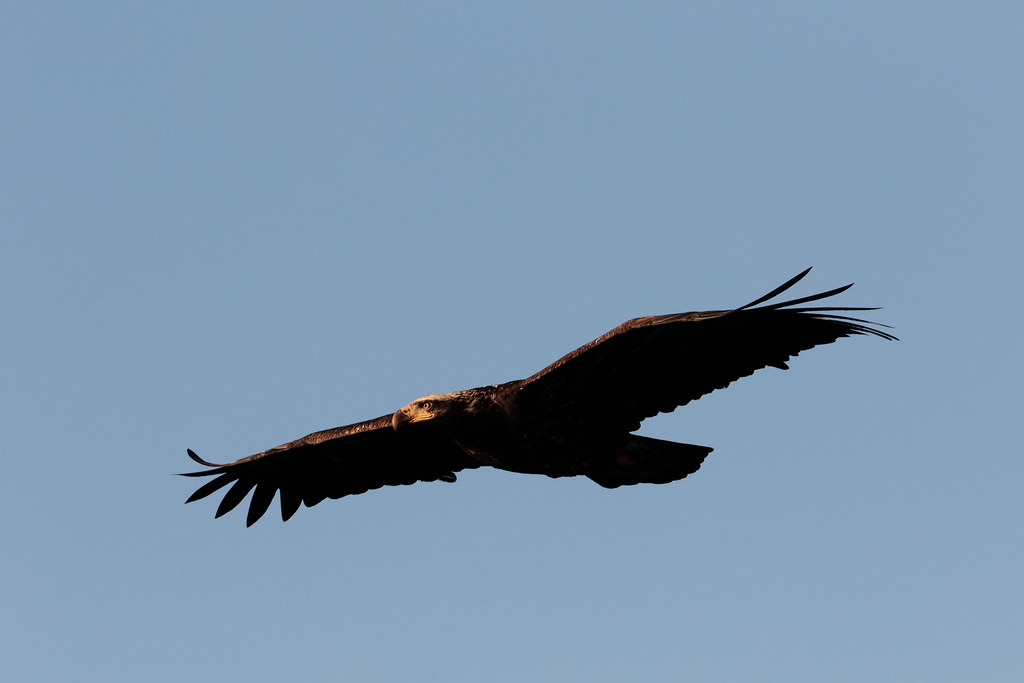
A bald eagle soars above Rest Lake on a cold winter morning. Next winter it should have the full white head from which the bald eagle’s name is derived, and I suspect it will attract much more attention from the resident adults as well. For now, though, its competition seemed to be the other young eagles on the refuge.
 Boolie