Watched & Watching

Watched & Watching

I headed up to Ridgefield National Wildlife Refuge yesterday for the first time in nearly a year, wondering what changes I might see, but the most unexpected change was one I saw in my rear view mirror. I had stopped along Rest Lake to photograph a couple of bitterns that were hunting near the road, but I kept having to move up to let traffic behind me through, before backing up to resume my watch.

The bitterns were soon gone but a great blue heron was slowly working its way in my direction, so I settled in to see how close it would come. I frequently checked my rear view mirror to watch for approaching cars but none came. But then in the mirror there was a slow movement of brown from one side of the road to the other, and when I swiveled my head around to look got my first glimpse of a Columbian white-tailed deer. Two of them actually, a doe and her fawn.

The doe had bright yellow tags in each ear and a large radio collar around each neck, she was one of thirty-seven that were emergency translocated earlier this year from another refuge in Washington (and one of twenty-nine that survived). Her fawn, though, belongs to the first generation born at Ridgefield. It and the other deer will be closely watched to see how they survive in their new home, as the Columbian whitetail was only recently downlisted from endangered to threatened status.

But at the moment, it was just the two of us watching each other, each seemingly as surprised as the other by the encounter.

Bad Luck, Good Luck

Bad Luck, Good Luck

Tundra swans usually don’t come close to the road at Ridgefield so I was particularly pleased late on a winter’s day to find an accommodating swan. But as I was photographing it, someone else came up and parked behind me and committed the cardinal sin of the auto tour — he opened his car door and got out. Of course the swan spooked and I drove away in frustration and was going to head home, but instead calmed myself and started looking for other things to shoot. The meadow at the end of the auto tour was empty, no herons or hawks or coyotes, so I thought I was done for the day.

But this great egret was waiting for me just past the parking lot and let me photograph it until it was time to head home.

Peace

A close-up view of the head and shoulders of a coyote

My favorite coyote picture, taken over a year ago in January of 2012.

Coyotes have a complicated and controversial relationship with our modern world, and I’m not sure how this pack will fare now that subdivisions have replaced the meadows on the hills above the refuge. I see them near the road sometimes as I drive into town before sunrise, but I see them as roadkill too. And there will be conflicts with barbed-wire fences and dogs and cats.

But on this morning, as it hunted for voles with its mate, and as a few snowflakes began to fall, all was peaceful. Only the three of us were around, and since I stayed quiet in my car, they let me watch at my leisure as they worked the length of the dike.

A peaceful morning for me, if not for the voles.

High Hopes

Crosstrek Christmas

For a car to work as my daily driver, it needs to do well in two situations:

  1. My commute to work
  2. The auto tour at Ridgefield National Wildlife Refuge

I’m in the midst of a long vacation so I (thankfully) haven’t had the chance to test our new Crosstrek on the work commute, but Christmas was lining up to be my first chance to test it at Ridgefield. It’s become a bit of a tradition for me to go to Ridgefield first thing on Christmas morning as sometimes I practically have the refuge to myself, a nice time for quiet contemplation during a hectic time of the year.

Late on Christmas Eve after my wife had gone to bed I went out into the garage and just looked at the car for a while. I was nervous, for the next day would prove whether my high hopes for this car would pan out at the refuge. I sat in it for a while and read the owner’s manual enough until I figured out how to quiet the beeps when you lock the car. My nerves settled, I headed up to bed and set my alarm to wake me before sunrise.

I love photographing in the rain and Christmas delivered the wet in abundance as I drove in the dark to the refuge, giving me a quick feel for how the little Subaru would handle the heavy rain compared to its bigger sibling (thankfully, it handled the soaked streets and big puddles quite well, I was thankful not to be in the Civic).

I was relieved to see the car did well along the auto tour too (the icing on the cake would have been if it had been a hybrid so I could drive more quietly around the refuge, but it was not to be). At this time of year you can’t get out of the car except in the parking lots, so I took a quick picture beside the sign in the entrance lot.

I’m definitely still in the honeymoon phase but so far I’m just loving this little car.

I’ve been back to the refuge and it’s gravel road a few times since Christmas, each time in the rain, and it’s starting to feel less and less like someone else’s car and more and more like mine. But she’s not quite as white as she used to be.

A Mystery

An American bittern stands in the water next to Rest Lake at Ridgefield National Wildlife Refuge in Ridgefield, Washington

This is one of my favorite bittern pictures as it shows the way I often wind down a day at Ridgefield, watching bitterns near the end of the auto tour before I have to leave to beat the closing of the automated gate, the setting sun leaving the bittern to hunt in shadow. These last moments always make me wonder — what do bitterns do in the dark?

Clues Two

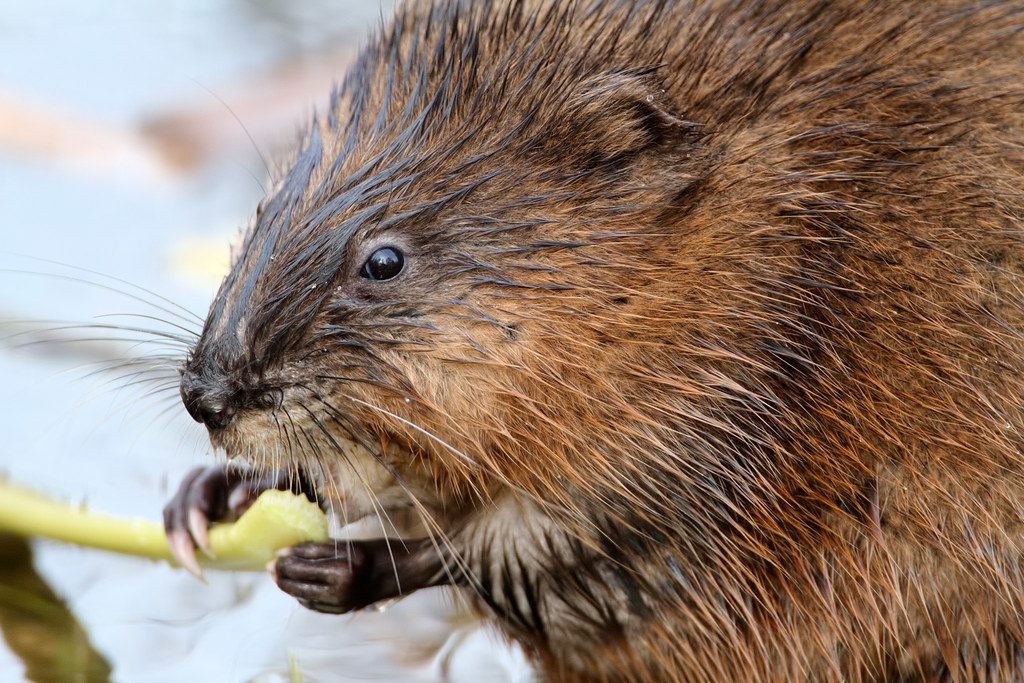
A close-up view of a common muskrat eating plants

I saw my first muskrat at the Virginia Tech Duck Pond back when I was first getting into photography. Sadly I found it dead not much later, but my fascination with these rodents was born. So I was particularly pleased when we moved to the Northwest to find them here as well. Over the years I’ve seen one in most of the ponds and lakes around the auto tour at Ridgefield, although surprisingly I seem to be the only one who is excited to see these adorable creatures.

While the face of the muskrat is unique compared to the other aquatic rodents at the refuge, its distinctive white claws are also an important clue, visible here on the front paws of this hungry muskrat. While I have seen muskrats many times, they are shy creatures and my glimpses are usually brief. Thankfully though this one let me photograph from close range to my heart’s content as it dined on plants at the edge of Canvasback Lake.

This is why I can’t stop going to Ridgefield.

Clues

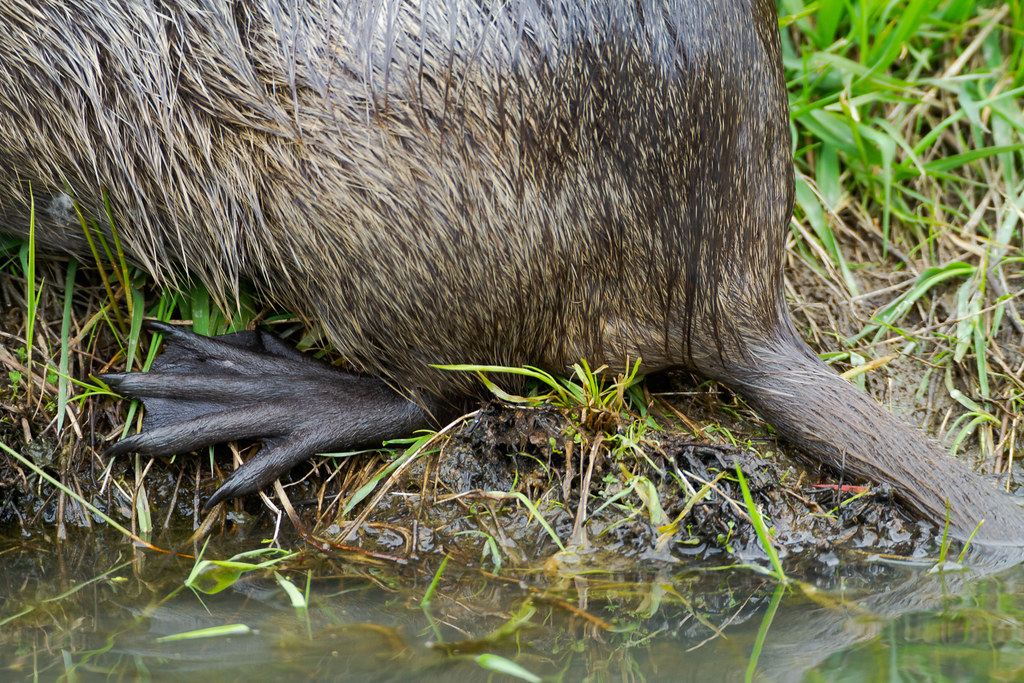
A close-up view of the rear foot of a nutria

Nutria are by far the most commonly seen of the aquatic rodents at Ridgefield, with muskrats being relatively common, beavers not common at all. There are enough clues in this picture to identify which of these rodents this is. The tail is the most obvious indicator, but the rear foot all by itself holds enough clues. A muskrat has white claws while those of a nutria and beaver are dark. Both beavers and nutria have heavily webbed rear feet, but all five of the beaver’s toes are webbed, on a nutria only the inner four.

Which begs the question: why?

I don’t know the answer but I do know this is a nutria.