Synchronized Preening

An adult American beaver preens and shows off its large flat tail in the early morning light at Ridgefield National Wildlife Refuge in May 2006

Early one morning on Mother’s Day, I stopped along the auto tour at Ridgefield to watch wood ducks in a quiet channel. A sudden dark form in the water caught my attention, I hoped for a beaver but knew it was more likely a nutria, the most commonly seen of the large rodents. Muskrat frequent the area as well but it was too large to be a muskrat.

My first impression from the size and shape of the head was that it probably was a beaver. There was little doubt left when its large, round form emerged onto the far bank, and no doubt remained when its broad flat tail finally came out of the water. I was feeling pretty blessed, watching the beaver preening, when a second dark shape swam onto the scene. To my delight, a smaller beaver climbed up onto the bank next to the large one and began grooming itself before finally snuggling up to the larger beaver.

Upon getting home, I learned that there is no difference in size between beaver sexes, but that the young often stay with the parents for the first couple of years, so this is most likely parent and child. I don’t know the sex of the older beaver, but given the day, I’d like to think they were mother and child.

An adult and a juvenile American beaver preen side-by-side in the early morning light at Ridgefield National Wildlife Refuge in May 2006

From Water to Earth

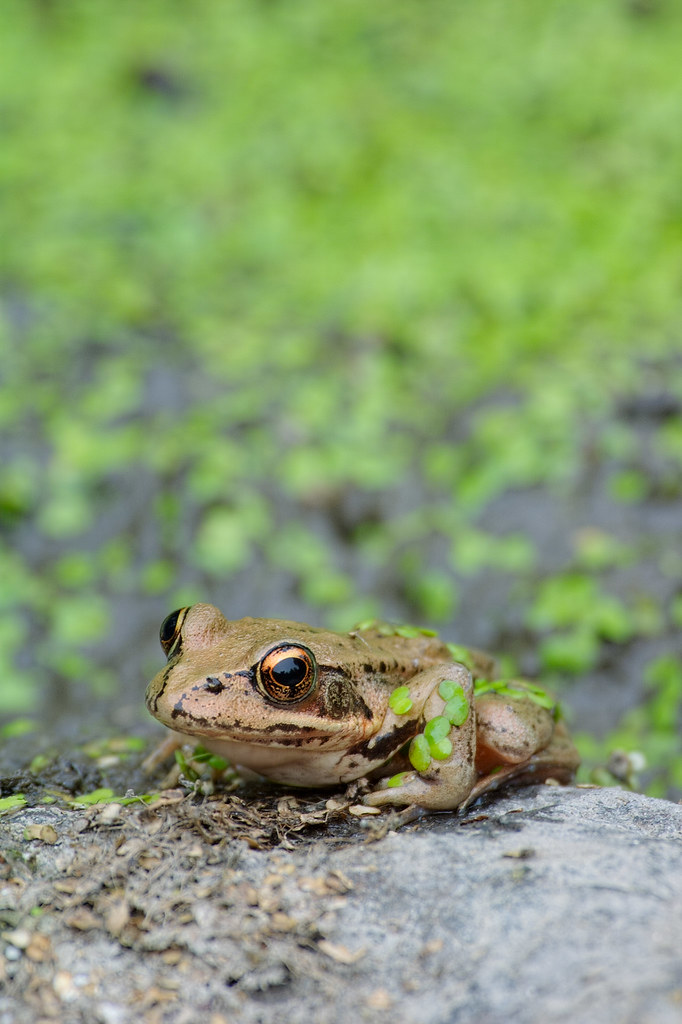
A red-legged frog sits on a rock beside duckweed-filled water

This red-legged frog had been sitting in the duckweed before hopping up onto a small rock. I wanted to convey a sense of the frog emerging from one world to another, so I placed it at the bottom of the frame with the top third green water, the middle third transitioning from water to earth, the bottom third solid ground.

Ooomm-ka-chooom

An American bittern calls out at Ridgefield National Wildlife Refuge on May 10, 2009. Original: _MG_4365.CR2

It amuses me that a bird that tries so hard not to be seen has a call that can be heard from so far away. The bittern has a distinctive ooomm-ka-chooom call that is one of my favorite sounds of the marsh, it reminds me more of a gurgling swamp than a bird. In this picture it has spread its throat out, sending out its call across the marsh.

📷: Canon 20D | Canon 500mm f/4 | Canon 1.4X
🗓️: May 10, 2009

Shadow of a Hunter

A great blue heron casts a long shadow as it perches above Bower Slough near the Kiwa Trail at Ridgefield National Wildlife Refuge

A great blue heron perches on a downed tree as its shadow is cast over the green water. Even though it was actively scanning and listening for movement in the water below, its perch seemed too high to have a chance at capturing any frogs or fish, so it may have been in reconnaissance mode. It eventually started hunting closer to the water.

No Blackberry Breakfast

Close-up of juvenile red-tailed hawk's face looking down

There’s an invasive species of blackberry that has spread across the Northwest and is prevalent at Ridgefield. A variety of animals will use the berries as food or the thickets as cover, but this young hawk was using it as a place to listen for breakfast, every sound from below drawing its eyes downward. It didn’t end up catching anything, at least not during our time together.

Gold Reward

A common yellowthroat perches in cattails at Ridgefield National Wildlife Refuge

The yellowthroats weren’t staying still for very long, so even if I got a clear view of one I had to move quickly. For a few seconds this male flew into the middle of the cattails, not so high as to draw the ire of the blackbirds. His eye was obscured by the cattail in front nearly the entire time, but he stuck his head out far enough for me to get one picture before he flew off.

My favorite picture of the day.