
Getting your back rubbed, sipping on fruit juice, enjoying the warmth of a summer evening in the desert. Sometimes life is good.

Scratcher of heads, rubber of bellies
Getting your back rubbed, sipping on fruit juice, enjoying the warmth of a summer evening in the desert. Sometimes life is good.

Last year after getting some confidence identifying the more common birds and mammals and reptiles of the Sonoran Desert, I decided to start learning the desert plants. I spent an evening reading up on the trees (there aren’t a bunch, this shouldn’t have been hard) but the next morning I couldn’t remember anything I had read the night before. I was a little frustrated with myself but heard a pleading voice that there had been too much that was new and to focus on the things I had to learn, not the things I wanted to learn.
As a creature of habit I knew Arizona would provide beneficial opportunities to experience something different but also that there was so much different both at work and at home that it might be overwhelming (the pandemic hasn’t helped). So I heeded that voice and put aside the guide books and stuck to familiar nearby parks rather than venturing further afield, trying out trails new to me when I felt up to a little challenge.
This summer has brought a mild awakening in being willing to learn new things, spurred on partially by the giant cactus out front that exploded in blooms after the summer monsoons and brought in a host of small creatures to feed on its bounty, and the butterflies that similarly burst into view at the same time either in our yard or on my beloved trails.
Insects have been tricky to learn but I believe this little lovely is a leaf-footed bug of the species Narnia femorata but take that with a grain of salt, I’m not a biologist much less an entomologist, and this is all new to me besides. While they apparently prefer prickly pear (the neighbors have a glorious patch) a group of them have been hanging out on this big cactus in our front yard, feeding either on the buds and blossoms like here on a rainy summer evening, or on the fruit that grew after the pollinators got to work.
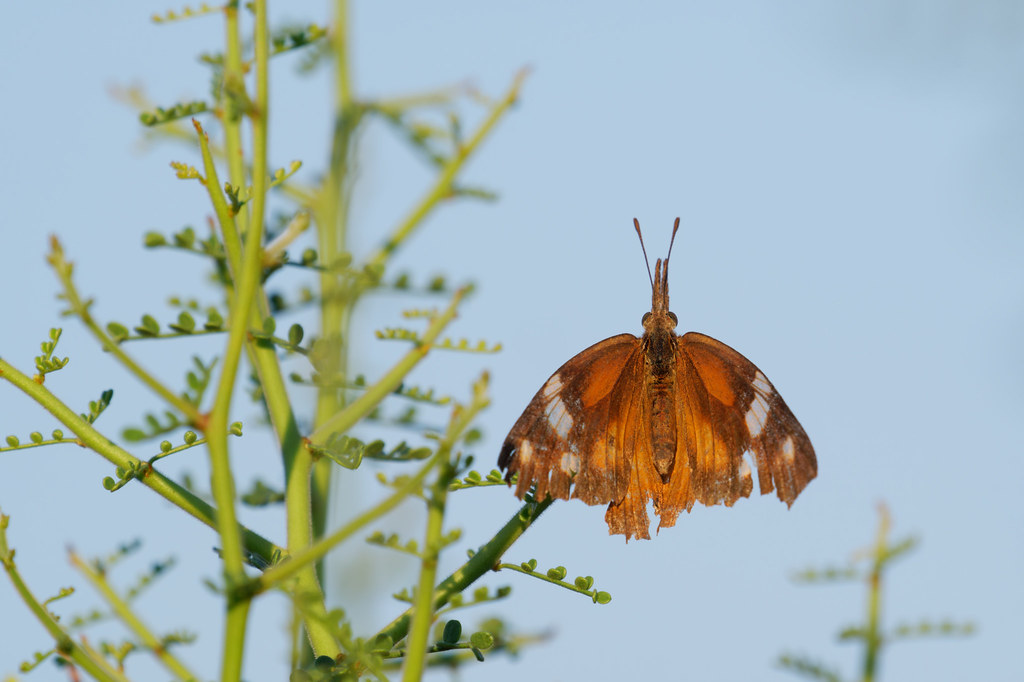
As the butterfly turned and spread its wings into the light of the rising sun, I could see how its wings resembled fallen leaves with uneven edges and transparent sections that mimic areas that have rotted away leaving only the veins. The disguise might be more effective in the forest than the desert where the leaves tend to be rather tiny.

To whoever named this beautiful butterfly, I don’t know, isn’t the name a little too on the nose?

Hard as it is to believe we’re in our third summer at our house. Out front in addition to a saguaro and a barrel cactus is some sort of big beautiful sprawling cactus. I was rather startled in July to see large flower buds emerging as it had sat silent during our time here, perhaps finally getting some decent rain this monsoon season woke it from its slumber. Even better? Like me, it blooms at night!
On a cloudy morning in late July the flowers hadn’t closed up yet so the bees were taking advantage of the new and abundant source of pollen. They seemed to struggle a bit gaining purchase on the flowers, such as this one clinging to the petal tops after clumsily climbing out from the center. Usually the flowers have closed up by the time I drag myself out of bed so I’ve developed a nightly ritual where I go out a couple of times to see the blooms and the wildlife feeding in the dark.
There are moths of course, mostly the little brown lovelies we see around but a couple of nights I saw what I think was a white-lined sphinx month, though I didn’t get a good enough look to be sure. Despite the large blossoms when this massive moth tried to land inside one it reminded me of when our dog Ellie would curl up in a cat bed when they took hers.
Best of all, we had a couple of bats coming in and resting in the alcove outside the front door. Have they been there before and I just haven’t noticed? Also best of all I saw a western banded gecko, while it doesn’t care about this cactus I wouldn’t have seen it if I hadn’t been going out to watch the blooms.
There are still a few flowers each night, mostly up high, and a whole bunch of fruit that some leaf-footed cactus bugs (at least I think that’s what they are) have been gorging themselves on, they stick around for more than just the night so I do have some pictures of them. And though I haven’t seen them, around me I can often hear coyotes howling to each other as they move about in the night. What joy this cactus has brought me, my brother in spirit if not in form.

One of my great joys this spring was to go to a local park on weekend evenings and watch a pair of gilded flickers raise their family in a nest near the top of an old saguaro. I’ve shared some of those pictures before and have more I haven’t sorted yet, but one of my favorites is the last one I took. Earlier in the weekend as I scouted for antelope squirrels lower in the park I heard a flicker calling out constantly and worried something had gone wrong and one of the adults was alarmed, but when I made my way to the nest I realized the last remaining youngster had found its full flicker voice and was putting it to good use.
It was as close to fledging as it could be, often hanging out of the nest hole and even leaning down occasionally to shoot out its long tongue (I’m presuming ants were climbing up the cactus as they are a favored food). It was happy enough to take feedings from its parents but after the sun set and I prepared to leave, I wondered if the Germans had a word for the feeling that as much as you had loved watching a flicker grow up, you hoped not to see it again. Not that I wouldn’t technically see it, just that I wouldn’t know I had, as I knew I wouldn’t be able to get back until the next weekend and something would have gone wrong for it not to have left the nest by then.
I took one last photo, though I had taken one just like it after the sun set the day before, and whispered let’s not meet here again. As I arrived the following weekend I was both happy and sad to walk up the trail and not hear the familiar voice, to see the nest hole emptied of a bird on the precipice of leaving the comfortable world it had known to join the fuller world that awaited, and hoped it would have a wonderful life.

First light on the Hawknest Trail revealed a young white-winged dove that was a little red-faced, courtesy of the saguaro fruit juice that stained its beak and the tip of its face. It was mid-July so there wasn’t much fruit left on the old giants but the plucky youngster seemed to have found some before perching on the ocotillo to preen its feathers. With its cleaning regimen complete followed by a few beak swipes on the ocotillo stem, it flew off to a nearby saguaro and chased off the adult that was feeding there.


In late July I had a quiet moment with our not-so-quiet state bird, the cactus wren. The sun had mostly dipped below the mountains as it posed for a moment before flying off with two others. More robin-sized than wren-sized, they don’t seem to cock their tails like their smaller cousins, but their personalities remind me of the ever-entertaining marsh wrens I watched in the Northwest. On recent hikes they’ve kept me company calling out from either side of the trail while mostly staying out of sight.

Always fun to see a humpback whale breach the desert floor, this one had the most adorable barnacle clinging to its mouth.

I was photographing two of my favorite subjects last weekend, saguaros and the rain, when my macro lens breathed its last (or so I thought), the manual focus ring barely turning. This is my favorite set of saguaro spines, I wanted to capture water droplets pooling on them while I had the chance as no lightning accompanied the rain. The soft white cushion from which the spine cluster emerges is known as the areole, a distinguishing feature of a cactus (compare these to the thorns of the the ocotillo in the previous post which grow directly out of the stem). A few larger spines shoot out from the center while smaller spines radiate out in all directions. Bit of a shame that English botanist Adrian Hardy Haworth’s proposed term in 1830 for the areole, spinarium, never caught on.
As I held the lens in the following days, thinking back to how many things I had photographed with it over the years, there was some comfort in knowing it died doing what it loved, or more precisely what I love. After it sat idle on my coffee table for a few days I picked it up again, idly turning the focus ring and was surprised to see the lens focus in response. I don’t know if some rain had inadvertently gotten in and caused a mechanical glitch or if a cat hair had worked its way past the lens casing but in any case, the situation resolved itself and the lens has sprung back to life.
 Boolie