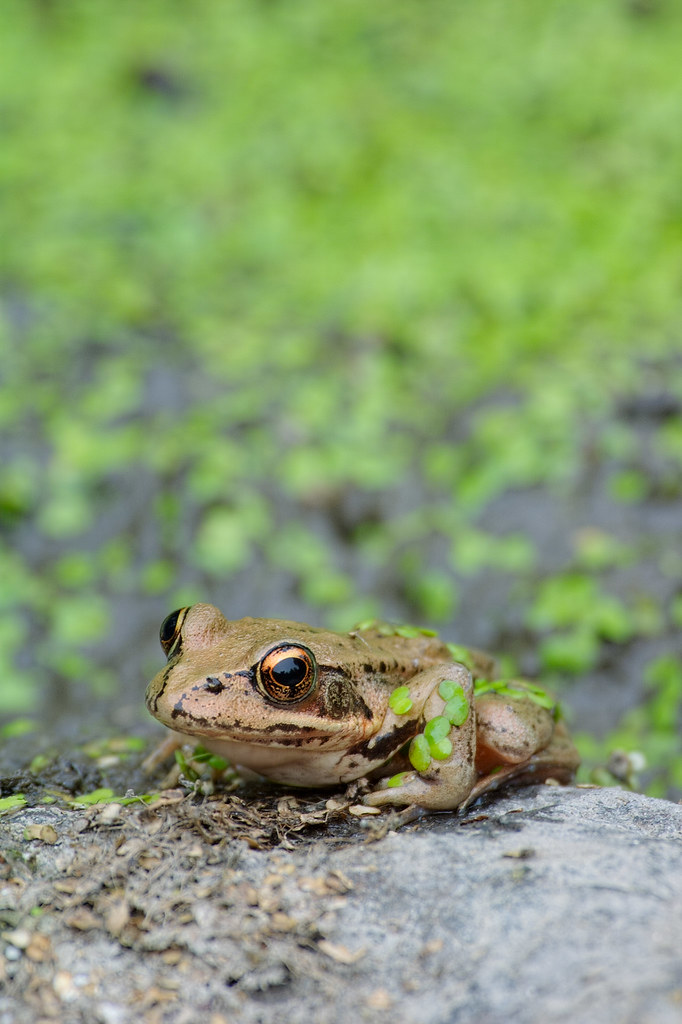
This red-legged frog had been sitting in the duckweed before hopping up onto a small rock. I wanted to convey a sense of the frog emerging from one world to another, so I placed it at the bottom of the frame with the top third green water, the middle third transitioning from water to earth, the bottom third solid ground.
Tag: Washington
Sign of Sanity
While visiting Olympic National Park in 2004, my wife and I escaped the crowds of the Hall of Mosses Trail and walked down the lovely Hoh River Trail where we met this Douglas’ squirrel. When you spend time photographing something as common as a squirrel at a place as special as the Hoh Rain Forest, some of the other tourists look at you with a mixture of curiosity and pity, as though you’re either slightly mad or slightly a moron.
Both of which might be true, but I enjoy photographing squirrels and do it no matter where I am, especially species like this one that I see less often. While the squirrels I see in my yard in the city are invaders from the east, the Douglas’ squirrel is one of the native tree squirrels in the Northwest.
Sunset on the Rocks
When I visited Mount Rainier National Park in the fall of 2008, I saw more pikas on the the Pinnacle Peak Trail than I’d ever seen on a single trail before. It would only be a slight exaggeration to say I saw more pikas on that hike than I had seen in my entire life until then. They weren’t all close to the trail, the talus fields are extensive and often lead far from the trail, but some of them were close enough for pictures, including this pika that popped out of a rock wall near sunset.
White Claws
Ooomm-ka-chooom
It amuses me that a bird that tries so hard not to be seen has a call that can be heard from so far away. The bittern has a distinctive ooomm-ka-chooom call that is one of my favorite sounds of the marsh, it reminds me more of a gurgling swamp than a bird. In this picture it has spread its throat out, sending out its call across the marsh.
📷: Canon 20D | Canon 500mm f/4 | Canon 1.4X
🗓️: May 10, 2009
Shadow of a Hunter
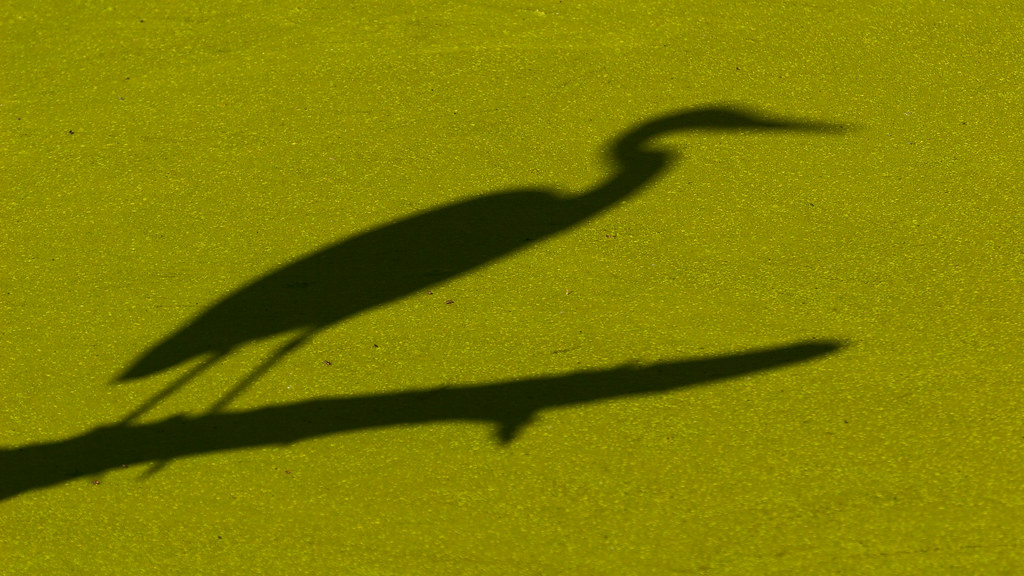
A great blue heron perches on a downed tree as its shadow is cast over the green water. Even though it was actively scanning and listening for movement in the water below, its perch seemed too high to have a chance at capturing any frogs or fish, so it may have been in reconnaissance mode. It eventually started hunting closer to the water.
Who Am I?
Can you guess who owns this feathery back?
I took the picture of the feathers while the heron hunted for fish in the shallows of Rest Lake, then focused on its face when it wheeled around to listen for voles in the grasses on the shoreline.
📷: Canon 20D | Canon 500mm f/4 | Canon 1.4X
🗓️: February 17, 2009
Roosevelt
The race of elk we have in the Pacific Northwest, Roosevelt elk, were named in honor of Theodore Roosevelt. I came across this bull, part of a larger herd, on a rainy morning near the Hoh Rain Forest in Olympic National Park.
While President Cleveland protected some of the forests of the Olympic Peninsula in 1897 by declaring an Olympic Forest Reserve, the protection did not extend to the elk who lived there and in a few years less than 2,000 survived. President Roosevelt (Theodore, not Franklin) established the Mount Olympus National Monument in 1909 to protect the elk but future politicians cut back the acreage to half of its original size. President Roosevelt (Franklin, not Theodore) granted National Park status in 1938 after visiting the area, the status it has retained to the current day, protecting not only the elk that bear the Roosevelt name but also the many plants and animals that are unique to the Olympic Peninsula.
You can find more info about the history of the park in a PDF on the official park site.
Wet Greens
With melting snow and approaching rain, I shoveled out a channel along the side of our street in Portland so all of that water would have some place to go. I know from past experience with fallen leaves that if the area beside our driveway isn’t completely clear we end up with a little lake where the driveway meets the road. The Hoh River in Olympic National Park is also fed by melting snow, but this snow is from glaciers high in the Olympic range that grind rocks into silt that color the runoff a milky blue. I suspect this little stream running through the Hall of Mosses Trail is spring fed, as unlike the Hoh its clear waters showed the brilliant green plants that were swaying in the gentle current.
Jealousy
It’s hard not to be jealous of how well-adapted some animals are to their environment. It was a little humbling to watch these tiny little pikas sprinting across the talus field with plants in their mouths. I don’t think I’d be quite so quick if I had to drag several 12 foot tall trees in my mouth as I ran across a boulder field with rocks as big as a school bus.