Gamera vs. Emma

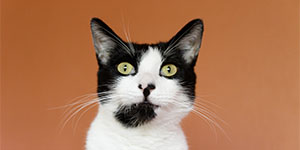
Our black cat Emma with her beloved stuffed turtle

Emma was sitting on my love seat and I put her favorite toy beside her so I’d have a portrait of the two of them. She loved this turtle and would sometimes carry it with her around the house. Sometimes she’d run with it, murmuring as she went, I suppose pretending she was on a great hunt.

Or maybe she was just a big Gamera fan.

I didn’t sleep well for months after she died, having recurring bad dreams. Not nightmares in the traditional sense, but the one that occurred most often was me visiting my favorite refuge in my car and I’d end up accidentally driving into the water. The car would slowly fill with water as I drove it around trying to find a place to get back onto solid ground, but I wasn’t worried about drowning, and my steering wheel could somehow direct the car even when floating, but I was worried about ruining both the car and the refuge yet didn’t know what to do. Being in an unfamiliar and deteriorating situation was the common refrain to all the dreams.

It’s not too surprising that I was haunted by such dreams, given that she slowly slipped through our fingers even though no tests identified why she was sick, and she died even though we tried everything we could. The nightmares slowly faded as I came to grips with her death.

I haven’t been out hiking since she died apart from a quick trip to Ridgefield right afterwards, initially from a mix of not feeling up to it emotionally or physically. But as I began to get more sleep, and as time healed wounds, the desire to get back out on the trails slowly returned. Unfortunately some chronic stomach problems also returned, and I even stayed home from work today, but hopefully with the return of cooler weather things will return to normal (it’s been a blistering summer here in Portland and heat is one of the things that can trigger it).

I’ll start planning my fall hiking trip this weekend, so the Tom Bihn travel bag I ordered in December will finally get to come out of its box and be put to good use.
When Two Frogs Love Each Other Very Much …

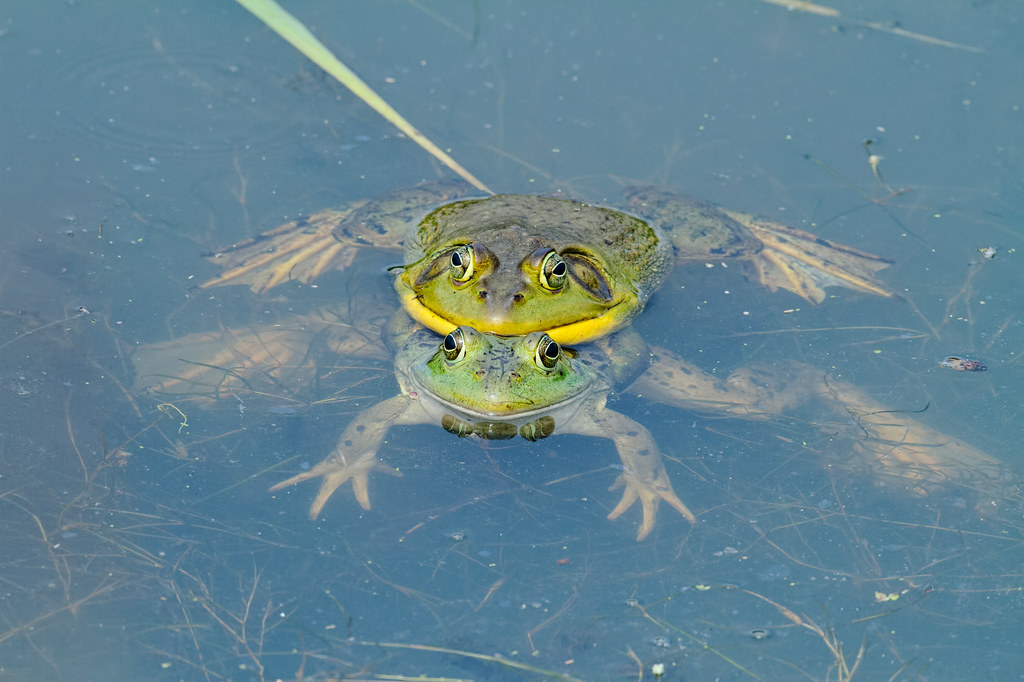
Two bullfrogs mating while floating in the water

These mating bullfrogs were serenely floating in the water while around them was chaos, with males playing leapfrog and wrestling each other into submission and croaking loudly. The male here is the one on top with his characteristic yellow throat and large tympani (the eardrums, the big circles behind the eyes). The water was mostly still but there was a subtle current and they both used their webbed rear feet to control their speed and balance. They don’t have webbing on their front toes, so the female used her front legs to maintain balance while the male has his wrapped around her body.

Ring-necked Thieves

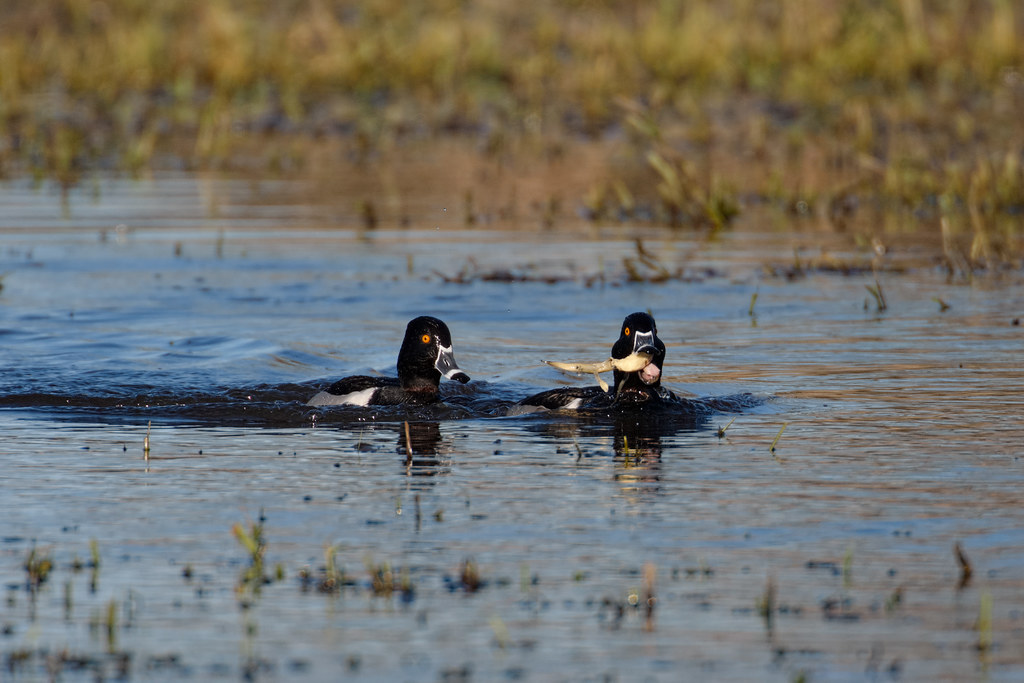
One ring-necked duck chases another to try and steal his food

Sometimes animal behavior seems all too familiar to our own.

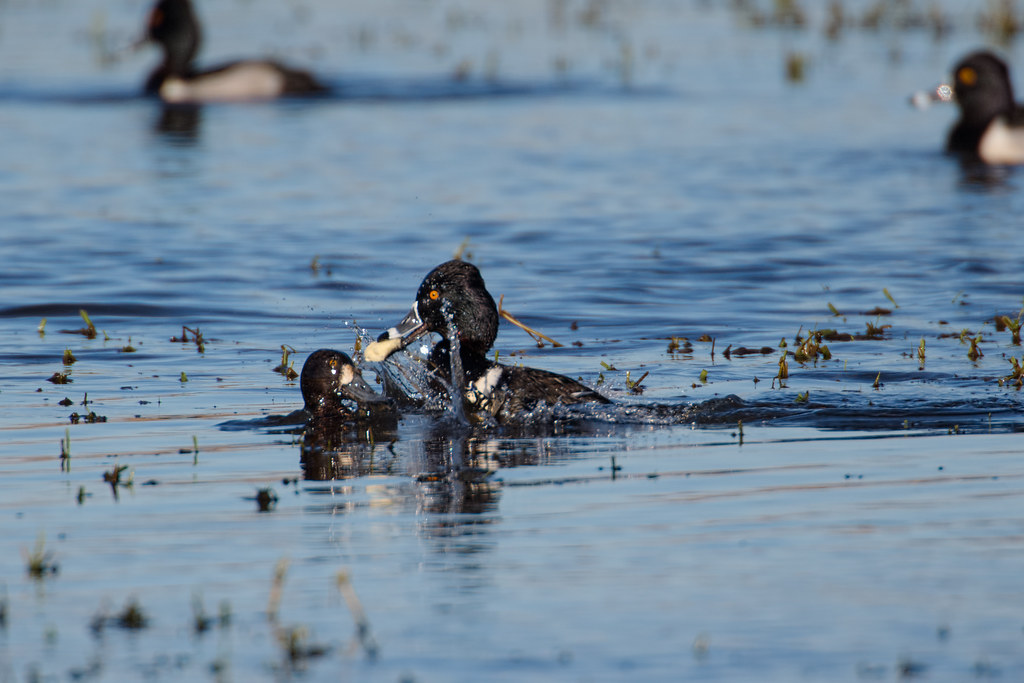
A small flock of ring-necked ducks was diving under the shallow waters of Bull Lake to feed, sometimes bringing up what I’m guessing is the root of an aquatic plant. Whatever it was, the ducks were very fond of it, and the one that surfaced with it would swim away from the others while trying to quickly eat it, all while any nearby ducks would try to swim over and steal it and eat it for themselves. I wasn’t sure which of these two males actually surfaced with the plant but the chase was on.

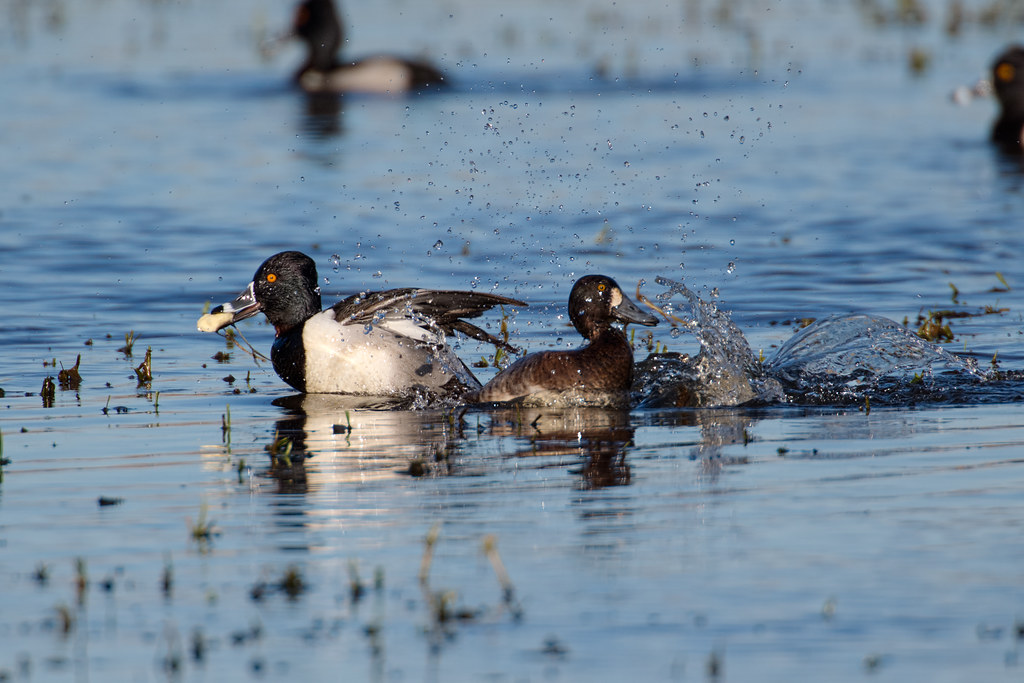
While in a mad dash to escape with his food, the ring-neck swam directly over a lesser scaup as she was surfacing, leaving her rather startled but none the worse for wear. He held onto his prize and was able to eat it at last.

Whoops!

Collision Course

Open Water

A flock of coots swims in a tight pack

Coots often hang out in large groups and when it gets cold enough to freeze the ponds at Ridgefield, such as this cold New Year’s Eve morning, the constant movement of the flock helps keep part of the pond from freezing. This not only benefits them, as they dive under the water both to feed and to avoid hunting eagles, but other waterfowl as well, such as the bufflehead who would join them the following morning.

The Deadly Aster

An assassin bug nymph sits on an aster blossom

After seeing a crab spider on our aster near our front steps, I started looking for her every time I went up or down. I noticed she was frequently on one of the blossoms but by the weekend when I had the time to photograph her again, she was on a flower that was not going to be easy for me to reach. But then I noticed this assassin bug nymph on a nearby blossom and photographed it instead. What a deadly place our beautiful little aster can be! The assassin bug kills other insects by attacking them with its proboscis (you can see it hanging below the face of the nymph) and injecting either venom or digestive juices, and then sucking out the fluids of their prey.

Come Here & Let Me Give You a Hug!

A female goldenrod crab spider lies in wait on the underside of an aster blossom

Don’t do it, ye bees and butterflies of the world, for in her inviting arms awaits a deadly embrace! The front two pairs of legs of the goldenrod crab spider like this large female are much longer than the back, as she doesn’t spin a web to catch her prey but rather waits for them to land on her flower, embraces and immobilizes them with a venomous bite, then sucks the fluids from their bodies. While they often hold out all four long legs to grab their prey, In this particular case she’s using two of her long legs to gain extra purchase on the petals of the aster and holds out only her two frontmost legs. From the front of the flower she was invisible save for two tiny feet sticking around the edge of the petals.

Defender of the Pollen

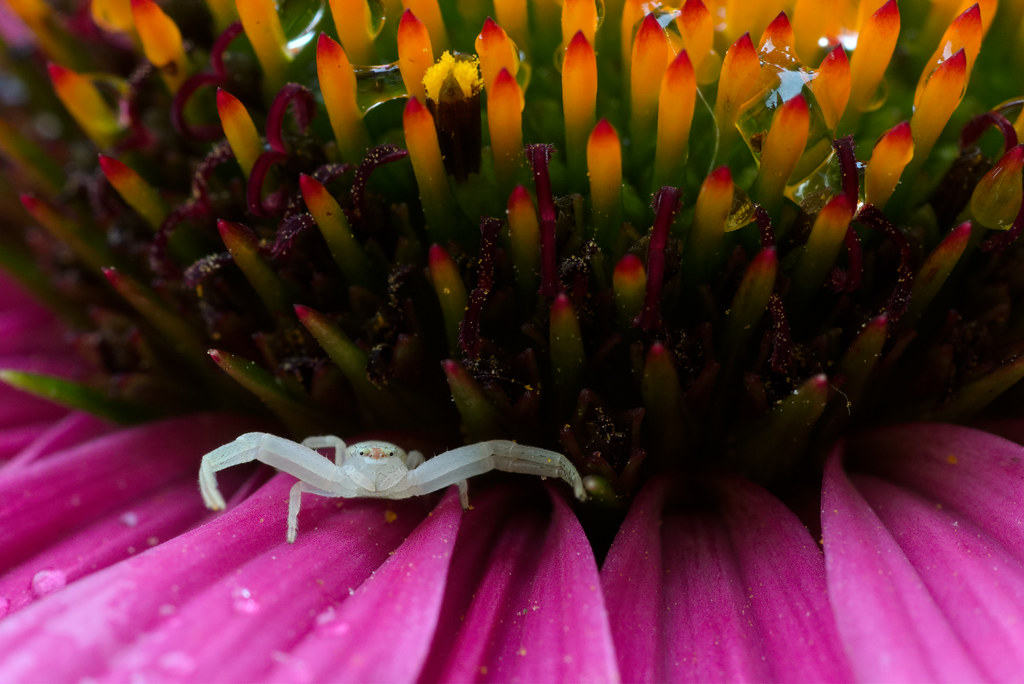
A goldenrod crab spider sits below a clump of pollen on a purple coneflower

After a much-needed summer shower, I grabbed my macro lens to take some pictures of rain drops on the flowers in our garden and was amused by this little crab spider seemingly defending the last remaining clump of pollen on one of our purple coneflowers. Her life is actually tied to the pollen, as she is lying in wait for a pollinator like a bee to land on the flower so she can kill and eat it.