Ring-necked Thieves

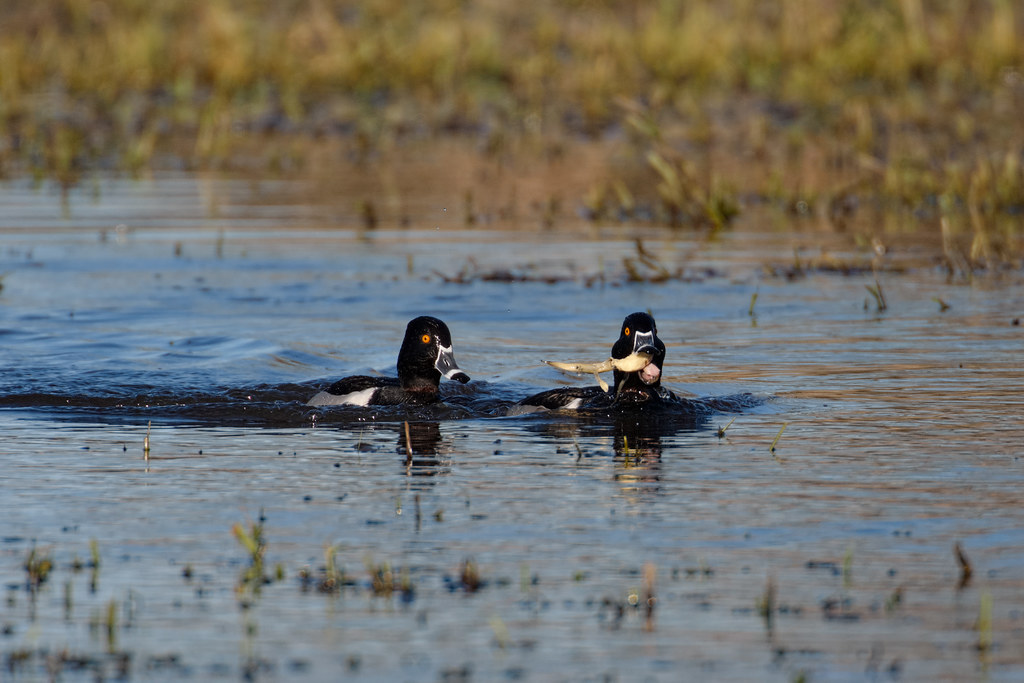
One ring-necked duck chases another to try and steal his food

Sometimes animal behavior seems all too familiar to our own.

A small flock of ring-necked ducks was diving under the shallow waters of Bull Lake to feed, sometimes bringing up what I’m guessing is the root of an aquatic plant. Whatever it was, the ducks were very fond of it, and the one that surfaced with it would swim away from the others while trying to quickly eat it, all while any nearby ducks would try to swim over and steal it and eat it for themselves. I wasn’t sure which of these two males actually surfaced with the plant but the chase was on.

While in a mad dash to escape with his food, the ring-neck swam directly over a lesser scaup as she was surfacing, leaving her rather startled but none the worse for wear. He held onto his prize and was able to eat it at last.
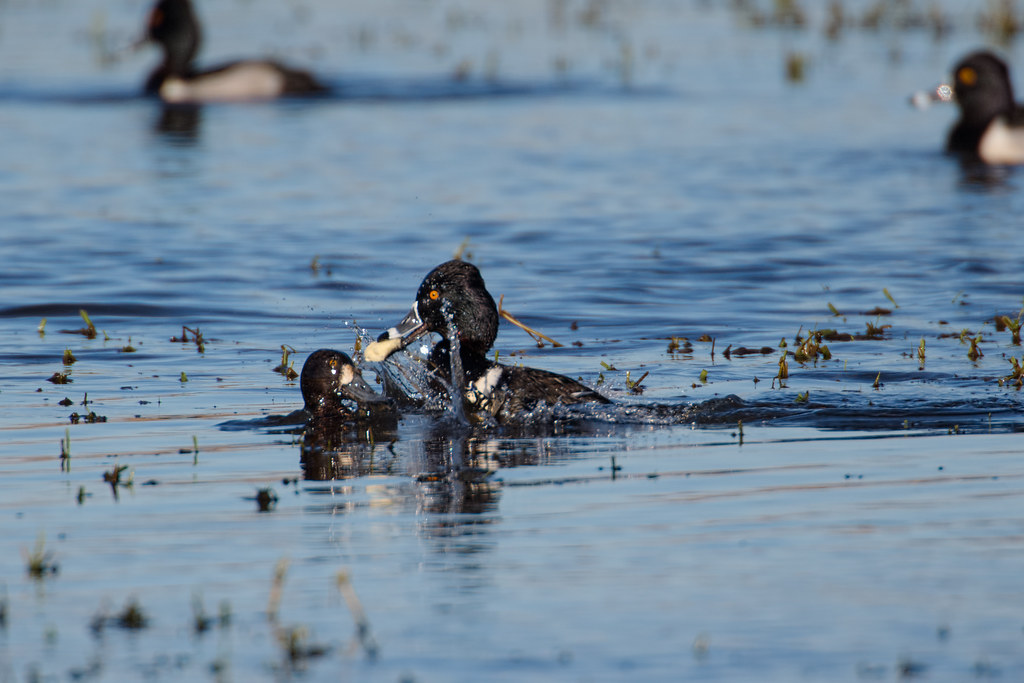
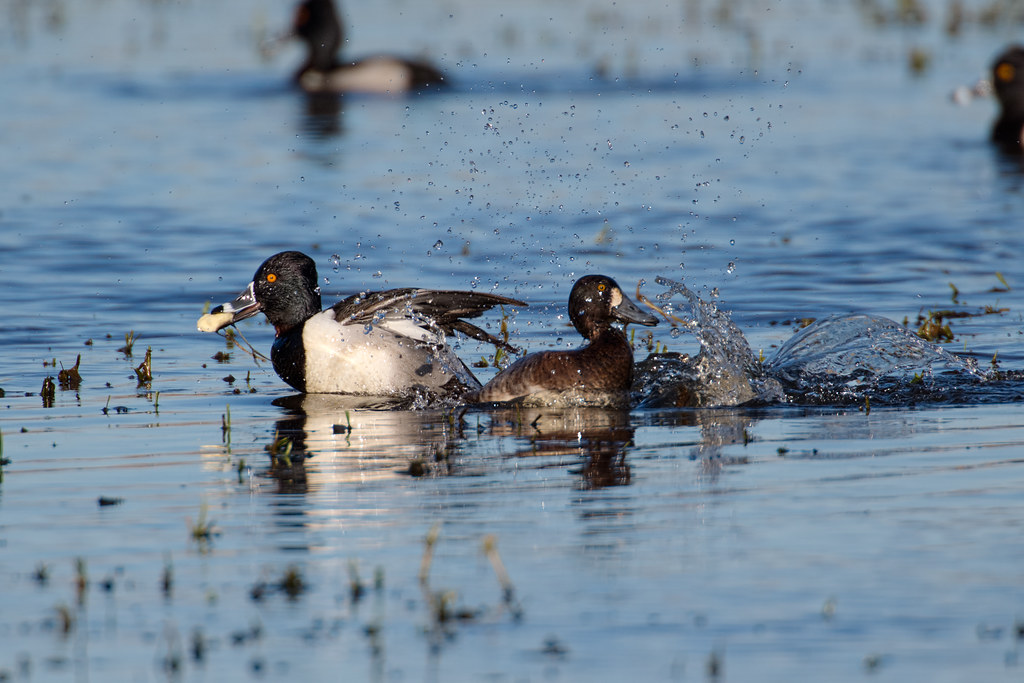
Whoops!

Collision Course

Open Water

A flock of coots swims in a tight pack

Coots often hang out in large groups and when it gets cold enough to freeze the ponds at Ridgefield, such as this cold New Year’s Eve morning, the constant movement of the flock helps keep part of the pond from freezing. This not only benefits them, as they dive under the water both to feed and to avoid hunting eagles, but other waterfowl as well, such as the bufflehead who would join them the following morning.

The Deadly Aster

An assassin bug nymph sits on an aster blossom

After seeing a crab spider on our aster near our front steps, I started looking for her every time I went up or down. I noticed she was frequently on one of the blossoms but by the weekend when I had the time to photograph her again, she was on a flower that was not going to be easy for me to reach. But then I noticed this assassin bug nymph on a nearby blossom and photographed it instead. What a deadly place our beautiful little aster can be! The assassin bug kills other insects by attacking them with its proboscis (you can see it hanging below the face of the nymph) and injecting either venom or digestive juices, and then sucking out the fluids of their prey.

Come Here & Let Me Give You a Hug!

A female goldenrod crab spider lies in wait on the underside of an aster blossom

Don’t do it, ye bees and butterflies of the world, for in her inviting arms awaits a deadly embrace! The front two pairs of legs of the goldenrod crab spider like this large female are much longer than the back, as she doesn’t spin a web to catch her prey but rather waits for them to land on her flower, embraces and immobilizes them with a venomous bite, then sucks the fluids from their bodies. While they often hold out all four long legs to grab their prey, In this particular case she’s using two of her long legs to gain extra purchase on the petals of the aster and holds out only her two frontmost legs. From the front of the flower she was invisible save for two tiny feet sticking around the edge of the petals.

Defender of the Pollen

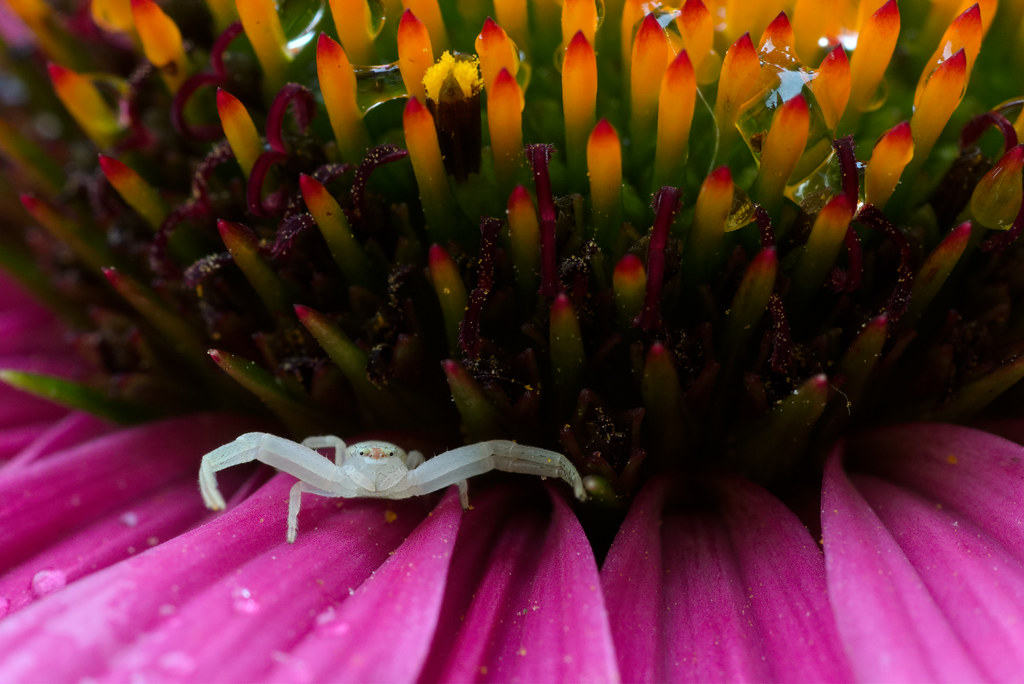
A goldenrod crab spider sits below a clump of pollen on a purple coneflower

After a much-needed summer shower, I grabbed my macro lens to take some pictures of rain drops on the flowers in our garden and was amused by this little crab spider seemingly defending the last remaining clump of pollen on one of our purple coneflowers. Her life is actually tied to the pollen, as she is lying in wait for a pollinator like a bee to land on the flower so she can kill and eat it.

Extreme Baseball

Four mounds of dirt await being spread onto a baseball diamond

Baseball is trying out some new rules in an effort to stay relevant to the youth of today. I’m not sure about the 5 Mound Rule, where four tall pitcher mounds have been added behind the normal one, allowing 5 batters to be pitched to at once. But I do like how the fifth mound partially blocks second base, sure to introduce some much needed somersaulting into the game.

Signs of Optimism

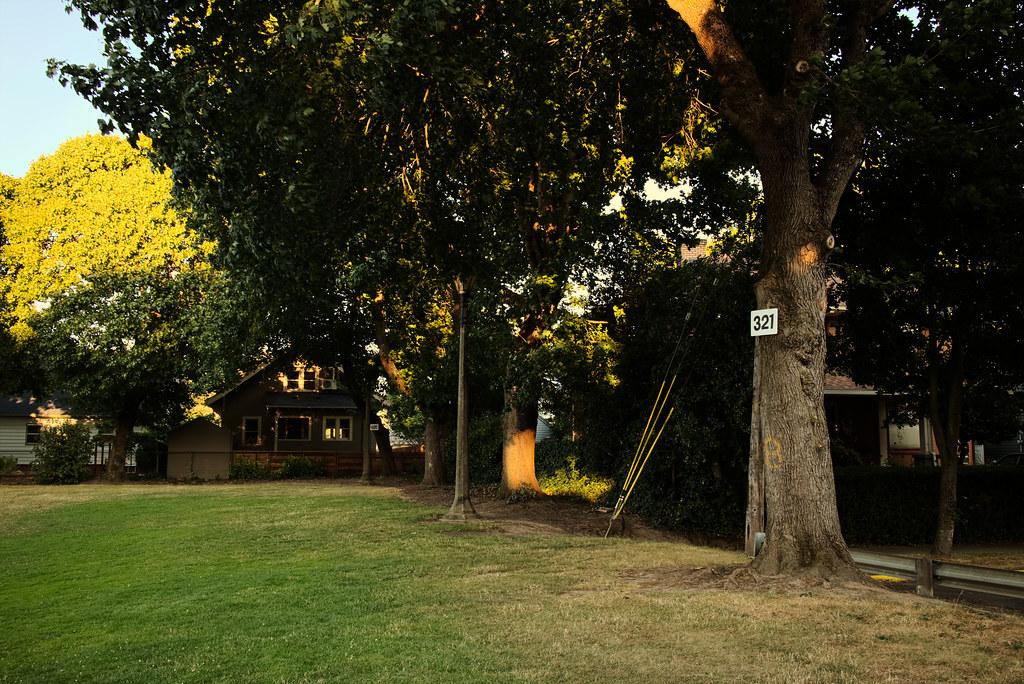
Trees in Irving Park with signs indicating the distance from home plate

During the dry months, this is where Ellie and I enter Irving Park every day on our walks. The park offers a number of recreational opportunities for the neighborhood, as in addition to the dog park there are basketball courts, tennis courts, a playground, picnic tables, open fields, and baseball diamonds. As in surrounding Irvington, many old trees provide shade and character throughout the park. Sometimes the baseball diamonds are not in the best of shape and there are no fences in the outfield, but the types of teams that play here aren’t likely to be hitting any home runs.

So I had to smile when someone put up these little signs on a few of the trees at the edge of the park, indicating the distance to home plate. Nothing wrong with a little optimism.

Hot Cake

An old truck parked on a Portland street with the words Hot Cake painted on the side

While not heavily travelled, Siskiyou is the busiest street Ellie and I cross on our walks, so long ago when training her I started giving her a treat if she’d wait for my command before we crossed. We frequently pass this old truck, owned by a resident on a nearby block, parked here as it’s a cross street with easier access and more available parking than the other streets. It’s often piled high with junk that I assume is awaiting transport to a recycling center. While I’m thankful it’s not parked in front of my house as it’s a bit of an eyesore, I was amused when I noticed it had ‘Hot Cake’ painted on one side, and I’m almost developing an affection for the old thing.

I’m less fond of it when it is parked near the intersection as it completely blocks us from the view of traffic, so I take Ellie to a different intersection to cross if there are any approaching vehicles.