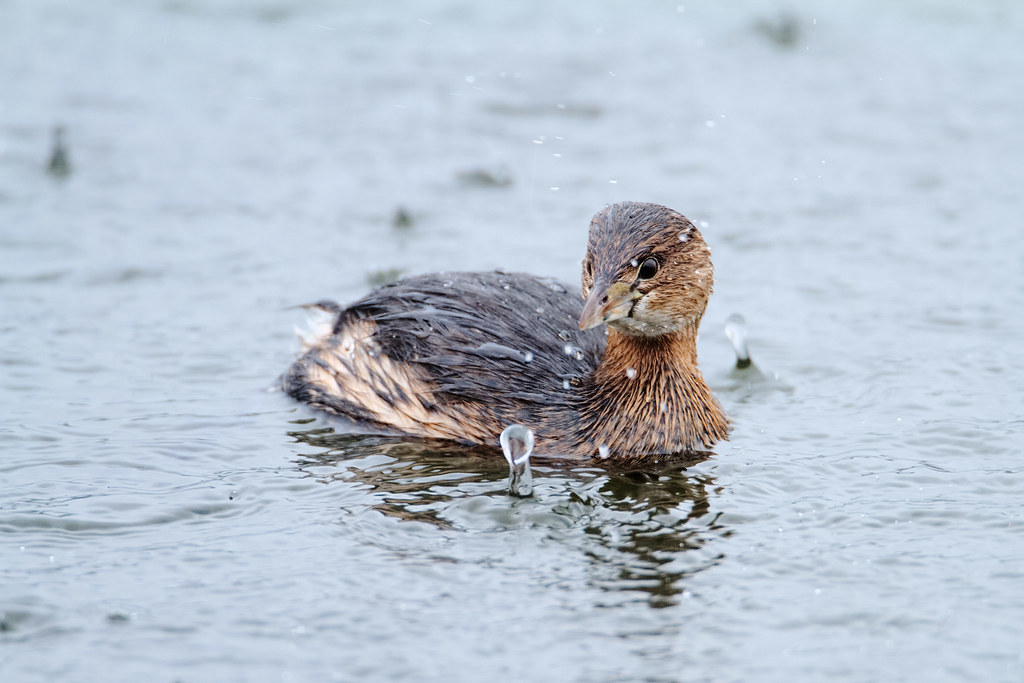
I was photographing this pied-billed grebe when such large raindrops began to fall that it looked like depth charges were exploding around it.
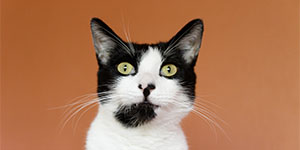
Scratcher of heads, rubber of bellies
I was photographing this pied-billed grebe when such large raindrops began to fall that it looked like depth charges were exploding around it.
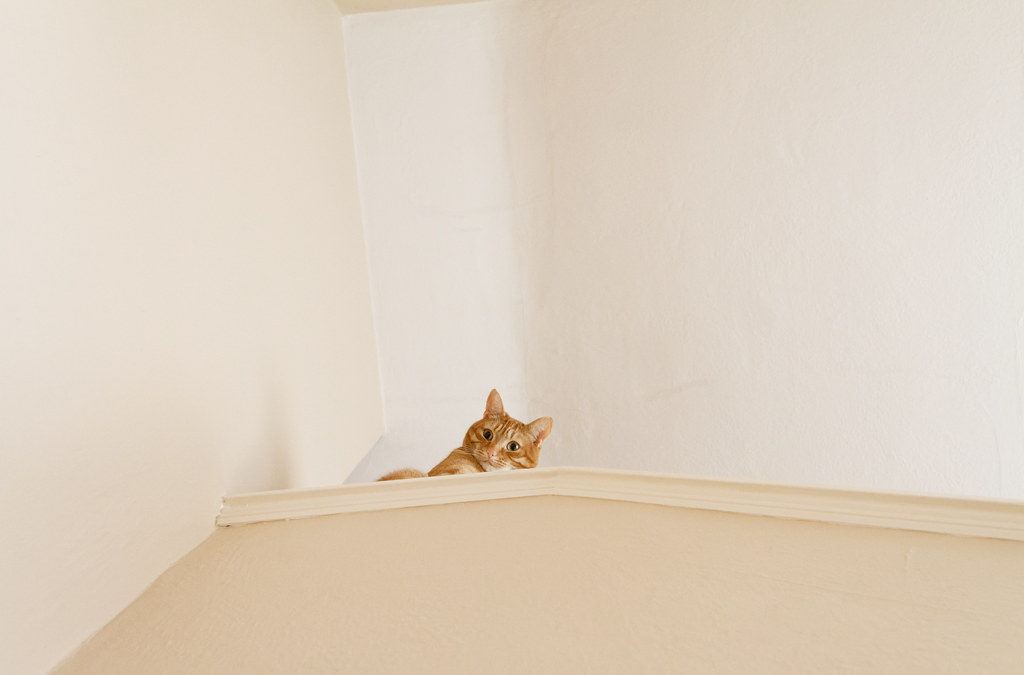
Sam looks down from atop the landing at the top of the stairs.

Many of the tasks on my big list involved finishing up the remodeling of my office that started about a year ago, including getting a better photo processing solution. I’ve been getting further and further behind in editing my pictures, which decreases my desire to go out and take new ones. I had four options and gave them each a lot of consideration but in the end settled on Apple’s adorable Mac mini. I’ve had a soft spot for them ever since the first model was introduced but never had a use for one until now.
Aperture runs much better on the mini than my laptop, which was a bit of a shock as the mini is made out of similar laptop parts. There are several big differences, the first the amount of RAM (the mini has 16 GB, twice that of the laptop). The second is the storage, the mini has Apple’s new Fusion drive that seamlessly combines an SSD and hard drive, the laptop a traditional hard drive. Regardless of the reason, I love the results.
I took advantage of the new USB 3.0 ports to get a faster card reader from Lexar, it downloaded my images so quickly that at first I thought something had gone wrong.
My biggest criticism is I wish it was slightly larger so it could house the bigger 3 TB Fusion drive that the iMac gets, letting me eliminate the hassle and clutter of my external drives. All-in-all though the mini has been a delight, greatly exceeding my expectations.
My glorious vacation is at an end. I used a combination of vacation and holidays to take a week off at Thanksgiving, go back to work for two weeks, then take four weeks off in December and early January. It has been fantastic, a mix of goofing off and getting things done.
I had a lot I wanted to get done so early on I made a huge list of tasks on a letter-sized piece of paper, both sides, multiple columns, and started crossing things off as I got them accomplished. There were too many things to do even during such a long vacation but I did make good progress.
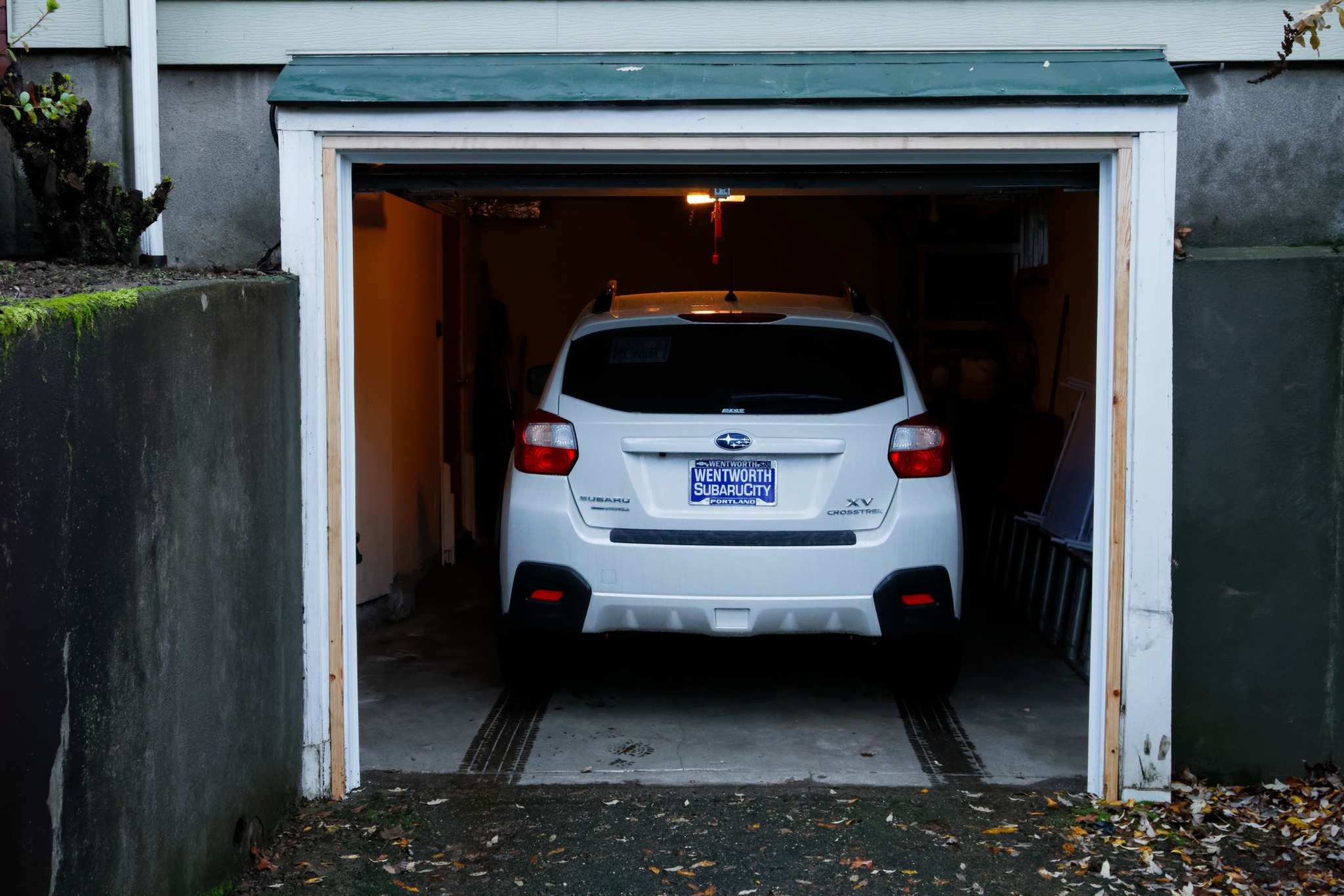
Two high priorities are shown here. The first was the Crosstrek, I knew it would be hard to find but wanted its all-wheel drive capability as soon as possible since we were into the rainy season, a decision I was already thankful for on my first drive out to Ridgefield as it poured rain. The second was to replace our garage door which had split in half, it looked fine from the outside but was so fragile we couldn’t even risk opening it. The new door has been installed and works better than the old to boot. The wood framing needs to be painted but that will have to wait for warmer and drier weather.
While I love small cars in general, you can also see why the little Crosstrek held such an appeal for us. Ours is an old house, the garage built into the basement level. The driveway is narrow and between two retaining walls, while the garage is small in all dimensions. The other car has to be parked on the street, where a small car is also convenient, so I had little doubt that at least one of us would find the Crosstrek a good fit.
Now the question is: will we end up with two?

For a car to work as my daily driver, it needs to do well in two situations:
I’m in the midst of a long vacation so I (thankfully) haven’t had the chance to test our new Crosstrek on the work commute, but Christmas was lining up to be my first chance to test it at Ridgefield. It’s become a bit of a tradition for me to go to Ridgefield first thing on Christmas morning as sometimes I practically have the refuge to myself, a nice time for quiet contemplation during a hectic time of the year.
Late on Christmas Eve after my wife had gone to bed I went out into the garage and just looked at the car for a while. I was nervous, for the next day would prove whether my high hopes for this car would pan out at the refuge. I sat in it for a while and read the owner’s manual enough until I figured out how to quiet the beeps when you lock the car. My nerves settled, I headed up to bed and set my alarm to wake me before sunrise.
I love photographing in the rain and Christmas delivered the wet in abundance as I drove in the dark to the refuge, giving me a quick feel for how the little Subaru would handle the heavy rain compared to its bigger sibling (thankfully, it handled the soaked streets and big puddles quite well, I was thankful not to be in the Civic).
I was relieved to see the car did well along the auto tour too (the icing on the cake would have been if it had been a hybrid so I could drive more quietly around the refuge, but it was not to be). At this time of year you can’t get out of the car except in the parking lots, so I took a quick picture beside the sign in the entrance lot.
I’m definitely still in the honeymoon phase but so far I’m just loving this little car.
I’ve been back to the refuge and it’s gravel road a few times since Christmas, each time in the rain, and it’s starting to feel less and less like someone else’s car and more and more like mine. But she’s not quite as white as she used to be.

A couple of years ago we started a hummingbird garden in memory of my mother-in-law. Many of the plants were chosen specifically to attract hummingbirds, while others were selected to expand it into a wildflower garden, plus we added a young dogwood to round things out. We also picked up a pretty little birdbath since we hadn’t had one for years, not since I accidentally knocked over our cheap one and broke it. A number of birds, such as this American robin, have been enjoying the bath ever since.

Purple coneflower is one of my favorites in our garden and we have a vigorous patch at the edge of our back patio. I deadhead them during the summer to encourage new flowers but at the end of the season I leave them be as I knew birds were eating the seeds in the dried-up cones during the winter — I just didn’t know which ones, as I had never seen any birds on the dead flowers. I had assumed my seed-eaters were finches but just discovered their true identity: dark-eyed juncos.
Junco plumages vary across populations, this is a female of the Oregon race which we commonly see in our backyard, she’s perched on one of the coneflower stems.
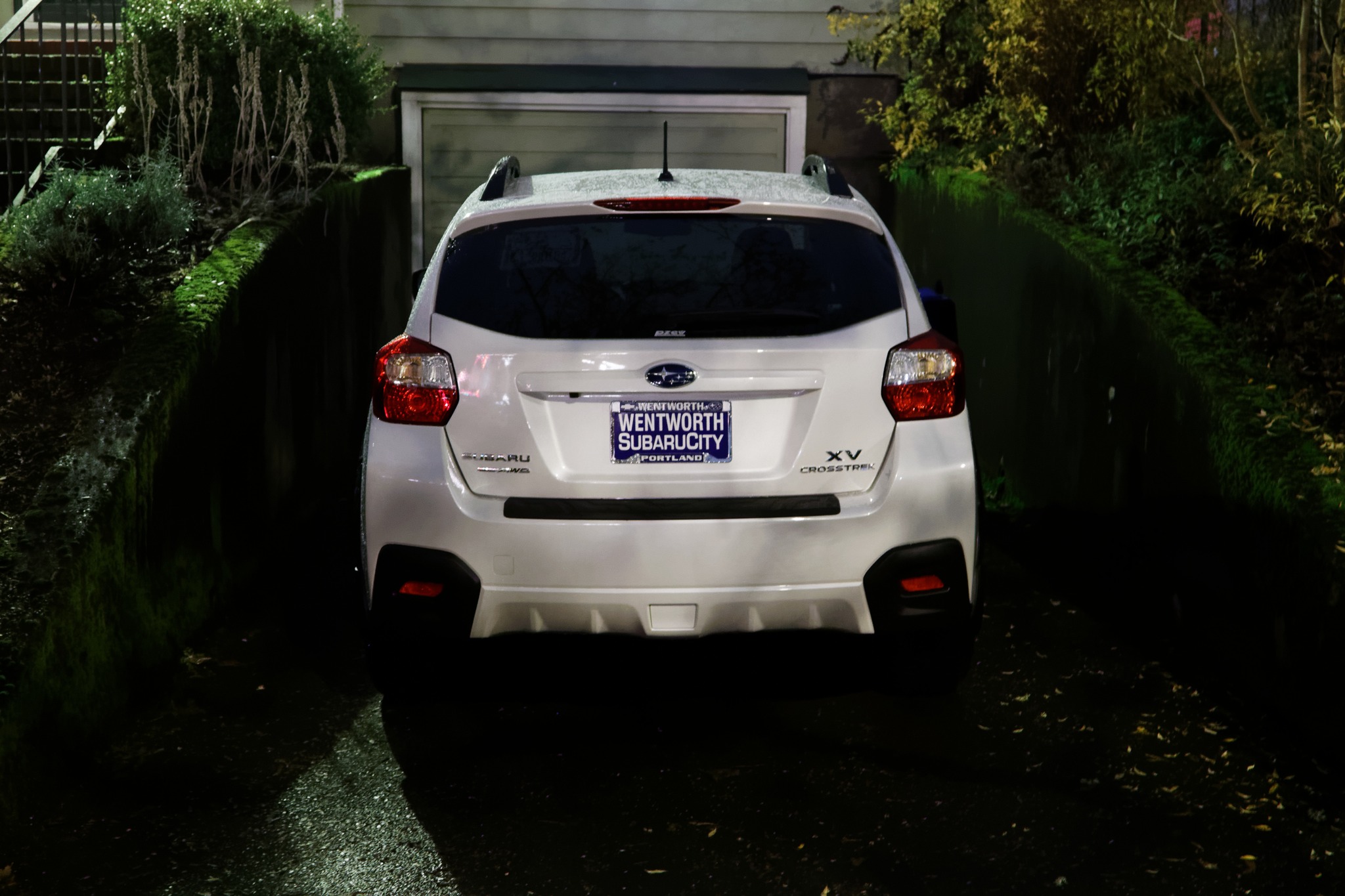
It’s going to be a white Christmas this year! A white Crosstrek Christmas!
The dealer called late this afternoon to say our car had arrived and thankfully they were able to squeeze us in so we could pick her up right away. This is going to be the best Christmas ever!
Will I be too excited to sleep tonight? I never could as a kid. We lived in Michigan in my younger years and one Christmas Eve with relatives in my room I ended up in the bottom bunk of my brother’s bed. Unable to sleep I contented myself with watching the snow fall outside his window. Suddenly there was a big gust of wind and snow as the bottom of Santa’s sleigh flew past, and just as quickly it was gone.
The over-active imagination of a kid who loved Christmas? I know what I saw! Even today in my memory I see his sleigh flying by.
Technically speaking the Crosstrek isn’t a Christmas present. And besides, as much as I love the car, Sam and Emma were far better presents. But yes I am excited, and yes I have a lot to be thankful for.
So too do Sam and Em, for I put up our artificial Christmas tree this afternoon. They were both sleeping under it before I even had time to spread out the branches and I don’t think they’ve left it in the hours since. Woodland cats, these two. Emma even tried to climb it while I was setting it up, but we know how that turns out.
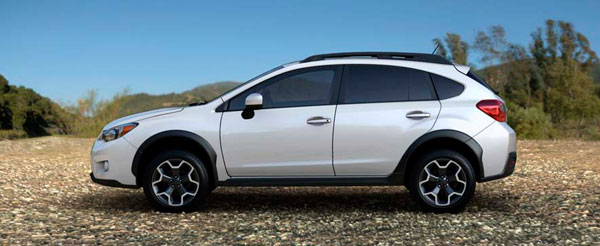
We started looking for a new car about a year ago, and ladies and gentlemen, we have a winner!
Our list of potential new cars had shrunk to one, the Subaru XV Crosstrek, and pretty soon we’ll have one of our very own. They’ve been in short supply and high demand since they arrived on our shores a few months back, but our dealer emailed me yesterday that a black one just came in so we went down today for a test drive. We loved the car and while we’re not interested in black, fortunately a white one is due to arrive in one to three weeks so we put a claim in on it. I’m not normally a fan of white but I think the XV looks great in it.
We’ve decided to replace the Civic first even though it has less miles than the Outback, it’s been a great little car but it just doesn’t fit our current lifestyle very well. So for the first time in over twenty years a Civic won’t be my daily driver. And the first time I won’t have a stick shift, which I’ll miss at times but not so much on my current commute with it’s heavier dose of stop-and-go traffic, and not at all at Ridgefield where the stick was downright obnoxious at the slow speeds I drive on the auto tour.
I’ll certainly miss the moonroof but not the several inches of headroom it robbed me of.
Not there will be any tears shed when it comes time to hand over the keys, these next one to three weeks can’t pass quickly enough!

This is one of my favorite bittern pictures as it shows the way I often wind down a day at Ridgefield, watching bitterns near the end of the auto tour before I have to leave to beat the closing of the automated gate, the setting sun leaving the bittern to hunt in shadow. These last moments always make me wonder — what do bitterns do in the dark?
 Boolie