Timing

A black bear with brown fur dines on huckleberries along the Skyline Trail in the Paradise area of Mount Rainier National Park

I’ve been taking a hiking trip each fall, in Wyoming this meant that not only did I miss the summer crowds, but also got fall colors and the elk rut. But it also meant the weather can be hit and miss, such as last year when a snowstorm forced me to cut my trip short.

My fear when I started my Washington trip was that I had waited one week too long. After nice sunny weather the previous week, the rain arrived heavily on the first day, then was off and on for much of the trip. Fortunately although the higher elevations got an occasional dusting of snow, it stayed off the roads so I didn’t have any travel problems.

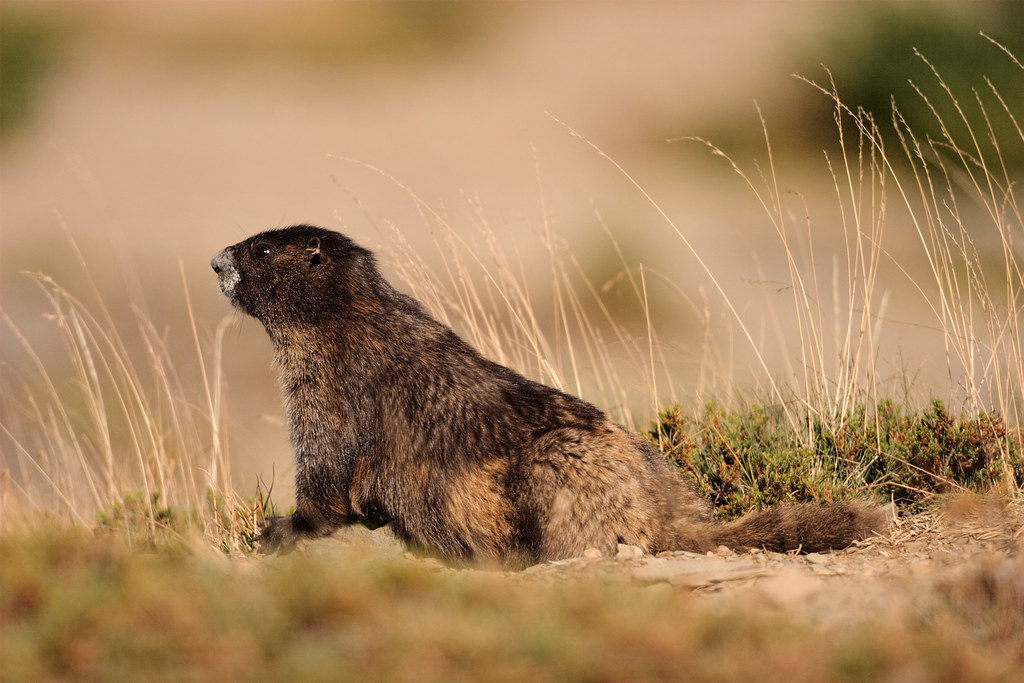
The occasional rain did mean I often had overcast skies, which is what I want during the day for wildlife photography. The sun did shine inconveniently at times, such as when I was watching the large marmot colony at the end of the Summerland Trail in Mount Rainier NP or when I came across a bear on the Beaver Valley Trail in Olympic NP.

I had overcast skies and rain when I came across this young bear on the Skyline Trail in Mount Rainier National Park, the most beautiful bear I’ve ever seen. Many of the pictures didn’t come out very well, the light was low and the rain sometimes heavy and my tripod was in my hotel room (intentionally, it was a long hike with a lot of elevation change). The bear was nose down in the huckleberry bushes and rarely raised its head, but it stopped to look at me once and you can see the seeds that have latched on to its head.

And that was the best part of the timing of the trip, getting to watch a variety of animals preparing for the long winter. I doubt I would have seen so many bears if they weren’t fattening themselves on the huckleberries, and also I spent a lot of time watching marmots and pikas gathering food. The marmots were putting on weight before hibernating for the winter, while the pikas (which don’t hibernate) were creating large stores of food above or under the rocks that they will feed on during the winter.

So despite my early fears, my timing turned out to be perfect.

Big and Little Feathers

A close-up of a sooty grouse's head on the Sourdough Ridge Trail in Mount Rainier National Park

When I think of bird feathers, I usually think of the large wing feathers. But birds have feathers of all sizes, and one of the fun things about close-up pictures like this is getting to see the individual feathers of all sizes. For example, although the eye ring of this sooty grouse looks like a solid band from a distance, up close you can see that it is actually a ring of tiny little feathers.

Does This Picture Seem Familiar?

Close-up view of a sooty grouse's head on the Sourdough Ridge Trail in Mount Rainier National Park

If you’ve followed my blog for a while and have a photographic memory, this picture will seem a little familiar. It certainly seemed familiar to me when I took it. This view of a sooty grouse is very similar to a picture I took last year of a dusky grouse while in the Tetons. Not exactly the same of course, the head is turned at a different angle and the light and colors are different, but I certainly had the older picture in mind when I took this one.

Sooty and dusky grouse used to be considered two races of one species, blue grouse, but were recently split into separate species. Here in the Northwest, the sooty grouse tend to be in the areas from the Cascades and west to the coast, while duskies tend to be in the eastern interior.

This picture is from the Sourdough Ridge Trail in the Sunrise area of Mount Rainier National Park, the trail where I saw grouse the most often. I also saw them down by the Paradise Inn, and saw one in Olympic National Park at the end of my trip.

That last encounter in the Olympics was the most like my experience with the grouse I photographed in the Tetons, I was driving out of the park when I saw one in the road in front of me. I stopped the car and turned on my hazard lights, as the bird was moving slowly and in no hurry to get out of the way. I got out of my car and encouraged it to hurry across the road, which is fortunate as a pickup came driving past right afterwards.

That’s twice now I’ve played crossing guard for grouse.

Heads Up

Close-up view of a sooty grouse's head on the Sourdough Ridge Trail in Mount Rainier National Park

After driving in the rain all day to get to Mount Rainier, I had a couple of hours before sunset. I started up the Sourdough Ridge Trail to Frozen Lake, hiking in a cold wind and rain and sometimes snow, fearing that the weather had turned and I had waited one week too long to start my trip.

But then I saw a hoary marmot near the trail and my mood brightened considerably. After reaching Frozen Lake I headed back down the trail and saw my second surprise of the short hike, four sooty grouse that were near the trail. They were remarkably tolerant of my presence so I knelt or sat on the ground to get at their eye level and slowly moved with them as they fed along the trail. At times they literally walked beside and around me, I’d be photographing one of them and would turn around and see another just inches away from me.

My gloves were the one part of my outfit that weren’t waterproof, so by this time my hands were wet and cold enough that I fumbled a bit with my camera. Knowing that it was about to get dark and needing to warm my hands, I reluctantly said goodbye to the four and headed back to the car.

Six Months

About six months ago I started tracking my web site traffic and during that time there have been 12,455 visitors from 115 countries.

A few quick thoughts:

  • 80% of my traffic comes from the United States, which is not as high as I expected.
  • Visitors came from most of the Americas and Europe, much of Asia, all of Australia (all or nothing there), but not so much in Africa.
  • In Asia, I was rarely visited by countries that end in stan.
  • 87 countries have visited at least twice in those six months.
  • 47 countries visited an average of at least once a month.
  • 15 countries visited an average of at least once a week.
  • 5 countries visited an average of at least once a day.
  • The top six countries show the long arm of the British Empire: the US, Canada, India, the UK, Ireland, and Australia.
  • The next six countries show the long arm of Google: the Philippines, South Africa, Germany, Malaysia, Hungary, and Singapore.
  • I received no visits from the United Republic of Templeton, which upon further research turns out not to be a real country and was never in fact ruled by a little gray cat. In my defense, his passport looked very authentic, it had holograms and everything!
  • Traffic dipped noticeably during the summer when students were out of school here in the States.
  • The top search term that brought people to my site? Pictures of moths. Moths! I only have one moth picture on my entire site and it’s not very good. And I’m not ranked highly in either Google or Yahoo for that term, but perhaps I had a brief moment of glory sometimes in those six months.
  • The majority of visitors referred by search engines are looking for reptile pictures, where my site is currently ranked third in Google. Those hacks at National Geographic are ranked number one so I suppose I have little chance of being top dog. Maybe I should start focusing on moths …
  • I did notice a number of people arriving at my post called Fleabitis and felt a little guilty about that, since people looking for information on their medical condition are probably not in the mood for me cracking wise about Scout’s flea allergy, so I added a note that the correct spelling is phlebitis and provided a link for more medical info. Whoever thought there could be a downside to me making puns about my cats?
Published
Categorized as General

Vacation

A quick update from the road, instead of going to Yellowstone and the Tetons this fall like I normally do, I decided to stay more local and go to Mount Rainier National Park and Olympic National Park.

I finished my stay in Mount Rainier yesterday and had a great visit (despite the weather) and am about to head out to the Hoh Rainforest for some good ol’ forest hiking. I focused on the higher altitude trails in Rainier instead of the lowland forests since I knew I was coming here, but I’m ready for a day of trails with giant trees and little altitude change!

Once I edit the pictures there will be new galleries for hoary marmots and sooty grouse, the marmot gallery in particular should have a number of pictures. I spent a lot of time watching marmots and pikas in the talus fields with Mount Rainier as the backdrop (when the clouds didn’t cover it). I had never seen hoary marmots before and often based my hiking plans on trails with the best marmot and pika viewing opportunities.

We all have our priorities.

There will also be updates to the existing galleries for pika, black-tailed deer, Townsend’s chipmunk, and golden-mantled ground squirrel (or possibly a new Cascade golden-mantled ground squirrel gallery, I need to pin down the species ID).

Oh and a new black bear picture or two, apparently you don’t have to travel to Yellowstone to see bears …

Published
Categorized as General

No Blackberry Breakfast

Close-up of juvenile red-tailed hawk's face looking down

There’s an invasive species of blackberry that has spread across the Northwest and is prevalent at Ridgefield. A variety of animals will use the berries as food or the thickets as cover, but this young hawk was using it as a place to listen for breakfast, every sound from below drawing its eyes downward. It didn’t end up catching anything, at least not during our time together.

String Theory

Our cat Emma chews on a piece of green yarn with her tongue sticking out in our backyard in August 2008. Original: _MG_7141.cr2

I used this green yarn to tie up some coneflower that were in danger of falling over and ended up with a piece of leftover yarn. During Outdoor Time, I’d drag it around behind me while running around the yard with Sam and Emma in hot pursuit. I held it loosely in my hand so that they could step on the string and capture it, then I’d pick it back up and the game started anew.

This quickly became our favorite game and the fun lasted for a week or two.

But then Emma started carrying the string away when she captured it. She’s always had a thing for strings so I didn’t think anything of it at first. If I didn’t take back the string, she’d find a spot to sit down in the yard and start chewing on the string. I thought it was cute so I grabbed the camera for a few quick pictures, but then I realized she was actually breaking off pieces of yarn and swallowing them.

I nipped that behavior in the bud right away, we’ve had a bad experience before with a thread chewer

Published
Categorized as Pets Tagged ,

You Don’t Want To Be A Cardboard Box In Our House

Our cat Sam chewing on a cardboard box

The only furnishings in our living room are cardboard boxes for the cats to play and sleep in. Templeton and Scout both loved boxes, so I wasn’t surprised to see the newcomers enjoy them so. I was surprised to see Sam add fiber to his diet by chewing on the boxes, a behavior I assumed would go away once he was no longer teething.

I assumed wrong.