First light on the Hawknest Trail revealed a young white-winged dove that was a little red-faced, courtesy of the saguaro fruit juice that stained its beak and the tip of its face. It was mid-July so there wasn’t much fruit left on the old giants but the plucky youngster seemed to have found some before perching on the ocotillo to preen its feathers. With its cleaning regimen complete followed by a few beak swipes on the ocotillo stem, it flew off to a nearby saguaro and chased off the adult that was feeding there.
Category: Birds
Quiet For a Moment
In late July I had a quiet moment with our not-so-quiet state bird, the cactus wren. The sun had mostly dipped below the mountains as it posed for a moment before flying off with two others. More robin-sized than wren-sized, they don’t seem to cock their tails like their smaller cousins, but their personalities remind me of the ever-entertaining marsh wrens I watched in the Northwest. On recent hikes they’ve kept me company calling out from either side of the trail while mostly staying out of sight.
The Ol’ Switcheroo
A male ladder-backed woodpecker clings to a dead tree on a cloudy morning in the Sonoran Desert, a little tribute to the overcast of the Northwest with a bird of the Southwest from someone lucky enough to have called both home. Not much later he and his mate pulled the ol’ switcheroo, when I wasn’t looking he flew off and she flew in but I didn’t notice the change at first. Taken in March of 2020, turned out to be my first sighting of the female, the male I had seen before.
You Should Have Called First!
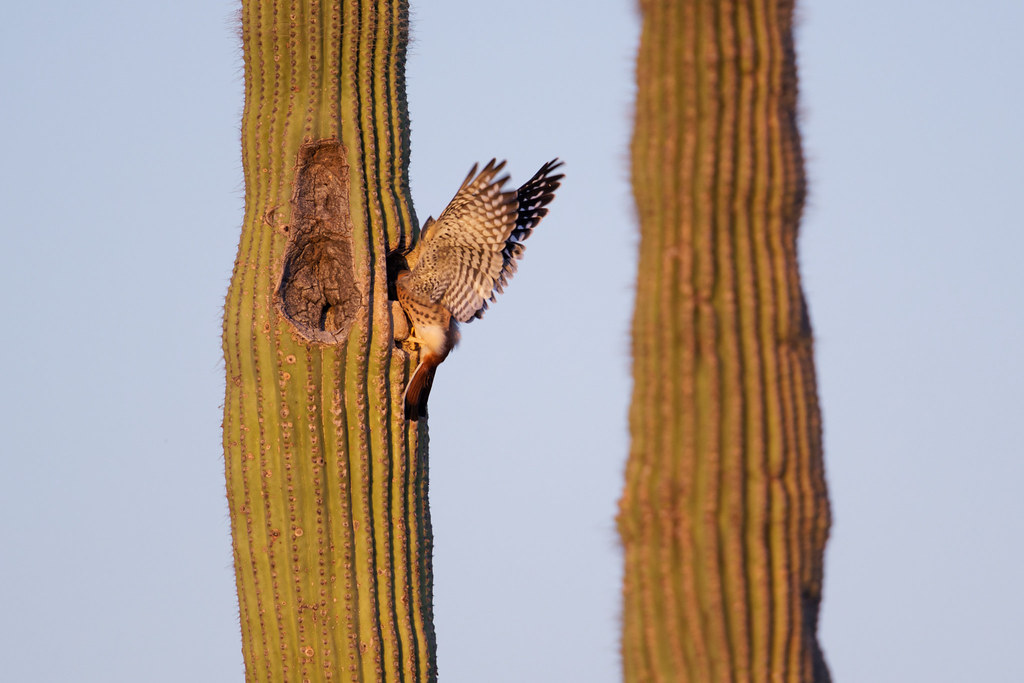
A male kestrel arrives at his nest in a saguaro to feed the last of his young that had not yet fledged but was surprised to find him sitting in the entrance hole. Strong winds blew as the sun was about to set but kestrels are agile fliers with a strong grip, so even though he had to fall backwards to avoid crashing into the youngster he was able to flare out his wings while grasping the cactus with his talons and maintain his purchase. He not only recovered with remarkable grace but soon leaned in and fed his hungry charge before flying off to look for the next meal.
I bet next time he calls first to let junior know he’s on his way.
Happy Father’s Day!
Happy Father’s Day to my father of the year, this gilded flicker nesting near the top of a saguaro. It was my first time watching a flicker raise a family so I was a bit confused when, unlike Gila woodpeckers, the adults arrived at the nest with empty beaks. As the nestlings grew old enough to lean out of the nest I understood why, they were regurgitating food into the always-hungry mouths of the little ones.
The nest was in a nearby park, best visible late in the day, so on weekends I’d stop by to watch this tireless provider feeding his babies before and after the sun set. I brought out my Canon 500mm telephoto for these pictures, the autofocus doesn’t work very well on my Sony cameras but it’s amazing it works at all given it’s a 15 year old Canon lens attached to a Sigma converter attached to a Sony camera, a combo they were not designed for. I often shot with the electronic shutter so I wouldn’t make any noise.
For a while I was concerned something had happened to the mother as I only ever saw this male (a bit of his red mustache is visible in the picture below as he feeds the last nestling) but it turned out to be a coincidence of timing as eventually I would see her too. The top picture is right before the sun set, the bottom two just after (on the following day).
A Faithful Father
My favorite times to be in the desert are around sunrise and sunset, transfixed by how rapidly the light rises and falls, changing not only in intensity but color. I love the moment as the sun fades when a little diffuse red light mixes in with the heavier scattered blues, similar to the light here. But the sun, while low in the sky, had not yet set, instead blocked by a band of smoke in the northwest from a burning desert. While a depressing sign of things to come in the drought-stricken West, there was hope before me too. Flower buds on an old saguaro, soon to burst into blossom. And a faithful flicker father landing at his nest, squeaking voices inside welcoming him home.
Red Mustache
A few weeks back flower buds dotted the tops of saguaro arms with the occasional early bloomers producing a flower or two. Normally the flowers are white but this one appeared to have a red mustache, perhaps a trick of the light as the sun dipped behind the mountains and only a little direct light fell upon the high points of the desert.
A Plethora of Perches
An old giant provides a plethora of perches for a young Harris’s hawk to choose from as it scans the desert floor at sunset. This time of year the perches are relatively soft courtesy of the large flower buds (and by now, flowers themselves). Apparently Audubon would name the birds for his friend and supporter Edward Harris but when he first drew one for his book Birds of America he called them the Louisiana hawk. The University of Pittsburgh has the entire collection online but be forewarned, it can be a real time sink.
There is a movement to rename birds named after people, something I’d like to see. I’d rather see birds named after their nature (especially for these hawks, their social network since it’s so unusual) rather than an homage to a human, regardless of whether the person should be remembered or forgotten or somewhere in between. Interestingly Wikipedia notes, among other things, Audubon may have stolen the Harris’s hawk specimen he used as a model for his drawing.
We humans are complicated creatures.
Hawkland
Most of the desert falls into shadow as the setting sun clings to the saguaros and mountains; a young Harris’s hawk looks out over its home from atop one of the old giants. Looking north towards Cholla Mountain there aren’t a lot of saguaros but there are around me, a short walk to my right leads to my favorite. Walking left leads to an area chock-a-block full of them and all the wildlife they support. Nearby too is the neighborhood entrance I’m heading towards with the park about to close, it’s not my neighborhood but we live close by and my wife was picking me up, having dropped me off earlier for an evening hike before the encroaching summer heat puts an end to those.
Great Scott’s!
Last weekend I stopped at the end of the Rustler Trail for a water break, trying to decide which way to meander on the network of trails, when an oriole flew into the ocotillo in front of me to feed from its flowers. Caught flat-footed holding a water bottle I didn’t want to make any sudden moves towards the camera, we both needed refreshment, but I did get a chance for pictures when he flew off to a distant saguaro and sang to me from the flower buds before disappearing down the trail.
I made a mental note to add Bullock’s oriole to my bird list for the day even though I was surprised his plumage was so yellow. It was only when I got home and looked at the pictures that I had a little laugh at myself when I noticed his head and shoulders were solid black and, while clearly an oriole, he looked nothing like a Bullock’s. In my defense I had gotten up two days in a row for a sunrise hike, the first time this year, so the old gray cells were not in finest form.
I fired up Sibley’s on the iPad and discovered my friend was a Scott’s oriole, a new species for me and thus a new species in my attempt to photograph every animal of the Sonoran Desert atop a saguaro (though I have to say, the mammals aren’t cooperating).
I ended up hiking the Upper Ranch Trail to the Rustler Trail to the Latigo Trail to the Hackamore Trail to the Tarantula Trail to the West Express Trail, returning via the Hackamore Trail to Cone Mountain Trail to Upper Ranch Trail. It was my first time on the West Express, there are formal trails in this part of the preserve now instead of the temporary off-map trails that were there before.