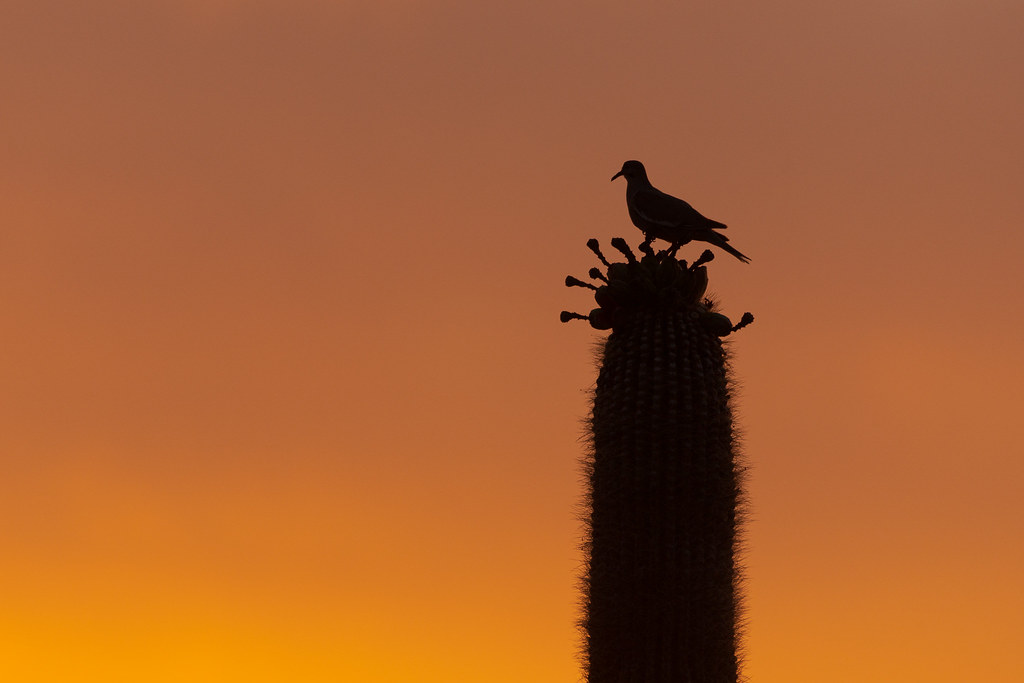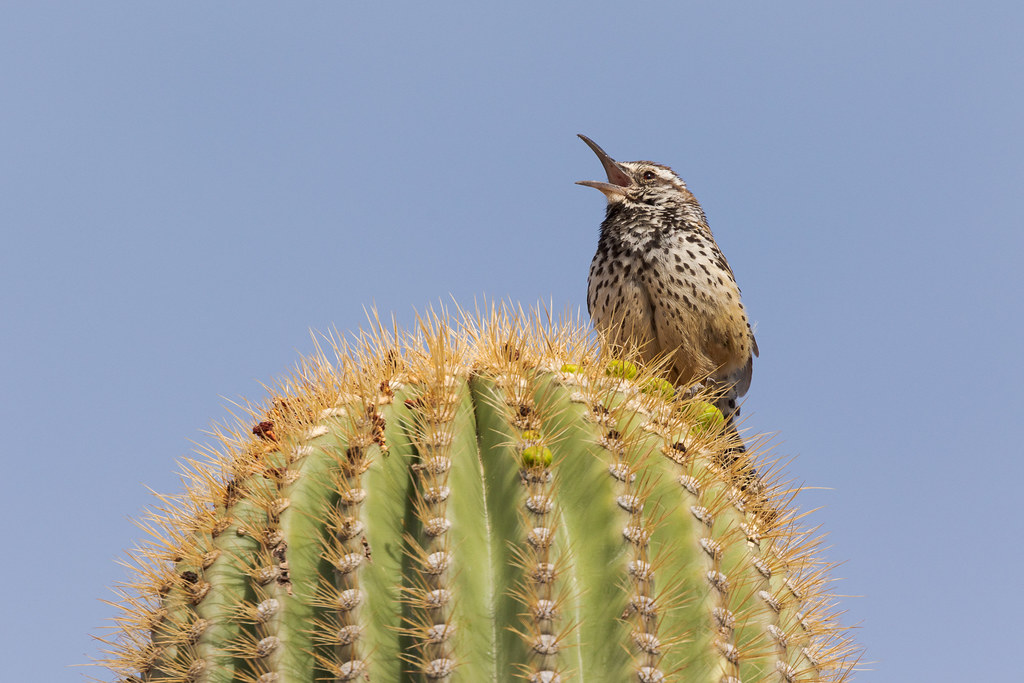
White-winged doves have been hiding from me all spring (on the trails, we see them regularly at home) but with the arrival of summer and fruit on the saguaros it seemed as though a white-wing was atop every saguaro each morning this weekend.
Category: Birds
Am I Forgiven?
The day after Ellie died I thought pruning a dense thicket of bougainvillea would be a welcome respite from endlessly pacing the house, though it was hard looking back at the empty porch. I have no experience with them and was struggling with a section that was growing mostly out of reach on the other side of the fence. I heard a mourning dove making a ruckus and my heart sank when I realized it was nesting in that thicket with a couple of eggs in its nest. I backed away immediately and left off the pruning and thankfully it stayed on the nest.
However the next few times I saw mourning doves on the trails they bolted before I could get pictures and I was afraid word had gotten out about the attempted dove killer. But then this one posed for me on the Latigo Trail in the early morning light, perhaps I had been forgiven.
In the Shadows, In the Light
As the rising sun lights up distant Pinnacle Peak, a white-winged dove perches in the shadows. The light soon reached the tips of the tallest saguaros and was a minute or two from reaching the fruiting saguaro this dove was jealously guarding from other doves when suddenly the lights went out. From my vantage point I couldn’t see the sun and saw naught but blue sky before me, but low-lying clouds in the east must have rolled in. Although I missed the first kiss of the soft red light the sun soon returned and I watched this dove and a variety of other birds from that one spot for quite some time, the only downside being I only hiked for a couple of miles that morning.
This Land Is My Land
Although I grew up with them in the east we didn’t have mockers in Oregon so I’m getting reacquainted after two decades apart. This past week I watched this mockingbird doing its dance on successive mornings, possibly to establish its territory from this high vantage point on a granite boulder where it would have been visible from further distances (I never saw another mockingbird). It would fly up a short distance and do these aerobatic maneuvers, reminding me more of a flycatcher, as it arrested its climb and returned to the rock. In between hops it sang a wide variety of songs, although a thrasher would sometimes fly in and the mockingbird would lay low for a while.
Desert Dance
Leaning
As a young photographer I had trouble keeping the horizon straight in my pictures and I only got better when cameras added built-in levels in the viewfinder. Despite appearances the camera was level in this picture, the white-winged dove is leaning over to get at the last bit of saguaro fruit while sitting on angled arms. Sometimes I’ll deliberately angle the camera if I think it works better for the picture but in this case I like the lean. Taken last year, they’ve been hiding from me this year.
5:20 am, Latigo
Usually I see woodpecker nests in vertical saguaro arms but this male and his mate had chosen an angled arm. At 5:20 am with the sun about to rise they were already bringing food to the nest, in this case a moth. Given the angle to the sun I wasn’t sure if the light would illuminate them when the sun came up or if the saguaro would cast them in shadow, and I still don’t know, as while they brought food to the nest at first they started holding back. Raising young is precarious and stressful enough so while I suspected they would quickly come to not see me as a threat I didn’t want to risk it and continued up the trail.
Father’s Day?
I’ve never seen a bird not defend its nest so I couldn’t comprehend what I was seeing. With one Harris’s hawk on its nest in a saguaro, multiple other adults were perched nearby, in trees, on saguaros, on large electrical towers. They called out repeatedly but to my untrained eyes and ears it seemed like they were keeping in touch rather than warning to keep away.
What was I seeing? Perhaps what I needed to see, what I wished for rather than what was, with Ellie’s death still stinging. But in this case both as I learned later Harris’s hawks live in family groups, even during nesting season with new life about to come into the world.
A week ago after sunup this adult flew to the nest, one leg outstretched to find purchase on a saguaro blossom while the other clutched twigs to spruce up the nest, as the two nestlings watched from the nest (they’re hard to see). Was it the father arriving? The mother? A sibling?
This morning one of the young hawks was continuously jumping from one arm to the other, working on its balance and testing its wings. I didn’t see the other until it flew over and landed awkwardly in a palo verde below the nest, having already fledged.
What joy these hawks, this family, have brought to me this spring as they add two more to their number.
Spring Sing
A cactus wren sings atop a saguaro at the end of April in 2018. It was also the end of our first month in Arizona and my second trip to Brown’s Ranch, having visited the day before as well. The cactus wren was the first bird I saw on my first hike after we moved here, at nearby Pinnacle Peak, also singing from a saguaro but before the sun had risen. They were nesting at the Brown’s Ranch trailhead and I assumed would always be so easy to see so close but I’ve had less luck this year.
At least on the trails, at home one was beside me a few minutes ago as it worked the porch for food. A couple of weeks ago two wren parents were also close by on the porch, feeding their hungry and boisterous chick as it fluttered its wings to draw attention the way so many young birds do. As one parent fed the little thing I heard a thud at a nearby window and my heart sank thinking the other adult had flown into it. But then I laughed when I realized the sound came from the other side of the window and the source was our youngest cat Trixie who could no longer hold back her desire to be introduced to the young family.
The Morning Stretch
I met this Harris’s hawk shortly before sunrise, it was mostly sleeping perched high in a dead tree. With the palo verdes blooming, there was one spot on the trail where if I lowered my tripod to a particular height I could frame the hawk using blossoms on trees between us and blossoms on the trees behind. The picture is a bit of a lie in that it gives the impression the hawk is in a dense section of trees but in truth it was in the open, I’ll post other pictures later that give a more accurate depiction of why it chose this perch.
I framed the shot for the pose when the hawk was resting but when it suddenly stretched after the sun came up most of the time its head was obscured behind the yellow blossoms, up until it reached the peak of its stretch and it came into full view again, showing off its chestnut shoulders and legs and the large white patch at the base of its tail and the white strip at the tip. I thought it was going to go to the bathroom, birds often do before they take flight, but it was just a morning stretch. Do all animals have their equivalent? Our cats do it after waking up from a nap, our dog Ellie did too and something about it always made me laugh.