The Night Owl & The Early Bird

A curve-billed thrasher sings atop a saguaro in the early morning light on the Jane Rau Trail in the McDowell Sonoran Preserve in Scottsdale, Arizona

I’m a night owl in a land of early birds. It wasn’t a good feeling when the alarm rang out at 4:30am but it was a great feeling when the sun tipped over the mountains and illuminated the curve-billed thrasher serenading me atop a saguaro. I love how gingerly it appears to be stepping on its prickly perch but in truth the birds fly onto these saguaros with great speed and alacrity.

Hello Gila

A female Gila woodpecker sits atop a saguaro cactus on the Bajada Nature Trail in McDowell Sonoran Preserve in Scottsdale, Arizona

One of the birds I was hoping to see once we moved to Arizona was the Gila woodpecker. It only took a couple of weeks, and my second time hiking, to find one, courtesy of the Gateway Loop Trail at McDowell Sonoran Preserve. My first Gila was a ways off but after finishing the loop I found this female atop a saguaro on the Bajada Nature Trail. I’ve since seen one in our backyard but wasn’t able to get a picture. The Gila is one of 14 new species for me since we moved here a few weeks ago (11 birds, 1 mammal, and 2 lizards).

Welcome to Arizona

A cactus wren perches on a saguaro cactus with the moon in the background

It’s been a busy week since we moved to Arizona but now it was time for some fun. I got up at 5 a.m. this morning (that wasn’t fun) and headed to Pinnacle Peak Park, the park I visited the day after I interviewed in February but now with time to hike the entire trail instead of just sampling hiking in the desert. As soon as I hit the trail, before the sun even rose above the horizon, I met this cactus wren perched on a large saguaro with the moon in the background, my first new wildlife species in our new home.

What a beautiful welcome to Arizona.

Goodbye Ridgefield, I Love You

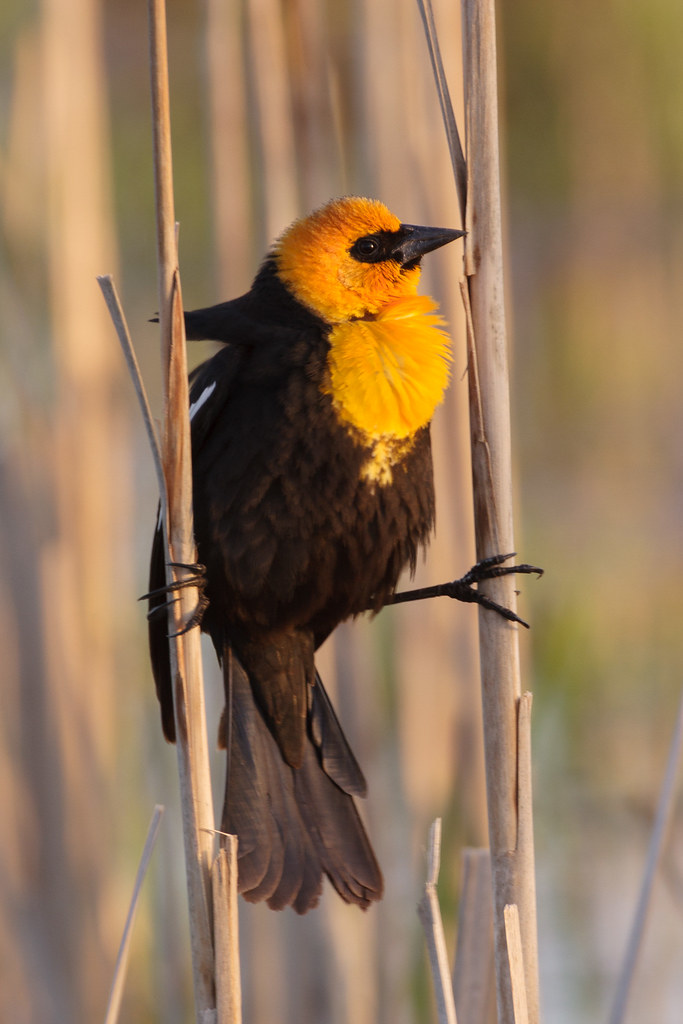
A yellow-headed blackbird straddles two stems at Rest Lake at Ridgefield National Wildlife Refuge in Washington

It’s not like Mount Rainier or Olympic National Parks, Ridgefield National Wildlife Refuge, not the sort of place you plan a trip around. It’s not scenic, there are no mountains, no beaches, no waterfalls, no old growth forests. But I spent more time here than anywhere else in the Pacific Northwest. I might have spent more time here than all other parks combined. Not because of what it didn’t have, but because of what it did: the auto tour.

There’s a mostly one-way gravel road that winds through the seasonal ponds and lakes of this unassuming little refuge across the Columbia in Washington where for significant portions of the year you have to stay in your car. Because the animals aren’t spooked so easily if you are in your car compared to when you are not, I watched birds and mammals behave naturally from close distances. I met this yellow-headed blackbird, showing off his acrobatic skills as he straddles two stems, at Rest Lake late on a sunny spring evening.

I stayed dry in the rain and warm in the cold. Relatively warm in the cold, I shut my car off when I stopped and sometimes I stopped for hours. I kept an extra coat to drape over my legs on the cold days, extra towels to drape around the car on wet ones. I started playing around with video towards the end once I got a camera capable of good video but it was too late for me to have taken very many, but those few videos joins thousands of pictures in my archives.

I’d be embarrassed to tell you how many hours I sat in my car and watched bitterns hunting at the edges of the lakes. Or watching herons and coyotes hunting voles in the big meadow at the end of the auto tour. Watching the eagles and swans at Rest Lake. Watching red-winged blackbirds, yellow-headed blackbirds, marsh wrens, song sparrows, common yellowthroats, American goldfinches, all from one spot at South Quigley Lake.

There are a couple of short hiking trails at the refuge, one only open during the warmer months when the cackling geese are gone, but mostly what drew me was the auto tour. Too much so I suppose, I knew I should explore other places more often, if nothing else for the exercise. But I kept having wonderful experiences so I kept coming back.

I haven’t been up as often the past few years, mostly because I was walking Ellie during the hours I would have normally visited the refuge, but Ridgefield I will hold in my heart for all of my days. Goodbye, I love you.
Not for the Squeamish

A female American kestrel eats a mouse at Ridgefield National Wildlife Refuge in Washington

A female American kestrel pulls apart what looks like a mouse at Ridgefield National Wildlife Refuge on a winter morning in 2006. There are a couple of species of mice at the refuge that I’m aware of, deer mice and Pacific jumping mice, but I have no idea which this is (was). Some predators at the refuge swallow their prey whole, while others like kestrels pull them apart and eat just the parts they want and toss aside the rest.

Balance

A northern mockingbird balances at the end of a tree branch while eating berries in Conway, South Carolina

I grew up with mockingbirds but I left them behind when I moved to Oregon 21 years ago. We’ve been reacquainted at times over the years when I traveled back east, I met this mocker eating berries while balanced at the end of a tree branch on a trip to South Carolina in 2006. My stepfather had passed away a couple of weeks earlier and my wife and I stayed with my mother through Christmas. I took a number of walks around the neighborhood, watching the local wildlife, seeking out joy to balance the sadness.

Mockingbirds will be a part of my life once more, they are one of a small group of birds that aren’t in my part of Oregon but are in both Arizona and the Southeast where I grew up. Looking forward to the reunion.