Face Full of Flowers

A white-winged dove sticks its entire face into a saguaro blossom as it feeds in McDowell Sonoran Preserve in Scottsdale, Arizona

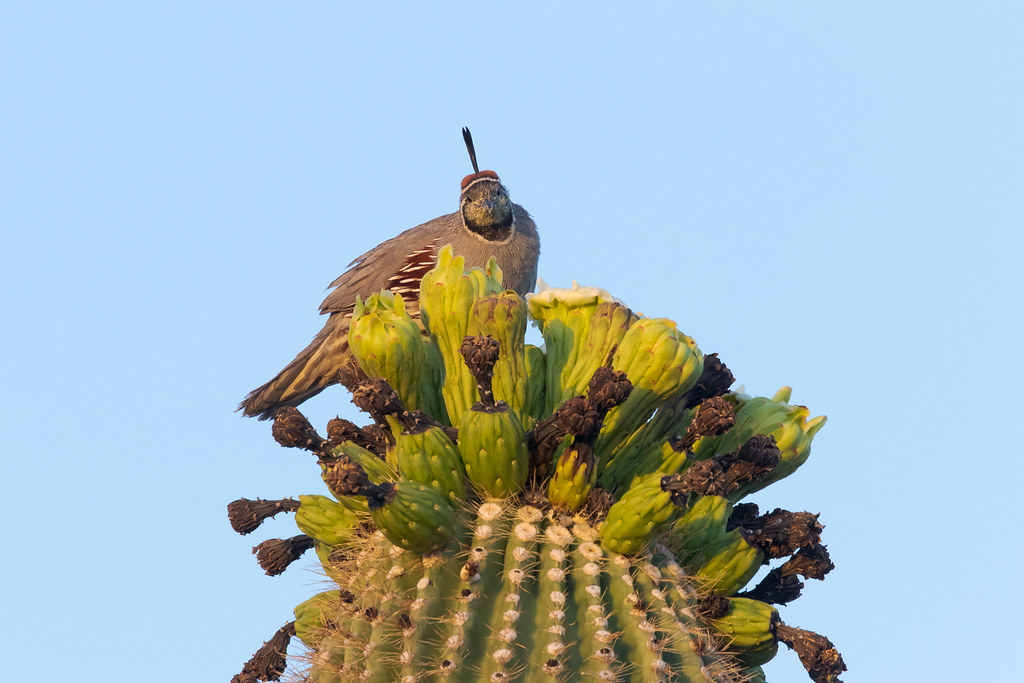
A white-winged dove sticks its entire face into a saguaro blossom as it feeds. It’s face was covered in pollen, as were many of the birds in my pictures from this time, such as the Gambel’s quail below. The birds and bats and bees took full advantage of the suddenly plentiful blooms, dining quickly as they flew from one flower to the next, pollination in action. The blooms are mostly gone now, this morning I saw only two flowers during several hours of hiking, and one of those was pretty wilted.

The face of a male Gambel's quail is covered in pollen from saguaro blossoms in McDowell Sonoran Preserve in Scottsdale, Arizona

A Father’s Day

A Gambel's quail chick in our backyard

Then Jesus told them this parable: “Suppose one of you has a hundred sheep and loses one of them. Does he not leave the ninety-nine in the open country and go after the lost sheep until he finds it? And when he finds it, he joyfully puts it on his shoulders and goes home. Then he calls his friends and neighbors together and says, ‘Rejoice with me; I have found my lost sheep’.”
Luke 15:3-6

A month ago I thought I saw a mouse running along the fence in our backyard but to my horror realized it was a baby Gambel’s quail. A male and female had been bringing their eight (!!!) tiny chicks to our backyard but somehow this little one had gotten isolated from its family who were nowhere to be seen. Life is hard for wildlife, even in backyards, especially so for the young. I thought this story would end in heartache.

A Gambel's quail male shelters his chick under our bird feeder

I refilled the bird feeder in hopes it would attract the parents and spread out some of the small feed the chick could eat in various places where it could feed away from the larger birds. Eventually it went over to the bird feeder and started following a towhee around, who was rather annoyed with this little chick that wouldn’t leave it alone.

It was hard to watch. Then dad flew in.

He settled in under the feeder and sheltered the little chick with his body. The scared little chick began to relax, sometimes hiding completely under its father and sometimes venturing out to feed, but never out from under his shadow.

A Gambel's quail male stays with his chick after it got separated from the rest of the family

I was relieved until the father led the chick over to the corner of the yard and leapt up onto the little retaining wall and then onto the larger wall behind, trying to get the chick to follow. The chick was far too young not only for flight but even to jump, so all it could do was chirp at its father and frantically run beside the wall. This went on repeatedly until I thought the father would abandon the chick and return to the rest of the family in their nest somewhere in the neighborhood. Instead he settled into the corner of the yard, laying down in the gravel with the chick safely underneath. Eventually the chick got enough courage that it began to playfully run up dad’s back until it finally settled under its father for good and they spent the night in our backyard.

They were gone before I got up for work (the side gate has a gap plenty large enough for the chick to get under, that’s how they were getting in and out of the yard before). The gang of eight (and mom and dad) are regular visitors to our feeder (they’re there now as I type this), the chicks grew impossibly quickly and are now about the size of the adults and can not only hop but fly. In the early days mom and day would chase all the other birds away from the feeder to allow their chicks to feed but the youngsters are bold and old enough now that the parents allow the other birds to stay.

On this Father’s Day, a story of a terrified child saved by his devoted father. But on this day too my government tears children from their parents at our borders. Defends it with Bible quotes, like the Christian slavers before them.

We need not be monsters, America. Let’s save those who are lost, and rejoice in it.

Sunrise Falcon

An American kestrel perches on a saguaro cactus at sunrise along the Vaquero Trail in the McDowell Sonoran Preserve in Scottsdale, Arizona

The alarm went off at 3:41 a.m. this morning, the start of a three day weekend. I’ve been a bit worn out and my stomach has bothered me a couple of days this week but I nevertheless crawled out of bed, if a bit reluctantly, as high clouds were predicted instead of the usual clear skies and I was curious to see what the sunrise might bring. I was on the trails before the sun but it looked like there wouldn’t be much color in the skies as the sun rose, and there wasn’t, save for one small portion of the sky. Unable to get the picture I hoped for I instead took my delight in the serenity of the desert morning.

Heading up the Vaquero Trail to where I had seen antelope squirrels the week before I stopped when I saw an American kestrel perched on a saguaro in the distance, one leg held in the air, silhouetted against the patch of orange sky. The little falcon didn’t stay long nor did the color but I got my sunrise picture after all, just not the one I was expecting, the first of several surprises the desert had in store for me this morning. The little appendages sticking out from the saguaro are spent flowers on top of the fruits developing below, handy perches above the cactus spines.

No Time to Rest

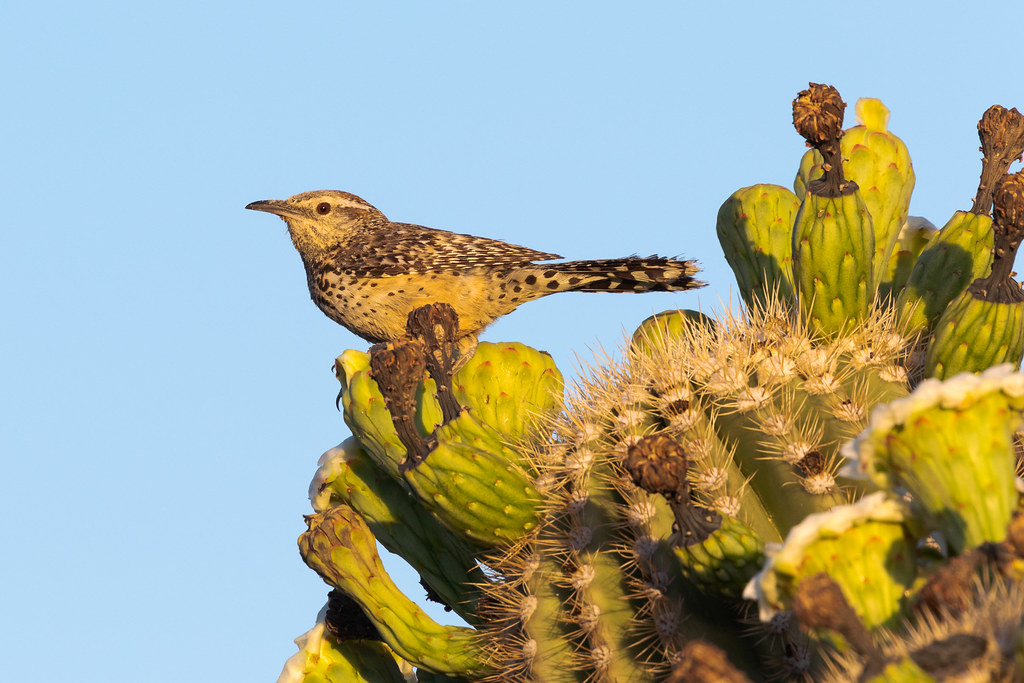
A cactus wren, its face covered in pollen, pauses on a saguaro while feeding its young

A cactus wren paused momentarily above its nest (not visible) while it and its mate constantly flew in and out feeding insects to their young. They were comfortable with my presence so I was able to watch them for a while as the sun quickly rose but I didn’t take many pictures since they paused so briefly. It’s face is covered in pollen from saguaro blossoms, I had seen several other species of birds face down in the flowers but the wrens seemed too busy feeding their young to feed themselves. The next week I did witness one quickly eating from a blossom but they didn’t take the time to gorge themselves like the finches and doves and quail.

As worn out as I am I’ve been getting up before sunrise to hike on all my days off as these springtime activities will soon be but a memory. The heat is quickly rising, summer will quickly follow, then it will be time to rest. Or at least nap, I’d still like to hike as much as the temperatures allow.

Calling Me Home

A male Gambel's quail sits atop spent saguaro blossoms in the Brown's Ranch section of McDowell Sonoran Preserve in Scottsdale, Arizona

One of the birds I most wanted to photograph when we arrived in Arizona was the Gambel’s quail. Not because they are rare – we saw them in the neighborhood when we were looking at our rental house – but because they called me home. It was our vacation in New Mexico a decade ago that got me excited about living in the Southwest, and my encounter with Gambel’s quail there was one of the highlights of the trip, their serenade at sunrise. So it was a special delight to photograph this male and female up on the saguaros as the sun rose, dining on the cactus blossoms, in our shared desert home. Home in a larger sense, though I see them every day in my backyard these quail were at Brown’s Ranch in McDowell Sonoran Preserve.

A female Gambel's quail eats from saguaro blossoms in the Brown's Ranch section of McDowell Sonoran Preserve in Scottsdale, Arizona

Not the Usual Suspects

A young male Bullock's oriole perches atop a blooming saguaro cactus in the Brown's Ranch section of McDowell Sonoran Preserve in Scottsdale, Arizona

In my short time here there are a handful of birds I’ve gotten used to seeing on the saguaros: Gila woodpeckers, gilded flickers, house finches, cactus wrens, and curve-billed thrashers. But I sometimes see more than the usual suspects, such as this splash of color that momentarily swooped into view early Saturday morning. He’s a young Bullock’s oriole, he’ll be even more colorful and vibrant in a year. I’ve only see this species a couple of times before, both during my years in Portland, so here’s hoping we meet more often in Arizona.

Life in the Desert

Two Harris's hawks along the Hackamore Trail in the Browns Ranch section of McDowell Sonoran Preserve in Scottsdale, Arizona

We’ve been in Arizona a month now and life in the desert is going pretty well. I am still a fish out of water at work but with each passing week more falls into place and I’ve been able to contribute a bit the past couple of weeks. The same can be said about life in general although I haven’t ventured further afield than driving to work and local hiking trails. I picked up my Arizona drivers license and license plates a while back, which drives home this is home, although with the new plates I did walk past my Subaru when returning from a hike until I realized my mistake.

It’s still spring so we haven’t had to deal with extreme heat – extreme heat for this area anyway, it is already as hot as it ever got in Portland – and while so far I haven’t minded the heat I am having a hard time imagining how it can be 20 degrees hotter, which it will be soon enough. In the meantime I am hiking as often as I can, as it is springtime in the desert and there is much to see and learn. Several varieties of cactus are starting to bloom so soon the desert will be at its most colorful.

This morning brought the 17th new species I’ve identified, a pair of Harris’s hawks along the Hackamore Trail. The one in flight is younger, it still has some of its juvenile coloration but it seems to be taking on the appearance of an adult, like the one perched below. I’ve seen more new species than this but some I can’t yet identify, especially the lizards, but I’ll get better in time. Reptile field guides aren’t nearly as good or plentiful as for birds, and I really wish there was an app, I love how the birding apps let you limit your selection to just the birds you might see in your area. I just ordered another reptile guide to go with the one I have so hopefully that will help.

But even for birds I have questions to be answered. I’ve seen a cactus wren building a nest in the arms of a saguaro, but after seeing these hawks a while later I came across a massive nest in a saguaro’s arms. Do the hawks nest in the saguaros too? There is plenty of time to learn the answer, and I hope with each answer another question follows, for that is part of the joy as I wander and wonder in my new desert home.

Gilded Thorns

A male gilded flicker perches on an ocotillo along the Hackamore Trail in the Brown's Ranch section of McDowell Sonoran Preserve in Scottsdale, Arizona

When we moved to Arizona the two birds I hoped to see above all others were both woodpeckers, the Gila woodpecker and the gilded flicker. My interest was piqued early on when we were looking at houses online and I noticed what looked like bird holes in a large saguaro in front of one of the houses and a little research revealed the likely culprits. Woodpeckers are one of my favorite birds, a love born in childhood in our wooded Michigan backyard, a love that never ended even when my daily exposure to them did.

I was delighted to arrive here and not only see both woodpeckers but see them frequently, even in our backyard. My first gilded flicker sighting was in our backyard but I met this male on this morning’s hike on the Hackamore Trail, one of the many interconnected trails in the McDowell Sonoran Preserve. Although I mostly see the woodpeckers on the saguaros where they live, he was perching on the branch of an ocotillo, a beautiful and distinctive plant covered in sharp thorns.