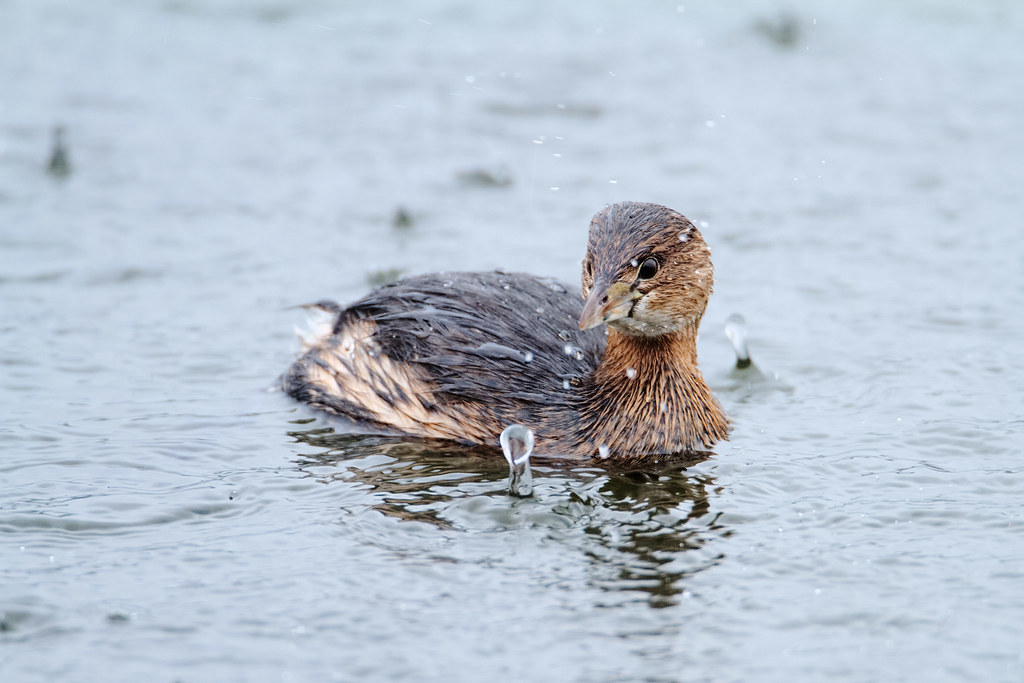
I was photographing this pied-billed grebe when such large raindrops began to fall that it looked like depth charges were exploding around it.
Scratcher of heads, rubber of bellies
I was photographing this pied-billed grebe when such large raindrops began to fall that it looked like depth charges were exploding around it.

A couple of years ago we started a hummingbird garden in memory of my mother-in-law. Many of the plants were chosen specifically to attract hummingbirds, while others were selected to expand it into a wildflower garden, plus we added a young dogwood to round things out. We also picked up a pretty little birdbath since we hadn’t had one for years, not since I accidentally knocked over our cheap one and broke it. A number of birds, such as this American robin, have been enjoying the bath ever since.

Purple coneflower is one of my favorites in our garden and we have a vigorous patch at the edge of our back patio. I deadhead them during the summer to encourage new flowers but at the end of the season I leave them be as I knew birds were eating the seeds in the dried-up cones during the winter — I just didn’t know which ones, as I had never seen any birds on the dead flowers. I had assumed my seed-eaters were finches but just discovered their true identity: dark-eyed juncos.
Junco plumages vary across populations, this is a female of the Oregon race which we commonly see in our backyard, she’s perched on one of the coneflower stems.

This is one of my favorite bittern pictures as it shows the way I often wind down a day at Ridgefield, watching bitterns near the end of the auto tour before I have to leave to beat the closing of the automated gate, the setting sun leaving the bittern to hunt in shadow. These last moments always make me wonder — what do bitterns do in the dark?
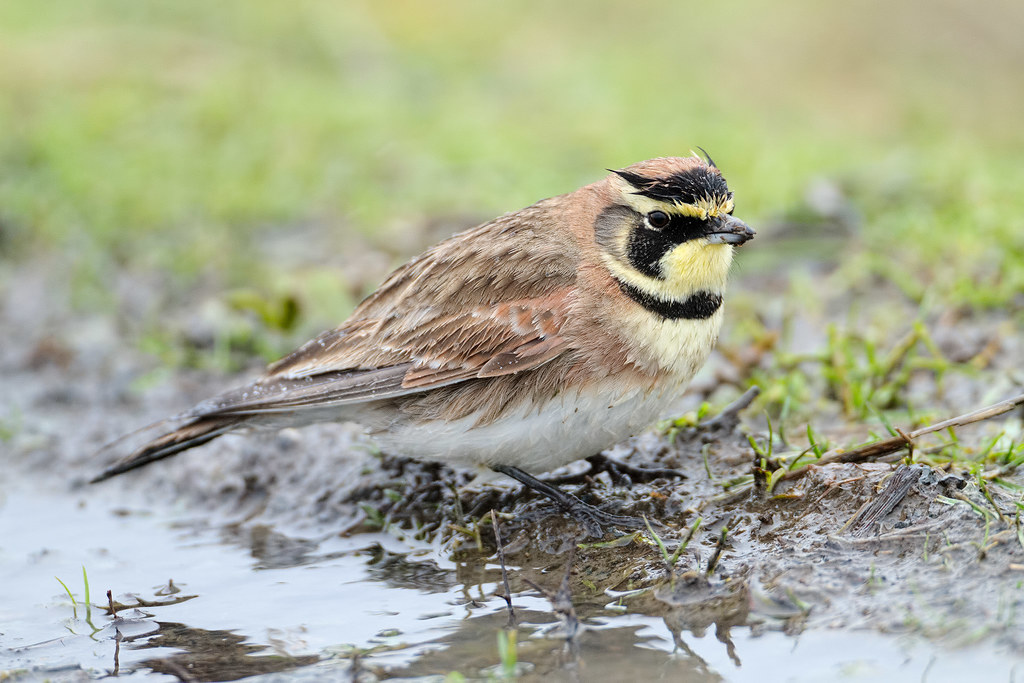
During the winter horned larks can be found in large numbers in the Northwest, but mostly on the eastern side of the Cascades. There are a few resident populations on the western side where I live but I had never seen a horned lark until this January when I found a male foraging near Schwartz Lake at Ridgefield.
I use Northwest Birds in Winter by Alan Contreras when I want to get more specific info on the distribution of one of our birds during the winter than you can get out of a general purpose field guide. I bought my copy in 1997, about a year after I moved here, when I met Alan at an Audubon event and he signed my copy. It’s definitely not a field guide and not useful for identifying birds, but a nice complement to my army of guides when I want to dig a little deeper.


I loved the little woodpeckers in the woods behind our house when I was growing up but I didn’t discover flickers until I got into birds & photography in graduate school. I put my neophyte bird guide skills to the test as I tried to identify the bird making a ruckus in the tree outside my apartment. I found my mark and have loved flickers ever since.
The race we typically see in the west, the red-shafted flicker, is slightly different from the race I first met in the east. I have long hoped to get a close-up of the red-shafted male with his spectacular red mustache, and one was calling out from the nearby trees when I photographed this female at Ridgefield, but he never joined her down in the grass. She gave me great looks as she fed in the rain, however, and I was thankful for the opportunity as flickers are usually pretty skittish.
We even have them in our yard, they are a particular favorite of our resident bird-watcher Emma, and she and Sam and I got a great look from my office this afternoon as a male bathed in our birdbath. No way to get pictures without disturbing him, I can’t park my car in the backyard and photograph him Ridgefield-style. But he gave us a nice long look at his feathers as he splayed them about in the water and seemed nonplussed by his furry fan chirping at him from the cat tree.
📷: Canon 7D | Canon 500mm f/4L IS USM + 1.4x III
🗓️: January 15, 2012
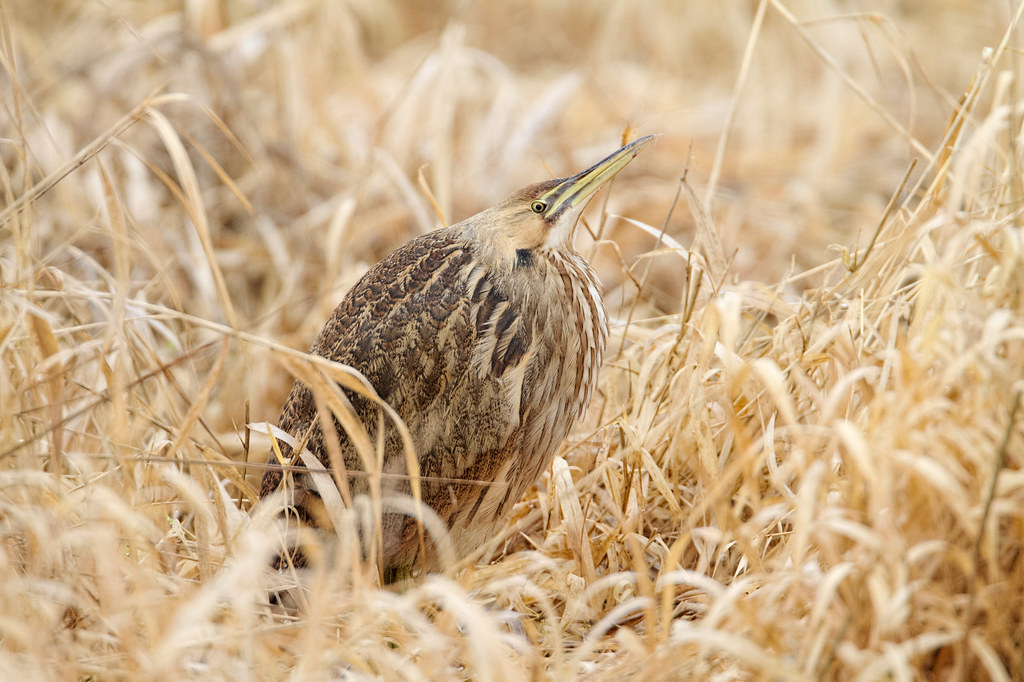
As you know by now, one of my favorite things to do at Ridgefield is to photograph bitterns. After having such great success last winter and spring, this year I’ve seen them mostly in glimpses and rarely had a chance to photograph them. I was tickled to have the chance to photograph this one in January, showing how well it’s coloring matches that of the dried grasses in which it loves to hunt.
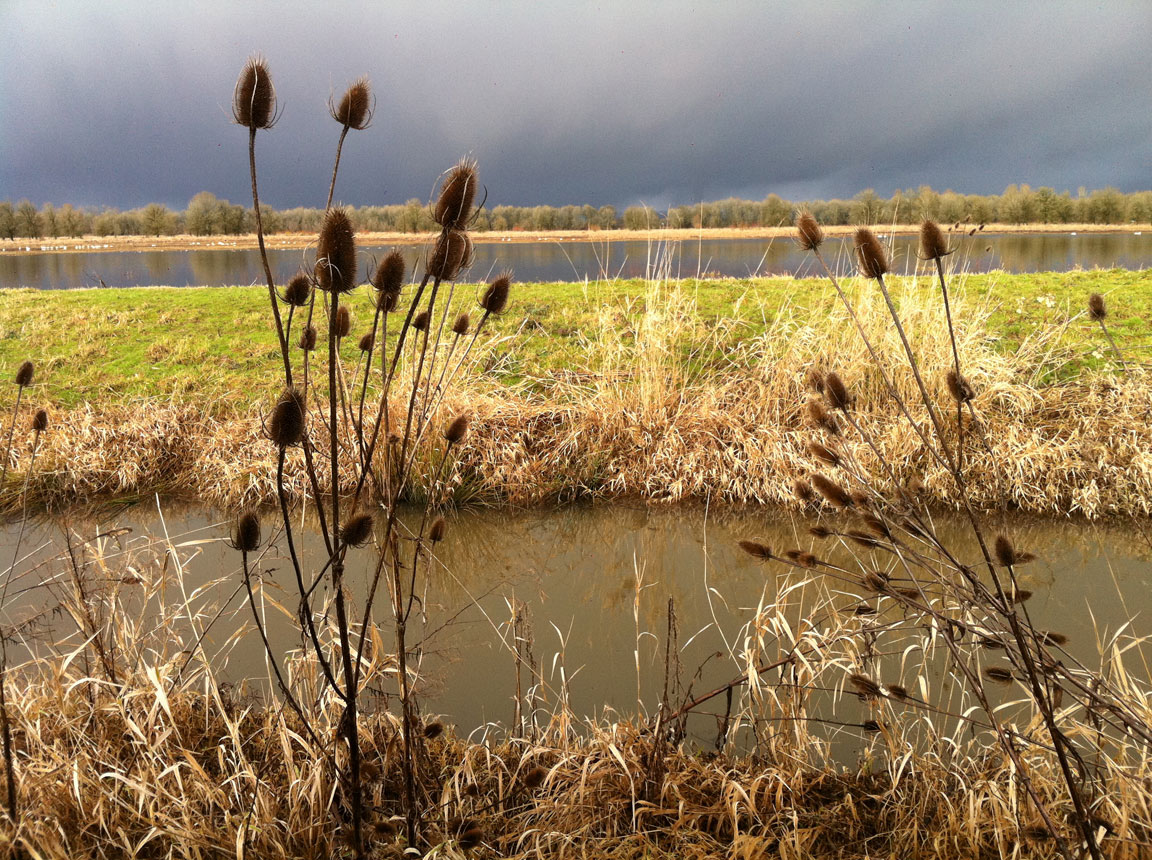
I took the picture below last winter with my iPhone, just wanted a quick shot of my favorite place to look for bitterns, I took it with the phone since the view is similar to what I see with my eyes as I drive along. It’s a bit hard to see but there’s a bittern almost dead center in the picture, on the opposite side of the channel a few feet up from the water line.
Suffice it to say they’re hard to see but I’ve gotten pretty good at it. Once I get to my favorite bittern areas, I wait until there’s no traffic behind me and then let the car creep along as slow as possible as I scan the grasses for these elusive birds. I normally take our Subaru to the refuge but this spring I’ve been taking our Civic, mostly to see if I could tolerate driving a stick shift at the refuge.
The biggest problem I encountered is exactly this scenario. At these speeds, the car is right at the stall speed and it requires a lot of pedal work to keep the car front stalling out. It’s doable, but annoying, and probably not so great for the clutch. So my preference for the next car will be an automatic, although if the stick is a particularly good one, the irritation at Ridgefield might be balanced out by fun on the commute.
And honestly, I’m done talking about cars, starting now!
By the by, the body of water on the other side of the the berm is Rest Lake, and those white dots are tundra swans that winter at the refuge in the hundreds. The bittern above was also at Rest Lake, but at a different spot than this one.

This young bald eagle was perched on a tree overlooking Canvasback Lake, watching the waterfowl below, when it suddenly took to the skies. Normally I would have liked more empty sky in the upper left corner of the picture but the eagle bolted with no warning, disturbed by the sharp retort of a shotgun blast, so I had no time to properly compose the shot. The birds aren’t normally so perturbed by the blasts, but I do prefer the off-days during duck hunting season, not because I have a problem with hunting per se but because I prefer the quiet.

I’ve hoped to photograph pied-billed grebe chicks each spring, as their fantastic faces look nothing like the birds they will become, but this is the first year I’ve had the chance. The two parents had a handful of chicks and were busy feeding them, catching a variety of underwater creatures and feeding them to the hungry chicks. It seemed to me the adults were killing their prey before handing it off to the youngsters, but even so the chicks often dropped their food into the water as they learned to move items about in their bills. The adult was always nearby if necessary to retrieve the food, but in this case the chick was able to pluck it from the water on its own.

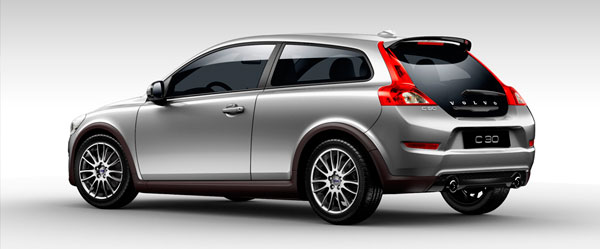
I’m at that age where I should be having a mid-life crisis, so in addition to my practical little hatchbacks I should be looking at a mid-life crisis car. My choice would be the same as any other man’s — a Volvo.
Ahem.
I’ve always had a soft spot for Volvos although I don’t know why. I’ve never owned one, and while we had one while I was a kid, we sold it before I was of driving age. But I’d occasionally see a beautiful little Volvo hatchback as I drove to work, and was vexed enough to want to know more, yet I never could get a good look at its nameplate. I searched Volvo’s website for hatchbacks but nothing came up, and even looked for it at the auto show in January but didn’t see it. Perhaps we just missed it at the end of a long day. But I discovered one in the neighborhood while walking Ellie and finally identified my mysterious beauty — the Volvo C30.
Volvo doesn’t call it a hatchback, even though it has a hatch in the back, but never mind. It’s not only still being made, it’s for sale here in the States and could be mine for the asking. Both inside and out I think the C30 is one of the prettiest cars on the road, at any price, and it’s quick but not at all fuel-efficient. So I think it qualifies as a mid-life crisis car, just with a Boolish twist. Not a sports car, but nevertheless a car for my heart and not my head.
But even that’s not quite true. This along with the Lexus CT would be two of the best cars for my commute, and would be comfortable for those winter and spring days at Ridgefield when I sit in the car for hour after hour, waiting for those lucky moments like this bald eagle at Long Lake. I’ve been taking our Civic to the refuge the past couple of months, mostly to see if I could tolerate a stick shift at the refuge, but I was caught off guard but how much less comfortable I was by the end of the day in the Civic compared to our Subaru. We’ve had both cars for about 12 years so it’s not as if they are new to me, but I guess I just haven’t spent long days in the Civic before.
If the C30 was available in all-wheel drive, I think my head would follow my heart on this one, but sadly it is not. Rumor has it the C30 is being discontinued in any event, so I suppose it’s a moot point.
 Boolie