
Though I cannot see
what lies before,
still I must take flight.
Scratcher of heads, rubber of bellies
Though I cannot see
what lies before,
still I must take flight.

One of the stories at Ridgefield this winter has been the American bitterns which have been putting on a show at several spots around the auto tour during many of my visits. I’ve always been on the lookout for bitterns so I’m not sure why I’ve had so much success watching them hunt lately, although it may have something to do with the fact that I spent far more time at the refuge over the Christmas break than I usually do. This bittern was mostly snagging small fish as it worked the channel beside Rest Lake, but at one point it stopped and started wiggling its neck side to side and then struck into the middle of the channel, bringing up this bullfrog. Bullfrogs themselves are voracious predators and, since they aren’t native to the Northwest, have combined with habitat loss to cause problems for some of our natives. This little bittern was doing its part to turn the tables and win one for the home team.

There are a handful of true falcons that typically breed in North America, all belonging to the genus Falco, with the smallest being the American kestrel (falco sparverius). The kestrels at Ridgefield are pretty wary and often won’t stay perched if you pass on the auto tour, and probably for good reason, as there are a number of other birds of prey that share these hunting grounds that dwarf the little falcons in size.
This lovely female was a ways off the road and stayed still for a few pictures before she took to the skies again to resume the hunt.

As the heron slowly stalked its prey through the tall brown grasses, mostly obscured from sight, it paused and stood upright for a moment. When it glanced over in my direction, a gust of wind blew out its neck feathers and I had my picture.

It amuses me that a bird that tries so hard not to be seen has a call that can be heard from so far away. The bittern has a distinctive ooomm-ka-chooom call that is one of my favorite sounds of the marsh, it reminds me more of a gurgling swamp than a bird. In this picture it has spread its throat out, sending out its call across the marsh.
📷: Canon 20D | Canon 500mm f/4 | Canon 1.4X
🗓️: May 10, 2009
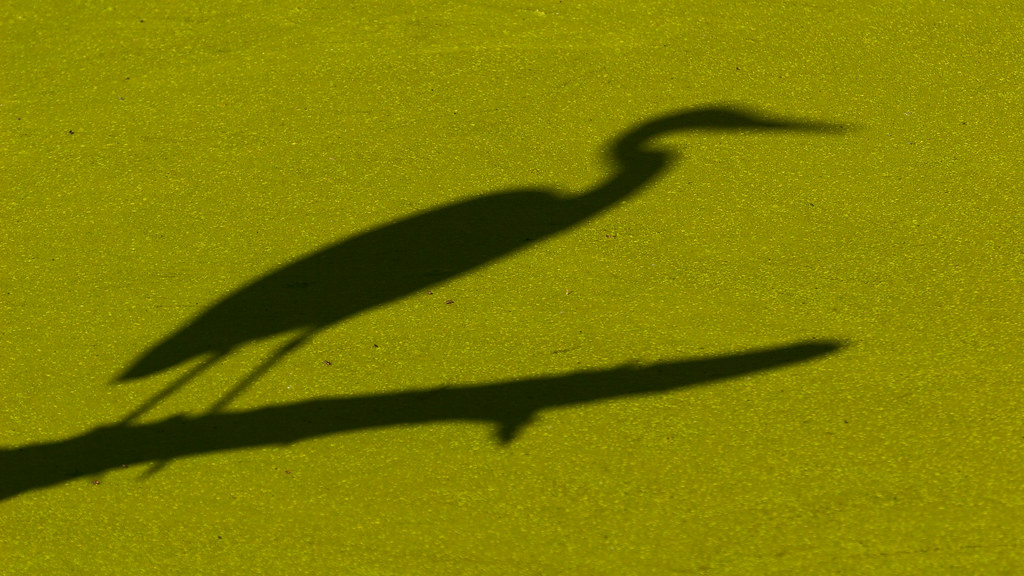
A great blue heron perches on a downed tree as its shadow is cast over the green water. Even though it was actively scanning and listening for movement in the water below, its perch seemed too high to have a chance at capturing any frogs or fish, so it may have been in reconnaissance mode. It eventually started hunting closer to the water.

Can you guess who owns this feathery back?
I took the picture of the feathers while the heron hunted for fish in the shallows of Rest Lake, then focused on its face when it wheeled around to listen for voles in the grasses on the shoreline.
Photo Details:
📷: Canon 20D | Canon 500mm f/4L IS USM + Tamron 1.4x (probably)
🗓️: February 17, 2009


When I think of bird feathers, I usually think of the large wing feathers. But birds have feathers of all sizes, and one of the fun things about close-up pictures like this is getting to see the individual feathers of all sizes. For example, although the eye ring of this sooty grouse looks like a solid band from a distance, up close you can see that it is actually a ring of tiny little feathers.
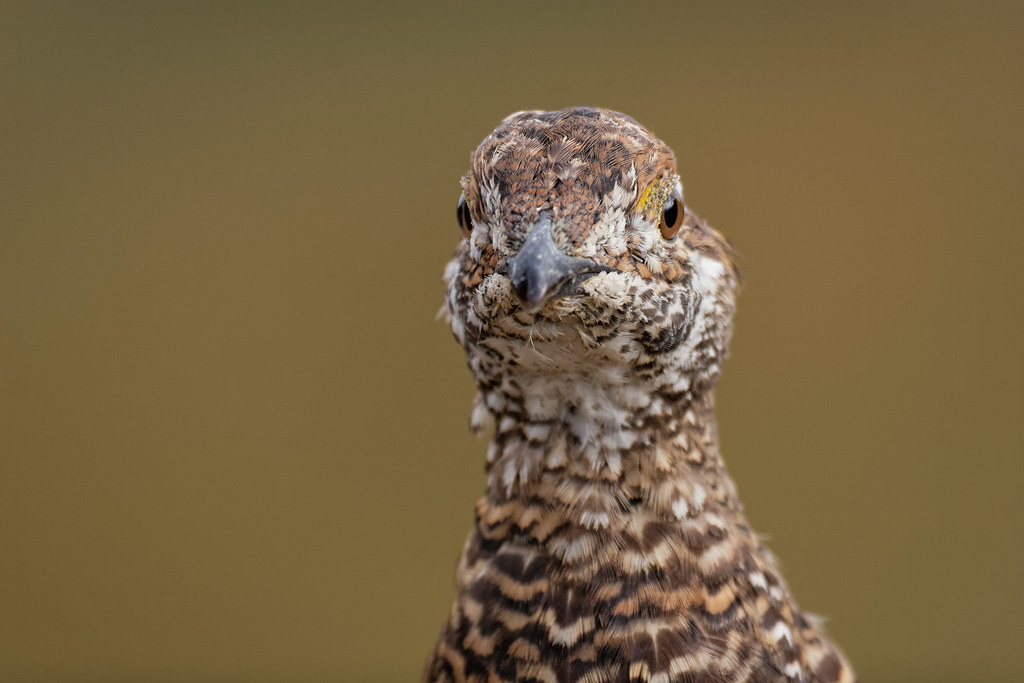
If you’ve followed my blog for a while and have a photographic memory, this picture will seem a little familiar. It certainly seemed familiar to me when I took it. This view of a sooty grouse is very similar to a picture I took last year of a dusky grouse while in the Tetons. Not exactly the same of course, the head is turned at a different angle and the light and colors are different, but I certainly had the older picture in mind when I took this one.
Sooty and dusky grouse used to be considered two races of one species, blue grouse, but were recently split into separate species. Here in the Northwest, the sooty grouse tend to be in the areas from the Cascades and west to the coast, while duskies tend to be in the eastern interior.
This picture is from the Sourdough Ridge Trail in the Sunrise area of Mount Rainier National Park, the trail where I saw grouse the most often. I also saw them down by the Paradise Inn, and saw one in Olympic National Park at the end of my trip.
That last encounter in the Olympics was the most like my experience with the grouse I photographed in the Tetons, I was driving out of the park when I saw one in the road in front of me. I stopped the car and turned on my hazard lights, as the bird was moving slowly and in no hurry to get out of the way. I got out of my car and encouraged it to hurry across the road, which is fortunate as a pickup came driving past right afterwards.
That’s twice now I’ve played crossing guard for grouse.

After driving in the rain all day to get to Mount Rainier, I had a couple of hours before sunset. I started up the Sourdough Ridge Trail to Frozen Lake, hiking in a cold wind and rain and sometimes snow, fearing that the weather had turned and I had waited one week too long to start my trip.
But then I saw a hoary marmot near the trail and my mood brightened considerably. After reaching Frozen Lake I headed back down the trail and saw my second surprise of the short hike, four sooty grouse that were near the trail. They were remarkably tolerant of my presence so I knelt or sat on the ground to get at their eye level and slowly moved with them as they fed along the trail. At times they literally walked beside and around me, I’d be photographing one of them and would turn around and see another just inches away from me.
My gloves were the one part of my outfit that weren’t waterproof, so by this time my hands were wet and cold enough that I fumbled a bit with my camera. Knowing that it was about to get dark and needing to warm my hands, I reluctantly said goodbye to the four and headed back to the car.
 Boolie