Gardening at Night

A honeybee clings to the top of a large flower of a cactus in our yard in Scottsdale, Arizona on July 24, 2021. Original: _RAC4490.arw

Hard as it is to believe we’re in our third summer at our house. Out front in addition to a saguaro and a barrel cactus is some sort of big beautiful sprawling cactus. I was rather startled in July to see large flower buds emerging as it had sat silent during our time here, perhaps finally getting some decent rain this monsoon season woke it from its slumber. Even better? Like me, it blooms at night!

On a cloudy morning in late July the flowers hadn’t closed up yet so the bees were taking advantage of the new and abundant source of pollen. They seemed to struggle a bit gaining purchase on the flowers, such as this one clinging to the petal tops after clumsily climbing out from the center. Usually the flowers have closed up by the time I drag myself out of bed so I’ve developed a nightly ritual where I go out a couple of times to see the blooms and the wildlife feeding in the dark.

There are moths of course, mostly the little brown lovelies we see around but a couple of nights I saw what I think was a white-lined sphinx month, though I didn’t get a good enough look to be sure. Despite the large blossoms when this massive moth tried to land inside one it reminded me of when our dog Ellie would curl up in a cat bed when they took hers.

Best of all, we had a couple of bats coming in and resting in the alcove outside the front door. Have they been there before and I just haven’t noticed? Also best of all I saw a western banded gecko, while it doesn’t care about this cactus I wouldn’t have seen it if I hadn’t been going out to watch the blooms.

There are still a few flowers each night, mostly up high, and a whole bunch of fruit that some leaf-footed cactus bugs (at least I think that’s what they are) have been gorging themselves on, they stick around for more than just the night so I do have some pictures of them. And though I haven’t seen them, around me I can often hear coyotes howling to each other as they move about in the night. What joy this cactus has brought me, my brother in spirit if not in form.

Little Pink Houses

An adult fork-tailed bush katydid eats inside a pink rose blossom in our yard in Portland, Oregon on September 12, 2009. Original: _MG_6338.cr2

As summer turned to fall in September 2009, an adult fork-tailed bush katydid dined on one of our rose blossoms. Once I discovered they were eating the rose petals I stopped pruning the flowers after they lost their aesthetic appeal and only cut them once the petals fell off. Which worked out well for both the katydids and myself, as they loved the roses and I loved watching them.

Are You a Tasty Bee: Gila Woodpecker Edition

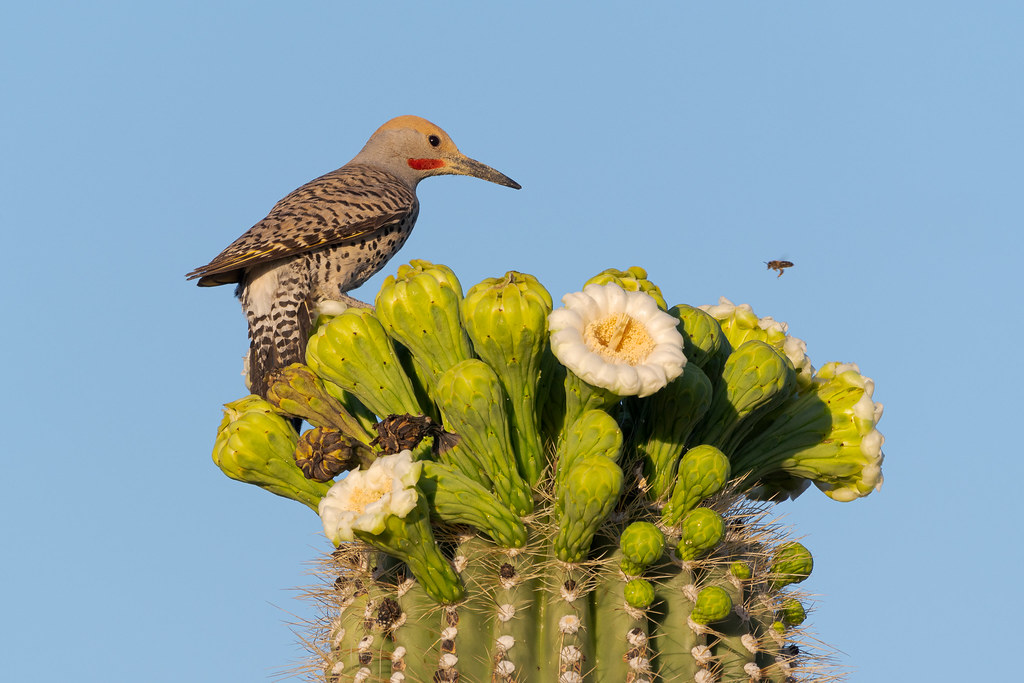
A male Gila woodpecker looks down at a honeybee hovering above a saguaro blossom near the 118th Street Trail in McDowell Sonoran Preserve in Scottsdale, Arizona in May 2020

Do Gila woodpeckers eat honeybees? With the sun starting to rise this honeybee hovered over the saguaro blossom for so long that this male craned his neck out and started watching it. If he was thinking about jumping out and snaring it he never did, he stayed at the nest entrance until his mate returned. Which didn’t take long, the pair was pretty amazing to watch, even before sunup they were constantly bringing food back to the nest. I don’t know if they eat honeybees or not but there is an ample supply nearby when the saguaros are blooming.

A male Gila woodpecker looks out while a honeybee hovers above a saguaro blossom near the 118th Street Trail in McDowell Sonoran Preserve in Scottsdale, Arizona in May 2020

Baby Food

A white-breasted nuthatch holds a multicolored Asian ladybeetle in its beak as it clings to a mossy tree in Bower Slough at Ridgefield National Wildlife Refuge in Ridgefield, Washington in June 2011

Another picture from 2011 and from another place near-and-dear to my heart, Ridgefield National Wildlife Refuge. This white-breasted nuthatch had snared a multicolored Asian ladybeetle (not native to the Pacific Northwest, I don’t think I ever saw a native ladybug in our many years there). While nuthatches do eat insects this meal I suspect was destined for the hungry maw of the babies in the nearby nest. I wish the picture had more depth of field but I was shooting as wide open as I could since I had forgotten my tripod at home and the light was dim under the canopy so I needed as much speed as I could muster.

Near Death Experience

A pair of grasshoppers sit on a plant next to a sooty grouse on the Deadhorse Creek Trail in Mount Rainier National Park in September 2014

I wonder if these two grasshoppers thought their end was near when this sooty grouse suddenly loomed large, as they are one of the insects grouse like to eat, but the bird paid them no heed as it sauntered through the mountain meadow. Taken in the fall of 2014 on my last visit to Mount Rainier National Park.

Don’t Lend Me a Hand

A master blister beetle clings to one brittlebush blossom while reaching out to try and grasp another blossom, taken on the Marcus Landslide Trail in McDowell Sonoran Preserve in Scottsdale, Arizona in May 2019

I didn’t read comics as a kid but I watched the Superfriends on TV and was enamored with Aquaman’s ability to communicate with animals. It would have come in handy on this morning in May as the master blister beetle was trying to move from one blossom to the next but finding it too far out of its reach. I would have loved to tell it to sit still and that I’d gently push the stem closer to the other flower, but alas I could not. Rather than scare it I left it alone, eventually it gave up and moved back down the stem. While I didn’t know it at the time there’s an extra reason not to lend a literal helping hand to these beetles as if they feel threatened they can cause caustic yellow blood to ooze from their legs, which can blister human skin. Lovely to watch though!

Mellow, Yellow

An overhead view of a master blister beetle sleeping on a heavily-chewed brittlesbush blossom on the Marcus Landslide Trail in McDowell Sonoran Preserve in Scottsale, Arizona in May 2019

A sleepy master blister beetle isn’t quite ready to shake off its slumber and rise to meet the world. From the heavily chewed flower petals you can see why the brittlebush is both bedroom and dining room for the lovely little ones, at least on the one and only time I saw them this spring.

A Surprise in the Familiar

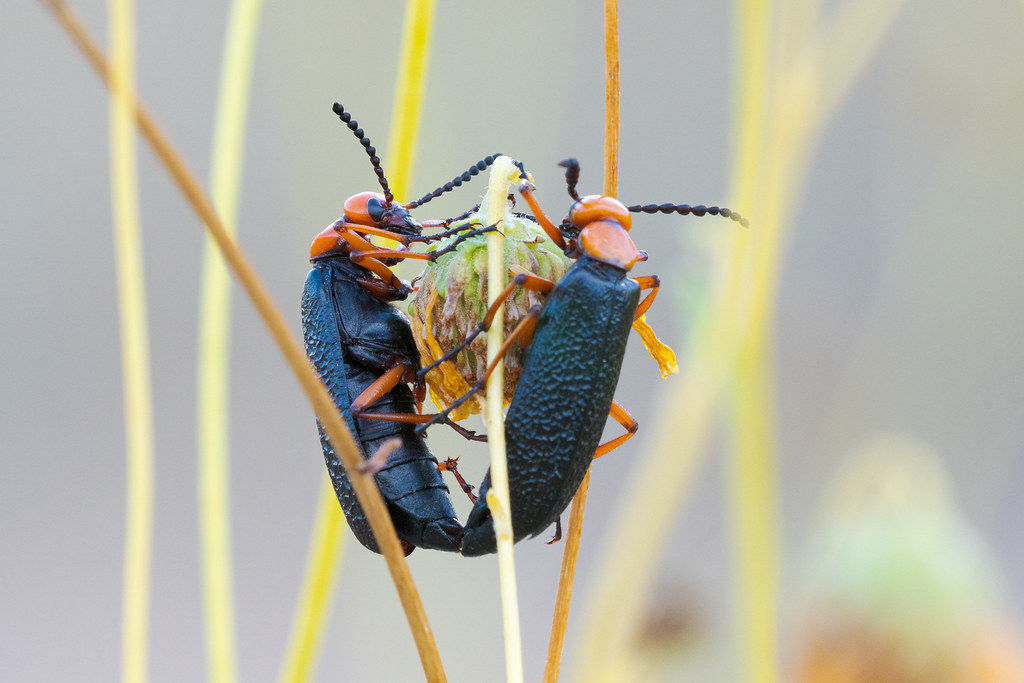
Two master blister beetles cling to a spent brittlebush flower early in the morning on the Marcus Landslide Trail in McDowell Sonoran Preserve in Scottsdale, Arizona in May 2019

While I enjoy exploring new trails I like to have a set of favorites I visit repeatedly, both because I find comfort in the familiar and because it makes it easier for me to see change from day-to-day and season-to-season, never more so than when we are in a new area like we are now. The Marcus Landslide Trail has been a favorite since I discovered it late last year but this morning in May had a surprise in store as these gorgeous little creatures clung to seemingly every blooming brittlebush. I had never seen them before (or since) so I did a little research when I got home to learn these jewels are master blister beetles. It was still pretty early, the sun still hiding below the mountains, when I found these two clinging to the same spent flower in the middle of the brittlebush.