First light on the Hawknest Trail revealed a young white-winged dove that was a little red-faced, courtesy of the saguaro fruit juice that stained its beak and the tip of its face. It was mid-July so there wasn’t much fruit left on the old giants but the plucky youngster seemed to have found some before perching on the ocotillo to preen its feathers. With its cleaning regimen complete followed by a few beak swipes on the ocotillo stem, it flew off to a nearby saguaro and chased off the adult that was feeding there.
Category: Plants
Spinarium
I was photographing two of my favorite subjects last weekend, saguaros and the rain, when my macro lens breathed its last (or so I thought), the manual focus ring barely turning. This is my favorite set of saguaro spines, I wanted to capture water droplets pooling on them while I had the chance as no lightning accompanied the rain. The soft white cushion from which the spine cluster emerges is known as the areole, a distinguishing feature of a cactus (compare these to the thorns of the the ocotillo in the previous post which grow directly out of the stem). A few larger spines shoot out from the center while smaller spines radiate out in all directions. Bit of a shame that English botanist Adrian Hardy Haworth’s proposed term in 1830 for the areole, spinarium, never caught on.
As I held the lens in the following days, thinking back to how many things I had photographed with it over the years, there was some comfort in knowing it died doing what it loved, or more precisely what I love. After it sat idle on my coffee table for a few days I picked it up again, idly turning the focus ring and was surprised to see the lens focus in response. I don’t know if some rain had inadvertently gotten in and caused a mechanical glitch or if a cat hair had worked its way past the lens casing but in any case, the situation resolved itself and the lens has sprung back to life.
Rain, Finally Rain
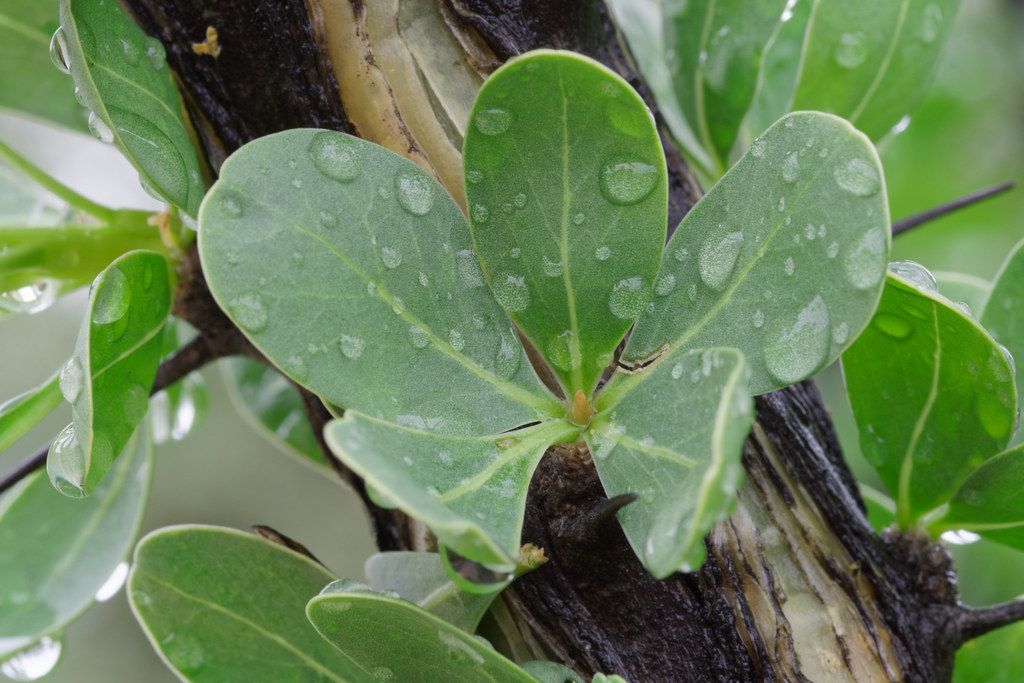
Thursday night a monsoon storm brought thunder and lightning and buckets of rain in a short period of time, while I prefer the Oregon rains that spread out a year’s worth of rainfall over hundreds of days rather than a few hours, I can’t complain as the desert desperately needs the water. Less intense thunderstorms arrived on Friday, since I was off work I was able to grab my macro lens to photograph a scene I had envisioned for a while but hadn’t been able to capture, large water drops collecting on the leaves of an ocotillo. The thunderstorms diminished as the weekend progressed but showers continued on and off through Sunday, giving me several days of joy out in the rain photographing plants around the yard.
The fun ended Sunday evening when the focusing unit of my Canon macro lens at long last gave up the ghost, I hoped it was a momentary glitch but sadly that does not appear to be the case. It was a few months shy of 22 years old as I bought it in November 1999 for $580, what fun we’ve had over the years! I have no idea what I’ll do for a replacement, modern lenses have a number of features I’d like that my old lens didn’t, but it’s the cameras that give me pause. Sony doesn’t have focus bracketing in their cameras but it would be so useful for the things I shoot I might add another system just to get it, but we’ll see.
You Should Have Called First!
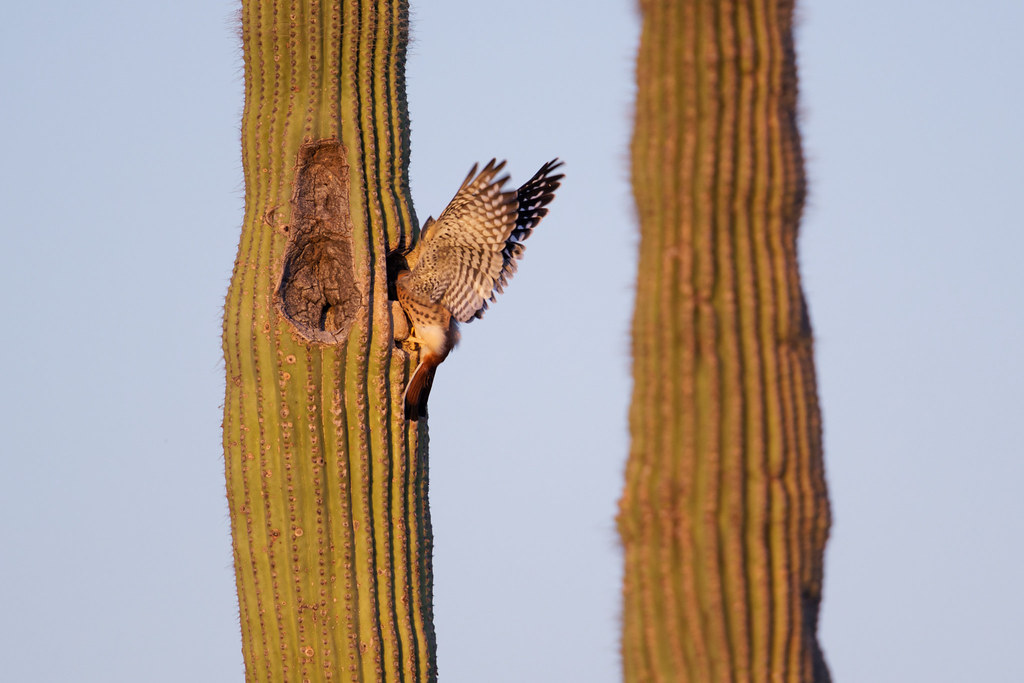
A male kestrel arrives at his nest in a saguaro to feed the last of his young that had not yet fledged but was surprised to find him sitting in the entrance hole. Strong winds blew as the sun was about to set but kestrels are agile fliers with a strong grip, so even though he had to fall backwards to avoid crashing into the youngster he was able to flare out his wings while grasping the cactus with his talons and maintain his purchase. He not only recovered with remarkable grace but soon leaned in and fed his hungry charge before flying off to look for the next meal.
I bet next time he calls first to let junior know he’s on his way.
Happy Father’s Day!
Happy Father’s Day to my father of the year, this gilded flicker nesting near the top of a saguaro. It was my first time watching a flicker raise a family so I was a bit confused when, unlike Gila woodpeckers, the adults arrived at the nest with empty beaks. As the nestlings grew old enough to lean out of the nest I understood why, they were regurgitating food into the always-hungry mouths of the little ones.
The nest was in a nearby park, best visible late in the day, so on weekends I’d stop by to watch this tireless provider feeding his babies before and after the sun set. I brought out my Canon 500mm telephoto for these pictures, the autofocus doesn’t work very well on my Sony cameras but it’s amazing it works at all given it’s a 15 year old Canon lens attached to a Sigma converter attached to a Sony camera, a combo they were not designed for. I often shot with the electronic shutter so I wouldn’t make any noise.
For a while I was concerned something had happened to the mother as I only ever saw this male (a bit of his red mustache is visible in the picture below as he feeds the last nestling) but it turned out to be a coincidence of timing as eventually I would see her too. The top picture is right before the sun set, the bottom two just after (on the following day).
A Faithful Father
My favorite times to be in the desert are around sunrise and sunset, transfixed by how rapidly the light rises and falls, changing not only in intensity but color. I love the moment as the sun fades when a little diffuse red light mixes in with the heavier scattered blues, similar to the light here. But the sun, while low in the sky, had not yet set, instead blocked by a band of smoke in the northwest from a burning desert. While a depressing sign of things to come in the drought-stricken West, there was hope before me too. Flower buds on an old saguaro, soon to burst into blossom. And a faithful flicker father landing at his nest, squeaking voices inside welcoming him home.
Red Mustache
A few weeks back flower buds dotted the tops of saguaro arms with the occasional early bloomers producing a flower or two. Normally the flowers are white but this one appeared to have a red mustache, perhaps a trick of the light as the sun dipped behind the mountains and only a little direct light fell upon the high points of the desert.
A Little Convincing
This might as well be a portrait of me each spring when I try to convince myself the pool is warm enough and I should just jump in and start swimming. I don’t like being cold in the slightest so it always takes a bit of convincing. Always nice to find a thrasher in an expressive pose as it can be hard to convey their personalities in pictures.
Fur-lined
I’ve not seen a house sparrow in the local desert but they are neighborhood residents, judging by the leaves and fur in this male’s beak I imagine he’s building a nest nearby. We may not be contributing to nesting materials here but I like to think a great many birds in our Irvington neighborhood in Portland grew up in the luxury of a fur-lined nest courtesy of a black lab who seemed to shed her weight in fur each week.
Curves
We left blue jays behind when we moved to Oregon but gained scrub jays and the occasional Steller’s jay. The large gregarious birds were a favorite of our cat Emma who would chirp to me from her perch in my office to let me know who was visiting our backyard, crows and flickers also being favorites. In Arizona we have another noisy neighbor I think she would have loved, here sitting in a flowering ocotillo on a warm spring morning. I saw a number of curve-billed thrashers on my walk last weekend in addition to this one, one pair was already feeding hungry babies in a nest in the arms of a saguaro.